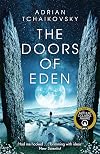
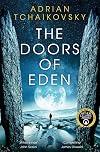
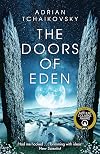
The Doors of Eden
by Adrian Tchaikovsky
On This Page
Description
They thought we were safe. They were wrong. Four years ago, two girls went looking for monsters on Bodmin Moor. Only one came back. Lee thought she'd lost Mal, but now she's miraculously returned. But what happened that day on the moors? And where has she been all this time? Mal's reappearance hasn't gone unnoticed by MI5 officers either, and Lee isn't the only one with questions. Julian Sabreur is investigating an attack on top physicist Kay Amal Khan. This leads Julian to clash with agents show more of an unknown power - and they may or may not be human. His only clue is grainy footage, showing a woman who supposedly died on Bodmin Moor. Dr Khan's research was theoretical; then she found cracks between our world and parallel Earths. Now these cracks are widening, revealing extraordinary creatures. And as the doors crash open, anything could come through. show lessTags
Recommendations










Member Reviews
A book club pick :)
Exhilarating!
I love it so much when a book gives me a sense of wonder, a feeling of falling head first into something amazing, when I am reminded why I read sci-fi. I am convinced that I have been elsewhere and now I have trouble surfacing.
Lee and Mal are childhood friends, then lovers. They graduate from D&D to hunting monsters (grainy footage seen on YouTube, yetis, etc). Something very strange happens to them. Lee comes home. Mal doesn’t.
Julian Sabreur is a Secret Service agent who is keeping an eye on nationalists and white supremacists. Something very strange happens.
These stories will converge, and a reader is in for a ride. Or is it an acid trip? This is a trip in which Tchaikovsky blends weirdness and show more intellectual candy. The interludes that are about might have beens, evolution, evolutionary biology and sentient life are just glorious! Those alone are worth the price of admission.
The characters are very believable, very real. I liked them all so much! The villain is well done too, despite turning rather cartoonish towards the end. This was probably intentional, with the author looking at the villains of our reality and realizing how cartoonish they are. It doesn’t make them less dangerous.
Parallel worlds and “the fate of the universe is at stake” have been done ad absurdum in SFF. It’s been a while since I’ve seen it done with so much skill, such amazing world building, and such emotional impact. Oh, and the plotting is awesome. You will not be able to stop reading, guaranteed. I very much wanted that Life, the Universe, and everything would just leave me alone so that I could read my book 24/7. They refused to cooperate!
I am a happy reader. Thank you yet again, Adrian Tchaikovsky!
Quotes I liked:
”What Julian actually felt like doing was not act like a security professional but rage and weep and curse the skies like a Shakespearean tragic hero.”
”You’d hear the bellow and grunt of their pack animals too, who also complain about the cold, but with brute sounds that indicate how very hard done by they feel about this domestication business.”
”My honoured colleague, if matters fail to transpire as we wish, then we are both entirely fucked.” show less
Exhilarating!
I love it so much when a book gives me a sense of wonder, a feeling of falling head first into something amazing, when I am reminded why I read sci-fi. I am convinced that I have been elsewhere and now I have trouble surfacing.
Lee and Mal are childhood friends, then lovers. They graduate from D&D to hunting monsters (grainy footage seen on YouTube, yetis, etc). Something very strange happens to them. Lee comes home. Mal doesn’t.
Julian Sabreur is a Secret Service agent who is keeping an eye on nationalists and white supremacists. Something very strange happens.
These stories will converge, and a reader is in for a ride. Or is it an acid trip? This is a trip in which Tchaikovsky blends weirdness and show more intellectual candy. The interludes that are about might have beens, evolution, evolutionary biology and sentient life are just glorious! Those alone are worth the price of admission.
The characters are very believable, very real. I liked them all so much! The villain is well done too, despite turning rather cartoonish towards the end. This was probably intentional, with the author looking at the villains of our reality and realizing how cartoonish they are. It doesn’t make them less dangerous.
Parallel worlds and “the fate of the universe is at stake” have been done ad absurdum in SFF. It’s been a while since I’ve seen it done with so much skill, such amazing world building, and such emotional impact. Oh, and the plotting is awesome. You will not be able to stop reading, guaranteed. I very much wanted that Life, the Universe, and everything would just leave me alone so that I could read my book 24/7. They refused to cooperate!
I am a happy reader. Thank you yet again, Adrian Tchaikovsky!
Quotes I liked:
”What Julian actually felt like doing was not act like a security professional but rage and weep and curse the skies like a Shakespearean tragic hero.”
”You’d hear the bellow and grunt of their pack animals too, who also complain about the cold, but with brute sounds that indicate how very hard done by they feel about this domestication business.”
”My honoured colleague, if matters fail to transpire as we wish, then we are both entirely fucked.” show less
Parallel Earths are not a new concept - most of the good SF writers had written at least one story involving the concept. And yet, Tchaikovsky found a way to write a novel that does not remind you of anything you read before - even while you can see all the giants whose shoulders the novel stepped on.
Creatures that cannot exist seem to be showing up in the middle of England. A network that cannot exist helps an MI5 analyst. A stocks broker company seems to be able to read the future... until it cannot. And someone really wants to get their hands on a theoretical physicist whose work noone understands. And while we read all that, we get passages from another book, a non-fiction about other Earths by a professor in California.
It takes show more awhile for all the stories to connect together, it takes 4/5th of the book to finally get a confirmation of what is going on but once that happens, everything clicks together. Not that one does not have their suspicions earlier on but they keep getting annihilated sooner or later.
The story is the story of Earth - Earths that could have been and the Earths that were. Evolution took a different turn, a different random mutation led to different outcomes. And something in that system is broken and the whole thing is about to collapse. And that's why they are trying to get the physicist - theoretical science turns into practical one overnight. Except that as usual there are a lot of players and not all of them have intentions that can pass as good or even decent. And almost none of the players is actually human even if all of them are the intellectual top of their own world.
And humanity is all there - warts and all - there is a xenophobic maniac who wants to protect his type of life, there is a bureaucrat, there is a girl that almost fell into it by mistake (there is a Doctor Who influence in here somewhere). And everyone keeps plotting - until they cannot anymore of course - when some of the other players are the size of 3 blocks, you kinda need to pay attention (on the other hand some of the others are oversized rats so there is that).
And then comes the end. Well - the almost end anyway. There are parallel earths which implies parallel timelines so why not explore the end in the same manner. The text repeats a page or so we read before and then someone takes another decision. The future branches and something else happens. The final solution ended up being right there in front of everyone - like most good solutions. And then the horizon of chance closes and the future comes back.
It is an interesting play on the branching worlds and the explanation for them actually makes sense (as much as it can anyway). And the characters are never two-dimensional - except when they are designed to be. Heroes and villains seem to change places occasionally because good and evil is not absolute. Or at least not completely absolute.
This is one of my favorite novels lately. It requires some patience but it never stopped moving. And if you do not have enough parallel lines, there are the very human ones - the homophobia and xenophobia (almost as 2 sides of the same coin), the country vs humanity decisions, the choices one makes every time. And there is love and monsters (both literally and not). show less
Creatures that cannot exist seem to be showing up in the middle of England. A network that cannot exist helps an MI5 analyst. A stocks broker company seems to be able to read the future... until it cannot. And someone really wants to get their hands on a theoretical physicist whose work noone understands. And while we read all that, we get passages from another book, a non-fiction about other Earths by a professor in California.
It takes show more awhile for all the stories to connect together, it takes 4/5th of the book to finally get a confirmation of what is going on but once that happens, everything clicks together. Not that one does not have their suspicions earlier on but they keep getting annihilated sooner or later.
The story is the story of Earth - Earths that could have been and the Earths that were. Evolution took a different turn, a different random mutation led to different outcomes. And something in that system is broken and the whole thing is about to collapse. And that's why they are trying to get the physicist - theoretical science turns into practical one overnight. Except that as usual there are a lot of players and not all of them have intentions that can pass as good or even decent. And almost none of the players is actually human even if all of them are the intellectual top of their own world.
And humanity is all there - warts and all - there is a xenophobic maniac who wants to protect his type of life, there is a bureaucrat, there is a girl that almost fell into it by mistake (there is a Doctor Who influence in here somewhere). And everyone keeps plotting - until they cannot anymore of course - when some of the other players are the size of 3 blocks, you kinda need to pay attention (on the other hand some of the others are oversized rats so there is that).
And then comes the end. Well - the almost end anyway. There are parallel earths which implies parallel timelines so why not explore the end in the same manner. The text repeats a page or so we read before and then someone takes another decision. The future branches and something else happens. The final solution ended up being right there in front of everyone - like most good solutions. And then the horizon of chance closes and the future comes back.
It is an interesting play on the branching worlds and the explanation for them actually makes sense (as much as it can anyway). And the characters are never two-dimensional - except when they are designed to be. Heroes and villains seem to change places occasionally because good and evil is not absolute. Or at least not completely absolute.
This is one of my favorite novels lately. It requires some patience but it never stopped moving. And if you do not have enough parallel lines, there are the very human ones - the homophobia and xenophobia (almost as 2 sides of the same coin), the country vs humanity decisions, the choices one makes every time. And there is love and monsters (both literally and not). show less
This book is a Nantucket sleigh-ride; Part One is entitled "Down the Rabbit Hole," and away you go. Having read Tchaikovsky's hard SF 'Children' novels, I had high hopes going into "The Doors of Eden," all of which which were certainly met.
"Mal laughed. 'I only have a human view. But who says a human-level view is as irrelevant as all that?'"
While good SF can center on totally novel concepts or stimuli (i.e., Watts' "Blindsight" or the Strugatskis' "Roadside Picnic"), that needn't always be the case. A top chef de cuisine can take familiar ingredients and, with thought and care, serve forth something fresh and delicious, making diners want to rush back for more. This latter is what Tchaikovsky has done here. Alternate timelines with show more fissures that allow crossing among them, edgy but 'real' characters, lots of England, nonhuman civilizations ... even "Time Bandits" has these, but 'TDoE' thoughtfully and carefully presents something fresh and delicious, and I know I'll be back to read it again. Indeed, "Interlude: The Humans" (pp. 461-8 in my edition) alone is one of the finest passages this anthropologically-trained SF reader has come across in a long time; somewhere, Ray Bradbury is nodding happily. show less
"Mal laughed. 'I only have a human view. But who says a human-level view is as irrelevant as all that?'"
While good SF can center on totally novel concepts or stimuli (i.e., Watts' "Blindsight" or the Strugatskis' "Roadside Picnic"), that needn't always be the case. A top chef de cuisine can take familiar ingredients and, with thought and care, serve forth something fresh and delicious, making diners want to rush back for more. This latter is what Tchaikovsky has done here. Alternate timelines with show more fissures that allow crossing among them, edgy but 'real' characters, lots of England, nonhuman civilizations ... even "Time Bandits" has these, but 'TDoE' thoughtfully and carefully presents something fresh and delicious, and I know I'll be back to read it again. Indeed, "Interlude: The Humans" (pp. 461-8 in my edition) alone is one of the finest passages this anthropologically-trained SF reader has come across in a long time; somewhere, Ray Bradbury is nodding happily. show less
I've been told, by a mostly reliable source, that as long as your ending is satisfying, you just can't complain too much. As much as my instinct is to argue, I've mulled it over and find myself unable to substantially disagree. Perhaps it all comes down to preferences: is it the lure of a story that arouses emotion through admiration and joy, or one that uses the frisson of aggravation as a road to pleasure? The Doors of Eden most definitely chose frustration as it followed a group of mostly exasperating humans as they attempt to decipher strange incursions into their lives.
Structured with a dual narrative, it alternates more 'academic' pieces with a third-person limited viewpoint from one of a handful of characters. Although multiple show more narratives are a technique that often annoy me, Tchaikovsky uses it to good effect. The academic pieces are usually short, while the character narratives are full of action and conflict. He's also kind enough to avoid leaving the reader on a cliff-hanger with each section. The academic writings are taken from an imaginary book, 'Other Edens: Speculative Evolution and Intelligence,' and while they have a drier, more academic tone, each explores a world where what humanity understands as evolution followed a more divergent path.
"To win the arms race of this Cambrian is to have the strongest shell. It is to be hauled up from the sediment by the the anomalocarids' fearsome arms, ground between their spines, gnamed at by their toothed ring of a mouth, then abandoned for flimsier prey. From such a forge, here is what will fight its way to dominance... When at last they take to the land, their shells fend off the killer radiation of the sun and their respiratory surfaces hold enough water for brief seaside strolls. Their articulated legs are initially only strong enough to drag their jointed bellies in the sand, but that will change."
It is an extraordinarily long book that doesn't feel long at all, which says something for Tchaikovsky's ability to balance those edges with plotting. I found myself remembering the sympathetic spiders and irritating humans in [b:Children of Time|25499718|Children of Time (Children of Time, #1)|Adrian Tchaikovsky|https://i.gr-assets.com/images/S/compressed.photo.goodreads.com/books/1431014197l/25499718._SY75_.jpg|45276208] and wondered if he was making a similar point here.
"He lost most of the journey to that familiar adult tension that was a mix of “I should be doing something” and “I have possibly screwed up” with a side order of 'I have just generated so much damn paperwork for someone, and that someone is probably me.'"
I'll be honest: there were parts where I was so very vexed with characterization. Part was Tchaikovsky's inconsistent and potentially sloppy characterization, while the other part was all me. There's one young woman, Lee, whose character did not feel consistant. She routines goes 'monster-hunting' experience with bestie and lover, continues after her lover disappears, and yet is absolutely flummoxed and overwhelmed when monsters turn out to be 'real.' Then there's ethics: our intrepid and supposedly moralistic intelligence agents have children, but literally give almost no thought to them. They have the kind of 'children' that harken back to imaginary, pre-social revolution times, where they are mentioned in books as a way of giving character 'background,' but seem to have absolutely no bearing on ethics or decision-making. There's a reason main characters are often childless--it's so we don't have to realize the characters are failing in being responsible to their progeny.
"She could feel herself teetering over a great well of despair. She had worked herself up for this; she had borrowed hope at a ruinous interest rate—one that she had no chance of paying back. She had, she forced herself to admit, been spectacularly stupid from start to finish."
The all-me part? Oh, that's because I like my characters to do a bit of learning, maybe have a bit of an arc. These people are largely static, despite great discoveries and supposed learning experiences, where horizons are, sometimes quite literally, opening around them. Lee is the only one who has any growth; Mal, Julian and Kay are all largely static, which is particularly frustrating as Tchaikovsky seems to take pleasure in showing us exactly where they could grow.
You're sensing my irritation, right? You should. At one point, I was actually reading for the academic interludes, which featured fascinating ideas on other evolutionary paths and tipping points. Creative and clever thought experiments that had their own drama, despite the faux-academic tone. I imagine if one had a whole book of these mini-epochal adventures, it might become dull (see Ursula LeGuin's [b:Changing Planes|13657|Changing Planes|Ursula K. Le Guin|https://i.gr-assets.com/images/S/compressed.photo.goodreads.com/books/1309211089l/13657._SY75_.jpg|1624573]), but cut between the action-filled human scenes, I found them intriguing. (mild spoilers) There were trilobites in the Cambrian, nautilus-like orthocones in the Ordovician ("Over ten thousand years, the ocean fills with their conversational flatulence.", the warrior sea-scorpion relatives of the Silurian seas (yes, I thought he was having fun with alliteration), the Devonian mudskippers and their climate correction, the Carboniferous cockroaches and their closed system, the aerial culture of the Permian pterosaurs, the weasels coming out of the Paleogene, the cats (I know he was laughing), the inbred, tribal lemurs and a few more.
I couldn't quite walk away: he'd tease me with an idea, so I'd read a little farther, become irritated, and then tickle my imagination again. He's good at stringing one along, that T. Then came the tipping point where I was hooked, and thoughts of leaving evaporated.
"This is a world where hard borders never existed: not between plant and animal, not between single and multicellular, not between species or individuals. It is a frontier town kind of world where the rules don’t apply. Something awoke when these creatures achieved a certain acreage, and what came to an awareness of itself was all of it. The world is a garden and the garden is a brain."
All that build up lead to an absolutely amazing final quarter. It looked to be heading one way, then he'd magician another possibility out of the sci-fi hat. What a pleasure it must have been for a writer, getting to play with all those possibilities! (spoiler!) Seriously, mind blown starting at the space-faring trilobites. And Fungus as God. Oh, and what an eye-roll at that pandering cat-world! Everything more I could say would be spoilers, so I won't. As an aside, if you thought [b:Dark Matter|27833670|Dark Matter|Blake Crouch|https://i.gr-assets.com/images/S/compressed.photo.goodreads.com/books/1472119680l/27833670._SY75_.jpg|43161998] failed to live up to the sci-fi premise, this is the book for you. I went from considering abandoning it, to a better mood, to wondering if it was another entry by T. into Sci-Fi Canon.
Because when he stops the teasing and it all comes together, it's just that good.
Many thanks to Phil and Nataliya for roles as wingmen show less
Structured with a dual narrative, it alternates more 'academic' pieces with a third-person limited viewpoint from one of a handful of characters. Although multiple show more narratives are a technique that often annoy me, Tchaikovsky uses it to good effect. The academic pieces are usually short, while the character narratives are full of action and conflict. He's also kind enough to avoid leaving the reader on a cliff-hanger with each section. The academic writings are taken from an imaginary book, 'Other Edens: Speculative Evolution and Intelligence,' and while they have a drier, more academic tone, each explores a world where what humanity understands as evolution followed a more divergent path.
"To win the arms race of this Cambrian is to have the strongest shell. It is to be hauled up from the sediment by the the anomalocarids' fearsome arms, ground between their spines, gnamed at by their toothed ring of a mouth, then abandoned for flimsier prey. From such a forge, here is what will fight its way to dominance... When at last they take to the land, their shells fend off the killer radiation of the sun and their respiratory surfaces hold enough water for brief seaside strolls. Their articulated legs are initially only strong enough to drag their jointed bellies in the sand, but that will change."
It is an extraordinarily long book that doesn't feel long at all, which says something for Tchaikovsky's ability to balance those edges with plotting. I found myself remembering the sympathetic spiders and irritating humans in [b:Children of Time|25499718|Children of Time (Children of Time, #1)|Adrian Tchaikovsky|https://i.gr-assets.com/images/S/compressed.photo.goodreads.com/books/1431014197l/25499718._SY75_.jpg|45276208] and wondered if he was making a similar point here.
"He lost most of the journey to that familiar adult tension that was a mix of “I should be doing something” and “I have possibly screwed up” with a side order of 'I have just generated so much damn paperwork for someone, and that someone is probably me.'"
I'll be honest: there were parts where I was so very vexed with characterization. Part was Tchaikovsky's inconsistent and potentially sloppy characterization, while the other part was all me. There's one young woman, Lee, whose character did not feel consistant. She routines goes 'monster-hunting' experience with bestie and lover, continues after her lover disappears, and yet is absolutely flummoxed and overwhelmed when monsters turn out to be 'real.' Then there's ethics: our intrepid and supposedly moralistic intelligence agents have children, but literally give almost no thought to them. They have the kind of 'children' that harken back to imaginary, pre-social revolution times, where they are mentioned in books as a way of giving character 'background,' but seem to have absolutely no bearing on ethics or decision-making. There's a reason main characters are often childless--it's so we don't have to realize the characters are failing in being responsible to their progeny.
"She could feel herself teetering over a great well of despair. She had worked herself up for this; she had borrowed hope at a ruinous interest rate—one that she had no chance of paying back. She had, she forced herself to admit, been spectacularly stupid from start to finish."
The all-me part? Oh, that's because I like my characters to do a bit of learning, maybe have a bit of an arc. These people are largely static, despite great discoveries and supposed learning experiences, where horizons are, sometimes quite literally, opening around them. Lee is the only one who has any growth; Mal, Julian and Kay are all largely static, which is particularly frustrating as Tchaikovsky seems to take pleasure in showing us exactly where they could grow.
You're sensing my irritation, right? You should. At one point, I was actually reading for the academic interludes, which featured fascinating ideas on other evolutionary paths and tipping points. Creative and clever thought experiments that had their own drama, despite the faux-academic tone. I imagine if one had a whole book of these mini-epochal adventures, it might become dull (see Ursula LeGuin's [b:Changing Planes|13657|Changing Planes|Ursula K. Le Guin|https://i.gr-assets.com/images/S/compressed.photo.goodreads.com/books/1309211089l/13657._SY75_.jpg|1624573]), but cut between the action-filled human scenes, I found them intriguing. (mild spoilers)
I couldn't quite walk away: he'd tease me with an idea, so I'd read a little farther, become irritated, and then tickle my imagination again. He's good at stringing one along, that T. Then came the tipping point where I was hooked, and thoughts of leaving evaporated.
"This is a world where hard borders never existed: not between plant and animal, not between single and multicellular, not between species or individuals. It is a frontier town kind of world where the rules don’t apply. Something awoke when these creatures achieved a certain acreage, and what came to an awareness of itself was all of it. The world is a garden and the garden is a brain."
All that build up lead to an absolutely amazing final quarter. It looked to be heading one way, then he'd magician another possibility out of the sci-fi hat. What a pleasure it must have been for a writer, getting to play with all those possibilities! (spoiler!)
Because when he stops the teasing and it all comes together, it's just that good.
Many thanks to Phil and Nataliya for roles as wingmen show less
Tchaikovsky, Adrian. The Doors of Eden. Tor, 2020.
There is a familiar science fiction subgenre that plays games with alternate history. Adrian Tchaikovsky does not do alternate history but rather alternate evolution. In his previous novels he has evolved squids and spiders to cognitive sentience. In Doors of Eden, he opens up the whole evolutionary toybox. We have space-faring trilobites and villages of friendly dinosaurs, just for starters. The plot begins with two young lesbians using their vacations to pursue strange animal sightings. They get a good deal more than they bargained for. The story is suspenseful with plenty of action and well-drawn characters. It is tighter and more controlled than anything Tchaikovsky has done so far. show more Highly recommended. show less
There is a familiar science fiction subgenre that plays games with alternate history. Adrian Tchaikovsky does not do alternate history but rather alternate evolution. In his previous novels he has evolved squids and spiders to cognitive sentience. In Doors of Eden, he opens up the whole evolutionary toybox. We have space-faring trilobites and villages of friendly dinosaurs, just for starters. The plot begins with two young lesbians using their vacations to pursue strange animal sightings. They get a good deal more than they bargained for. The story is suspenseful with plenty of action and well-drawn characters. It is tighter and more controlled than anything Tchaikovsky has done so far. show more Highly recommended. show less
We spend too long with this cast of characters. The most compelling of them are the Cousins and we don't get their vp at all. If the entire universe is to be the stakes, at least the reader should care something for the people we watch trying to save it. This is more of an ideas playground than a real story.
Originally posted on Just Geeking By.
Trigger warning:
Please note that the villain of the piece is a horrible bigot who throws around homophobic and transphobic slurs as well as deadnaming a transgender character at one point and forcing them to wear the clothes of their former gender. The Doors of Eden is an LGBTQ positive novel and this character is the one exception. I just don’t want anyone to be caught unaware.
There are some authors that draw me in by their name only and Adrian Tchaikovsky is one of them. As soon as I saw one of his books listed on NetGalley I hit apply. I’ve only read one other book by Tchaikovsky (Empire in Black and Gold, the first book of his Shadows of the Apt fantasy series), however, I've had the pleasure show more of interviewing him and got to see the mind of a creative writer at work. From that point, I knew that any new releases I was going to check out because I knew they would be incredible.
So yes, I did go into this book with a high level of anticipation. As the synopsis states, Tchaikovsky is an Arthur C. Clarke Award-winning author, after all, and there is a certain level of writing you expect from that even if you aren’t familiar with the author. Familiarity aside I’d have picked The Doors of Eden up based on the synopsis anyway. It’s filled to the brim with a mystery which is something I love and poses so many questions that I would just keep coming back to it wondering about the answers. Missing people, MI5, powers, parallel earths and… theoretical physics?! It’s a delicious mix of questions, plots and intriguing characters and that’s just the synopsis!
The Doors of Eden is an imaginative science fiction novel that asks the ultimate question of “what if?”. If one tiny thing went differently at the very start of existence what would that mean? It’s a question I hadn’t really considered until I read The Doors of Eden and afterwards I was a little overwhelmed by the colossal ramifications suggested by Tchaikovsky. It’s all fictional, yet it’s also completely theoretically possible and that is the part that gets to you.
I’m no stranger to the idea of alternate timelines. To the idea that for every decision we make there’s an alternative timeline where we made the opposite one. In The Doors of Eden Tchaikovsky has not gone beyond that concept; it’s gone before it. The events that split the timeline happen before sentient species even occur and they significantly shape the species of each of the parallel earths. Some of them are species you may have considered as possibilities before, and some of them you won’t have come up with in a million years. That’s the beauty of a creative genius at work and this is Tchaikovsky at his best with no holds barred.
Alongside the parallel earths is something just as remarkable; everyday people. Yes, I’m saying that ordinary people are interesting and the reason for that is because Tchaikovsky’s human characters are as skillfully written as the rest of the novel. They’re also wonderfully diverse with the cast featuring a lesbian couple, a transgender character, and a character with severe anxiety. Through these everyday characters, Tchaikovsky reminds us that the British secret service can be anyone; they’re not all James Bond super agents. In fact, it’s mostly filled with analysts and investigators.
As they are drawn into a mystery surrounding top physicist Kay Amal Khan the agents find their investigation going beyond the scope of anything they could ever have imagined. Unlike the other characters, these are the two outsiders, and it’s through their experiences, their feelings that the reader is able to truly feel the fascination, wonder and at times horror of what is happening. There is no review that can prepare you for that aspect of this book; you will come out with more questions than answers. With more thoughts regarding the world we live in and the possibilities of science than you ever thought possible.
As The Doors of Eden is a science-heavy book, specifically physics, there is a lot of mathematics and jargon in the book. I have dyscalculia so I fully understand if that sentence has just made anyone reading this think ‘uh, no this one isn’t for me’. I don’t just dislike numbers; they terrify me. They’re completely alien and unyielding. With that in mind, I still stand by my 5 star rating of The Doors of Eden because while it is a book about calculations, it’s not only about calculations. They are a fundamental part of the plot, and if you finish the book you’ll understand exactly what I mean, but this is still very much a book about life and people.
Despite my initial excitement and interest in this book, it took me a long time to finish it. There are several reasons for that and I wanted to talk about this because it’s something that can easily dissuade people from finishing the book. The Doors of Eden has multiple moving parts which for quite a while seems really fragmented. While there are the separate narratives of the different players (Lee and Mal, Julian Sabreur, Kay Amal Khan and others you meet along the way) there are scientific interludes in-between them. These are excerpts from a Professor from the University of California and some of them can be quite dense, full of scientific jargon and if you’re not interested in that kind of thing, really dull. I found the early ones difficult to read and scanned through them quickly (a skill I picked up at University), and as the book progressed I found the later ones really fascinating.
They seem utterly random, a fun little add-in by the author until you get to the final stages of the book. That is the ultimate beauty and skill of Tchaikovsky’s writing. All those random stories, facts and bits of information come together and suddenly it all makes sense. So my advice to anyone reading The Doors of Eden, if you’re struggling with it; keep going! It’s one of those books that has a very slow buildup.
The Doors of Eden is simply mindblowing. It has everything you want from a science fiction thriller, and then even more. It’s a mystery, it’s a story about people and their search for answers, and it’s about saving everything before it’s too late. If you’re looking for a book that will keep stick with you after you’ve finished it, and open a whole new world to you, then The Doors of Eden is for you. show less
Trigger warning:
Please note that the villain of the piece is a horrible bigot who throws around homophobic and transphobic slurs as well as deadnaming a transgender character at one point and forcing them to wear the clothes of their former gender. The Doors of Eden is an LGBTQ positive novel and this character is the one exception. I just don’t want anyone to be caught unaware.
There are some authors that draw me in by their name only and Adrian Tchaikovsky is one of them. As soon as I saw one of his books listed on NetGalley I hit apply. I’ve only read one other book by Tchaikovsky (Empire in Black and Gold, the first book of his Shadows of the Apt fantasy series), however, I've had the pleasure show more of interviewing him and got to see the mind of a creative writer at work. From that point, I knew that any new releases I was going to check out because I knew they would be incredible.
So yes, I did go into this book with a high level of anticipation. As the synopsis states, Tchaikovsky is an Arthur C. Clarke Award-winning author, after all, and there is a certain level of writing you expect from that even if you aren’t familiar with the author. Familiarity aside I’d have picked The Doors of Eden up based on the synopsis anyway. It’s filled to the brim with a mystery which is something I love and poses so many questions that I would just keep coming back to it wondering about the answers. Missing people, MI5, powers, parallel earths and… theoretical physics?! It’s a delicious mix of questions, plots and intriguing characters and that’s just the synopsis!
The Doors of Eden is an imaginative science fiction novel that asks the ultimate question of “what if?”. If one tiny thing went differently at the very start of existence what would that mean? It’s a question I hadn’t really considered until I read The Doors of Eden and afterwards I was a little overwhelmed by the colossal ramifications suggested by Tchaikovsky. It’s all fictional, yet it’s also completely theoretically possible and that is the part that gets to you.
I’m no stranger to the idea of alternate timelines. To the idea that for every decision we make there’s an alternative timeline where we made the opposite one. In The Doors of Eden Tchaikovsky has not gone beyond that concept; it’s gone before it. The events that split the timeline happen before sentient species even occur and they significantly shape the species of each of the parallel earths. Some of them are species you may have considered as possibilities before, and some of them you won’t have come up with in a million years. That’s the beauty of a creative genius at work and this is Tchaikovsky at his best with no holds barred.
Alongside the parallel earths is something just as remarkable; everyday people. Yes, I’m saying that ordinary people are interesting and the reason for that is because Tchaikovsky’s human characters are as skillfully written as the rest of the novel. They’re also wonderfully diverse with the cast featuring a lesbian couple, a transgender character, and a character with severe anxiety. Through these everyday characters, Tchaikovsky reminds us that the British secret service can be anyone; they’re not all James Bond super agents. In fact, it’s mostly filled with analysts and investigators.
As they are drawn into a mystery surrounding top physicist Kay Amal Khan the agents find their investigation going beyond the scope of anything they could ever have imagined. Unlike the other characters, these are the two outsiders, and it’s through their experiences, their feelings that the reader is able to truly feel the fascination, wonder and at times horror of what is happening. There is no review that can prepare you for that aspect of this book; you will come out with more questions than answers. With more thoughts regarding the world we live in and the possibilities of science than you ever thought possible.
As The Doors of Eden is a science-heavy book, specifically physics, there is a lot of mathematics and jargon in the book. I have dyscalculia so I fully understand if that sentence has just made anyone reading this think ‘uh, no this one isn’t for me’. I don’t just dislike numbers; they terrify me. They’re completely alien and unyielding. With that in mind, I still stand by my 5 star rating of The Doors of Eden because while it is a book about calculations, it’s not only about calculations. They are a fundamental part of the plot, and if you finish the book you’ll understand exactly what I mean, but this is still very much a book about life and people.
Despite my initial excitement and interest in this book, it took me a long time to finish it. There are several reasons for that and I wanted to talk about this because it’s something that can easily dissuade people from finishing the book. The Doors of Eden has multiple moving parts which for quite a while seems really fragmented. While there are the separate narratives of the different players (Lee and Mal, Julian Sabreur, Kay Amal Khan and others you meet along the way) there are scientific interludes in-between them. These are excerpts from a Professor from the University of California and some of them can be quite dense, full of scientific jargon and if you’re not interested in that kind of thing, really dull. I found the early ones difficult to read and scanned through them quickly (a skill I picked up at University), and as the book progressed I found the later ones really fascinating.
They seem utterly random, a fun little add-in by the author until you get to the final stages of the book. That is the ultimate beauty and skill of Tchaikovsky’s writing. All those random stories, facts and bits of information come together and suddenly it all makes sense. So my advice to anyone reading The Doors of Eden, if you’re struggling with it; keep going! It’s one of those books that has a very slow buildup.
The Doors of Eden is simply mindblowing. It has everything you want from a science fiction thriller, and then even more. It’s a mystery, it’s a story about people and their search for answers, and it’s about saving everything before it’s too late. If you’re looking for a book that will keep stick with you after you’ve finished it, and open a whole new world to you, then The Doors of Eden is for you. show less
Members
- Recently Added By
Lists

2021 Hugo Eligible Novels
37 works; 14 members

ALA Reading List: Science Fiction 2021-2026
30 works; 3 members

Books Read in 2022
5,168 works; 114 members

Books Read in 2025
4,091 works; 97 members

Kindle Fantasy/Science Fiction Re-Read
151 works; 1 member
Author Information

133+ Works 27,874 Members
Adrian Tchaikovsky is a British fantasy and science fiction author, born on June 14, 1972 in Woodhall Spa, Lincolnshire. He studied Zoology and Psychology at the University of Reading. His career focus changed to law and has worked as a Legal Executive in both Reading and Leeds. He's the author of the Shadows of the Apt series, and his standalone show more novel Children of Time is the winner of the 2016 Arthur C Clarke Award for Best Science Fiction Novel. (Bowker Author Biography) show less
Some Editions
Awards and Honors
Awards
Common Knowledge
- Canonical title*
- Le porte dell'Eden
- Original publication date
- 2020-08-18
- Dedication
- To lost chances.
- First words
- For three billion years the only life here has been microscopic.
- Last words
- (Click to show. Warning: May contain spoilers.)An eye blink later, there was just Stig, standing outside the domed house in the rain.
- Publisher's editor
- Pagan, Bella
- Blurbers
- Baxter, Stephen; Scalzi, John; Thompson, Tade; Hamilton, Peter F.
*Some information comes from Common Knowledge in other languages. Click "Edit" for more information.
Classifications
Statistics
- Members
- 696
- Popularity
- 41,047
- Reviews
- 29
- Rating
- (3.82)
- Languages
- English, German, Hungarian, Italian
- Media
- Paper, Audiobook, Ebook
- ISBNs
- 19
- ASINs
- 5