On This Page
Description
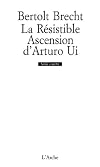
Described by Brecht as 'a gangster play that would recall certain events familiar to us all', Arturo Ui is a witty and savage satire of the rise of Hitler - recast by Brecht into a fictional, small-time Chicago gangster's takeover of the city's greengrocery trade in the 1930s. The satirical allegory combines Brecht's Epic style of theatre with black comedy and overt didacticism. Using a wide range of parody and pastiche - from Al Capone to Shakespeare's Richard III and Goethe's Faust - show more Brecht's compelling parable continues to have relevance wherever totalitarianism appears today. Written during the Second World War in 1941, the play was one of the Berliner Ensemble's most outstanding box-office successes in 1959, and has continued to attract a succession of major actors, including Leonard Rossiter, Christopher Plummer, Antony Sher and Al Pacino. This version of The Resistible Rise of Arturo Ui is by Canadian theatre academic Jennifer Wise. show lessTags
Recommendations








































Member Reviews
Hitler as a cauliflower-dealing gangster in Chicago.
By presenting the successive installation of a fascist system on a much smaller scale, Brecht not only makes Hitler look ridiculous. He also proves totalitarianism is possible everywhere and at every-time.
One has to add that Brecht did not have the chance to complete this play. While its content appears all done, it's lacking polishing, as Brecht admitted in a letter. However, this does not minor the enjoyment that comes with reading this drama. It does not require deeper involvement and can be read within a day.
By presenting the successive installation of a fascist system on a much smaller scale, Brecht not only makes Hitler look ridiculous. He also proves totalitarianism is possible everywhere and at every-time.
One has to add that Brecht did not have the chance to complete this play. While its content appears all done, it's lacking polishing, as Brecht admitted in a letter. However, this does not minor the enjoyment that comes with reading this drama. It does not require deeper involvement and can be read within a day.
Chef minable d'une bande de gangsters du Bronx, Arturo Ui parvient à s'imposer par la terreur comme 'protecteur' du trust du chou-fleur à Chicago. Il réduit au silence un politicien corrompu, Hindsborough, fait éliminer par Gori (Goering) et Gobbola (Goebbels), ses séides, un homme de main à lui, Roma (Röhm), assassine le patron du trust des légumes de Cicero, la ville voisine, et séduit la veuve de celui-ci, quasiment sur le cercueil de la victime. Le résultat est que l'on vote partout pour lui, tant à Cicero qu'à Chicago. D'autres crimes et d'autres conquêtes suivront. Rien n'arrêtera Arturo Ui, hormis les peuples, qui finiront par en avoir raison. 'Mais il ne faut pas nous chanter victoire, il est encore trop tôt : le show more ventre est encore fécond, d'où a surgi la bête immonde.' show less
Ratings
Members
- Recently Added By
Author Information

Bertolt Brecht was born on February 10, 1898 in Augsburg, Bavaria, and died on August 14, 1956. He was a German playwright, theatre director and Marxist. The modest house where he was born is today preserved as a Brecht Museum. Brecht formed a writing collective which became prolific and very influential. He wrote many lyrics for musicals and show more collaborated with Kurt Weill to create Die Dregroschenoper -- the biggest hit in 1920s Berlin. Brecht experimented with his own theater and company -- the Berliner Ensemble -- which put on his plays under his direction and which continued after his death with the assistance of his wife. Brecht aspired to create political theater, and it is difficult to evaluate his work in purely aesthetic terms. Brecht died in 1956. (Bowker Author Biography) show less
Some Editions
Awards and Honors
Awards
Series

Belongs to Publisher Series
Modern Plays {Methuen} (Brecht)
edition suhrkamp (144)
Work Relationships
Is contained in
Brecht Plays 3 : Caucasian chalk circle + Life of Galileo + Resistable rise of Arturo Ui by Hugh Rorrison
Werke: Werke (Ln), Große kommentierte Berliner und Frankfurter Ausgabe, 30 Bde., Bd.7, Stücke: Bd 7 by Bertolt Brecht
Brecht : Collected plays : Volume 6 : Dansen + The good person of Szechwan + How much is your iron? + Practice pieces for actors + Puntila and Matti, his hired man + The resistible rise of Arturo Ui by Bertolt Brecht
Brecht Plays 6 : The good person of Szechwan {Willett} + The resistible rise of Arturo Ui {Manheim} + Mr Puntila and his man Matti {Willett} by John Willett
Has the adaptation
Has as a reference guide/companion
Has as a supplement
Has as a commentary on the text
Has as a student's study guide
Common Knowledge
- Canonical title
- The resistible rise of Arturo Ui
- Original title
- Der aufhaltsame Aufstieg des Arturo Ui
- Original publication date
- 1941 (ontstaan) (ontstaan); 1957
- People/Characters
- Arturo Ui
- Important places
- Duitsland; Berlin, Germany
- First words*
- Verehrtes Publikum, wir bringen heute - / Ruhe dort hinten, Leute!
- Last words*
- (Click to show. Warning: May contain spoilers.)Die Völker wurden seiner Herr, jedoch / Daß keiner uns zu früh da triumphiert - / Der Schoß ist furchtbar noch, aus dem das kroch.
- Original language
- German
- Disambiguation notice
- 0413344509 1976 softcover English Eyre Methuen (tr. Tabori)
0573614733 2011 softcover English Samuel French (tr. Tabori)
1408179938 | 9781408179932 2013 softcover English Methuen Drama Modern Plays (tr. Wise)
147256... (show all)6572 | 9781472566577 2013 softcover English Methuen Drama Modern Plays (tr. Tabori/Beaton)
1559705434 2001 softcover English Arcade
3518101447 1966 softcover German edition suhrkamp 144
3518739956 2017 eBook German edition suhrkamp 144
*Some information comes from Common Knowledge in other languages. Click "Edit" for more information.
Classifications
Statistics
- Members
- 314
- Popularity
- 101,616
- Reviews
- 2
- Rating
- (3.78)
- Languages
- 9 — Danish, Dutch, English, French, German, Hungarian, Italian, Russian, Spanish
- Media
- Paper, Ebook
- ISBNs
- 23
- ASINs
- 8