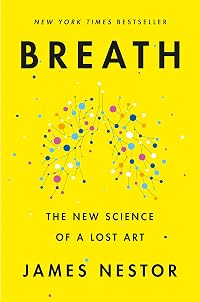
Breath: The New Science of a Lost Art
by James Nestor
On This Page
Description
A New York Times BestsellerA Washington Post Notable Nonfiction Book of 2020
Named a Best Book of 2020 by NPR
“A fascinating scientific, cultural, spiritual and evolutionary history of the way humans breathe—and how we’ve all been doing it wrong for a long, long time.” —Elizabeth Gilbert, author of Big Magic and Eat Pray Love
No matter what you eat, how much you exercise, how skinny or young or wise you are, none of it matters if you’re not breathing properly.
There is show more nothing more essential to our health and well-being than breathing: take air in, let it out, repeat twenty-five thousand times a day. Yet, as a species, humans have lost the ability to breathe correctly, with grave consequences.
Journalist James Nestor travels the world to figure out what went wrong and how to fix it. The answers aren’t found in pulmonology labs, as we might expect, but in the muddy digs of ancient burial sites, secret Soviet facilities, New Jersey choir schools, and the smoggy streets of São Paulo. Nestor tracks down men and women exploring the hidden science behind ancient breathing practices like Pranayama, Sudarshan Kriya, and Tummo and teams up with pulmonary tinkerers to scientifically test long-held beliefs about how we breathe.
Modern research is showing us that making even slight adjustments to the way we inhale and exhale can jump-start athletic performance; rejuvenate internal organs; halt snoring, asthma, and autoimmune disease; and even straighten scoliotic spines. None of this should be possible, and yet it is.
Drawing on thousands of years of medical texts and recent cutting-edge studies in pulmonology, psychology, biochemistry, and human physiology, Breath turns the conventional wisdom of what we thought we knew about our most basic biological function on its head. You will never breathe the same again. show less
Tags
Recommendations








Member Recommendations
The Oxygen Advantage: Simple, Scientifically Proven Breathing Techniques to Help You Become Healthier, Slimmer, Faster, and Fitter by Patrick McKeown
caimanjosh Both works delve heavily into the science of breathing. McKeown's book is heavily based on Buteyko's work and goes into much detail on it; Nestor's is more wide-ranging. I'd highly recommend both.
WendyRobyn Different topic. Same sense of wonder, same useful applicability to health and wellbeing.
The Secret of the Five Rites: In Search of a Lost Western Tradition of Inner Alchemy by John Michael Greer
industrialchemy For a more complete and accurate history of the Five Rites than is given in this book.
Member Reviews
The gist of this popular science book is that although breathing is something we instinctively do 25,000 times per day, we've allegedly lost the art of how to breathe correctly. Nestor presents the evidence on what's changed through evolution, the potential grave consequences and what we can do about it.
Straight away Nestor cuts to the chase about mouth breathing, and apparently we've much more than bad breath and cavities to worry about. According to the research he's done, at best mouth breathing leads to increased stuffiness / infections in the nasal cavities, and at worst leads to hypertension and the metabolic and cognitive problems that come with sleep apnea. If you regularly get up in the middle of the night for a wee your mouth show more breathing could be to blame as it also affects kidney regulation.
It's not only breathing through the correct airway that improves our health but also how we breathe (5.5 seconds in and out is optimal, which is probably a lot less breaths per minute than most of us take) and, believe it or not, how we chew. Science has shown that man's change of diet in evolution to softer foods has decreased the size of our mouth cavities to a size which is sub-optimal for allowing room for our teeth and room for an effective airway system. Whilst not everyone is likely to queue up for the type of orthodontic 'widening' device that Nestor tries out (successfully, in terms of his overall sinus function), he provides detail on how new facial bone can be developed at any age through the regular use of certain hard gum (nasty habit - I struggled to get on board with that idea, although the science behind it sounds plausible).
I loved this book. It was interesting and written in a very engaging style, and I took a lot from it in terms of practices I want to start adopting.
4.5 stars - entertaining, fascinating and potentially life transformative. Recommended. show less
Straight away Nestor cuts to the chase about mouth breathing, and apparently we've much more than bad breath and cavities to worry about. According to the research he's done, at best mouth breathing leads to increased stuffiness / infections in the nasal cavities, and at worst leads to hypertension and the metabolic and cognitive problems that come with sleep apnea. If you regularly get up in the middle of the night for a wee your mouth show more breathing could be to blame as it also affects kidney regulation.
It's not only breathing through the correct airway that improves our health but also how we breathe (5.5 seconds in and out is optimal, which is probably a lot less breaths per minute than most of us take) and, believe it or not, how we chew. Science has shown that man's change of diet in evolution to softer foods has decreased the size of our mouth cavities to a size which is sub-optimal for allowing room for our teeth and room for an effective airway system. Whilst not everyone is likely to queue up for the type of orthodontic 'widening' device that Nestor tries out (successfully, in terms of his overall sinus function), he provides detail on how new facial bone can be developed at any age through the regular use of certain hard gum (nasty habit - I struggled to get on board with that idea, although the science behind it sounds plausible).
I loved this book. It was interesting and written in a very engaging style, and I took a lot from it in terms of practices I want to start adopting.
4.5 stars - entertaining, fascinating and potentially life transformative. Recommended. show less
"Breath" has been a bestseller. Although it was written before the pandemic, it seems to have benefited from all the attention that has being going to breath and breathing in the period since.
Breath is an atheistic book. And by this, I mean that it is all about the "how," or the mechanisms, related to breathing. For example, Nestor cites studies that looked at the healing effects of prayer, and chalks this up to the fact that many prayers force us to breath more slowly. Although I'm sure this is the case, it is sort of missing the point. It is sort of like saying that raising a child is good exercise; missing the point that many of us care about the future of our children and the people they are becoming. In other words, it is a book show more that is oblivious to "effects," in the sense of holistic or systemic outcomes.
That said, being at least partially acculturated in a reductionistic Western world, I can't help but find all the benefits of good breathing that Nestor documents compelling. For example, I've been hearing friends tell me about [[Wim Hof]] for years, but I can't recall what purported benefits his breathing techniques proffer, except that maybe it has something to do with cold? Nestor explores Hof, what he's doing, and how it works.
The basics of the book are intuitive to me. As a child, I recall my father mentioning on many occasions to breath through my nose, and this is something I do, despite chronic mild congestion (which I've never quite been able to diagnose). I was taught various meditation techniques and breathing techniques, some of which are go-to practices for me.
What was most striking to me about this book was its emphasis on the importance of carbon dioxide in our blood, and its effects on metabolism and efficiency. Apparently carbon dioxide is just as essential as oxygen to the function of our cells, and for some reason, no one ever taught me this! A lot of the health benefits of good breathing are actually about higher levels of CO2 in our bloodstreams; not higher (or lower) levels of oxygen.
Although Nestor documents a number of ancient techniques, Dhikr is glaringly omitted. Dhikr, in the Islamic Sufi tradition, is the most remarkable breath technique in which I have participated. Most Dhikr are practiced in community (although a few can be practiced alone), and have a certain violence to them in their gait and fervor. They also have unequivocally consciousness-altering effects. I'm sure there are many other equally remarkable techniques from traditions of which I'm currently unaware.
At the level of storytelling, in the tradition of Michael Pollan, Nestor describes his research through his own story of self-exploration—including excruciating experiments that one wonders if he participated in simple for the shock value (such as blocking his nose with silicone plugs for ten days to try a state of forced mouth breathing). I notice a lot of authors using this style, and it is an easy way to make your work more relatable. Maybe it also grabs attention in a way that is required in our attention-fragmented current day (people put down less voyeuristic books).
To move into epistemology and pedagogy, unfortunately books are one of the poorer ways to teach people about breathing. As breath is such a somatic phenomenon, it is best taught person-to-person, in-person (which is what Nestor did throughout the book). Anyone that takes Nestor's jubilance to heart will need to find ways of actually getting out and practicing what is described in the book. show less
Breath is an atheistic book. And by this, I mean that it is all about the "how," or the mechanisms, related to breathing. For example, Nestor cites studies that looked at the healing effects of prayer, and chalks this up to the fact that many prayers force us to breath more slowly. Although I'm sure this is the case, it is sort of missing the point. It is sort of like saying that raising a child is good exercise; missing the point that many of us care about the future of our children and the people they are becoming. In other words, it is a book show more that is oblivious to "effects," in the sense of holistic or systemic outcomes.
That said, being at least partially acculturated in a reductionistic Western world, I can't help but find all the benefits of good breathing that Nestor documents compelling. For example, I've been hearing friends tell me about [[Wim Hof]] for years, but I can't recall what purported benefits his breathing techniques proffer, except that maybe it has something to do with cold? Nestor explores Hof, what he's doing, and how it works.
The basics of the book are intuitive to me. As a child, I recall my father mentioning on many occasions to breath through my nose, and this is something I do, despite chronic mild congestion (which I've never quite been able to diagnose). I was taught various meditation techniques and breathing techniques, some of which are go-to practices for me.
What was most striking to me about this book was its emphasis on the importance of carbon dioxide in our blood, and its effects on metabolism and efficiency. Apparently carbon dioxide is just as essential as oxygen to the function of our cells, and for some reason, no one ever taught me this! A lot of the health benefits of good breathing are actually about higher levels of CO2 in our bloodstreams; not higher (or lower) levels of oxygen.
Although Nestor documents a number of ancient techniques, Dhikr is glaringly omitted. Dhikr, in the Islamic Sufi tradition, is the most remarkable breath technique in which I have participated. Most Dhikr are practiced in community (although a few can be practiced alone), and have a certain violence to them in their gait and fervor. They also have unequivocally consciousness-altering effects. I'm sure there are many other equally remarkable techniques from traditions of which I'm currently unaware.
At the level of storytelling, in the tradition of Michael Pollan, Nestor describes his research through his own story of self-exploration—including excruciating experiments that one wonders if he participated in simple for the shock value (such as blocking his nose with silicone plugs for ten days to try a state of forced mouth breathing). I notice a lot of authors using this style, and it is an easy way to make your work more relatable. Maybe it also grabs attention in a way that is required in our attention-fragmented current day (people put down less voyeuristic books).
To move into epistemology and pedagogy, unfortunately books are one of the poorer ways to teach people about breathing. As breath is such a somatic phenomenon, it is best taught person-to-person, in-person (which is what Nestor did throughout the book). Anyone that takes Nestor's jubilance to heart will need to find ways of actually getting out and practicing what is described in the book. show less
There is a lot of really fascinating information in this book! Unfortunately, the author tends to jump from topic to topic, and leave a lot of things unresolved. I get that he's trying to build a narrative and create some tension, but in an informational book like this, we don't really need a narrative or tension. The narrative he builds is about his own experience of using breath to cure some lifelong health problems and improve his general health. To build tension, he jumps between telling his own story, and telling the stories of how scientists learned what we currently know about breath. Frustratingly, he has a habit to leave some of these stories unfinished. For instance, there's a fascinating section about a yoga guru who could show more control his heart rate and body temperature with his breath. Nestor describes how scientists hooked this man up to a bunch of measuring equipment and made him do his tricks... but then never tells us what scientists learned from these experiments. There are several other unresolved stories like that.
However, the information about breathing and breath is really fascinating. But maybe I should have just skipped to the end and read the section that describes all the breathing exercises and their benefits. show less
However, the information about breathing and breath is really fascinating. But maybe I should have just skipped to the end and read the section that describes all the breathing exercises and their benefits. show less
One “litmus test” I use for gauging the value of a nonfiction book can be boiled down to one question: Did it spur me to think about something that I previously gave little or no thought to. “Breath” passed this test with flying colors.
I learned so much about a vital function that most of us take for granted. The author aptly bills it as an adventure into the lost art of breathing. In an engaging, non-jargon filled way, Nestor demonstrates how making simple changes in the way we breathe can improve our health, create a healthier mindset and help us live longer. The book even includes simple exercises for improving breathing patterns. I’ve tried it several times, then checked my blood pressure. The exercises seem to work!
I learned so much about a vital function that most of us take for granted. The author aptly bills it as an adventure into the lost art of breathing. In an engaging, non-jargon filled way, Nestor demonstrates how making simple changes in the way we breathe can improve our health, create a healthier mindset and help us live longer. The book even includes simple exercises for improving breathing patterns. I’ve tried it several times, then checked my blood pressure. The exercises seem to work!
He puts forth hypotheses that are easy enough to test whether they make any particular kind of difference in my individual life, so I figure why not just test them? In this way the book is memetic. If I’m trying out old gum and taping my mouth shut, I’m probably going to talk about it with other people, which invites the question: what the fuck are you doing that for? Fair.
The chewing thing makes sense, that mastication would lead to bone growth in the maxillas, which could—__could__—help my sinus issues. Same for the sleeping with my mouth shut. My childhood experience with sinus infections, getting an allergy to an antibiotic because of overuse, chest X-rays every six weeks for years and years, all that led to a frustration show more with my sinuses, that meant that I would prefer to breathe through my mouth, which just perpetuated the likelihood of my breathing out of my mouth more—it made it a habit, one that reinforces itself. That tracks, I think. I know that I do feel better when I breath from my nose, when I exhale more in an intentional way, when I breathe slowly. All these things are ways I’ve found of calming myself, of soothing myself. So it makes sense that there’s folks out there who think that this is a part of some kind of way of transcending modernity through “the wisdom of the ancients” or some such alluring promise of deliverance by lost knowledge. That last step is where I grow uncomfortable, but the rest of it seems harmless enough, and offers just enough for me to make inferences about my own life and how little interventions could improve it.
It certainly can’t hurt to breathe more through my nose, and that’s the slack I give the book; it’s not hurting people with its material recommendations. Some of the other stuff, particularly the appeals to evolution, are shaky. The worst offense is how it castigates processed food and the rise of the industrial revolution with the changes, though I think it also wants to make some cases about agriculture? It doesn’t make many strong claims. But it does seem to be trying to say something like: "We don’t chew right or enough, so our skulls don’t develop right, which is wrong." Which is one step away from saying that the technological inventions that enable so many more people to live rather than die as children is somehow _bad_. And I have a problem with that kind of argument. It’s very close to evolutionary humanism, which is very close to eugenics. show less
The chewing thing makes sense, that mastication would lead to bone growth in the maxillas, which could—__could__—help my sinus issues. Same for the sleeping with my mouth shut. My childhood experience with sinus infections, getting an allergy to an antibiotic because of overuse, chest X-rays every six weeks for years and years, all that led to a frustration show more with my sinuses, that meant that I would prefer to breathe through my mouth, which just perpetuated the likelihood of my breathing out of my mouth more—it made it a habit, one that reinforces itself. That tracks, I think. I know that I do feel better when I breath from my nose, when I exhale more in an intentional way, when I breathe slowly. All these things are ways I’ve found of calming myself, of soothing myself. So it makes sense that there’s folks out there who think that this is a part of some kind of way of transcending modernity through “the wisdom of the ancients” or some such alluring promise of deliverance by lost knowledge. That last step is where I grow uncomfortable, but the rest of it seems harmless enough, and offers just enough for me to make inferences about my own life and how little interventions could improve it.
It certainly can’t hurt to breathe more through my nose, and that’s the slack I give the book; it’s not hurting people with its material recommendations. Some of the other stuff, particularly the appeals to evolution, are shaky. The worst offense is how it castigates processed food and the rise of the industrial revolution with the changes, though I think it also wants to make some cases about agriculture? It doesn’t make many strong claims. But it does seem to be trying to say something like: "We don’t chew right or enough, so our skulls don’t develop right, which is wrong." Which is one step away from saying that the technological inventions that enable so many more people to live rather than die as children is somehow _bad_. And I have a problem with that kind of argument. It’s very close to evolutionary humanism, which is very close to eugenics. show less
I am tempted to give this five stars, but it had some slower parts, and I'm a little dubious of some of the data presented here, scientifically and statistically I think this is lacking.
Nestor looks at historical practices and some physiological and anthropological sources to come to some conclusions that may not be entirely related. He performs some tests on himself and a friend, they experiment, but he also interviews several people who regularly do breathwork--they have anecdotal evidence, and he speaks to a researcher who has findings related to anxiety.
I really enjoyed the journey, his research also looked at spiritual practitioners over a much longer period. I'm more inclined to believe breathwork results of thousands of years; show more overall I think there's some great stuff in this book, and it's intriguing enough to try. show less
Nestor looks at historical practices and some physiological and anthropological sources to come to some conclusions that may not be entirely related. He performs some tests on himself and a friend, they experiment, but he also interviews several people who regularly do breathwork--they have anecdotal evidence, and he speaks to a researcher who has findings related to anxiety.
I really enjoyed the journey, his research also looked at spiritual practitioners over a much longer period. I'm more inclined to believe breathwork results of thousands of years; show more overall I think there's some great stuff in this book, and it's intriguing enough to try. show less
Breath is a fascinating work of alternative medicine. Like a lot of people, Nestor was plagued by chronic respiratory problems, which were alleviated by a transformative experience at a breathwork class near his house in Haight-Ashbury. This lead Nestor down a decade-long journey into the world of what he calls pulmonauts; seekers, yogis, coaches, who have plumbed the mysteries of breath.
From a sense of raw physiology, modern breathing problems are just that, modern and artificial. Anthropological collections of pre-industrial skulls, as well as ethnological reports from around the world, show that people once had much better developed sinuses and jaws, and were in generally in better health. Nestor tracks this devolution to a diet of show more processed food, a change that occurred roughly 300 years ago. However, it can be reversed with jaw strengthening orthodontics (not tooth removal and braces), as well as a practice of nasal breathing.
There is a consensus that nasal breathing at around 5.5 complete continuous breaths per minute is important for health. This is the basic rhythm of yogi, qi gong, Christian prayers, and Plains Indians culture. "Mouth breather" is more than an insult. An experiment where Nestor and fellow pulmonaut Anders Olsson of the Conscious Breathing institute blocked their nostrils for 10 days basically wrecked his health. A following 10 day experiment on nasal breathing saw a more-than-complete recovery.
A host of Western scientific renegades have studied breath through the 20th century, prompting miraculous recoveries in sanitorium patients. Lung capacity is the best correlate of life expectance, though correlation doesn't imply causation. One interesting scientific thread follows the role of CO2 in healthy respiration. Anders Olsson is a strong proponent that most people breath too much, and that higher levels of blood CO2 confer health benefits. CO2 is linked to a very fundamental fear trigger divorced from other neural mechanisms, and CO2 therapy might have use in treating anxiety by resetting the breath.
After that is extreme breathing. Tumo is the Tibetan practice of using breath to increase the body's energy output, with monks literally melting circles in the snow around them. Wim Hof is a similar Western technique, and there are also athletic practices which have led to record setting outcomes. These extreme techniques basically involve small amounts of deliberate damage to build bodily strength, a reversal of the best practices of slow nasal breathing.
This book is inspiring, but has some oddities in its presentation. The conventional medical attitude towards breathwork comes off as conspiratorial. Nestor writes about miraculous changes, with a publisher's note that this is not medical advice and you should consult a doctor. The main causal mechanism around diseases of modernity, processed foods, has some causal problems as well. I'll buy that softer and more chewable food has lead to a host of problems, but I have some questions about the timing. Notably, 300 years ago doesn't seem to correspond to any shift. The modern grist mill was invented 200 years ago. Canning, refrigeration, and the TV dinner are more recent. Again, I'm not an expert on this, but 300 years ago most people were eating about the same stuff that they'd been eating since the dawn of agriculture, i.e. mostly gruel with a little bread and dairy.
I've become a lot more serious about making sure my breath is closed. And if you're interested, www.mrjamesnestor.com has a host of video tutorials as well as sources. show less
From a sense of raw physiology, modern breathing problems are just that, modern and artificial. Anthropological collections of pre-industrial skulls, as well as ethnological reports from around the world, show that people once had much better developed sinuses and jaws, and were in generally in better health. Nestor tracks this devolution to a diet of show more processed food, a change that occurred roughly 300 years ago. However, it can be reversed with jaw strengthening orthodontics (not tooth removal and braces), as well as a practice of nasal breathing.
There is a consensus that nasal breathing at around 5.5 complete continuous breaths per minute is important for health. This is the basic rhythm of yogi, qi gong, Christian prayers, and Plains Indians culture. "Mouth breather" is more than an insult. An experiment where Nestor and fellow pulmonaut Anders Olsson of the Conscious Breathing institute blocked their nostrils for 10 days basically wrecked his health. A following 10 day experiment on nasal breathing saw a more-than-complete recovery.
A host of Western scientific renegades have studied breath through the 20th century, prompting miraculous recoveries in sanitorium patients. Lung capacity is the best correlate of life expectance, though correlation doesn't imply causation. One interesting scientific thread follows the role of CO2 in healthy respiration. Anders Olsson is a strong proponent that most people breath too much, and that higher levels of blood CO2 confer health benefits. CO2 is linked to a very fundamental fear trigger divorced from other neural mechanisms, and CO2 therapy might have use in treating anxiety by resetting the breath.
After that is extreme breathing. Tumo is the Tibetan practice of using breath to increase the body's energy output, with monks literally melting circles in the snow around them. Wim Hof is a similar Western technique, and there are also athletic practices which have led to record setting outcomes. These extreme techniques basically involve small amounts of deliberate damage to build bodily strength, a reversal of the best practices of slow nasal breathing.
This book is inspiring, but has some oddities in its presentation. The conventional medical attitude towards breathwork comes off as conspiratorial. Nestor writes about miraculous changes, with a publisher's note that this is not medical advice and you should consult a doctor. The main causal mechanism around diseases of modernity, processed foods, has some causal problems as well. I'll buy that softer and more chewable food has lead to a host of problems, but I have some questions about the timing. Notably, 300 years ago doesn't seem to correspond to any shift. The modern grist mill was invented 200 years ago. Canning, refrigeration, and the TV dinner are more recent. Again, I'm not an expert on this, but 300 years ago most people were eating about the same stuff that they'd been eating since the dawn of agriculture, i.e. mostly gruel with a little bread and dairy.
I've become a lot more serious about making sure my breath is closed. And if you're interested, www.mrjamesnestor.com has a host of video tutorials as well as sources. show less
Members
- Recently Added By
Lists

Top Five Books of 2023
767 works; 317 members

Men's healing resources
747 works; 1 member

Nervous system
43 works; 1 member
Author Information
7+ Works 2,609 Members
All Editions
Some Editions
Awards and Honors
Awards
Distinctions
Common Knowledge
- Canonical title*
- L'arte di respirare. La nuova scienza per rieducare un gesto naturale.
- Original publication date
- 2020-05-21
- People/Characters
- Anders Olsson
- Dedication
- To K.S.
- First words
- The patient arrived, pale and torpid, at 9:32 a.m. Male, middle-aged, 175 pounds. Talkative and friendly but visibly anxious. Pain: none. Fatigue: a little. Level of anxiety: moderate. Fears about progression and future sympt... (show all)oms: high.
- Quotations
- During the first trial, Douillard told the athletes to breathe entirely through their mouths. As the intensity increased, so did the rate of breathing, which was expected. By the time athletes reached the hardest stage of the... (show all) test, pedaling out 200 watts of power, they were panting and struggling to catch a breath.
Then Douillard repeated the test while the athletes breathed through their noses. As the intensity of exercise increased during this phase, the rate of breathing decreased. At the final, 200-watt stage, one subject who had been mouthbreathing at a rate of 47 breaths per minute was nasal breathing at a rate of 14 breaths a minute. He maintained the same heart rate at which he'd started the test, even though the intensity of the exercise had increased tenfold.
Simply training yourself to breathe through your nose, Douillard reported, could cut total exertion in half and offer huge gains in endurance. The athletes felt invigorated while nasel breathing rather than exhausted. They all swore off breathing through their mouths ever again.
Finding the best heart rate for exercise is easy: subtract your age from 180. The result is the maximum your body can withstand to stay in the aerobic state.
Mouthbreathing causes the body to lose 40 percent more water.
contrary to what most of us might think, no amount of snoring is normal, and no amount of sleep apnea comes without risks of serious health effects.
The right nostril is a gas pedal. When you're inhaling primarily through this channel, circulation speeds up, your body gets hotter, and cortisol levels, blood pressure, and heart rate all increase. This happens because breat... (show all)hing through the right side of the nose activates the sympathetic nervous system, the "fight or flight" mechanism that puts the body in a more elevated state of alertness and readiness. Breathing through the right nostril will also feed more blood to the opposite hemisphere of the brain, specifically to the prefrontal cortex, which has been associated with logical decisions, language, and computing.
Inhaling through the left nostril has the opposite effect: it works as a kind of brake system to the right nostril's accelerator. The left nostril is more deeply connected to the parasympathetic nervous system, the rest-and-r... (show all)elax side that lowers blood pressure, cools the body, and reduces anxiety. Left-nostril breathing shifts blood flow to the opposite side of the prefrontal cortex, to the area that influences creative thought and plays a role in the formation of mental abstractions and the production of negative emotions.
Our bodies operate most efficiently in a state of balance, pivoting between action and relaxation, daydreaming and reasoned thought. This balance is influenced by the nasal cycle, and may even be controlled by it.
In a single breath, more molecules of air will pass through your nose than all the grains of sand on all the world's beaches—trillions and trillions of them. These little bits of air come from a few feet or several yards aw... (show all)ay. As they make their way toward you, they'll twist and spool like the stars in a van Gogh sky, and they'll keep twisting and spooling and scrolling as they pass into you, traveling at a clip of about five miles per hour.
They gathered two decades of data from 5,200 subjects, crunched the numbers, and discovered that the greatest indicator of life span wasn't genetics, diet, or the amount of daily exercise, as many had suspected. It was lung c... (show all)apacity.
The smaller and less efficient lungs became, the quicker subjects got sick and died. The cause of deterioration didn't matter. Smaller meant shorter. But larger lungs equaled longer lives.
Moderate exercise like walking or cycling has been shown to boost lung size by up to 15 percent.
What Stough had discovered, and what Martin had learned, was that the most important aspect of breathing wasn't just to take in air through the nose. Inhaling was the easy part. The key to breathing, lung expansion, and the l... (show all)ong life that came with it was on the other end of respiration. It was in the transformative power of a full exhalation.
What's less acknowledged is the role carbon dioxide plays in weight loss. That carbon dioxide in every exhale has weight, and we exhale more weight than we inhale. And the way the body loses weight isn't through profusely swe... (show all)ating or "burning it off." We lose weight through exhaled breath.
For every ten pounds of fat lost in our bodies, eight and a half pounds of it comes out through the lungs; most of it is carbon dioxide mixed with a bit of water vapor. The rest is sweated or urinated out.
The lungs are the weight-regulating system of the body.
"Everyone always talks about oxygen," Olsson told me during our interview in Stockholm. "Whether we breathe thirty times or five times a minute, a healthy body will always have enough oxygen!"
What our bodies really want, ... (show all)what they require to function properly, isn't faster or deeper breaths. It's not more air. What we need is more carbon dioxide.
Blood with the most carbon dioxide in it (more acidic) loosened oxygen from hemoglobin. In some ways, carbon dioxide worked as a kind of divorce lawyer, a go-between to separate oxygen from its ties so it could be free to lan... (show all)d another mate.
This discovery explained why certain muscles used during exercise received more oxygen than lesser-used muscles. They were producing more carbon dioxide, which attracted more oxygen. It was supply on demand, at a molecular level. Carbon dioxide also had a profound dilating effect on blood vessels, opening these pathways so they could carry more oxygen-rich blood to hungry cells. Breathing less allowed animals to produce more energy, more efficiently.
Meanwhile, rapid and panicked breaths would purge carbon dioxide. Just a few moments of heavy breathing above metabolic needs could cause reduced blood flow to muscles, tissues, and organs. We'd feel light-headed, cramp up, get a headache, or even black out. If these tissues were denied consistent blood flow for long enough, they'd break down.
"Carbon dioxide is the chief hormone of the entire body; it is the only one that is produced by every tissue and that probably acts on every organ," Henderson later wrote. "Carbon dioxide is, in fact, a more fundamental compo... (show all)nent of living matter than is oxygen."
They discovered that the optimum amount of air we should take in at rest per minute is 5.5 liters. The optimum breathing rate is about 5.5 breaths per minute. That's 5.5-second inhales and 5.5-second exhales. This is the perf... (show all)ect breath.
Breathing, as it happens, is more than just a biochemical or physical act; it's more than just moving the diaphragm downward and sucking in air to feed hungry cells and remove wastes. The tens of billions of molecules we brin... (show all)g into our bodies with every breath also serve a more subtle, but equally important role. They influence nearly every internal organ, telling them when to turn on and off. They affect heart rate, digestion, moods, attitudes; when we feel aroused, and when we feel nauseated. Breathing is a power switch to a vast network called the autonomic nervous system.
exposing the body to carbon dioxide, whether in water or through injections or via inhalation, increases oxygen delivery to muscles, organs, brain, and more; it dilates arteries to increase blood flow, helps dissolve more fat... (show all), and is a powerful treatment for dozens of ailments.
Humans "rust" as well. As the cells in our bodies lose the ability to attract oxygen, Szent-Gyorgyi wrote, electrons within them will slow and stop freely interchanging with other cells, resulting in unregulated and abnormal ... (show all)growth. Tissues will begin "rusting" in much the same way as other materials. But we don't call this "tissue rust." We call it cancer. And this helps explain why cancers develop and thrive in environments of low oxygen.
The Indus Valley was the birthplace of yoga.
Video and audio tutorials of these techniques, and more, are available at mrjamesnestor.com/breath.
Box Breathing
Navy SEALs use this technique to stay calm and focused in tense situations. It's simple:
• Inhale to a count of 4; hold 4; exhale 4; hold 4. Repeat.
Longer exhalations will elicit ... (show all)a stronger parasympathetic response. A variation of Box Breathing to more deeply relax the body that's especially effective before sleeping is as follows:
• Inhale to a count of 4; hold 4; exhale 6; hold 2. Repeat.
Try at least six rounds, more if necessary. - Last words
- (Click to show. Warning: May contain spoilers.)The wave comes, washes over and runs up, then turns around and recedes, back to the ocean.
- Original language
- Engels
*Some information comes from Common Knowledge in other languages. Click "Edit" for more information.
Classifications
- Genres
- General Nonfiction, Health & Wellness, Nonfiction, Science & Nature
- DDC/MDS
- 613.192 — Applied science & technology Medicine & health Personal health and Fitness Environmental factors Sunlight Breathing exercises
- LCC
- RA782 .N47 — Medicine Public aspects of medicine Public aspects of medicine Public health. Hygiene. Preventive medicine Personal health and hygiene
- BISAC
Statistics
- Members
- 2,256
- Popularity
- 8,904
- Reviews
- 72
- Rating
- (3.91)
- Languages
- 13 — Czech, Danish, Dutch, English, Finnish, French, German, Italian, Polish, Romanian, Russian, Spanish, Portuguese (Portugal)
- Media
- Paper, Audiobook, Ebook
- ISBNs
- 37
- ASINs
- 10
