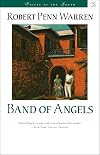
Band of Angels
by Robert Penn Warren
On This Page
Description
Amantha Starr, born and raised by a doting father on a Kentucky plantation in the years before the Civil War, is the heroine of this powerfully dramatic novel. At her father's death Amantha learns that her mother was a slave and that she, too, is to be sold into servitude. What follows is a vast panorama of one of the most turbulent periods of American History as seen through the eyes of star-crossed young woman. Amantha soon finds herself in New Orleans, where she spends the war years with show more Hamish Bond, a slave trader. At war?s end, she marries Tobias Sears, a Union officer and Emersonian idealist. Despite sporadic periods of contentment, Amantha finds life with Tobias trying, and she is haunted still by her tangled past. ?Oh, who am I?? she asks at the beginning of the novel. Only after many years, after achieving a hard-won wisdom and maturity, does she begin to understand that question. Band of Angels puts on ready display Robert Penn Warren?s prodigious gifts. First published in 1955, it is one of the most searing and vivid fictional accounts of the Civil War era ever written. show lessTags
Recommendations















Member Reviews
This is a novel about identity. The book opens in 1852 and is narrated by Amantha Starr, 10 years old, whose father owns a planation. Amantha, or Manty as she is called, is her father’s darling, but when the father dies it emerges that Manty’s deceased mother was a slave, and so Manty is sold into slavery as part of the liquidation of the estate. What follows is a long story about Amantha’s encounters with various men/benefactors, chief amongst them being Hamish Bond, a rich plantation owner who buys Amantha for $2000 and keeps her as his wife through the first half of the book.
History plays an important part in this novel. One of the set pieces in “Band of Angels” is a long description of the New Orleans massacre of 1866, in show more which freedmen were set upon and murdered by disgruntled whites. Ostensibly narrated by Amantha, the description is actually pure history, not so much a first person account at all. In fact, the intricacy of the historical detail, and the assumption that the reader would be familiar with the events described led to nothing but confusion, forcing me to do some historical research to determine what was actually happening.
A strange feature of this book is the fact that the female narrator, Amantha Starr, never really comes to life. Her narration seems external to itself. Yes, her passions and her tribulations are on full display, but at no point does the reader really get fully into her head. Much of Warren’s theme here is that of discovering one’s true identity, so the author may be forgiven for some ambiguity and shrouding, but more likely the problem lies in Warren attempting to speak like and imagine the inner life of a woman, which is a difficult voice to sustain consistently.
On the other hand, Hamish Bond (who is himself not who he pretends to be) comes fully to life in his dialogue and his long description of the horrors of the slave trade in Africa, which comes out on the night of the riots in New Orleans. Indeed, Warren does not hesitate to include scenes of precise and horrid violence, shockingly described, here and elsewhere in the book.
Other men enter Amantha’s life, amongst them Seth Parton, the intensely religious boy she met at Oberlin College, who turns up later in the book (not what he seems). Seth’s best friend, the high-minded Tobias Sears, ends up marrying Amantha. At some point Amantha suspects that Tobias sees her as his “project”, and she resents this, which is about as close as we get to an overarching theme: the difference between high ideals and actual love. A third man, Rau-Ru, a black man who was Hamish Bond’s *k’la* or slave master, features prominently in the later half of the book as Amatha’s sardonic benefactor, having fled his master’s house years earlier after defending Amantha’s honor against yet another man, a neighboring plantation owner and Lothario, Charles de Marigny Prieur-Denis. It is fair to say that there are no heroes in the book. Al the characters are flawed, one way or another. Tobias quotes Emerson’s essay about the mingling of beauty and filth, about the imperfectability of man, and this seems to be Warren’s point too: everything is messy, especially when it comes to treating people like people.
Parts of the book are rather pedestrian, moving us forward in time, getting us to the next events in a perfunctory manner. Still, all in all, this is a book worth reading. As mentioned above, “Band of Angels” is laced with historical research which crops up unobtrusively in the plot, mostly, but sometimes reads like history for the sake of history, unattached to a narrator. This is unfortunate because one does not read literature for historical “lessons” but for emotional truths. Nonetheless, it is clear that Warren knows his subject well, and he largely succeeds in conveying his complicated message. show less
History plays an important part in this novel. One of the set pieces in “Band of Angels” is a long description of the New Orleans massacre of 1866, in show more which freedmen were set upon and murdered by disgruntled whites. Ostensibly narrated by Amantha, the description is actually pure history, not so much a first person account at all. In fact, the intricacy of the historical detail, and the assumption that the reader would be familiar with the events described led to nothing but confusion, forcing me to do some historical research to determine what was actually happening.
A strange feature of this book is the fact that the female narrator, Amantha Starr, never really comes to life. Her narration seems external to itself. Yes, her passions and her tribulations are on full display, but at no point does the reader really get fully into her head. Much of Warren’s theme here is that of discovering one’s true identity, so the author may be forgiven for some ambiguity and shrouding, but more likely the problem lies in Warren attempting to speak like and imagine the inner life of a woman, which is a difficult voice to sustain consistently.
On the other hand, Hamish Bond (who is himself not who he pretends to be) comes fully to life in his dialogue and his long description of the horrors of the slave trade in Africa, which comes out on the night of the riots in New Orleans. Indeed, Warren does not hesitate to include scenes of precise and horrid violence, shockingly described, here and elsewhere in the book.
Other men enter Amantha’s life, amongst them Seth Parton, the intensely religious boy she met at Oberlin College, who turns up later in the book (not what he seems). Seth’s best friend, the high-minded Tobias Sears, ends up marrying Amantha. At some point Amantha suspects that Tobias sees her as his “project”, and she resents this, which is about as close as we get to an overarching theme: the difference between high ideals and actual love. A third man, Rau-Ru, a black man who was Hamish Bond’s *k’la* or slave master, features prominently in the later half of the book as Amatha’s sardonic benefactor, having fled his master’s house years earlier after defending Amantha’s honor against yet another man, a neighboring plantation owner and Lothario, Charles de Marigny Prieur-Denis. It is fair to say that there are no heroes in the book. Al the characters are flawed, one way or another. Tobias quotes Emerson’s essay about the mingling of beauty and filth, about the imperfectability of man, and this seems to be Warren’s point too: everything is messy, especially when it comes to treating people like people.
Parts of the book are rather pedestrian, moving us forward in time, getting us to the next events in a perfunctory manner. Still, all in all, this is a book worth reading. As mentioned above, “Band of Angels” is laced with historical research which crops up unobtrusively in the plot, mostly, but sometimes reads like history for the sake of history, unattached to a narrator. This is unfortunate because one does not read literature for historical “lessons” but for emotional truths. Nonetheless, it is clear that Warren knows his subject well, and he largely succeeds in conveying his complicated message. show less
This story, at times tragic, tells about the life of a pampered daughter of a slave owner who, upon his death learns that she is the daughter of a slave and is herself sold into slavery. What follows is her journey of self- acceptance. Her life coincides with the tumultuous history of our country.
Some of the book is gripping and easy to stay with. Other parts are overly extended. I was also frustrated by the last 100 pages of the book. The main characters seem to be drifting apart in their marriage, but the author is never clear why. The book is redeemed by a fabulous ending.
Some of the book is gripping and easy to stay with. Other parts are overly extended. I was also frustrated by the last 100 pages of the book. The main characters seem to be drifting apart in their marriage, but the author is never clear why. The book is redeemed by a fabulous ending.
Robert Penn Warren was masterful at capturing the emotion and psychology of a wide variety of characters in different states of life. Band of Angels offers insight into the world of slavery just before and during the Civil War, as well as a view of the politics of Reconstruction in Louisiana. The book reveals the cultural assumptions that kept slavery going, as well as the cultural elements that challenged it. I gained a richer perspective for the time period. The internal journey of the main character offers valuable lessons for people in any time.
Ratings
Members
- Recently Added By
Lists

Books Set in Kentucky
14 works; 5 members

National Book Award Finalists - Fiction
377 works; 12 members
Author Information

138+ Works 14,476 Members
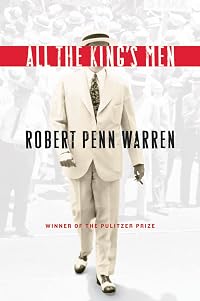
Robert Penn Warren, the first Poet Laureate of the United States, was an unusually versatile writer who tried his hand at almost every kind of literature. In all of these forms, he achieved recognition and distinction, but it is as a poet, critic, and novelist that he was most widely known. Writing almost always about his native South, Warren show more produced 10 novels and a collection of short stories, The Circus in the Attic and Other Stories (1948). By far the most successful of his novels is All the King's Men (1946), the story of a southern politician and demagogue named Willie Stark, which Warren based on the rise and fall of Huey Long. Warren was considered one of the most influential of the New Critics, whose influence on the teaching of literature in American schools and universities during the late 1940s and 1950s could scarcely be overestimated. Because All the King's Men seemed to be the very epitome of what a good work of literature should be in New Critical terms---a complicated but highly readable narrative filled with irony and ambiguity---the novel came to be used widely in courses on modern fiction. It won both the Pulitzer Prize and the Southern Authors Award in 1947. Warren's other novels are disappointing by comparison. Following the success of All the King's Men, however, Warren seemed to turn to more loosely told stories about dramatic and romantic subjects, such as the interracial theme of Band of Angels (1955) or the natural catastrophes that serve as the crisis background for The Cave (1959) and Flood: A Romance of Our Time (1964). Wilderness: A Tale of the Civil War (1961) is an allegory of a man's spiritual quest for truth about himself and the world. Meet Me in the Green Glen (1971), the story of a tragic love affair, seemed to mark a return to the tighter structure and more complex artistry of Warren's earlier novels, but A Place to Come To (1977), his last novel, in which an elderly and renowned scholar who seems to owe much to Warren himself looks back on his family's past in an effort to find the meaning of his life, struck some reviewers as a confused and tired work. Sometime midway through his career as a novelist it is as if Warren stopped thinking of himself as a southern writer in the tradition of William Faulkner and turned instead to Thomas Wolfe for inspiration. Although in retrospect that switch must be regretted, no one can deny the immense influence of Robert Penn Warren on modern letters. Warren's poetry is intellectual, rich in powerful images, and has its roots in the pre-Civil War South. He continued to write impressive poetry almost until the time of his death. (Bowker Author Biography) show less
Awards and Honors
Awards
Distinctions
Series
Belongs to Publisher Series
Work Relationships
Is contained in
Has the adaptation
Common Knowledge
- Canonical title*
- La banda degli angeli
- Original title
- Band of Angels
- Original publication date
- 1955
- Related movies
- Band of Angels (1957 | IMDb)
- Epigraph*
- Quando potrò morire e liberarmi del male che fece mio padre? - A.E. Housman
- Dedication*
- A Eleanor
- First words*
- Oh, chi sono? Per molto, molto tempo fu questo, si può ben dirlo, il grido del mio cuore. V'erano momenti in cui ripetevo a me stessa il mio nome - mi chiamo Amantha Starr - più e più volte, tentando, in qualche modo, di r... (show all)endermi reale.
- Last words*
- (Click to show. Warning: May contain spoilers.)"No", risposi, "non credo". O almeno, penso che risposi così. O tentai, ma forse non mi fu possibile con il viso premuto contro il suo petto e le lacrime che mi sgorgavano con la spaventosità della gioia - tutte le antiche ombre delle nostre vite cancellate nella gioia - e con la mano di lui che mi accarezzava le spalle, mentre egli diceva tesoro, tesoro, tesoro. Così disse.
- Disambiguation notice
- This is the work for the novel; please do not combine with the movie.
*Some information comes from Common Knowledge in other languages. Click "Edit" for more information.
Classifications
- Genres
- General Fiction, Fiction and Literature, Historical Fiction
- DDC/MDS
- 813.52 — Literature & rhetoric American literature in English American fiction in English 1900-1999 1900-1945
- LCC
- PZ3 .W2549 .B — Language and Literature Fiction and juvenile belles lettres Fiction and juvenile belles lettres Fiction in English
- BISAC
Statistics
- Members
- 290
- Popularity
- 111,396
- Reviews
- 3
- Rating
- (3.65)
- Languages
- English, French, Italian
- Media
- Paper
- ISBNs
- 12
- ASINs
- 14