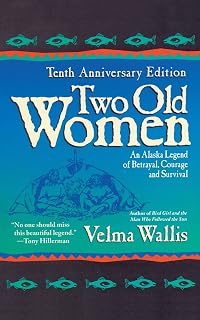
Two Old Women: An Alaska Legend of Betrayal, Courage, and Survival
by Velma Wallis
On This Page
Description
Velma Wallis's award-winning, bestselling novel about two elderly Native American women who must fend for themselves during a harsh Alaskan winter. Based on an Athabascan Indian legend passed along for many generations from mothers to daughters of the upper Yukon River Valley in Alaska, this is the suspenseful, shocking, ultimately inspirational tale of two old women abandoned by their tribe during a brutal winter famine. Though these women have been known to complain more than contribute, show more they now must either survive on their own or die trying. In simple but vivid detail, Wallis depicts a landscape and way of life that are at once merciless and starkly beautiful. show lessTags
Recommendations








Member Reviews
A good friend of mine was once aghast to hear that I had given my grandmother a copy of Velma Wallis's Two Old Women for her birthday, inscribed as follows: To Gran, the strongest woman I know, with love on your 90th Birthday, Abby. Apparently the women of her family, regardless of their age, did not like to be thought "old," and it would have been considered an unpardonable breach of good manners for my friend to have given any of her elders a book with such a title. For my part, I was dismayed, though perhaps not astonished, given our image-obsessed culture, that anyone would consider "old" such a pejorative term, or think of age as something to be ashamed of and hidden, rather than celebrated.
I also recall thinking that if a woman show more didn't know she was old at ninety, or could take offense at a heartfelt gift, meant to express love and deep respect for her wisdom and strength, than she must be sadly lacking in either reason or dignity; and I was glad that such a thing could not be said of the women of my family. But since it would most DEFINITELY have been an unpardonable breach of good manners to have expressed such a sentiment to her, I simply replied, "I do not think my grandmother will be offended."
This wonderful book, based upon a legend passed down among the Athabascan women of Alaska, relates the story of two old women who are cast out by their tribe one hard winter. Two old complainers, who seem to have little to contribute to the welfare of the group, Ch'idzigyaak and Sa' have become an untenable burden to a people struggling to survive in a harsh and unforgiving landscape, and it is decided that they must be abandoned.
But it is not the young alone who have courage, and when these two old women set out to "die trying," they discover that they still have what it takes to survive. Their knowledge of old fishing grounds stands them in good stead, and when they are reunited with the People, they demonstrate that they do indeed have something vital to contribute: the knowledge that comes with experience and age.
As a story of survival, Two Old Women is an engrossing, exciting read. As a fable about aging, the place of the elderly in a culture, and reconciliation between the generations, it was truly moving. I was impressed that no one was vilified in the story, and each decision reached, however much we might disagree with it in today's world, made sense in the context of that time and place. I always hesitate to use the word "inspirational," as it has been so abused that it seems to have lost all meaning...but there doesn't seem to be any help for it. This truly was an inspirational book, and I highly recommend it to people of all ages.
And as for my grandmother? When we had the misfortune to lose her a few years back, we found this among her books. She had been in the habit of underlining any bit of text she found especially moving or meaningful. Almost every paragraph was underlined... show less
I also recall thinking that if a woman show more didn't know she was old at ninety, or could take offense at a heartfelt gift, meant to express love and deep respect for her wisdom and strength, than she must be sadly lacking in either reason or dignity; and I was glad that such a thing could not be said of the women of my family. But since it would most DEFINITELY have been an unpardonable breach of good manners to have expressed such a sentiment to her, I simply replied, "I do not think my grandmother will be offended."
This wonderful book, based upon a legend passed down among the Athabascan women of Alaska, relates the story of two old women who are cast out by their tribe one hard winter. Two old complainers, who seem to have little to contribute to the welfare of the group, Ch'idzigyaak and Sa' have become an untenable burden to a people struggling to survive in a harsh and unforgiving landscape, and it is decided that they must be abandoned.
But it is not the young alone who have courage, and when these two old women set out to "die trying," they discover that they still have what it takes to survive. Their knowledge of old fishing grounds stands them in good stead, and when they are reunited with the People, they demonstrate that they do indeed have something vital to contribute: the knowledge that comes with experience and age.
As a story of survival, Two Old Women is an engrossing, exciting read. As a fable about aging, the place of the elderly in a culture, and reconciliation between the generations, it was truly moving. I was impressed that no one was vilified in the story, and each decision reached, however much we might disagree with it in today's world, made sense in the context of that time and place. I always hesitate to use the word "inspirational," as it has been so abused that it seems to have lost all meaning...but there doesn't seem to be any help for it. This truly was an inspirational book, and I highly recommend it to people of all ages.
And as for my grandmother? When we had the misfortune to lose her a few years back, we found this among her books. She had been in the habit of underlining any bit of text she found especially moving or meaningful. Almost every paragraph was underlined... show less
Alhamdulillah, I picked this up at the right time. I felt guilty for it sitting on my shelf for so long, but really it was waiting for this time. My own decrepitude, whining, and recent knee injury has made me feel like my time is over, that's it, I'm old, ain't going to get better. The story of these women, abandoned, in their old age by their people during hungry times gives me courage. They survived! They challenged their bodies and drew upon their skills and knowledge, that lay dormant when they were with their tribe, as grumpy complacent elders. This book made my heart ache, but it also made me proud of them, and of their tribe (in the end).
Two Old Women tells the legendary Gwich'in story of Ch'idzigyaak and Sa', two elderly women who are abandoned by their nomadic tribe during a harsh winter famine in Alaska. Rather than give in to despair, the women draw on their inner strength and resourcefulness and do their best to survive. They set off to locate sources of food and build shelter at their selected campsites.
The prose is straightforward, in the manner of oral storytelling, describing the harsh environment and practical mindset of the two women. It is told from an omniscient perspective that allows readers access to both women's thoughts. As expected in an indigenous legend, it emphasizes moral lessons, which are embedded in the tale rather than explicitly stated. The show more author learned of this story through her grandmother, a tribal elder.
Themes include aging, dignity, and the value of elders in society. I particularly enjoyed this book for giving voice to older women, a demographic that is often marginalized. Do not miss the informative end note explaining more about the Gwich'in, one of the northern Athabaskan groups, traditionally inhabiting areas of what is now Fort Yukon and Chalkyitsik. show less
The prose is straightforward, in the manner of oral storytelling, describing the harsh environment and practical mindset of the two women. It is told from an omniscient perspective that allows readers access to both women's thoughts. As expected in an indigenous legend, it emphasizes moral lessons, which are embedded in the tale rather than explicitly stated. The show more author learned of this story through her grandmother, a tribal elder.
Themes include aging, dignity, and the value of elders in society. I particularly enjoyed this book for giving voice to older women, a demographic that is often marginalized. Do not miss the informative end note explaining more about the Gwich'in, one of the northern Athabaskan groups, traditionally inhabiting areas of what is now Fort Yukon and Chalkyitsik. show less
This is a slim book based on an Indigenous Alaskan story that teaches the lesson of hard work, determination, and forgiveness. Two old women, who have been deemed to only add to the work of the community and contribute nothing, are left behind during a brutal winter. They rally to save themselves and use their life knowledge to survive. When they are brought back together with their starving tribe, they will have to decide whether to forget and forgive or continue to live well on their own.
It's a meaningful story, simply told. I enjoyed it.
It's a meaningful story, simply told. I enjoyed it.
Two Old Women is based on an Alaskan legend. In a time of famine, two old women are abandoned by their people during a brutal winter. Left alone in the woods with minimal supplies, the women must remember skills from their youth in order to survive.
This is a beautiful, well-written re-telling of a native legend. The depiction of the cold winter and utter aloneness the women face abandoned in the Yukon is written masterfully by Wallis. The women grow strong, fueled by their betrayal and abandonment at the hands of their own people. In the end, they learn the power of friendship and forgiveness.
I loved this story. It's a quick read at only 140 pages. The adventurous tale of two elderly women surviving in the wilderness alone is show more beautiful and heart-warming. Plus, they learn so much their own strength and worth, while discovering the value of friendship, community, trust, forgiveness and cooperation. As with most legends, there is a deep truth at the foundations of this tale. Elders have a huge value to their families and should be treated with respect and kindness. And, the elderly should not just becoming complainers who expect to be served. The elderly should remember that they have strength, responsibilities and the power to inspire and teach those around them, especially children. This is just a lovely re-telling of a traditional Athabascan Indian tale.
Velma Wallis has also written two other books based on Alaskan lore: Bird Girl & The Man Who Followed The Sun, and Raising Ourselves: A Gwitch'in Coming Of Age Story From The Yukon River. show less
This is a beautiful, well-written re-telling of a native legend. The depiction of the cold winter and utter aloneness the women face abandoned in the Yukon is written masterfully by Wallis. The women grow strong, fueled by their betrayal and abandonment at the hands of their own people. In the end, they learn the power of friendship and forgiveness.
I loved this story. It's a quick read at only 140 pages. The adventurous tale of two elderly women surviving in the wilderness alone is show more beautiful and heart-warming. Plus, they learn so much their own strength and worth, while discovering the value of friendship, community, trust, forgiveness and cooperation. As with most legends, there is a deep truth at the foundations of this tale. Elders have a huge value to their families and should be treated with respect and kindness. And, the elderly should not just becoming complainers who expect to be served. The elderly should remember that they have strength, responsibilities and the power to inspire and teach those around them, especially children. This is just a lovely re-telling of a traditional Athabascan Indian tale.
Velma Wallis has also written two other books based on Alaskan lore: Bird Girl & The Man Who Followed The Sun, and Raising Ourselves: A Gwitch'in Coming Of Age Story From The Yukon River. show less
An engaging tale of two old Alaskan Athabascan women, abandoned by their tribe at the start of a winter of scarcity, when the tribe is near starving. The women decide to “let us die trying” rather than simply waiting for death. This story of survival illuminates the nomadic lifestyle of the Athabascan people before contact with Europeans as well as universal human nature. I also enjoyed the brief editor’s afterword that tells about how the book came to be published.
The moving story of Two Old Women by Velma Wallis is a written version of an indigenous fable that the author learned from her mother when she was a girl. This is a simple story of two elderly women who, when the village is starving and weak, are left behind to die. They are devastated that their people think so little of them that they leave them stranded in the wilderness, but they also decide that they will survive.
They fall back on techniques and skills that they learned when young and not only survive but thrive so that when the next winter comes they are well prepared to sustain themselves through the barren months. Their people on the other hand are once again suffering and most regret leaving the two elderly women behind. When show more they have a chance to reunite what will happen? Will the elders forgive the abandonment and help their people or has the trust and love been broken forever.
A simple story told gracefully with powerful themes of friendship, dignity and human integrity shining through on every page. The author recounts the legend in vivid details that helps the reader to see the life of labour that is needed in order to live in such a hostile environment. A moving and comforting story that was a delight to read and imagine. show less
They fall back on techniques and skills that they learned when young and not only survive but thrive so that when the next winter comes they are well prepared to sustain themselves through the barren months. Their people on the other hand are once again suffering and most regret leaving the two elderly women behind. When show more they have a chance to reunite what will happen? Will the elders forgive the abandonment and help their people or has the trust and love been broken forever.
A simple story told gracefully with powerful themes of friendship, dignity and human integrity shining through on every page. The author recounts the legend in vivid details that helps the reader to see the life of labour that is needed in order to live in such a hostile environment. A moving and comforting story that was a delight to read and imagine. show less
Members
- Recently Added By
Lists

500 Great Books by Women
507 works; 60 members

Books Read in 2014
2,343 works; 86 members

Top 100 books by Indigenous Masters
134 works; 7 members

Winter Books
8 works; 1 member

Indigenous America Reader
145 works; 12 members

Native American / Indigenous Literature
172 works; 100 members

Books Read in 2024
4,623 works; 126 members
Author Information

6+ Works 2,132 Members
Velma Wallis was born in Fort Yukon, a remote village in Interior Alaska, and now her family divides their time among Fairbanks, Fort Yukon, and traditional hunting, fishing, and trapping grounds. Wallis's books are based on the Athabaskan stories her mother told her when she was growing up
Some Editions
Awards and Honors
Awards
Notable Lists
Series
Belongs to Publisher Series
Piper (4034)
Work Relationships
Has as a student's study guide
Common Knowledge
- Canonical title
- Two Old Women: An Alaska Legend of Betrayal, Courage, and Survival
- Original title
- Two old women
- Original publication date
- 1993
- People/Characters
- Ch'idzigyaak; Sa'; Shruh Zhuu
- Important places
- Alaska, USA
- Dedication
- This book is dedicated to all of the elders whom I have known and who have made an impression in my mind with their wisdom, knowledge and uniqueness.
- First words
- Introduction
Each day after cutting wood we would sit and talk in our small tent on the bank at the mouth of the Porcupine River, near where it flows into the Yukon.
Chapter 1
The air stretched tight, quiet and cold over the vast land. - Last words
- (Click to show. Warning: May contain spoilers.)They had learned a lesson taught by two whom they came to love and care for until each died a truly happy old woman.
- Blurbers
- Hillerman, Tony
- Original language
- English
- Canonical DDC/MDS
- 398.2089972
- Canonical LCC
- E99.K84
Classifications
- Genre
- Fiction and Literature
- DDC/MDS
- 398.2089972 — Society, government, & culture Customs, etiquette & folklore Folklore & Folktales Folk literature Groups of people Folklore by ethnic group Native Americans
- LCC
- E99 .K84 — History of the United States America Indians of North America Indian tribes and cultures
- BISAC
Statistics
- Members
- 1,755
- Popularity
- 12,539
- Reviews
- 67
- Rating
- (3.95)
- Languages
- 10 — Dutch, English, Estonian, Finnish, French, German, Italian, Norwegian (Bokmål), Spanish, Swedish
- Media
- Paper, Audiobook, Ebook
- ISBNs
- 48
- UPCs
- 1
- ASINs
- 16