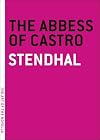
The Abbess of Castro
by Stendhal
On This Page
Description
Stendhal's novella tells the story of a pair of star crossed lovers, using biting realism and deep psychological insight. In Lazio in Italy, a young girl with a disapproving family meets a fatherless brigand, the two fall in love and meet in secret. However their passion has unintended and dangerous consequences. Whilst contemporary readers may have not appreciated Stendhal's ironic style, the modern reader will appreciate his use of realism and the depth of human passion that he portrays.Tags
Recommendations




























Member Reviews
Sure you’ve probably read stories about prison breaks or jewel heists before, but what about the equally thrilling phenomenon of convent abductions? Sometimes nuns get in the way of a love affair and the only solution is to gather a band of miscreants and storm the gates!
In 'The Abbess of Castro', Stendhal tells the tragic story of Elena de' Campireali, only daughter in a wealthy 16th century Italian family, and her lover, a brigand named Giulio Branciforte. Stendhal describes the setting in great detail, explaining the influence of wealthy families, their relationship to Rome and the Church, the political allegiances among the brigands, and the particular geography of the Alban Hills in Italy. Sometimes this level of detail seems unmotivated, as when the Abby architecture or a battle formation is described, but later many of these details are shown to have been significant. I found this explanatory prose style to be a bit off-putting, breaking from the narrative too often for my taste, but it did show more provide vivid depictions of critical scenes and it clarified some complicated character motivations. show less
La badessa di un convento cistercense intreccia una relazione con il suo vescovo, e ne ha segretamente un figlio. Il fatto però viene scoperto e i due vengono processati. La storia di questo scandalo cinquecentesco, aggiustata a scopo edificante dalle cronache che l'hanno tramandata, piacque a Stendhal che ne trasse spunto per una delle sue narrazioni più famose. Basato sugli atti originali del processo, ritrovati dopo secoli, questo libro ricostruisce la vera storia del vescovo e della badessa restituendo un vivido spaccato del mondo e delle circostanze nelle quali lo scandalo maturò, e mostrandoci cosa fossero la vita claustrale e il dramma delle monacazioni forzate, così come le strategie difensive e le sofferenze di chi cercava, show more affannosamente, una via d'uscita da un destino già segnato. show less
Feb 3, 2020Italian
Ratings
Members
- Recently Added By
Author Information

481+ Works 21,792 Members
One of the great French novelists of the nineteenth century, Stendhal (pseudonym for Marie-Henri Beyle) describes his unhappy youth with sensitivity and intelligence in his autobiographical novel The Life of Henri Brulard. It was written in 1835 and 1836 but published in 1890, long after his death. He detested his father, a lawyer from Grenoble, show more France, whose only passion in life was making money. Therefore, Stendhal left home as soon as he could. Stendhal served with Napoleon's army in the campaign in Russia in 1812, which helped inspire the famous war scenes in his novel The Red and the Black (1831). After Napoleon's fall, Stendhal lived for six years in Italy, a country he loved during his entire life. In 1821, he returned to Paris for a life of literature, politics, and love affairs. Stendhal's novels feature heroes who reject any form of authority that would restrain their sense of individual freedom. They are an interesting blend of romantic emotionalism and eighteenth-century realism. Stendhal's heroes are sensitive, emotional individuals who are in conflict with the society in which they live, yet they have the intelligence and detachment to analyze their society and its faults. Stendhal was a precursor of the realism of Flaubert. He once described the novelist's function as that of a person carrying a mirror down a highway so that the mirror would reflect life as it was, for all society. (Bowker Author Biography) show less
Series
Belongs to Publisher Series
Work Relationships
Is contained in
Contains
Common Knowledge
- Canonical title
- The Abbess of Castro
- Original title
- L'Abbesse de Castro
- Original publication date
- 1832
- People/Characters
- Elena; Ugone
- Important places
- Grenoble, Isère, Auvergne-Rhône-Alpes, France; France
- First words
- We have so often been shewn in melodrama the Italian brigands of the sixteenth century, and so many people have spoken of them without any real knowledge, that we have come to hold the erroneous ideas of what they were like.
- Last words
- (Click to show. Warning: May contain spoilers.)Ugone went and speedily returned; he found Elena dead; the dirk was in her heart.
Classifications
- Genres
- Fiction and Literature, General Fiction, Romance
- DDC/MDS
- 843.7 — Literature & rhetoric French Literature French fiction Constitutional monarchy 1815–48
- LCC
- PQ2435 .A7 .E5 — Language and Literature French, Italian, Spanish and Portuguese literatures French literature Modern literature 19th century
- BISAC
Statistics
- Members
- 143
- Popularity
- 228,119
- Reviews
- 3
- Rating
- (3.58)
- Languages
- 11 — Catalan, Dutch, English, French, German, Italian, Japanese, Latvian, Portuguese, Croatian, Spanish
- Media
- Paper, Audiobook, Ebook
- ISBNs
- 33
- ASINs
- 23