
The Glass Key
by Dashiell Hammett
On This Page
Description
"Paul Madvig was a cheerfully corrupt ward-heeler who aspired to something better: the daughter of Senator Ralph Bancroft Henry, the heiress to a dynasty of political purebreds. Did he want her badly enough to commit murder? And if Madvig was innocent, which of his dozens of enemies was doing an awfully good job of framing him?"--Publisher's web site.Tags
Recommendations







































Member Reviews
The Glass Key by Dashiell Hammett is a hard-boiled puzzler that keeps the reader guessing until the end. The main character is Ned Beaumont, a professional gambler and racketeer who works for his friend, political boss Paul Madvig. He is investigating the murder of a local senator’s son, even though all the evidence points to Madvig being the killer. Meanwhile in the background, both a political race and a potential gang war are building.
At one point or another suspicion falls on just about every character in the book, the reader isn’t ever totally sure of Ned’s motivation as this character is kept remote and never indulges in any inner monologue. Is he trying to clear Madvig or drag him into it. Madvig himself is trying to stay show more clear of it as he is in love with the senator’s daughter and doesn’t want to be blamed for the death of her brother. Unfortunately for him, the senator’s daughter and Ned are also developing feelings for each other.
The Glass Key has constantly shifting human relationships, glimpses of underworld corruption and the seedy alliances between that world and the political one. This along with Hammett’s visual and stylistic writing ensure that this book well deserves it’s “classic” rating. show less
At one point or another suspicion falls on just about every character in the book, the reader isn’t ever totally sure of Ned’s motivation as this character is kept remote and never indulges in any inner monologue. Is he trying to clear Madvig or drag him into it. Madvig himself is trying to stay show more clear of it as he is in love with the senator’s daughter and doesn’t want to be blamed for the death of her brother. Unfortunately for him, the senator’s daughter and Ned are also developing feelings for each other.
The Glass Key has constantly shifting human relationships, glimpses of underworld corruption and the seedy alliances between that world and the political one. This along with Hammett’s visual and stylistic writing ensure that this book well deserves it’s “classic” rating. show less
Love Triangle
As a caution, if you have not yet read The Glass Key (and really, why haven’t you?), you may wish to wait on this as it does contain spoilers.
Once upon a time, in a small city somewhere in America, a boss ran a city with liberal doses of money and violence. His loyal henchman watched the boss’s back for him, and the boss treated the henchman as a member of his family. The henchman called the boss’s mother, who lived with the boss, “Mom,” and the boss’s daughter “Snip.” When the boss decided to upgrade his standing by courting and eventually marrying a senator’s daughter, the henchman stood by the boss, even though he himself seemed to have feelings for the young woman. When the daughter’s brother, who show more was courting the boss’s daughter to the displeasure of the boss, turned up dead and everybody turned on the boss, believing he had murdered the brother, the henchman stood by the boss. His loyalty to the boss and his family was so fierce nothing could dissuade him of the boss’s innocence. He set about to prove it to everybody who doubted, sustained some brutal abuse, and dished some out as well. In the end, though, he proved that the boss indeed was an innocent man, at least of this one crime. But in proving it, he severed connections to the boss, maybe severed forever, when in the end he revealed to the boss that he was leaving town and taking the young woman the boss had set his heart on with him. Yet, we were all left to wonder, who, in fact, did the henchman love truly, the boss or the girl, when at that fateful moment with the boss exiting out the door, the girl looked at the henchman and the henchman stared unwaveringly at the vanishing boss.
Dashiell Hammett’s The Glass Key is at once a superb novel about mob corruption in a small city, the ruthlessness of gangsters, the vacillating loyalty of paid-off pols and cops, and the casual acceptance of murder, unless it involves a member of the elite class, and the disturbing idea that nobody is above, at least for long, their basest emotions and motivations. Underneath all that there simmers another story, a love affair so faint it barely takes shape during the course of the action, and then crystalizes at the very end as the reader is about to close the book in the last two sentences. As a warning, here follows those last two sentences featuring Janet Henry, the girl, Ned Beaumont, the henchman, and just exited Paul Madvig, the boss, that those who have not read the novel might like to avert their eyes from: “Janet Henry looked at Ned Beaumont. He stared fixedly at the door.”
The Thin Man and The Maltese Falcon are both achievements and tutorials in the art of hard boiled detective fiction, but The Glass Key may be Dashiell Hammett’s true masterpiece of crime noir. It’s a must-read for anybody interested in the genre, and for everybody interested in fine, restrained, and subtle writing. show less
As a caution, if you have not yet read The Glass Key (and really, why haven’t you?), you may wish to wait on this as it does contain spoilers.
Once upon a time, in a small city somewhere in America, a boss ran a city with liberal doses of money and violence. His loyal henchman watched the boss’s back for him, and the boss treated the henchman as a member of his family. The henchman called the boss’s mother, who lived with the boss, “Mom,” and the boss’s daughter “Snip.” When the boss decided to upgrade his standing by courting and eventually marrying a senator’s daughter, the henchman stood by the boss, even though he himself seemed to have feelings for the young woman. When the daughter’s brother, who show more was courting the boss’s daughter to the displeasure of the boss, turned up dead and everybody turned on the boss, believing he had murdered the brother, the henchman stood by the boss. His loyalty to the boss and his family was so fierce nothing could dissuade him of the boss’s innocence. He set about to prove it to everybody who doubted, sustained some brutal abuse, and dished some out as well. In the end, though, he proved that the boss indeed was an innocent man, at least of this one crime. But in proving it, he severed connections to the boss, maybe severed forever, when in the end he revealed to the boss that he was leaving town and taking the young woman the boss had set his heart on with him. Yet, we were all left to wonder, who, in fact, did the henchman love truly, the boss or the girl, when at that fateful moment with the boss exiting out the door, the girl looked at the henchman and the henchman stared unwaveringly at the vanishing boss.
Dashiell Hammett’s The Glass Key is at once a superb novel about mob corruption in a small city, the ruthlessness of gangsters, the vacillating loyalty of paid-off pols and cops, and the casual acceptance of murder, unless it involves a member of the elite class, and the disturbing idea that nobody is above, at least for long, their basest emotions and motivations. Underneath all that there simmers another story, a love affair so faint it barely takes shape during the course of the action, and then crystalizes at the very end as the reader is about to close the book in the last two sentences. As a warning, here follows those last two sentences featuring Janet Henry, the girl, Ned Beaumont, the henchman, and just exited Paul Madvig, the boss, that those who have not read the novel might like to avert their eyes from: “Janet Henry looked at Ned Beaumont. He stared fixedly at the door.”
The Thin Man and The Maltese Falcon are both achievements and tutorials in the art of hard boiled detective fiction, but The Glass Key may be Dashiell Hammett’s true masterpiece of crime noir. It’s a must-read for anybody interested in the genre, and for everybody interested in fine, restrained, and subtle writing. show less
Love Triangle
As a caution, if you have not yet read The Glass Key (and really, why haven’t you?), you may wish to wait on this as it does contain spoilers.
Once upon a time, in a small city somewhere in America, a boss ran a city with liberal doses of money and violence. His loyal henchman watched the boss’s back for him, and the boss treated the henchman as a member of his family. The henchman called the boss’s mother, who lived with the boss, “Mom,” and the boss’s daughter “Snip.” When the boss decided to upgrade his standing by courting and eventually marrying a senator’s daughter, the henchman stood by the boss, even though he himself seemed to have feelings for the young woman. When the daughter’s brother, who show more was courting the boss’s daughter to the displeasure of the boss, turned up dead and everybody turned on the boss, believing he had murdered the brother, the henchman stood by the boss. His loyalty to the boss and his family was so fierce nothing could dissuade him of the boss’s innocence. He set about to prove it to everybody who doubted, sustained some brutal abuse, and dished some out as well. In the end, though, he proved that the boss indeed was an innocent man, at least of this one crime. But in proving it, he severed connections to the boss, maybe severed forever, when in the end he revealed to the boss that he was leaving town and taking the young woman the boss had set his heart on with him. Yet, we were all left to wonder, who, in fact, did the henchman love truly, the boss or the girl, when at that fateful moment with the boss exiting out the door, the girl looked at the henchman and the henchman stared unwaveringly at the vanishing boss.
Dashiell Hammett’s The Glass Key is at once a superb novel about mob corruption in a small city, the ruthlessness of gangsters, the vacillating loyalty of paid-off pols and cops, and the casual acceptance of murder, unless it involves a member of the elite class, and the disturbing idea that nobody is above, at least for long, their basest emotions and motivations. Underneath all that there simmers another story, a love affair so faint it barely takes shape during the course of the action, and then crystalizes at the very end as the reader is about to close the book in the last two sentences. As a warning, here follows those last two sentences featuring Janet Henry, the girl, Ned Beaumont, the henchman, and just exited Paul Madvig, the boss, that those who have not read the novel might like to avert their eyes from: “Janet Henry looked at Ned Beaumont. He stared fixedly at the door.”
The Thin Man and The Maltese Falcon are both achievements and tutorials in the art of hard boiled detective fiction, but The Glass Key may be Dashiell Hammett’s true masterpiece of crime noir. It’s a must-read for anybody interested in the genre, and for everybody interested in fine, restrained, and subtle writing. show less
As a caution, if you have not yet read The Glass Key (and really, why haven’t you?), you may wish to wait on this as it does contain spoilers.
Once upon a time, in a small city somewhere in America, a boss ran a city with liberal doses of money and violence. His loyal henchman watched the boss’s back for him, and the boss treated the henchman as a member of his family. The henchman called the boss’s mother, who lived with the boss, “Mom,” and the boss’s daughter “Snip.” When the boss decided to upgrade his standing by courting and eventually marrying a senator’s daughter, the henchman stood by the boss, even though he himself seemed to have feelings for the young woman. When the daughter’s brother, who show more was courting the boss’s daughter to the displeasure of the boss, turned up dead and everybody turned on the boss, believing he had murdered the brother, the henchman stood by the boss. His loyalty to the boss and his family was so fierce nothing could dissuade him of the boss’s innocence. He set about to prove it to everybody who doubted, sustained some brutal abuse, and dished some out as well. In the end, though, he proved that the boss indeed was an innocent man, at least of this one crime. But in proving it, he severed connections to the boss, maybe severed forever, when in the end he revealed to the boss that he was leaving town and taking the young woman the boss had set his heart on with him. Yet, we were all left to wonder, who, in fact, did the henchman love truly, the boss or the girl, when at that fateful moment with the boss exiting out the door, the girl looked at the henchman and the henchman stared unwaveringly at the vanishing boss.
Dashiell Hammett’s The Glass Key is at once a superb novel about mob corruption in a small city, the ruthlessness of gangsters, the vacillating loyalty of paid-off pols and cops, and the casual acceptance of murder, unless it involves a member of the elite class, and the disturbing idea that nobody is above, at least for long, their basest emotions and motivations. Underneath all that there simmers another story, a love affair so faint it barely takes shape during the course of the action, and then crystalizes at the very end as the reader is about to close the book in the last two sentences. As a warning, here follows those last two sentences featuring Janet Henry, the girl, Ned Beaumont, the henchman, and just exited Paul Madvig, the boss, that those who have not read the novel might like to avert their eyes from: “Janet Henry looked at Ned Beaumont. He stared fixedly at the door.”
The Thin Man and The Maltese Falcon are both achievements and tutorials in the art of hard boiled detective fiction, but The Glass Key may be Dashiell Hammett’s true masterpiece of crime noir. It’s a must-read for anybody interested in the genre, and for everybody interested in fine, restrained, and subtle writing. show less
In this political imbroglio, greed is mixed with passion where ambition trumps family and loyalty. I very much enjoyed the political power struggles mixed with a light murder mystery and a prohibition backdrop. Compared to today's technologies and convoluted plots, the intrigue comes across as simplistic, but this is also the novel's charm: a back to basics suspense where the hero follows a fairly linear path. What really makes this book's strength is the writing and in particular the dialogues: it felt like I was watching an old fashioned black and white movie with wise cracking bad guys, tough but honourable good guys, sassy dames and charming damsels. The stereotypes are all there, but are they really since they are the originals?
A show more great read where the atmosphere will bring the reader right back to the lawless Prohibition. show less
A show more great read where the atmosphere will bring the reader right back to the lawless Prohibition. show less
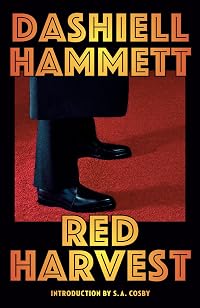
The only Hammett novel without a strong female lead. The romance is odd. But the gambling, cigar-chomping main man delivers some excellent tough-guy dialogue and action. The plot is less exciting than Hammet's other novels, and the villains are what carry you through. The villains are just as good as those in The Maltese Falcon and the Chief of Police in Red Harvest.
Somewhere, I read that not all hard-boiled fiction was throw-away dreck, but that some of it was actually good literature. The examples given included a number of Raymond Chandler novels and Dashiell Hammett's The Glass Key. I guess I don't see it. This wasn't a horrible book, but I've read lots of pulp fiction that is just as good, but which no one would ever deign to claim to be literature. Raymond Chandler might well be, but I've yet to read anything of Hammett that isn't rather wooden and stupid, with the possible exception of The Maltese Falcon. The only reason The Thin Man is famous is that some Hollywood types made a fascinating series of movies out of a vague semblance of the idea first lined out by Hammett.
This book makes it show more rather an burden trying to figure out the actual relationship between the protagonists. Eventually, we do figure out that Ned Beaumont is a hanger on, and perhaps sometimes fixer, for a political boss, Paul Madvig. They are concerned with the re-election of Sen. Ralph Henry. Madvig is in love with Henry's daughter, although she only plays him along because she wants Madvig on her father's side come election time. The trouble begins when Beaumont finds Henry's son, Tyler, lying murdered in the street.
The actual plot might be interesting, but the characterization is bizarre. Beaumont is allegedly the brains behind Madvig, the political boss of the city. But he's stupidly impetuous and is constantly barging around getting himself into trouble and is almost incapable of rational human communication with other human beings. He's curt and dismissive to a fault. So how is someone, who does stupid things and who has very little skill at diplomatic communication, capable of being a trusted advisor of a political boss? It just makes no sense. I think the plot outline, in the hands of a capable author might be turned into something well worth reading. In the hands of Hammett, it's just another piece of throw-away pulp fiction. Ok for reading on the commuter train, but not something you'd want to savor on a comfortable evening by the fire in December or on a lake side in August. show less
This book makes it show more rather an burden trying to figure out the actual relationship between the protagonists. Eventually, we do figure out that Ned Beaumont is a hanger on, and perhaps sometimes fixer, for a political boss, Paul Madvig. They are concerned with the re-election of Sen. Ralph Henry. Madvig is in love with Henry's daughter, although she only plays him along because she wants Madvig on her father's side come election time. The trouble begins when Beaumont finds Henry's son, Tyler, lying murdered in the street.
The actual plot might be interesting, but the characterization is bizarre. Beaumont is allegedly the brains behind Madvig, the political boss of the city. But he's stupidly impetuous and is constantly barging around getting himself into trouble and is almost incapable of rational human communication with other human beings. He's curt and dismissive to a fault. So how is someone, who does stupid things and who has very little skill at diplomatic communication, capable of being a trusted advisor of a political boss? It just makes no sense. I think the plot outline, in the hands of a capable author might be turned into something well worth reading. In the hands of Hammett, it's just another piece of throw-away pulp fiction. Ok for reading on the commuter train, but not something you'd want to savor on a comfortable evening by the fire in December or on a lake side in August. show less
When Taylor Henry, the son of the influential Senator Henry, turns up dead almost on the doorstep of construction magnate - and crime boss - Paul Madvig, it is the opportunity that Madvig's enemies, both criminal and political, have been waiting for. With an election looming, control of the city at stake, a scandal is the last thing that Madvig can afford. Nor is an accusation of murder doing much to help him in his pursuit of Janet Henry, the Senator's daughter and the victim's sister. A raft of anonymous letters accusing Madvig of the murder and the police of failing to investigate are also keeping the pot stirred, particularly when circumstances seem to indicate that the letters are the handiwork of Madvig's own daughter, Opal, who show more was Taylor Henry's mistress. It is up to Ned Beaumont, Madvig's best friend and right-hand man, to try and steer a course between corrupt officials, rival crime bosses, hired goons and the various women in Paul Madvig's life in an effort to clear his boss's name and salvage the situation - while doing his best not to wind up one more casualty of an election campaign that is racking up quite a body count...
Written in terse, staccato prose and dealing with crime, violence and corruption in the most matter-of-fact manner, Dashiell Hammett's The Glass Key is textbook noir, an indelible portrait of a bleak and vicious world. Hammett draws for us the dark underbelly of the 1930s, the network of politics and crime on which society was built: a newspaper editor prints what he is ordered to; the district attorney is told who he may and may not pursue; a crime boss is genuinely indignant when his speakeasies are raided by the police, having paid good money to be protected from that sort of thing. The reader is dropped without introduction into the twilight life of Ned Beaumont, gambler, drinker, strong-arm man and professional punching-bag ("He's a God-damned massacrist. You know what a massacrist is?"), who must fight fire with fire, violence with violence and lies with lies in an effort to save his friend and employer, Paul Madvig, from the gathering forces trying to tear him down. In a world where everything is corrupt and everyone for sale, Ned Beaumont is a "hero" only in the sense that he alone seems to have some grasp of the concept of loyalty...but what that loyalty will lead him to do will make your blood run cold...
Going on hands and knees into the bathroom when he had regained consciousness after the last of these beatings, he saw, on the floor behind the washstand's pedestal, a narrow safety-razor-blade red with rust of months. Getting it out from behind the pedestal was a task that took him all of ten minutes, and his nerveless fingers failed a dozen times before they succeeded in picking it up from the tiled floor. He tried to cut his throat with it, but it fell out of his hand after he had no more than scratched his chin in three places. He lay down on the bathroom floor and sobbed himself to sleep. show less
Written in terse, staccato prose and dealing with crime, violence and corruption in the most matter-of-fact manner, Dashiell Hammett's The Glass Key is textbook noir, an indelible portrait of a bleak and vicious world. Hammett draws for us the dark underbelly of the 1930s, the network of politics and crime on which society was built: a newspaper editor prints what he is ordered to; the district attorney is told who he may and may not pursue; a crime boss is genuinely indignant when his speakeasies are raided by the police, having paid good money to be protected from that sort of thing. The reader is dropped without introduction into the twilight life of Ned Beaumont, gambler, drinker, strong-arm man and professional punching-bag ("He's a God-damned massacrist. You know what a massacrist is?"), who must fight fire with fire, violence with violence and lies with lies in an effort to save his friend and employer, Paul Madvig, from the gathering forces trying to tear him down. In a world where everything is corrupt and everyone for sale, Ned Beaumont is a "hero" only in the sense that he alone seems to have some grasp of the concept of loyalty...but what that loyalty will lead him to do will make your blood run cold...
Going on hands and knees into the bathroom when he had regained consciousness after the last of these beatings, he saw, on the floor behind the washstand's pedestal, a narrow safety-razor-blade red with rust of months. Getting it out from behind the pedestal was a task that took him all of ten minutes, and his nerveless fingers failed a dozen times before they succeeded in picking it up from the tiled floor. He tried to cut his throat with it, but it fell out of his hand after he had no more than scratched his chin in three places. He lay down on the bathroom floor and sobbed himself to sleep. show less
Members
- Recently Added By
Lists

1001 Books You Must Read Before You Die
1,448 works; 1,134 members

The Guardian's 1000 Novels Everyone Must Read
1,005 works; 551 members

Best Noir Fiction
160 works; 14 members

Best Crime Fiction
262 works; 39 members
The Top 100 Crime Novels of All Time
100 works; 15 members

Noirvember: The Best Noir
113 works; 56 members

Top 100 Mystery Novels of All Time
98 works; 9 members

In or About the 1930s
198 works; 27 members

Haycraft Queen Cornerstones
181 works; 3 members

Books mentioned in Julian Symons’ Bloody Murder
438 works; 6 members

Books You Couldn't Finish
202 works; 32 members

Books Read in 2018
4,360 works; 110 members

1930s
262 works; 5 members

Books Read in 2013
1,630 works; 51 members

American Lit for Eng 11 Research Project
368 works; 6 members

Canon de la narrativa universal del siglo XX
254 works; 6 members
Canon de la narrativa universal del s. XX (cicutadry)
499 works; 3 members

Tozai Mystery Best 100 | The Top 100 Mystery Novels
111 works; 3 members
Author Information

362+ Works 32,350 Members
Samuel Dashiell Hammett was born on May 27, 1894 in St Mary's County, Maryland. Raised in Baltimore and Philadelphia, he attended Baltimore Polytechnic until he was 13 years old, but was forced to drop out and work a series of jobs to help support his family. At the age of 21 Hammett was hired by the Pinkerton National Detective Agency as an show more operative. After a stint in the United States Army during World War II, he married a nurse named Josephine Annas Dolan, whom he met when he fell ill with tuberculosis. In 1922, Hammett began writing for Black Mask magazine. Using his background in detective work, he created the tough guy detective characters Sam Spade and the Continental Op, as well as debonair sleuths Nick and Nora Charles. By 1927, Hammett had written the Poisonville series, which later became the novel Red Harvest. He wrote more than 85 short stories and five novels during his lifetime. The novels include The Dain Curse, The Glass Key, The Thin Man, and The Maltese Falcon, which was later adapted into a classic movie starring Humphrey Bogart. He also wrote an autobiography entitled Beams Falling: The Art of Dashiell Hammett. After his marriage faltered in the late 1920s, Hammett met Lillian Hellman, then a married 24-year-old aspiring playwright. In 1930, Hellman left her husband for Hammett. Eventually they both divorced their spouses and, although the two never married, they remained together until Hammett's death on January 10, 1961. (Bowker Author Biography) show less
Some Editions
Awards and Honors
Notable Lists
Series
Belongs to Publisher Series
Work Relationships
Is contained in
The Dain Curse / The Thin Man / The Glass Key / Red Harvest / The Maltese Falcon by Dashiell Hammett
Dashiell Hammett: The Library of America Edition: (Two-volume boxed set) by Dashiell Hammett (indirect)
The Glass Key / The Thin Man / Red Harvest / The Adventures of Sam Spade / The Maltese Falcon / The Dain Curse by Dashiell Hammett
The Thin Man / The Adventures of Sam Spade / The Glass Key / The Maltese Falcon / Red Harvest by Dashiell Hammett
Has the adaptation
Is abridged in
Inspired
Has as a commentary on the text
Common Knowledge
- Canonical title
- The Glass Key
- Original title
- The Glass Key
- Original publication date
- 1931
- People/Characters
- Ned Beaumont; Paul Madvig; Opal Madvig; Shad O'Rory; Janet Henry
- Related movies
- The Glass Key (1935 | IMDb); The Glass Key (1942 | IMDb)
- Dedication
- To Nell Martin
- First words
- Green dice rolled across the green table, struck the rim together, and bounced back.
- Last words
- (Click to show. Warning: May contain spoilers.)He stared fixedly at the door.
- Original language
- English
Classifications
Statistics
- Members
- 2,289
- Popularity
- 8,727
- Reviews
- 52
- Rating
- (3.70)
- Languages
- 13 — Catalan, Danish, Dutch, English, Finnish, French, German, Hungarian, Italian, Norwegian, Portuguese, Spanish, Swedish
- Media
- Paper, Audiobook, Ebook
- ISBNs
- 70
- ASINs
- 34