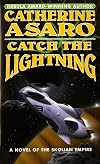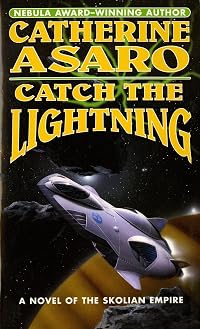
Catch the Lightning
by Catherine Asaro
Skolian Empire Publication Order (2), Skolian Empire Novels Chronological Order (2328), Skolian Empire Chronological Order (2328)
On This Page
Description
When a young girl from Earth falls in love with a handsome stranger, she becomes a pawn in an interstellar war. In the distant future, the Skolian Empire rules one third of the human galaxy and is the most powerful of all empires. The ruling family has the power of telepathy, and through it, the ability to communicate faster than light across interstellar space. But their most determined enemy, the traders, who thrive on human pain, need to interbreed with a Skolian to gain their powers. And show more now they have her. show lessTags
Recommendations



Member Reviews
Impoverished and orphaned, a seventeen year old Latina named Tina works as a waitress while dreaming of going to college and escaping her gang-dominated neighborhood. Tina was abandoned by her father, lost her mother to circumstances and her protective cousin to drugs and gang violence, leaving her alone to dodge the local criminal strongman. And one night she comes across an imposing but seemingly friendly stranger on her way home from work. And her life changes. And the fate of three interstellar nations changes as well.
Although Catch the Lightning was the second book published in the Skolian Saga, the events depicted in its pages take place near the end of the long story arc of the series. This only becomes clear as the story show more unfolds, and a reader who has read Primary Inversion will notice that many events described by the main character in Catch the Lightning don't seem to connect well to the events from the first book in the series, which can be disconcerting until one realizes that most of the books in the Skolian Saga take place in between these two stories. In this regard, it seems that Asaro drew from the same well that J. Michael Straczynski often did when writing Babylon 5, showing the reader how the story ends, but not really showing how the story got there. Which highlights that the critical element in many stories is not the ending, but the journey to the ending.
In addition, the story is told as a recollection as Tina recalls the events after the fact, letting the reader know that she survives to the end. But once again, the interesting question is not whether Tina survives or not, but rather what happens to her on the way and where she ends up. And it all starts when she meets Althor, a mysterious man in a black sleeveless outfit, under a streetlamp in Los Angeles in 1987. He seems friendly, but strange, especially once she notices his gold skin, purple hair, and double-lidded eyes. And this, coupled with his odd attire, which she mistakes for gang clothes, makes her question his proffered story that he was on his way to a formal reception with the President and got sidetracked. Of course, his story turns out to be absolutely true, which is just the first revelation that turns Tina's expectations upside down.
One of the recurring themes in the book is the confounding of expectations - both of the reader and of the characters. Tina is frightened by Althor's imposing appearance, but he turns out to be entirely unlike what she expects. His alien appearance and manners (including his blue colored blood) belie his humanity, but at the same time, at times he seems to be more machine than human. Althor is at the same time, a man, a machine, his ship, and himself. Althor's ship is Althor, and yet also not Althor. The story starts in Los Angeles in 1987, which results in the reader making certain assumptions - assumptions that on several points prove to be ill-founded. People that seem untrustworthy turn out to be reliable, and old friends turn out to be enemies. Time travel turns out to not actually be time travel, but instead Reiman sheet transitions. Tina has no measurable power as a telepath, but is able to establish a telepathic connection with Althor and his ship and turns out to be the key to reviving a fading empire's hopes of survival. Over and over again, the novel flips the reader's expectations, leading to a story that is continuously changing, and even though one knows that Tina survives, almost everything else seems to be up for grabs.
That said, the novel follows a more or less predictable pattern, first establishing a fish-out-of-water story with Althor navigating Tina's world of gangs and CalTech students in the first half, and then Tina forced to deal with Althor's world of shifting interstellar alliances and dynastic politics in the second half of the book. And though their courtship is established at a break neck pace, and is to a certain extent genetically predetermined, it doesn't seem forced. And even though the reader pretty much knows what Tina will do when presented with the choice to go with Althor to an uncertain and alien future or stay with her familiar life and a relatively safe alternative, the choice she is presented with is a real choice - differentiating the story from many other romantic story lines in which many present the main character with the false choice of a good choice and a second clearly inferior alternative. Despite the knowing which path Tina will take the reader can see that the choice is not an easy one, which makes the subsequent struggles she faces that much more poignant.
Because despite returning to a world in which Althor is not only an elite warrior, but also a prince, they face an uphill struggle. As one might guess, when one has more authority, one has bigger enemies, and Althor's enemies loom large. And once again Asaro doesn't let her characters off the hook, because even though the penultimate villain in the second half of the book is misguided, foolish, and probably insane, his rage at Althor and the regime that Althor represents is justified. As she did in Primary Inversion, Asaro doesn't pretend that those living on the low end of the totem pole under a government that exalts the elite and effectively disenfranchises the rest of the populace will be happy with their lot, no matter how necessary exigencies may make such a system. It is this refusal to make the opposition wholly evil that separates Asaro's book from lesser works, because even though the ultimate villain is, as with most Traders in the Skolian Saga, an irredeemable monster, the dissent that underlies the actions of those that deliver Althor to him gives the story a depth that merely having a collection of wooden villains would lack.
As it is presaged in the opening pages, it will surprise no one that in the end Tina ends up ensconced deep in the advanced technological civilization that Althor hails from. But what matters is the path she took to get there, and the layered story that Asaro provides detailing that path is well worth reading. Even the end where Tina ends up on a desert planet with sword wielding bodyguards (and why do sword-wielding desert dwellers show up so often in science fiction) contains a few unexpected twists that keep the reader guessing. Overall Catch the Lightning accomplishes the difficult task of being both a good second book and a good concluding volume to the multibook Skolian Saga epic.
This review has been posted to my blog Dreaming About Other Worlds. show less
Although Catch the Lightning was the second book published in the Skolian Saga, the events depicted in its pages take place near the end of the long story arc of the series. This only becomes clear as the story show more unfolds, and a reader who has read Primary Inversion will notice that many events described by the main character in Catch the Lightning don't seem to connect well to the events from the first book in the series, which can be disconcerting until one realizes that most of the books in the Skolian Saga take place in between these two stories. In this regard, it seems that Asaro drew from the same well that J. Michael Straczynski often did when writing Babylon 5, showing the reader how the story ends, but not really showing how the story got there. Which highlights that the critical element in many stories is not the ending, but the journey to the ending.
In addition, the story is told as a recollection as Tina recalls the events after the fact, letting the reader know that she survives to the end. But once again, the interesting question is not whether Tina survives or not, but rather what happens to her on the way and where she ends up. And it all starts when she meets Althor, a mysterious man in a black sleeveless outfit, under a streetlamp in Los Angeles in 1987. He seems friendly, but strange, especially once she notices his gold skin, purple hair, and double-lidded eyes. And this, coupled with his odd attire, which she mistakes for gang clothes, makes her question his proffered story that he was on his way to a formal reception with the President and got sidetracked. Of course, his story turns out to be absolutely true, which is just the first revelation that turns Tina's expectations upside down.
One of the recurring themes in the book is the confounding of expectations - both of the reader and of the characters. Tina is frightened by Althor's imposing appearance, but he turns out to be entirely unlike what she expects. His alien appearance and manners (including his blue colored blood) belie his humanity, but at the same time, at times he seems to be more machine than human. Althor is at the same time, a man, a machine, his ship, and himself. Althor's ship is Althor, and yet also not Althor. The story starts in Los Angeles in 1987, which results in the reader making certain assumptions - assumptions that on several points prove to be ill-founded. People that seem untrustworthy turn out to be reliable, and old friends turn out to be enemies. Time travel turns out to not actually be time travel, but instead Reiman sheet transitions. Tina has no measurable power as a telepath, but is able to establish a telepathic connection with Althor and his ship and turns out to be the key to reviving a fading empire's hopes of survival. Over and over again, the novel flips the reader's expectations, leading to a story that is continuously changing, and even though one knows that Tina survives, almost everything else seems to be up for grabs.
That said, the novel follows a more or less predictable pattern, first establishing a fish-out-of-water story with Althor navigating Tina's world of gangs and CalTech students in the first half, and then Tina forced to deal with Althor's world of shifting interstellar alliances and dynastic politics in the second half of the book. And though their courtship is established at a break neck pace, and is to a certain extent genetically predetermined, it doesn't seem forced. And even though the reader pretty much knows what Tina will do when presented with the choice to go with Althor to an uncertain and alien future or stay with her familiar life and a relatively safe alternative, the choice she is presented with is a real choice - differentiating the story from many other romantic story lines in which many present the main character with the false choice of a good choice and a second clearly inferior alternative. Despite the knowing which path Tina will take the reader can see that the choice is not an easy one, which makes the subsequent struggles she faces that much more poignant.
Because despite returning to a world in which Althor is not only an elite warrior, but also a prince, they face an uphill struggle. As one might guess, when one has more authority, one has bigger enemies, and Althor's enemies loom large. And once again Asaro doesn't let her characters off the hook, because even though the penultimate villain in the second half of the book is misguided, foolish, and probably insane, his rage at Althor and the regime that Althor represents is justified. As she did in Primary Inversion, Asaro doesn't pretend that those living on the low end of the totem pole under a government that exalts the elite and effectively disenfranchises the rest of the populace will be happy with their lot, no matter how necessary exigencies may make such a system. It is this refusal to make the opposition wholly evil that separates Asaro's book from lesser works, because even though the ultimate villain is, as with most Traders in the Skolian Saga, an irredeemable monster, the dissent that underlies the actions of those that deliver Althor to him gives the story a depth that merely having a collection of wooden villains would lack.
As it is presaged in the opening pages, it will surprise no one that in the end Tina ends up ensconced deep in the advanced technological civilization that Althor hails from. But what matters is the path she took to get there, and the layered story that Asaro provides detailing that path is well worth reading. Even the end where Tina ends up on a desert planet with sword wielding bodyguards (and why do sword-wielding desert dwellers show up so often in science fiction) contains a few unexpected twists that keep the reader guessing. Overall Catch the Lightning accomplishes the difficult task of being both a good second book and a good concluding volume to the multibook Skolian Saga epic.
This review has been posted to my blog Dreaming About Other Worlds. show less
This is a classic example of a book being very good, but I can't give it a four for reasons that are a bit hard to explain and may not even be fair. I read the first installment of the Skolian Empire series a year or two ago and liked it - and somewhere along the way acquired this one, the second. It has everything good sf should have - some fun theoretical stuff , a good messy galaxy-wide plot, Mayan telepaths, and romance too - but the spunky protagonist is just a bit too young for my comfort (17). There's a big age gap between the 'love interest' pair and we're supposed to accept this his culture 'matures' more slowly and hers, well, even though it's 20th century, she's someone who had to grow up fast, and so on. I don't know why show more Asaro couldn't have made her 19 or 20. But, it is clear she was intent on that and aware that some wouldn't like it as it is mentioned often in various contexts. The other plaint is less easily described - Asaro stops and has the character fill in some detail about something we need to know and you think, hunh? How does she know this? After Cherryh's meticulous attention to the 'deer in the headlights' character who is thrown into a new situation, it jars. Together, those are not huge complaints, are they? It's really a thumping good read as was #1. The theoretical physics is really fun. She's done her homework. Not that I get any of it, but I've surely struggled to understand many of the concepts she mentions! ***1/2 show less
Part of me wants to say I liked this a lot more than 3 stars, but parts of this book really annoyed the crap out of me.
Asaro brings the awesome-sciencey fun like she always does with the physics and explanations of physics terms and ideas that I am not terribly knowledgeable in. Her ability to bring complex physics theories and ideas into her books are why I like this series so much.
She didn't have as much political intrigue in this book, which is something else I really enjoy about the Skolian Saga books, but it makes sense that some of the interplay between people/societies wasn't as well developed.
Althor is probably my second least favorite character so far - he is written entirely too inconsistently.
The romance part of the story show more fell incredibly flat and occasionally creepy (graphic sex between a 17 year old and an almost 50 year old? No thanks). It even got downright annoying, which is why this one doesn't get 4 stars for me. Also, I know the series features a slaver-race/society, but the rapeyness in this book really could be toned down.
It was alright - I did like the later parts of the book a whole lot, and it definitely wasn't as bad as Diamond Star. show less
Asaro brings the awesome-sciencey fun like she always does with the physics and explanations of physics terms and ideas that I am not terribly knowledgeable in. Her ability to bring complex physics theories and ideas into her books are why I like this series so much.
She didn't have as much political intrigue in this book, which is something else I really enjoy about the Skolian Saga books, but it makes sense that some of the interplay between people/societies wasn't as well developed.
Althor is probably my second least favorite character so far - he is written entirely too inconsistently.
The romance part of the story show more fell incredibly flat and occasionally creepy (graphic sex between a 17 year old and an almost 50 year old? No thanks). It even got downright annoying, which is why this one doesn't get 4 stars for me. Also, I know the series features a slaver-race/society, but the rapeyness in this book really could be toned down.
It was alright - I did like the later parts of the book a whole lot, and it definitely wasn't as bad as Diamond Star. show less
Part of me wants to say I liked this a lot more than 3 stars, but parts of this book really annoyed the crap out of me.
Asaro brings the awesome-sciencey fun like she always does with the physics and explanations of physics terms and ideas that I am not terribly knowledgeable in. Her ability to bring complex physics theories and ideas into her books are why I like this series so much.
She didn't have as much political intrigue in this book, which is something else I really enjoy about the Skolian Saga books, but it makes sense that some of the interplay between people/societies wasn't as well developed.
Althor is probably my second least favorite character so far - he is written entirely too inconsistently.
The romance part of the story show more fell incredibly flat and occasionally creepy (graphic sex between a 17 year old and an almost 50 year old? No thanks). It even got downright annoying, which is why this one doesn't get 4 stars for me. Also, I know the series features a slaver-race/society, but the rapeyness in this book really could be toned down.
It was alright - I did like the later parts of the book a whole lot, and it definitely wasn't as bad as Diamond Star. show less
Asaro brings the awesome-sciencey fun like she always does with the physics and explanations of physics terms and ideas that I am not terribly knowledgeable in. Her ability to bring complex physics theories and ideas into her books are why I like this series so much.
She didn't have as much political intrigue in this book, which is something else I really enjoy about the Skolian Saga books, but it makes sense that some of the interplay between people/societies wasn't as well developed.
Althor is probably my second least favorite character so far - he is written entirely too inconsistently.
The romance part of the story show more fell incredibly flat and occasionally creepy (graphic sex between a 17 year old and an almost 50 year old? No thanks). It even got downright annoying, which is why this one doesn't get 4 stars for me. Also, I know the series features a slaver-race/society, but the rapeyness in this book really could be toned down.
It was alright - I did like the later parts of the book a whole lot, and it definitely wasn't as bad as Diamond Star. show less
Sci-fi romance. Off the top of my head, it's the only attempt I've heard of to make the Mayan culture relevant in a star spanning civilization. Not bad, just not me. If it's your thing, you'll likely like it a lot. I checked out a couple of reviews before I wrote this one, it's interesting that this one does seem to skew along gender lines in my limited checking.
The first half of this book was very disappointing. When a novel that you know takes place in a futuristic Imperium starts off on Earth in the 1980s, you know it isn't going to remain there. Thus, it becomes very hard to engage with the characters as you suspect most of them won't be in the second half of the novel - and indeed, most of them were not.
The point of view character is a young, poorly educated woman of Mayan ancestry. This causes a bit problem for a novel that deals with space travel, Riemann surfaces and the like. The most common phrase in the book is: "As I was later to learn" which comes up every time something involving physics or math is described.
This is a real plot-killer as it means you already know the character is show more going to survive and settle down in a future where she will be in a position to learn all about ftl inversion theory.
In one or two places, the writer becomes so used to this handy fallback that she uses it even when it isn't necessary. She tells us rather than showing us explanations for events - even when the character is actually able to work out from evidence around her what is happening.
I can also catch traces of the historical background to the Skolian Empire being inconsistent - and that's really annoying.
The second half of the book was a lot more interesting than the first, which is a good thing because otherwise I wouldn't bother reading any more of Asaro's novels. show less
The point of view character is a young, poorly educated woman of Mayan ancestry. This causes a bit problem for a novel that deals with space travel, Riemann surfaces and the like. The most common phrase in the book is: "As I was later to learn" which comes up every time something involving physics or math is described.
This is a real plot-killer as it means you already know the character is show more going to survive and settle down in a future where she will be in a position to learn all about ftl inversion theory.
In one or two places, the writer becomes so used to this handy fallback that she uses it even when it isn't necessary. She tells us rather than showing us explanations for events - even when the character is actually able to work out from evidence around her what is happening.
I can also catch traces of the historical background to the Skolian Empire being inconsistent - and that's really annoying.
The second half of the book was a lot more interesting than the first, which is a good thing because otherwise I wouldn't bother reading any more of Asaro's novels. show less
So I was pretty happy with this book. Sure, it’s more of a rags-to-riches story in a science fictional setting, but I am a sucker for that kind of thing. I still like Primary Inversion the best (I still think it's the strongest book), but if you haven’t read any of these novels, you could easily start with Catch the Lightning just as much as you could start with Primary Inversion. I still think I’m going to tackle the rest of these chronologically for my own peace of mind, though. :)
For a full review, which may or may not include spoilers, please click here: http://calico-reaction.livejournal.com/20940.html
For a full review, which may or may not include spoilers, please click here: http://calico-reaction.livejournal.com/20940.html
Members
- Recently Added By
Author Information

59+ Works 9,232 Members
Oakland, California native Catherine Asaro received a doctorate in physics from Harvard University. She has published a number of papers on theoretical physics and was a physics professor until 1990, when she established Molecudyne Research, which she currently runs. A former ballerina, she has performed with ballets and in musicals on both show more coasts, and founded the Mainly Jazz Dance program at Harvard. She now teaches at the Caryl Maxwell Classical Ballet. Her husband is John Kendall Cannizzo, an astrophysicist at NASA show less
Some Editions
Awards and Honors
Awards
Series


Common Knowledge
- Canonical title
- Catch the Lightning
- Original title
- The Radiant Seas
- Original publication date
- 1996
- People/Characters
- Akushtina Santis Pulivok; Althor Vyan Selei
- Dedication
- This book is dedicated to Sharon Todd and David Dansky, two gifted teaqchers who made a difference in my life
- First words
- I last saw Earth in 1987, when I was seventeen.
- Last words
- (Click to show. Warning: May contain spoilers.)Althor smiled and held out his hand to me. "Bienvenido, ?Akushtina. Welcome home."
- Blurbers
- Kress, Nancy; Barton, William
Classifications
Statistics
- Members
- 505
- Popularity
- 59,952
- Reviews
- 15
- Rating
- (3.60)
- Languages
- English, French, German
- Media
- Paper, Audiobook, Ebook
- ISBNs
- 14
- ASINs
- 1