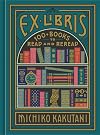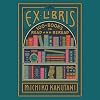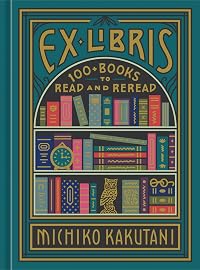
Ex Libris: 100 Books to Read and Reread
by Michiko Kakutani
On This Page
Description
"From "the most powerful book critic in the English-speaking world" (Vanity Fair) comes 100 personal, thought-provoking essays of the life-changing books she wouldn't want you to miss--beautifully illustrated throughout"--Tags
Recommendations




Member Recommendations
by anonymous user
by anonymous user
by anonymous user
Member Reviews
This was my Jolabokaflod/Jólabókaflóð gift this year - books about books are catnip to me, but I'd have loved it for the illustrations and binding alone - it's just a really attractive book.
The author, who's a literary critic for the New York Times in her day job, has assembled 100+ books she thinks are not only worth reading but also re-reading. Most of these are not run-of-the-mill canon books, and she includes a mix of fiction, non-fiction, memoir and poetry. Most were titles I'd never heard of; most for solid reasons concerning my own reading tastes. There's a heavy theme of dystopia throughout that I think is a mistake - we might be living in dark days, indeed, but referencing, or tying books back into, our specific times and show more our specific monkeys will have the unfortunate effect of dating this collection before its time.
There were almost a dozen books, though, that I've added to my list books I'd like to pursue at some point. Most are non-fiction, a few - like the Federalist Papers, the speeches and writings of Lincoln, and Washington's Farewell Address have been on the radar for years, but there are a couple of memoirs, a book about Bell Labs and at least one work of fiction I discovered by reading this collection. My TBR didn't need the additional heft, but I suspect it will be a better, more well-rounded TBR for having these titles added.
If you're looking to expand your reading horizons, or are just a TBR masochist like I am, this book provides fertile ground, in spite of its dystopian slant towards collective self-loathing; between all the 'world has gone to hell' titles there are quite a few gems that are sure to appeal to a multitude of tastes. And did I mention the (hardcover) book is gorgeous? show less
The author, who's a literary critic for the New York Times in her day job, has assembled 100+ books she thinks are not only worth reading but also re-reading. Most of these are not run-of-the-mill canon books, and she includes a mix of fiction, non-fiction, memoir and poetry. Most were titles I'd never heard of; most for solid reasons concerning my own reading tastes. There's a heavy theme of dystopia throughout that I think is a mistake - we might be living in dark days, indeed, but referencing, or tying books back into, our specific times and show more our specific monkeys will have the unfortunate effect of dating this collection before its time.
There were almost a dozen books, though, that I've added to my list books I'd like to pursue at some point. Most are non-fiction, a few - like the Federalist Papers, the speeches and writings of Lincoln, and Washington's Farewell Address have been on the radar for years, but there are a couple of memoirs, a book about Bell Labs and at least one work of fiction I discovered by reading this collection. My TBR didn't need the additional heft, but I suspect it will be a better, more well-rounded TBR for having these titles added.
If you're looking to expand your reading horizons, or are just a TBR masochist like I am, this book provides fertile ground, in spite of its dystopian slant towards collective self-loathing; between all the 'world has gone to hell' titles there are quite a few gems that are sure to appeal to a multitude of tastes. And did I mention the (hardcover) book is gorgeous? show less
Very USA-centric, Political & Trumpphobic
Review of the Clarkson Potter hardcover (2020)
I'm a sucker for books about books, so when I saw Kakutani's 100+ Books to Read and Reread listed, I didn't hesitate. I imagined that it would be an overview of classics to modern day, perhaps geared to favourite books that Kakutani hadn't been given a chance to review during her career as the New York Times chief book reviewer.
While my assumption was correct about mostly classics & contemporary fiction (& surprisingly a lot of non-fiction), there were about 20 or so books inserted for what seemed like the purpose of discussing American democracy, politics and/or world dystopias with no opportunity missed to take a swipe at Donald Trump. It is like show more Kakutani didn't get it all out of her system in The Death of Truth: Notes on Falsehood in the Age of Trump (2018) and just had to keep on going. This dates and rather spoils this otherwise well written collection badly. You may think that I'm exaggerating here, but when your entire review of George Orwell's 1984 (1949) is about Donald Trump, I'd say there are some issues there.
The book had the added oddity of using frequent pull quotes* as if to pad the material as is done in newspaper and magazine articles.
To end on a positive note, the collection is wonderfully illustrated with about 27 imagined book covers by the chalk artist Dana Tanamachi, who has illustrated at least several real-life covers previously issued in the Puffin Chalk series such as Peter Pan (Puffin-Chalk 2014), Pippi Longstocking (Puffin-Chalk 2013) and The Wizard of Oz (Puffin-Chalk 2014).
Trivia and Links
*Pull quote is the term for when a quote is pulled from an article (usually in a magazine or newspaper) and duplicated in a larger font block of text inserted on the page in order to emphasize it. See various definitions at Magazine Designing.
See several examples of Dana Tanamachi's imagined book covers at her Instagram
See a timelapse video of Dana Tanamachi designing her cover for "Peter Pan" on Vimeo here. show less
Review of the Clarkson Potter hardcover (2020)
I'm a sucker for books about books, so when I saw Kakutani's 100+ Books to Read and Reread listed, I didn't hesitate. I imagined that it would be an overview of classics to modern day, perhaps geared to favourite books that Kakutani hadn't been given a chance to review during her career as the New York Times chief book reviewer.
While my assumption was correct about mostly classics & contemporary fiction (& surprisingly a lot of non-fiction), there were about 20 or so books inserted for what seemed like the purpose of discussing American democracy, politics and/or world dystopias with no opportunity missed to take a swipe at Donald Trump. It is like show more Kakutani didn't get it all out of her system in The Death of Truth: Notes on Falsehood in the Age of Trump (2018) and just had to keep on going. This dates and rather spoils this otherwise well written collection badly. You may think that I'm exaggerating here, but when your entire review of George Orwell's 1984 (1949) is about Donald Trump, I'd say there are some issues there.
The book had the added oddity of using frequent pull quotes* as if to pad the material as is done in newspaper and magazine articles.
To end on a positive note, the collection is wonderfully illustrated with about 27 imagined book covers by the chalk artist Dana Tanamachi, who has illustrated at least several real-life covers previously issued in the Puffin Chalk series such as Peter Pan (Puffin-Chalk 2014), Pippi Longstocking (Puffin-Chalk 2013) and The Wizard of Oz (Puffin-Chalk 2014).
Trivia and Links
*Pull quote is the term for when a quote is pulled from an article (usually in a magazine or newspaper) and duplicated in a larger font block of text inserted on the page in order to emphasize it. See various definitions at Magazine Designing.
See several examples of Dana Tanamachi's imagined book covers at her Instagram
See a timelapse video of Dana Tanamachi designing her cover for "Peter Pan" on Vimeo here. show less
Ex libris. What does that even mean?
Adverb: used as an inscription on a bookplate to show the name of the book's owner:
Noun: ex libris (noun) · ex libris (plural noun): a bookplate inscribed to show the name of the book's owner.
Origin: Latin, literally ‘out of the books or library (of someone)’.
While I’m not too hot on the title (the sound and visual throw me), Ex Libris--100 Books to Read and Reread is a book devotional by Michiko Kakutani, famed senior book critic for the New York Times (now retired). Published in 2020, that terrible year, this book was one of the better things to emerge from the maelstrom. It’s a lovely volume, with beautiful illustrations by Dana Tanamachi that give the book as much merit at least as the show more text itself. Beautiful end papers and book titles illustrations are delightful and give an emotional lift with their vibrant colors and design. The contents are arranged alphabetically by the authors’ surnames.
I assume these are 100 of Ms. Kakutani’s favorites; hasn’t she read everything written at least in 2 centuries? The reviews are combinations of the original book review published in the NYT and additional remarks, perhaps written for this publication. Titles go back as far as The Odyssey (Emily Wilson’s 2017 translation) and as recent as On Earth We’re Briefly Gorgeous; books about work and vocation by various authors, and books on democracy and tyranny, a topic of great concern to Ms. Kakutani when Ex Libris was published, no doubt because of Trump’s presidency. She has a searing distaste for him, and I salute her for it.
I don’t think it’s available in paperback; while available in audiobook, it’s best read as a hand-held book, at least to appreciate the illustrations. Non-glare heavyweight 5x8 pages await your comments. 304 pages. Blank pages at the end for personal additions. A thoughtful layout makes this volume feel like a gift from one book lover to another. show less
Adverb: used as an inscription on a bookplate to show the name of the book's owner:
Noun: ex libris (noun) · ex libris (plural noun): a bookplate inscribed to show the name of the book's owner.
Origin: Latin, literally ‘out of the books or library (of someone)’.
While I’m not too hot on the title (the sound and visual throw me), Ex Libris--100 Books to Read and Reread is a book devotional by Michiko Kakutani, famed senior book critic for the New York Times (now retired). Published in 2020, that terrible year, this book was one of the better things to emerge from the maelstrom. It’s a lovely volume, with beautiful illustrations by Dana Tanamachi that give the book as much merit at least as the show more text itself. Beautiful end papers and book titles illustrations are delightful and give an emotional lift with their vibrant colors and design. The contents are arranged alphabetically by the authors’ surnames.
I assume these are 100 of Ms. Kakutani’s favorites; hasn’t she read everything written at least in 2 centuries? The reviews are combinations of the original book review published in the NYT and additional remarks, perhaps written for this publication. Titles go back as far as The Odyssey (Emily Wilson’s 2017 translation) and as recent as On Earth We’re Briefly Gorgeous; books about work and vocation by various authors, and books on democracy and tyranny, a topic of great concern to Ms. Kakutani when Ex Libris was published, no doubt because of Trump’s presidency. She has a searing distaste for him, and I salute her for it.
I don’t think it’s available in paperback; while available in audiobook, it’s best read as a hand-held book, at least to appreciate the illustrations. Non-glare heavyweight 5x8 pages await your comments. 304 pages. Blank pages at the end for personal additions. A thoughtful layout makes this volume feel like a gift from one book lover to another. show less
Short reflections on 100+ books, some with their book covers as illustrations. This is surprisingly political at points which it needn't have been (i.e., anti-Trump). The aim of the book is promote book reading as a people connector, which it is. A wide variety of books are listed. Some well known, others very niche. A decent selection of titles which if you took the time to read, you would be satisfactorily rewarded. Overall this is a good book to add to your library of book reviews and book lists. Some of my favorite books are listed, while others were I'd unheard. Valuable to me for that reason. A few I would never read but everyone could say the same thing with limited leisure reading time. Some of my favorites included are: Life, show more Keith Richards; 1984, George Orwell; The Odyssey, Homer; Where the Wild Things Are, Maurice Sendak; The Plays of Shakespeare.
The author is the former chief book critic for the New York Times. show less
The author is the former chief book critic for the New York Times. show less
I don't know how to rate this. It was mildly entertaining, but the entire time I read it was just wondering what the heck the point of it was.
This is a series of short essays about a bunch of books without any particular focus. So it's not just lesser-known great books. (The Great Gatsby is in here, ffs; Kakutani opens her review by acknowledging that most of her audience will have written a paper about it in middle or high school. I know I did, and she didn't have anything to say that Mrs. Dosher didn't already teach me.) It's not just older books. (For example, On Earth We're Briefly Famous is in here, which was released in 2019, probably just before Kakutani started writing this book.) It's not on any special theme, though it feels show more like about half of the books are related to Trump, fascism, totalitarianism, and the decline of actual truth. (Is this stressful reading? Why yes. Yes, it is.) It's just some essays about some books she loves.
And that's part of the problem. She clearly loves these books, and she is unsurprisingly great at describing the central premise and pulling a few excellent quotes to give you a sense of the book. But one hundred raves in a row gets old. I would have loved to see some essays in here on books she hates, just so it was a little less one-note.
Another part of the problem is that, okay, sure, I didn't know about all these books. That 1981 book about Hollywood's classic romantic comedies? I'm thrilled to learn it exists! I would LOVE to read it! And I can't fucking find it, because it was published forty years ago. Meanwhile, the books I can easily get -- Educated comes to mind -- I already knew about. My mind was made up about whether to read them or not long before I read this book, and reading it didn't change anything.
Also, Kakutani is, as I said, unsurprisingly and wildly well-read, but she doesn't cover every genre with equal deftness. (No human could.) I really wish she had focused on just the areas she knows well and reads in widely, because some of her essays about books in the genres I know best made me go, "Okay, you think this is innovative because you've never read anything else in this subgenre."
The best essays are definitely the ones where she talks about what the book means to her, specifically, and links it to a time in her life or a mental state. This book would be SO much better if it were structured around any kind of theme, but I think the one I'd most like to see is her life in books. (I would read that from almost ANYONE. Tell me what books were important to you or very present in your life when you were four! Fourteen! Fifty! Whatever.)
I don't know. I can't dislike this, I can't recommend it, I can't find a feeling to have about it. It's a perfectly fine book, but I honestly cannot understand why it exists. show less
This is a series of short essays about a bunch of books without any particular focus. So it's not just lesser-known great books. (The Great Gatsby is in here, ffs; Kakutani opens her review by acknowledging that most of her audience will have written a paper about it in middle or high school. I know I did, and she didn't have anything to say that Mrs. Dosher didn't already teach me.) It's not just older books. (For example, On Earth We're Briefly Famous is in here, which was released in 2019, probably just before Kakutani started writing this book.) It's not on any special theme, though it feels show more like about half of the books are related to Trump, fascism, totalitarianism, and the decline of actual truth. (Is this stressful reading? Why yes. Yes, it is.) It's just some essays about some books she loves.
And that's part of the problem. She clearly loves these books, and she is unsurprisingly great at describing the central premise and pulling a few excellent quotes to give you a sense of the book. But one hundred raves in a row gets old. I would have loved to see some essays in here on books she hates, just so it was a little less one-note.
Another part of the problem is that, okay, sure, I didn't know about all these books. That 1981 book about Hollywood's classic romantic comedies? I'm thrilled to learn it exists! I would LOVE to read it! And I can't fucking find it, because it was published forty years ago. Meanwhile, the books I can easily get -- Educated comes to mind -- I already knew about. My mind was made up about whether to read them or not long before I read this book, and reading it didn't change anything.
Also, Kakutani is, as I said, unsurprisingly and wildly well-read, but she doesn't cover every genre with equal deftness. (No human could.) I really wish she had focused on just the areas she knows well and reads in widely, because some of her essays about books in the genres I know best made me go, "Okay, you think this is innovative because you've never read anything else in this subgenre."
The best essays are definitely the ones where she talks about what the book means to her, specifically, and links it to a time in her life or a mental state. This book would be SO much better if it were structured around any kind of theme, but I think the one I'd most like to see is her life in books. (I would read that from almost ANYONE. Tell me what books were important to you or very present in your life when you were four! Fourteen! Fifty! Whatever.)
I don't know. I can't dislike this, I can't recommend it, I can't find a feeling to have about it. It's a perfectly fine book, but I honestly cannot understand why it exists. show less
A lovely book, small in format but not content, with colorful woodcut illustrations throughout. I had anticipated reading it gradually, perhaps one or two recommendations at night before going to sleep. But once I started I found myself pulled forward, eager to learn the reasons she recommended these books.
Some of my own favorites showed up here - [b:All the King's Men|5527|All the King's Men|Robert Penn Warren|https://i.gr-assets.com/images/S/compressed.photo.goodreads.com/books/1342193852l/5527._SY75_.jpg|900927], [b:The Woman Warrior|30852|The Woman Warrior|Maxine Hong Kingston|https://i.gr-assets.com/images/S/compressed.photo.goodreads.com/books/1541333110l/30852._SY75_.jpg|1759], [b:The Movie-goer|25417283|The Movie-goer|Walker show more Percy|https://i.gr-assets.com/images/S/compressed.photo.goodreads.com/books/1429853495l/25417283._SY75_.jpg|1209450] among others. And there were others that I had passed on, and will continue to leave unread despite Kakutani’s enthusiasm for them.
Her need to recommend books that examine the distressed condition of the world at this moment in time, the effects of political, technological, and ecological forces on individuals and nations, is evident throughout. But so is her eclectic side; Keith Richard’s autobiography, [b:Life|13373906|Life|Keith Richards|https://i.gr-assets.com/images/S/compressed.photo.goodreads.com/books/1480438496l/13373906._SY75_.jpg|14323907], gets high marks from her.
I’ve added a few of her recommendations to my TBR, and I will be keeping the book close at hand for future suggestions. show less
Some of my own favorites showed up here - [b:All the King's Men|5527|All the King's Men|Robert Penn Warren|https://i.gr-assets.com/images/S/compressed.photo.goodreads.com/books/1342193852l/5527._SY75_.jpg|900927], [b:The Woman Warrior|30852|The Woman Warrior|Maxine Hong Kingston|https://i.gr-assets.com/images/S/compressed.photo.goodreads.com/books/1541333110l/30852._SY75_.jpg|1759], [b:The Movie-goer|25417283|The Movie-goer|Walker show more Percy|https://i.gr-assets.com/images/S/compressed.photo.goodreads.com/books/1429853495l/25417283._SY75_.jpg|1209450] among others. And there were others that I had passed on, and will continue to leave unread despite Kakutani’s enthusiasm for them.
Her need to recommend books that examine the distressed condition of the world at this moment in time, the effects of political, technological, and ecological forces on individuals and nations, is evident throughout. But so is her eclectic side; Keith Richard’s autobiography, [b:Life|13373906|Life|Keith Richards|https://i.gr-assets.com/images/S/compressed.photo.goodreads.com/books/1480438496l/13373906._SY75_.jpg|14323907], gets high marks from her.
I’ve added a few of her recommendations to my TBR, and I will be keeping the book close at hand for future suggestions. show less
Kakutani, Michiko. Ex Libris: 100+ Books to Read and Reread. Clarkson Potter, 2020.
Michiko Kakutani recently retired as a book reviewer for the New York Times. Ex Libris offers her a chance to give brief reviews to an eclectic group of books she has found memorable. Some are recent reads like Colson Whitehead’s Underground Railroad, some are established classics like Moby Dick, and others, like Dr. Seuss, go back to her earliest experiences as a reader. She writes her Dr. Seuss review in the style of one of his poems. She is an accomplished stylist, and one finds little to argue with in her critical assessments. Most of the works are on the serious side, Winesburg, Ohio, and The Origins of Totalitarianism, for example. But there are show more exceptions, notably Judd Apatow’s Sick in the Head, a collection of interviews with comedians. If you are looking for something to put on your want-to-read list, you will find some good stuff here, whatever your taste. 4 stars. show less
Michiko Kakutani recently retired as a book reviewer for the New York Times. Ex Libris offers her a chance to give brief reviews to an eclectic group of books she has found memorable. Some are recent reads like Colson Whitehead’s Underground Railroad, some are established classics like Moby Dick, and others, like Dr. Seuss, go back to her earliest experiences as a reader. She writes her Dr. Seuss review in the style of one of his poems. She is an accomplished stylist, and one finds little to argue with in her critical assessments. Most of the works are on the serious side, Winesburg, Ohio, and The Origins of Totalitarianism, for example. But there are show more exceptions, notably Judd Apatow’s Sick in the Head, a collection of interviews with comedians. If you are looking for something to put on your want-to-read list, you will find some good stuff here, whatever your taste. 4 stars. show less
Members
- Recently Added By
Lists

On Books
70 works; 1 member

TBR of Books I Don't Own
132 works; 1 member
Author Information

5+ Works 1,248 Members
Michiko Kakutani is an American literary critic and writer. Her alma mater is Yale University. Early in her career she worked for The Washington Post and then Time magazine. She began at The New York Times in 1979 as a cultural reporter. She is the former chief book critic of The New York Times. In 1998, she won the Pulitzer Prize for Criticism. show more Her debut book was published in July 2018 and is entitled The Death of Truth: Notes on Falsehood in the Age of Trump. (Bowker Author Biography) show less
Awards and Honors
Awards
Common Knowledge
- Original title
- EX-LIBRIS: 100+ Books to Read and Reread
- Original publication date
- 2020
- Dedication
- FOR READERS AND WRITERS
EVERYWHERE - First words
- [Introduction] As a child, the Pulitzer Prize-winning playwright August Wilson recalled in a speech that he was the one in his family who wanted to read all the books in the house, who wore out his library card and kept book... (show all)s way past their due date.
With "Americanah", Chimamanda Ngozi Adichie has written a wonderfully touching, incisive and very funny coming-of-age tale that's both an old-fashioned love story and a sharp-eyed meditation on race, class, immigration and id... (show all)entity in our rapidly changing, globalized world. - Quotations
- Over the years, I had the good fortune to have some inspiring teachers who enriched my understanding and appreciation of books.
- Last words
- (Click to show. Warning: May contain spoilers.)[Introduction] It can give us an understanding of lives very different from our own, and a sense of the shared joys and losses of human experience.
(Click to show. Warning: May contain spoilers.)This eruption of madness, they told themselves, "could not last in the twentieth century." - Original language
- English
Classifications
- Genres
- Literature Studies and Criticism, Nonfiction, General Nonfiction
- DDC/MDS
- 028 — Computer science, information & general works Library & information sciences Reading and use of other information media
- LCC
- Z1035.9 .K35 — Bibliography, Library Science and Information Resources General bibliography Best books
- BISAC
Statistics
- Members
- 671
- Popularity
- 42,917
- Reviews
- 19
- Rating
- (3.67)
- Languages
- Dutch, English
- Media
- Paper, Audiobook, Ebook
- ISBNs
- 9
- ASINs
- 3