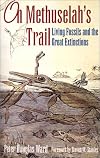
On Methuselah's Trail: Living Fossils and the Great Extinctions
by Peter Douglas Ward
On This Page
Description
Examines ancient species which have survived unchanged while others have evolved or been annihilated.Tags
Recommendations

















Member Reviews
Methulselah becomes a metaphor for living fossils in Peter Ward's eloquent book On Methuselah's Trail: Living Fossils and the Great Extinctions . The presence of peculiar forms like, the horseshoe crab, the nautilus, echinoids, and assorted other animals and plants puzzled Darwin. How, he asked, could these species have survived millions of years with little change while most other species evolved, sometimes slowly, sometimes rapidly, often becoming extinct? He resolved the question to his satisfaction by arguing that some species did not experience any predatory pressure or competition, nor did their environment change so drastically as to compel metamorphosis or extinction: i.e., they were well adapted to their particular environment show more and had generalized enough not to have to change.
Ward's specialty is the nautilus, and his book is most fascinating when he is discussing the differences between the ammonites (a species similar to the nautilus, but which specialized in response to environmental and predatory changes and which, despite flourishing during several epochs, became extinct. Ward takes us on location to various parts of the world in search of fossil evidence. His enthusiasm and fascination for pieces of rock is almost enough to cause you to resign from your job and switch to geology as a new career.
"Paleontologists live like that in some sense; their physical lives run along in simple, linear track of time, but their minds move back and forth through the ages, jumping onto the tracks where time moves at a more complicated pace. Perhaps we are searching for the lessons of our own survival, chasing clues by studying the lives of the Methuselahs." show less
Ward's specialty is the nautilus, and his book is most fascinating when he is discussing the differences between the ammonites (a species similar to the nautilus, but which specialized in response to environmental and predatory changes and which, despite flourishing during several epochs, became extinct. Ward takes us on location to various parts of the world in search of fossil evidence. His enthusiasm and fascination for pieces of rock is almost enough to cause you to resign from your job and switch to geology as a new career.
"Paleontologists live like that in some sense; their physical lives run along in simple, linear track of time, but their minds move back and forth through the ages, jumping onto the tracks where time moves at a more complicated pace. Perhaps we are searching for the lessons of our own survival, chasing clues by studying the lives of the Methuselahs." show less
Nice, easy & informative read.
Ratings
Members
- Recently Added By
Author Information

20 Works 2,410 Members
Peter D. Ward is Professor of Geological Sciences at the University of Washington in Seattle.
Common Knowledge
- Canonical title*
- Der lange Atem des Nautilus oder Warum lebende Fossilien noch leben
- Original title
- On Methuselah's Trail
- Original publication date
- 1992
- Dedication*
- Für Nicholas, Angela und Joe
- Original language*
- English
*Some information comes from Common Knowledge in other languages. Click "Edit" for more information.
Classifications
Statistics
- Members
- 101
- Popularity
- 321,094
- Reviews
- 2
- Rating
- (3.64)
- Languages
- English, German
- Media
- Paper
- ISBNs
- 3
- ASINs
- 1