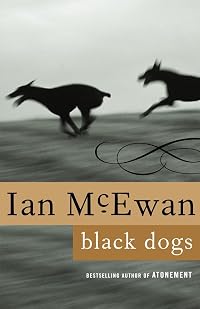
Black Dogs
by Ian McEwan
On This Page
Description
Set in late 1980s Europe at the time of the fall of the Berlin Wall, this novel is the intimate story of the crumbling of a marriage, as witnessed by an outsider—from the Booker Prize winner and bestselling author of Atonement."Brilliant.... [A] meditation on ... the intoxications and the redemptive power of love." —The New Yorker
Jeremy is the son-in-law of Bernard and June Tremaine, whose union and estrangement began almost simultaneously. Seeking to comprehend how their deep love show more could be defeated by ideological differences Bernard and June cannot reconcile, Jeremy undertakes writing June's memoirs, only to be led back again and again to one terrifying encouner forty years earlier—a moment that, for June, was as devastating and irreversible in its consequences as the changes sweeping Europe in Jeremy's own time.
In a finely crafted, compelling examination of evil and grace, Ian McEwan weaves the sinister reality of civiliation's darkest moods—its black dogs—with the tensions that both create love and destroy it. Historical Fiction. Literature. Fiction. show less
Tags
Recommendations





















Member Reviews
This is very interesting. The narrator is a man who looses his parents early and spends his teens being semi adopted by his friend's parents. He then finds himself with an almost closer relationship to his in-laws than his wife and her siblings. June & Bernard have a complicated relationship, and he spends a significant proportion of the book preparing notes for a memoir of some description. It pops backwards and forwards in time until, in the final portion, we hear about the great event that June believed changed her life and that Bernard dismisses entirely. Maybe because he was otherwise engaged drawing a caterpillar. It strikes me as an essay in how different people can look at the same event, or hear the same story and take vastly show more different things from it.
I found it poignant that they clearly cared for each other but were unable to live together. The events that we spend a lot of the book building up to was quite shocking, both in the event and their quite disparate reactions to it. The final portion is quite thought provoking, because of the incident with the black dogs, their plans are changed and the house in France is bought. Does the family owe some of their current happiness to an incident that, to some extent, cause a rift between June & Bernard that persisted for the rest of their lives? We are, each of us, a summation of our life experiences and to change any one of them could change the route through life.
I listened to this and, for once, I think this would have been better read, to enable me to pause and reflect on some of the ideas raised. show less
I found it poignant that they clearly cared for each other but were unable to live together. The events that we spend a lot of the book building up to was quite shocking, both in the event and their quite disparate reactions to it. The final portion is quite thought provoking, because of the incident with the black dogs, their plans are changed and the house in France is bought. Does the family owe some of their current happiness to an incident that, to some extent, cause a rift between June & Bernard that persisted for the rest of their lives? We are, each of us, a summation of our life experiences and to change any one of them could change the route through life.
I listened to this and, for once, I think this would have been better read, to enable me to pause and reflect on some of the ideas raised. show less
Tre stelle sono poche, ma quattro son troppe. Ci sono delle idee molto interessanti e, come sempre, scorre che è una meraviglia.
Non mi ha convinto l'ultima parte, l'ho sentita "staccata" dal resto del romanzo, anche se non so spiegare bene il perché.
Non mi ha convinto l'ultima parte, l'ho sentita "staccata" dal resto del romanzo, anche se non so spiegare bene il perché.
This book consists of five parts. The first is a preface that explains protagonist and narrator Jeremy’s interest in other peoples’ parents due to being orphaned at an early age. The second introduces June Tremain, Jeremy’s mother-in-law, who is nearing the end of her life. Jeremy is interviewing her in the hopes of writing a memoir of her life. The third covers Jeremy’s trip to Germany with his father-in-law, Bernard Tremain, where they witnessed the aftermath of the fall of the Berlin Wall. The fourth recounts Jeremy’s first meeting with his future wife, July Tremain, daughter of June and Bernard. The fifth is Jeremy’s attempt at a memoir, describing June’s encounter with the titular black dogs.
Except for the preface, show more the storyline moves backward in time. Black dogs are mentioned in both a figurative and literal sense. June and Bernard are initially involved in the Communist party, taken in by the idealism of the movement. Bernard’s idealism is shattered by the actions of Stalin and, later, the USSR’s invasion of Hungary, but it takes Bernard ten years to leave the party, whereas June had only been a member for a few months. Bernard is more science-oriented, while June is influenced by spiritualism and, eventually, religious views. June and Bernard’s marriage became increasingly estranged after her encounter with the black dogs. It is short but contains some fairly deep themes, such as history, war, memory, science, rationality, spiritualism, and religion.
I think the fact that it was published in 1992, another time of great optimism, is noteworthy. My take on it is that it is a commentary on the difficulty of capturing history accurately, the transience of memory, a warning that Europe is not going to easily rid itself of wars, and the importance of balancing compassion with logic. I enjoyed analyzing it afterward more than the reading experience itself. show less
Except for the preface, show more the storyline moves backward in time. Black dogs are mentioned in both a figurative and literal sense. June and Bernard are initially involved in the Communist party, taken in by the idealism of the movement. Bernard’s idealism is shattered by the actions of Stalin and, later, the USSR’s invasion of Hungary, but it takes Bernard ten years to leave the party, whereas June had only been a member for a few months. Bernard is more science-oriented, while June is influenced by spiritualism and, eventually, religious views. June and Bernard’s marriage became increasingly estranged after her encounter with the black dogs. It is short but contains some fairly deep themes, such as history, war, memory, science, rationality, spiritualism, and religion.
I think the fact that it was published in 1992, another time of great optimism, is noteworthy. My take on it is that it is a commentary on the difficulty of capturing history accurately, the transience of memory, a warning that Europe is not going to easily rid itself of wars, and the importance of balancing compassion with logic. I enjoyed analyzing it afterward more than the reading experience itself. show less
This had to sit on my palate a while after finishing it for me to really enjoy the taste. The surface level of the story is fairly pointless. A man and woman become husband and wife and then grow apart based on a mysterious encounter with a couple of black dogs. The book explores their ideologies, how the man believes politics can save the world and the woman believes only inward transformation can save the world. Along the way their's a very interesting exploration of the impact of World War II on Europe and an account of the dismantling of the Berlin Wall.
Looking deeper in the text, however, it became apparent to me how deep this story goes. The black dogs directly relate to the horror inflicted on Europe through World War II and the show more adherence to the belief that political ideologies can change the world for the better, even when the ideologies are responsible for horrible atrocities. There are reactions of withdrawal, both in the wife and in the Polish concentration camp which refuses to admit that Jews were killed there. There are reactions of a political nature that seem to say "if only we try again, we can get it right this time", as seen in the husband and the fall of the Berlin Wall.
A very interesting read for someone like me who grew up in America in the 70s and 80s at the end of the Cold War. Not McEwan's best work, but as an investigation of how the second half of the 20th century affected individuals and their relationships, it was a fascinating and worthy read. show less
Looking deeper in the text, however, it became apparent to me how deep this story goes. The black dogs directly relate to the horror inflicted on Europe through World War II and the show more adherence to the belief that political ideologies can change the world for the better, even when the ideologies are responsible for horrible atrocities. There are reactions of withdrawal, both in the wife and in the Polish concentration camp which refuses to admit that Jews were killed there. There are reactions of a political nature that seem to say "if only we try again, we can get it right this time", as seen in the husband and the fall of the Berlin Wall.
A very interesting read for someone like me who grew up in America in the 70s and 80s at the end of the Cold War. Not McEwan's best work, but as an investigation of how the second half of the 20th century affected individuals and their relationships, it was a fascinating and worthy read. show less
The first of Ian McEwan's books that I have read; a freebie from a former work colleague.
I found it refeshingly ordinary - in terms of the narrative. As a lover of the gothic and fantastical this very down to earth story was a welcome change.
McEwan has a wonderful gift for illuminating the internal anxieties and ideas of his characters that I felt close to and really opens up his world and makes it breathe.
Looking forward to reading more.
I found it refeshingly ordinary - in terms of the narrative. As a lover of the gothic and fantastical this very down to earth story was a welcome change.
McEwan has a wonderful gift for illuminating the internal anxieties and ideas of his characters that I felt close to and really opens up his world and makes it breathe.
Looking forward to reading more.
Very disappointing, and yet not a dreadful book either (I've read five other McEwan's, all 4* or 5*).
Remembering
The narrator is preparing the memoirs of his dying mother-in-law. He particularly wants details of a terrifying encounter with black dogs more than 40 years ago that changed the direction of her life, and therefore that of her husband and children.
Jeremy describes his own childhood, contrasting it with that of his wife, and tells of trips to the care home to talk to his mother-in-law, recounting snippets of her life. As the book progressed, I became increasingly annoyed about this big secret and heavy-handed metaphor that would, presumably, be revealed at the end, thinking it would probably be an anticlimax. And it show more was.
Truth
Other than that, the main theme is honesty - to oneself and to others. June and Bernard (Jeremy's parents-in-law) joined the Communist party at the end of the war. For me, the most effective passages were those that looked at how people twist or ignore the truth to maintain their faith in something, and the tensions between scientific rationalism and more instinctive spiritual aspects. McEwan points out that "Laboratory work teaches you better than anything how easy it is to bend a result to fit a theory", acknowledging that "rationalism is blind faith". Jean and Bernard were very different, except "their capacity, their appetite, for belief never diminished", though not necessarily in the same things.
I was also stunned and delighted at the idea of "The Socialist Cycling Club of Amersham". It's a very hilly area with a notable shortage of socialists!
Repeating Down the Generations
Perhaps related to that, Jeremy is very conscious of one generation repeating the faults of a previous one, though he sometimes uses that as a convenient excuse. For example, almost losing touch with a young relative because "I could not bear to undergo another parting from X. The thought that I was inflicting on her the very loss I had suffered myself intensified my loneliness".
The elephant in the room is the titular black dog!
Depression is never really addressed, which is odd, given the title: the book even mentions that "the black dog" was how Churchill personified his depressive episodes.
Seductive Writing
There are snippets where McEwan's perceptive writing shines though; it's the book as a whole that doesn't work for me. To end with the good writing:
* "The companionable love-making that is the privilege and compromise of married life."
* A terminally ill person was "buried in a sleep that had itself been smothered in an illness" so on waking, "she had to reconstruct her whole existence, who and where she was."
* The liturgy at a funeral was "a succession of brilliant phrases, book titles, dying cadences that breathed life, pure alertness, along the spine".
* An unhappy family entering a restaurant was "a luminous envelope of familial intensity". show less
Remembering
The narrator is preparing the memoirs of his dying mother-in-law. He particularly wants details of a terrifying encounter with black dogs more than 40 years ago that changed the direction of her life, and therefore that of her husband and children.
Jeremy describes his own childhood, contrasting it with that of his wife, and tells of trips to the care home to talk to his mother-in-law, recounting snippets of her life. As the book progressed, I became increasingly annoyed about this big secret and heavy-handed metaphor that would, presumably, be revealed at the end, thinking it would probably be an anticlimax. And it show more was.
Truth
Other than that, the main theme is honesty - to oneself and to others. June and Bernard (Jeremy's parents-in-law) joined the Communist party at the end of the war. For me, the most effective passages were those that looked at how people twist or ignore the truth to maintain their faith in something, and the tensions between scientific rationalism and more instinctive spiritual aspects. McEwan points out that "Laboratory work teaches you better than anything how easy it is to bend a result to fit a theory", acknowledging that "rationalism is blind faith". Jean and Bernard were very different, except "their capacity, their appetite, for belief never diminished", though not necessarily in the same things.
I was also stunned and delighted at the idea of "The Socialist Cycling Club of Amersham". It's a very hilly area with a notable shortage of socialists!
Repeating Down the Generations
Perhaps related to that, Jeremy is very conscious of one generation repeating the faults of a previous one, though he sometimes uses that as a convenient excuse. For example, almost losing touch with a young relative because "I could not bear to undergo another parting from X. The thought that I was inflicting on her the very loss I had suffered myself intensified my loneliness".
The elephant in the room is the titular black dog!
Depression is never really addressed, which is odd, given the title: the book even mentions that "the black dog" was how Churchill personified his depressive episodes.
Seductive Writing
There are snippets where McEwan's perceptive writing shines though; it's the book as a whole that doesn't work for me. To end with the good writing:
* "The companionable love-making that is the privilege and compromise of married life."
* A terminally ill person was "buried in a sleep that had itself been smothered in an illness" so on waking, "she had to reconstruct her whole existence, who and where she was."
* The liturgy at a funeral was "a succession of brilliant phrases, book titles, dying cadences that breathed life, pure alertness, along the spine".
* An unhappy family entering a restaurant was "a luminous envelope of familial intensity". show less
This is a great little book. It tells a story I've not seen elsewhere. Yet the underlying story is probably more common in reality than the lack of presence in literature would lead us to believe. It can be reduced to a simple arc. Young people think they've found a person who understands them enough to love them only to realize they are extremely different to the point where they cannot live together but refuse to give up on their love. While many choose divorce some permanent denial. This is the story of two people who choose never to dissolve their union. The narrator is neither of them. He's a man who loses his parents while he was still a child and looks to others about parenting. He marries a young woman and turns his attention to show more her parents. It's their story which he unravels in talks with her mother, who is dying and wants him to write her memoir, and her husband who sees their story from a totally different perspective. Who should he believe?
McEwan takes us back to a time in England when idealism flourished and many were attracted to a belief system that promised a better life for all – communism. These two young intellectuals are both drawn to those who challenged the status quo based on an ideology that envisioned a new way. Russia had even become an ally against the common threat of fascism. These two party members served their country during the war in their own ways and postponed getting married until the war was over. They decide to honeymoon in post war Europe which had not yet recovered from the war. They tour Italy and southern France enjoying the natural beauty. Having little money they hike together to get from place to place.
It's on one of their hikes that the pivotal event occurs. He's a naturalist and gets distracted by a bright shiny insect. She marches on. They get separated. She sees what appears to be vicious dogs in the distance. She screams to try and get his attention but they are too far apart and he never hears her. The dogs see her and begin their approach . She is saved but this is where the split begins.
From her perspective this is a message from God. Satan's dogs are closing in and it is time to change. She needs to depend on no one but herself. She needs to make her faith in God obvious. Nature is all around her and it is beautiful. She can no longer depend on him. She needs to put her faith in God. The party is not the answer, God is. Where she is, South France is beautiful, she buys a place to make a future home. She has a path and it is not where she was going before this.
From his perspective this may never have happened and it certainly wasn't a message from God. He remembers meeting with locals who see this differently. If there were dogs they think they know who they were. This is rural France and the Germans barely paid attention to the area. But it was Gestapo controlled territory and they employed vicious dogs to keep the locals intimidated. When the war ended they let the dogs loose. The locals were convinced this was a feral pair and put together some hunters to find them and eliminate them.
But the damage to the relationship was done. They quarreled and quarreled. He eventually leaves the Party and becomes a Labour MP. She still loves him. He loves her. They even have a daughter but they are both convinced they are right and the other is wrong. She decides to return to France and enjoy nature with her daughter. He can even visit them but returning to England is only possible when she becomes ill. That's when she recruits her daughter's husband to write her memoir.
Who do you believe? show less
McEwan takes us back to a time in England when idealism flourished and many were attracted to a belief system that promised a better life for all – communism. These two young intellectuals are both drawn to those who challenged the status quo based on an ideology that envisioned a new way. Russia had even become an ally against the common threat of fascism. These two party members served their country during the war in their own ways and postponed getting married until the war was over. They decide to honeymoon in post war Europe which had not yet recovered from the war. They tour Italy and southern France enjoying the natural beauty. Having little money they hike together to get from place to place.
It's on one of their hikes that the pivotal event occurs. He's a naturalist and gets distracted by a bright shiny insect. She marches on. They get separated. She sees what appears to be vicious dogs in the distance. She screams to try and get his attention but they are too far apart and he never hears her. The dogs see her and begin their approach . She is saved but this is where the split begins.
From her perspective this is a message from God. Satan's dogs are closing in and it is time to change. She needs to depend on no one but herself. She needs to make her faith in God obvious. Nature is all around her and it is beautiful. She can no longer depend on him. She needs to put her faith in God. The party is not the answer, God is. Where she is, South France is beautiful, she buys a place to make a future home. She has a path and it is not where she was going before this.
From his perspective this may never have happened and it certainly wasn't a message from God. He remembers meeting with locals who see this differently. If there were dogs they think they know who they were. This is rural France and the Germans barely paid attention to the area. But it was Gestapo controlled territory and they employed vicious dogs to keep the locals intimidated. When the war ended they let the dogs loose. The locals were convinced this was a feral pair and put together some hunters to find them and eliminate them.
But the damage to the relationship was done. They quarreled and quarreled. He eventually leaves the Party and becomes a Labour MP. She still loves him. He loves her. They even have a daughter but they are both convinced they are right and the other is wrong. She decides to return to France and enjoy nature with her daughter. He can even visit them but returning to England is only possible when she becomes ill. That's when she recruits her daughter's husband to write her memoir.
Who do you believe? show less
Members
- Recently Added By
Published Reviews
ThingScore 50
An uneasy mixture of mystery, contemporary history, and novel of ideas.
added by jburlinson
Lists

1001 Books You Must Read Before You Die
1,448 works; 1,137 members

Booker Prize
491 works; 62 members
Booker Prize Shortlist: Titles Read
103 works; 10 members

Man Booker Prize Longlist 1992
6 works; 2 members

Animals in the Title
498 works; 11 members

A Rainbow of Books: Colors in the Title
570 works; 24 members
Author Information

80+ Works 100,188 Members
Ian McEwan was born in Aldershot, England on June 21, 1948. He received a B.A. in English Literature from the University of Sussex and an M.A. in English Literature from the University of East Anglia. He writes novels, plays, and collections of short stories including In Between the Sheets, The Cement Garden, The Comfort of Strangers, The show more Innocent, Black Dogs, The Daydreamer, Enduring Love, Sweet Tooth, The Children Act and Nutshell. He has won numerous awards including the 1976 Somerset Maugham Award for First Love, Last Rites; the 1987 Whitbread Novel Award and the 1993 Prix Fémina Etranger for The Child in Time; the 1998 Booker Prize for Fiction for Amserdam; the 2002 W. H. Smith Literary Award, the 2003 National Book Critics' Circle Fiction Award, the 2003 Los Angeles Times Prize for Fiction, and the 2004 Santiago Prize for the European Novel for Atonement; and the 2006 James Tait Black Memorial Prize for Saturday. (Bowker Author Biography) show less
Awards and Honors
Awards
Series
Belongs to Publisher Series
Work Relationships
Is contained in
Common Knowledge
- Canonical title*
- Les chiens noirs
- Original title
- Black Dogs
- Original publication date
- 1992
- People/Characters
- June Tremaine; Bernard Tremaine; Jeremy (narrator, June & Bernard's son-in-law); Jenny (Jeremy's wife)
- Important places
- Wiltshire, England, UK; Berlin, Germany; Languedoc, Occitanie, France; Les Salces, Occitanie, France; Saint-Maurice-Navacelles, Occitanie, France; The Dolmen de la Prunarede (show all 7); Majdanek concentration camp, Lublin, Lublin, Poland
- Important events
- World War II (1939-1945); Fall of the Berlin Wall (1989)
- Epigraph
- In these times I don't, in a manner of speaking, know what I want; perhaps I don't want what I know and want what I don't know.
-Marsilio Ficino, letter to Giovanni Cavalcanti, c. 1475 - Dedication
- TO JON COOK, WHO
SAW THEM TOO - First words
- Ever since I lost mine in a road accident when I was eight, I have had my eye on other people's parents.
- Quotations
- It is photography itself that creates the illusion of innocence. Its ironies of frozen narrative lend to its subjects an apparent unawareness that they will change or die. It is the future they are innocent of. Fifty years on... (show all) we look at them with the godly knowledge of how they turned out after all--who they married, the date of their death--with no thought for who will one day be holding photographs of us.
"The truth is we love each other, we've never stopped, we're obsessed. And we failed to do a thing with it. We couldn't make a life. We couldn't give up the love, but we wouldn't bend to its power. . . . Whenever I'm complain... (show all)ing about some latest social breakdown in the newspapers, I have to remind myself--why should I expect millions of strangers with conflicting interests to get along when I couldn't make a simple society with the father of my children, the man I've loved. . . ?
[H]e was struck by the recently concluded war not as a historical, geopolitical fact but as a multiplicity, a near infinity of private sorrows. . . .
"The work we have to do is with ourselves if we're ever going to be at peace with each other." - Last words
- (Click to show. Warning: May contain spoilers.)They [the black dogs] are crossing the shadow line and going deeper, where the sun never reaches . . . and as sleep rolls in they are receding from her, black stains in the gray of the dawn, fading as they move into the foothills of the mountains from where they will return to haunt us, somewhere in Europe, in another time.
- Blurbers
- Connolly, Cressida
- Original language
- English
*Some information comes from Common Knowledge in other languages. Click "Edit" for more information.
Classifications
Statistics
- Members
- 2,477
- Popularity
- 7,840
- Reviews
- 54
- Rating
- (3.43)
- Languages
- 16 — Catalan, Czech, Danish, Dutch, English, Finnish, French, German, Hebrew, Italian, Norwegian (Bokmål), Romanian, Spanish, Swedish, Turkish, Portuguese (Portugal)
- Media
- Paper, Audiobook, Ebook
- ISBNs
- 62
- UPCs
- 1
- ASINs
- 16