
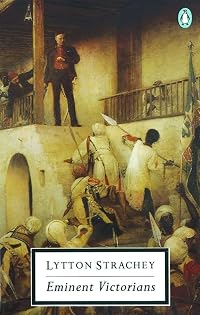
Eminent Victorians
by Lytton Strachey
On This Page
Description
Eminent Victorians, Lytton Strachey's wonderfully witty and Wildean quartet of biographies, stands out as one of the most radical and groundbreaking works of its genre. With relentless precision, Strachey explores the lives of four exemplars of the Victorian age: Cardinal Manning, Florence Nightingale, Thomas Arnold and General Gordon, irreverently bringing to light the flaws, strengths, ambitions and hypocrisies of these treasured legends. The combination of thrilling and imaginative show more narratives with Strachey's ironic reckoning shocked many contemporary readers of the time, and even altered the course of biography, making a powerful case for its elevation to high art. show lessTags
Recommendations





















Member Recommendations

Member Reviews
A brilliantly iconoclastic book in which a long-haired gay aesthete detonates the great and good of imperial England and the obsequious tradition of Victorian biography/hagiography along with them. The ‘ascetic’ Cardinal Manning is portrayed as a worldly and calculating careerist; Thomas Arnold as an educator who elevated religious indoctrination and ‘character-building’ above actual education; and General Gordon as a reckless, drunken and ultimately self-destructive adventurer. Interestingly, as she is the only female in the quartet, Strachey is rather more sympathetic towards Florence Nightingale and clearly on her side in her battles with the male dunderheads of the War Office.
Strachey may have been less than industrious with show more the research (he did no primary research), sometimes loftily indifferent to mere facts and a dab hand at embroidery in the interests of getting a laugh, but he wrote like an avenging angel and Eminent Victorians is eminently readable. Whatever its strengths and weaknesses as history, it’s straight from the top drawer as a work of literature. Above all, it’s very funny and teeming with great one-liners, sarcastic quips elevated to the level of art and lethal verbal hand-grenades disguised as elegant epigrams.
Strachey was writing against the backdrop of the appalling slaughter of the First World War (he was declared medically unfit but was an outspoken conscientious objector nonetheless) which was, arguably, the logical culmination of all that Victorian deference and veneration of ‘great men.’ Behind the sardonic humour this is a deeply felt work and through layers of irony Strachey wrote from the heart.
In his preface, reacting against the turgid two volume biographies of the time, he asserts that brevity should be the essence of biography. Despite Strachey’s reputation as the founder of modern biography this is one piece of advice many subsequent biographers have chosen to ignore. The idea persists that a definitive biography is possible and, it seems, the longer the biography the more ‘definitive’ it is. The two biographies of recent times I have enjoyed most are relatively concise by the blockbusting standards still prevalent in the genre - Ma’am Darling (99 Glimpses of Princess Margaret) and One Two Three Four: The Beatles in Time. Both are by satirist Craig Brown and possess distinctly Stracheyan qualities of playfulness, formal invention and subversive wit. Like Strachey, Brown is concerned not with imparting new information about his subjects but providing a fresh perspective on a familiar story. He has said that his approach to biography is to leave out the boring bits; Lytton Strachey would undoubtedly have approved. show less
Strachey may have been less than industrious with show more the research (he did no primary research), sometimes loftily indifferent to mere facts and a dab hand at embroidery in the interests of getting a laugh, but he wrote like an avenging angel and Eminent Victorians is eminently readable. Whatever its strengths and weaknesses as history, it’s straight from the top drawer as a work of literature. Above all, it’s very funny and teeming with great one-liners, sarcastic quips elevated to the level of art and lethal verbal hand-grenades disguised as elegant epigrams.
Strachey was writing against the backdrop of the appalling slaughter of the First World War (he was declared medically unfit but was an outspoken conscientious objector nonetheless) which was, arguably, the logical culmination of all that Victorian deference and veneration of ‘great men.’ Behind the sardonic humour this is a deeply felt work and through layers of irony Strachey wrote from the heart.
In his preface, reacting against the turgid two volume biographies of the time, he asserts that brevity should be the essence of biography. Despite Strachey’s reputation as the founder of modern biography this is one piece of advice many subsequent biographers have chosen to ignore. The idea persists that a definitive biography is possible and, it seems, the longer the biography the more ‘definitive’ it is. The two biographies of recent times I have enjoyed most are relatively concise by the blockbusting standards still prevalent in the genre - Ma’am Darling (99 Glimpses of Princess Margaret) and One Two Three Four: The Beatles in Time. Both are by satirist Craig Brown and possess distinctly Stracheyan qualities of playfulness, formal invention and subversive wit. Like Strachey, Brown is concerned not with imparting new information about his subjects but providing a fresh perspective on a familiar story. He has said that his approach to biography is to leave out the boring bits; Lytton Strachey would undoubtedly have approved. show less
Eminent Victorians is a seminal work of biography that elevated the genre to the status of fine art. The biographical project was liberated by Strachey's humour, iconoclasm, and narrative flair, which replaced veneration with cynicism. For a decade, his images of Cardinal Manning, Florence Nightingale, Thomas Arnold, and General Gordon transformed people's conceptions of Victorians.
When Lytton Strachey's biographical articles on four "great Victorians" were published in 1918, they sent a shockwave through Victorian England. It was the beginning of the modern biography, elevating the genre to the status of high literary art. Strachey used his iconoclastic wit and cynicism to approach his themes rather than devotion.
When Lytton Strachey's biographical articles on four "great Victorians" were published in 1918, they sent a shockwave through Victorian England. It was the beginning of the modern biography, elevating the genre to the status of high literary art. Strachey used his iconoclastic wit and cynicism to approach his themes rather than devotion.
I read "Eminent Victorians" a few years ago, but I don't think I understood why it was considered an interesting or notable history. After this rereading, I think I might get it. It's not the biographical data it contains that makes it important: it's bibliography isn't exactly extensive, and, while Florence Nightingale is likely to be the only figure here that is still familiar to modern readers, all four of its subjects were extremely famous in their own day. In witty, strategically understated prose, Strachey argues that these four personages owed a great deal of their success to less-than-admirable character traits: a superficial morality that masked powerful ambitions, a constant tension between self-promotion and self-abnegation, show more a talent for organization and bureaucratic maneuvering, and an overweening self-confidence and, sometimes, an astonishing disregard for facts. I was, for example, amazed to learn that for all the work she did in sanitation and medical training, Ms. Nightingale wasn't convinced by Pasteur's germ theory. It should probably be noted that Strachey might have been writing with an agenda in mind; he belonged to a social set that sought to unmask what they saw as Victorian hypocrisy. Still, the portraits he presents here are largely convincing. He seems to have a talent for isolating the most revealing bits of the mountains of personal memoranda and personal docuementation that each of his subjects left behind. In any event, his book still serves as a valuable historical document: reading the self-lacerating diary entries of the thinkers involved in the Oxford Movement, or bits of General Gordon's manic, messianic account of the siege of Khartoum might tell you more about the Victorian mindset than an armful of Trollope. Especially recommended to those with a special interest in the Victorian period or in the Modernists who sought to overcome their Victorian origins and seek a new path. show less
I read this book many years ago, maybe in college, and enjoyed it. It was a quick, easy read. I was familiar with the subjects, admittedly, least so with Cardinal Manning. It felt brisk and light-hearted. Years later, I read a review which stated that Strachey began the modern tendency to tear down and mock public figures, and gave this book as the start of the decline of public morals. I was a bit surprised at how much animosity the author had towards this slim little volume. So, when I saw it on the "Recommended" shelf at my local library, I picked it up to see if I had missed anything.
I had. After years of reading serious, scholarly biographies, the agenda in this work jumped off the pages. Strachey was a very angry man, and he show more channelled his anger into a passive aggressive tour de force. I ended up going back to the library for more detailed biographies of all four figures, just to get some context. (Since Strachey was writing sketches, about 50 pages or so, there was very little context.) Each of the serious biographies I read explicitly addressed Strachey's portrait, usually arguing very strongly that he misinterpreted things, ignored extenuating circumstances, etc. All of these works were published much more recently than Eminent Victorians, and it says something about the power of Strachey's writing that his versions of people has survived, even as his work is read less and less frequently.
Strachey published this in 1918, just after the end of WWI. He was part of the generation that saw their world ripped apart by the war, and they were all bitter and traumatized. He attacked these public heroes of the Victorian age as a way of drawing attention to the disaster that followed from their examples, their policies, their worldview. He had a definite agenda - to put an end to the entire corrupt, incompetent, murderous system. His light tone, and sly, snarky authorial voice were intended to make the whole thing so ludicrous that it would collapse of its own weight.
I don't know that he succeeded in that. Contra the earlier review I read, I don't think he personally started the fabled "decline in public morals." This is a fun book, and interesting book in the history of ideas, and is more interesting, the more you know about the subjects, the author, and the circumstances of its writing and publication. show less
I had. After years of reading serious, scholarly biographies, the agenda in this work jumped off the pages. Strachey was a very angry man, and he show more channelled his anger into a passive aggressive tour de force. I ended up going back to the library for more detailed biographies of all four figures, just to get some context. (Since Strachey was writing sketches, about 50 pages or so, there was very little context.) Each of the serious biographies I read explicitly addressed Strachey's portrait, usually arguing very strongly that he misinterpreted things, ignored extenuating circumstances, etc. All of these works were published much more recently than Eminent Victorians, and it says something about the power of Strachey's writing that his versions of people has survived, even as his work is read less and less frequently.
Strachey published this in 1918, just after the end of WWI. He was part of the generation that saw their world ripped apart by the war, and they were all bitter and traumatized. He attacked these public heroes of the Victorian age as a way of drawing attention to the disaster that followed from their examples, their policies, their worldview. He had a definite agenda - to put an end to the entire corrupt, incompetent, murderous system. His light tone, and sly, snarky authorial voice were intended to make the whole thing so ludicrous that it would collapse of its own weight.
I don't know that he succeeded in that. Contra the earlier review I read, I don't think he personally started the fabled "decline in public morals." This is a fun book, and interesting book in the history of ideas, and is more interesting, the more you know about the subjects, the author, and the circumstances of its writing and publication. show less
Lytton Strachey is credited with reinventing the art of writing biographies in his brilliant Eminent Victorians. Strachey published the book in 1918, not long after the end of the Victorian Era. Rather than attempt a comprehensive history of the Victorian Era, which he viewed as impossible, Strachey instead wrote short biographies of four truly eminent Victorians that punctured the moral pretensions and historical myths of that famous era.
Strachey's subjects are barely remembered today. I suppose Florence Nightingale's name has some small current familiarity because of its association with selflessly nursing injured soldiers. I found her biography to be the flattest of them all. She came from a privileged background, stubbornly show more resisted her parents' efforts to marry her off, and exerted remarkable energy, persistence, and fortitude to accomplish significant changes in military medicine (which previously languished in a horrific state).
Strachey's Dr. Arnold is a cautious educational reformer at best, rather than the revered innovator who established the English Public School system. The education provided at Arnold's Rugby School was quite limited with a dreary focus on religion and the classics. The sciences were entirely neglected. He did establish the prefectorial system whereby the old boys terrorized the younger boys who in their turn got to terrorize the next batch. Readers of Flashman will recognize Dr. Arnold as the head of the school that produced Tom Brown (and kicked Flashman out for drunkenness).
Strachey's treatment of the life of Cardinal Manning is fascinating although the subject is arcane. Even in 1918 when Strachey wrote his book he said that few remembered Manning. The Pope's recent visit to the UK highlighted one Manning's archrivals, Cardinal Newman. Both Manning and Newman had risen high in the Anglican hierarchy when the Oxford Movement gradually led them to doubt that Henry VIII had been divinely inspired when he founded that church. Both converted to Catholicism, but the politically astute Manning managed a meteoric rise to Cardinal (with the connivance of the Pope's top assistant) while Newman languished in obscurity. Newman had ideas and ideas were threatening and indeed essentially heretical to Pio Nono, Pius IX (the pope who formally decreed papal infallibility). Only in his dotage was Newman gifted the red hat when the Duke of Norfolk intervened with the Pope on his behalf. Strachey's life of Cardinal Manning is simply a treat of wonderful writing, wit, with a thorough skewering of papal pomposity.
The highlight of Eminent Victorians, for me, was the final biography of General Gordon, in which Strachey blows apart the mythology surrounding Gordon and indeed the Empire. Gordon had been hired by the leaders of Shanghai during the Taiping Rebellion to lead the Ever Victorious Army, which as Strachey notes had been seldom victorious prior to Gordon's ascendancy. Gordon famously dispatched the rebels.
Gordon later served as British governor-general of the Sudan, but more often worked as a mercenary. He had returned to England and relative obscurity when the Mahdi Revolt broke out in the Sudan (see Mahdi Revolt). Gladstone wanted nothing more than to exit the Sudan, but he needed someone self-effacing with diplomatic skill for the job. Conservative elements in Gladstone's own government hit upon Gordon as the ideal man for the job. It is difficult to imagine any person less suited for the task of withdrawing than the strong-willed, idiosyncratic, and mercurial Gordon. With the appointment made, the die was cast: Gordon arrived in Khartoum, decided he could not abandon those fine people, and ended up a martyr when the city was predictably overrun (refusing numerous opportunities to leave for safety). The Gordon biography is simply high art.
Bertrand Russell described Eminent Victorians as "brilliant, delicious, exquisitely civilized". I agree completely. Read it. show less
Strachey's subjects are barely remembered today. I suppose Florence Nightingale's name has some small current familiarity because of its association with selflessly nursing injured soldiers. I found her biography to be the flattest of them all. She came from a privileged background, stubbornly show more resisted her parents' efforts to marry her off, and exerted remarkable energy, persistence, and fortitude to accomplish significant changes in military medicine (which previously languished in a horrific state).
Strachey's Dr. Arnold is a cautious educational reformer at best, rather than the revered innovator who established the English Public School system. The education provided at Arnold's Rugby School was quite limited with a dreary focus on religion and the classics. The sciences were entirely neglected. He did establish the prefectorial system whereby the old boys terrorized the younger boys who in their turn got to terrorize the next batch. Readers of Flashman will recognize Dr. Arnold as the head of the school that produced Tom Brown (and kicked Flashman out for drunkenness).
Strachey's treatment of the life of Cardinal Manning is fascinating although the subject is arcane. Even in 1918 when Strachey wrote his book he said that few remembered Manning. The Pope's recent visit to the UK highlighted one Manning's archrivals, Cardinal Newman. Both Manning and Newman had risen high in the Anglican hierarchy when the Oxford Movement gradually led them to doubt that Henry VIII had been divinely inspired when he founded that church. Both converted to Catholicism, but the politically astute Manning managed a meteoric rise to Cardinal (with the connivance of the Pope's top assistant) while Newman languished in obscurity. Newman had ideas and ideas were threatening and indeed essentially heretical to Pio Nono, Pius IX (the pope who formally decreed papal infallibility). Only in his dotage was Newman gifted the red hat when the Duke of Norfolk intervened with the Pope on his behalf. Strachey's life of Cardinal Manning is simply a treat of wonderful writing, wit, with a thorough skewering of papal pomposity.
The highlight of Eminent Victorians, for me, was the final biography of General Gordon, in which Strachey blows apart the mythology surrounding Gordon and indeed the Empire. Gordon had been hired by the leaders of Shanghai during the Taiping Rebellion to lead the Ever Victorious Army, which as Strachey notes had been seldom victorious prior to Gordon's ascendancy. Gordon famously dispatched the rebels.
Gordon later served as British governor-general of the Sudan, but more often worked as a mercenary. He had returned to England and relative obscurity when the Mahdi Revolt broke out in the Sudan (see Mahdi Revolt). Gladstone wanted nothing more than to exit the Sudan, but he needed someone self-effacing with diplomatic skill for the job. Conservative elements in Gladstone's own government hit upon Gordon as the ideal man for the job. It is difficult to imagine any person less suited for the task of withdrawing than the strong-willed, idiosyncratic, and mercurial Gordon. With the appointment made, the die was cast: Gordon arrived in Khartoum, decided he could not abandon those fine people, and ended up a martyr when the city was predictably overrun (refusing numerous opportunities to leave for safety). The Gordon biography is simply high art.
Bertrand Russell described Eminent Victorians as "brilliant, delicious, exquisitely civilized". I agree completely. Read it. show less
Ok. Monocle? Check. Queen Anne chair? Check. Glowing embers, hearth? Check. So then, camera, action!
"There comes a time, as one explores British Literature more thoroughly, when one encounters the name 'Lytton Strachey' with increasing frequency. At some point a refererence is made to his innovations in the craft of biography. Or perhaps, as one learns of the Bloomsbury group, or the euphemism, 'the love that dares not speak its name,' one becomes intrigued, and indulges in a bit of the old Googly-Wikipee."
Cough.
Well, finally, I did get around to reading Strachey's Eminent Victorians, after many years of encountering his reputation. My motivation was to learn a bit more about the Victorian era. I attached an extra memory disk to my show more cerebral jack slot, and prepared for a bit of a slog. History, even when made more palatable by the spice of biography, can be a cross between beef jerky and a dog chewy. And it was not like I knew anything about Cardinal Manning, Dr.Arnold, or General Gordon. As for Florence Nightingale, somehow, over the years, her name had become all bollixed up in my storm ravaged brain with Jenny Lind, and it was a relief to be reminded that she had something to do with hospitals. I knew that...
What a surprise! Turns out that Lytton Strachey is the grandfather of Kitty Kelley, and the great-grandfather of E! News. To simplify this review a tad, these Victorian Eminences were:
- a clerical backstabber (Manning)
- a prig of an educator (Arnold)
- a mad dog of a military man (Gordon)
- a workaholic do-gooder (Nightingale).
Not that Strachey is quite so blunt. The section on Manning is an excellent introduction to the Oxford Movement, Tractarianism, Cardinal Newman, and the upheavals in the Anglican Church. The section on Arnold provides a picture of the possibilities of educational modernization and reform that were shelved for a generation. General Gordon illustrates how the British military, and by implication the Empire, grew more unwieldy, like an extended halberd, with its operations in China and Africa. Nightingale is treated in a kindly manner; her leadership in hospital reform, and heroic work with Crimean war wounded were commendable. But it took her monomaniacal personality to budge the inertia and chauvanism of the British bureaucracy.
Strachey's style is colorful and clear. And after a mere 340 pages, he provides the reader with psychological portraits of four vivid and distinct Victorian personalities. But the genius of Strachey's masterpiece, is how, just as laser beams create a hologram, these four flawed personalities illuminate the Victorian era, recreating its dynamism and its confusion. In short, suggesting how an Empire came to be, and came to be lost. show less
"There comes a time, as one explores British Literature more thoroughly, when one encounters the name 'Lytton Strachey' with increasing frequency. At some point a refererence is made to his innovations in the craft of biography. Or perhaps, as one learns of the Bloomsbury group, or the euphemism, 'the love that dares not speak its name,' one becomes intrigued, and indulges in a bit of the old Googly-Wikipee."
Cough.
Well, finally, I did get around to reading Strachey's Eminent Victorians, after many years of encountering his reputation. My motivation was to learn a bit more about the Victorian era. I attached an extra memory disk to my show more cerebral jack slot, and prepared for a bit of a slog. History, even when made more palatable by the spice of biography, can be a cross between beef jerky and a dog chewy. And it was not like I knew anything about Cardinal Manning, Dr.Arnold, or General Gordon. As for Florence Nightingale, somehow, over the years, her name had become all bollixed up in my storm ravaged brain with Jenny Lind, and it was a relief to be reminded that she had something to do with hospitals. I knew that...
What a surprise! Turns out that Lytton Strachey is the grandfather of Kitty Kelley, and the great-grandfather of E! News. To simplify this review a tad, these Victorian Eminences were:
- a clerical backstabber (Manning)
- a prig of an educator (Arnold)
- a mad dog of a military man (Gordon)
- a workaholic do-gooder (Nightingale).
Not that Strachey is quite so blunt. The section on Manning is an excellent introduction to the Oxford Movement, Tractarianism, Cardinal Newman, and the upheavals in the Anglican Church. The section on Arnold provides a picture of the possibilities of educational modernization and reform that were shelved for a generation. General Gordon illustrates how the British military, and by implication the Empire, grew more unwieldy, like an extended halberd, with its operations in China and Africa. Nightingale is treated in a kindly manner; her leadership in hospital reform, and heroic work with Crimean war wounded were commendable. But it took her monomaniacal personality to budge the inertia and chauvanism of the British bureaucracy.
Strachey's style is colorful and clear. And after a mere 340 pages, he provides the reader with psychological portraits of four vivid and distinct Victorian personalities. But the genius of Strachey's masterpiece, is how, just as laser beams create a hologram, these four flawed personalities illuminate the Victorian era, recreating its dynamism and its confusion. In short, suggesting how an Empire came to be, and came to be lost. show less
I picked this up at a Little Free Library because I knew the author name in a vague sense and Victorians are definitely in my wheelhouse. I wasn't quite sure what to expect and I'm still not sure now I have finished it. It started with the quite long and fairly involved biography of the totally unknown to me Cardinal Manning, a British Roman Catholic, with much on the Oxford Movement. Each bio got a little shorter but they did all seem to knit together in a strange way. I learned much more about the Victorian period and people I knew little to nothing about and it gave me things to look at and learn about going forward. So, it was a good read in that way. Lytton Strachey has a fairly barbed wit but I enjoyed it.
Members
- Recently Added By
Lists

The Telegraph's 110 Best Books: The Perfect Library
101 works; 18 members

Recommend the 20 best books you've read in the last five years
2,168 works; 606 members

Modern Library 100 Best Nonfiction Books
100 works; 8 members

Books Read in 2012
816 works; 34 members

Folio Society
831 works; 53 members

Trinity College Booklist (1951): Class Six, Biography
119 works; 4 members

Modernism
140 works; 8 members
Newsweek's Top 100 Books: The Meta-List
100 works; 18 members
Author Information

45+ Works 4,511 Members
Lytton Strachey (1880-1932), among the most famous writers of his time, was a member of the Bloomsbury group and the author of a number of biographies
Some Editions
Awards and Honors
Notable Lists
Series
Belongs to Publisher Series
Work Relationships
Contains
Is abridged in
Has as a student's study guide
Common Knowledge
- Canonical title
- Eminent Victorians
- Original title
- Eminent Victorians
- Alternate titles
- Eminent Victorians: Cardinal Manning, Florence Nightingale, Dr. Arnold, General Gordon
- Original publication date
- 1918
- People/Characters
- Thomas Arnold, headmaster of Rugby School; Isabella Beeton; Charles George Gordon; Henry Edward Manning; John Henry Newman; Florence Nightingale (show all 7); Henry John Temple, 3rd Viscount Palmerston
- Important places
- United Kingdom
- Important events
- Crimean War
- Dedication
- To H.T.J.N.
- First words
- The history of the Victorian Age will never be written: we know too much about it.
- Quotations
- Human beings are too important to be treated as mere symptoms of the past.
The art of biography seems to have fallen on evil times in England…..Those two fat volumes, with which it is our custom to commemorate the dead — who does not know them, with their ill-digested masses of material, their s... (show all)lipshod style, their tone of tedious panegyric, their lamentable lack of selection, of detachment, of design? They are as familiar as the cortege of the undertaker, and wear the same air of slow, funereal barbarism. - Last words
- (Click to show. Warning: May contain spoilers.)At any rate it had all ended very happily - in a glorious slaughter of twenty thousand Arabs, a vast addition to the British Empire, and a step in the Peerage for Sir Evelyn Baring.
- Original language
- English
Classifications
- Genres
- Biography & Memoir, History, Nonfiction, General Nonfiction
- DDC/MDS
- 941.0810922 — History & geography History of Europe British Isles Historical periods of British Isles 1837- Period of Victoria and House of Windsor Victoria 1837-1901
- LCC
- CT782 .S8 — Auxiliary Sciences of History Biography Biography National biography
- BISAC
Statistics
- Members
- 1,944
- Popularity
- 10,901
- Reviews
- 33
- Rating
- (3.74)
- Languages
- English, French, Italian, Spanish
- Media
- Paper, Audiobook, Ebook
- ISBNs
- 90
- ASINs
- 71