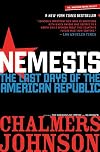
On This Page
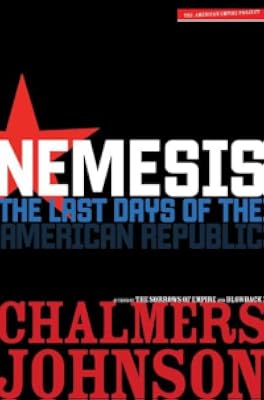
Description
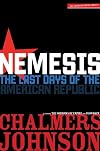
In Blowback, Chalmers Johnson linked the CIA's clandestine activities abroad to disaster at home. In The Sorrows of Empire, he explored the ways in which the growth of American militarism has jeopardized our stability. Now, in Nemesis, he shows how imperial overstretch is undermining the republic itself, both economically and politically. Delving into new areas--from plans to militarize outer space to Constitution-breaking presidential activities at home and the corruption of a toothless show more Congress--Nemesis offers a description of the trap into which the dreams of America's leaders have taken us. Drawing comparisons to empires past, Johnson explores just what the unintended consequences of our dependence on a permanent war economy are likely to be. What does it mean when the globe's sole "hyperpower," no longer capable of paying for the ambitions of its leaders, becomes the greatest hyper-debtor of all times?--From publisher description. show lessTags
Recommendations
























Member Reviews
If you want a book that deeply explores why America seems to be (I'm being hopeful) headed down the wrong river, this is it -- with discussions on the rise of militarism; a comparison of Rome, Britain & America; the sordid history of the CIA; the basing of soldiers anywhere on the globe America pleases; the drive to militarize outer space; and more. To really get the full impact of what Chalmers Johnson is saying (and warning us all about), you should read the whole trilogy: "The Sorrows of Empire", "Blowback", and then "Nemesis".And Nemesis is definitely the most appropriate metaphor to use for the continuing fall from grace that America is blindly and arrogantly treading: the Greek goddess of divine justice and retribution, it's in show more our (American citizens') best interest to use her as a mirror of ourselves. As Johnson says, "We are on the cusp of losing our democracy for the sake of keeping our empire [versus the opposite path as Britain took, for instance:]. Once a nation is started down that path, the dynamics that apply to all empires come into play -- isolation, overstretch, the uniting of forces opposed to imperialism, and bankruptcy. Nemesis stalks our life as a free nation."I especially like a quote by Harry Browne starting the last chapter... "When America is no longer a threat to the world, the world will no longer threaten us." No truer words could be said about the dire necessity for America to learn once again how to become a respected member of the world community rather than its bully and self-appointed master.America's path can be corrected, but we, her people, must become more aware, and then take action. Chalmers' "Nemesis" is a clarion call for us all to act, before it's too late.Originally written on May 12, 2008 at 04:49PM show less
Chalmers Johnson's third book about the pernicious influence of militarism on our country is excellent. I was a participant in or observer of many of the incidents Dr. Johnson discussed in his first book, "Blowback", and worked with him when I was the US Information Agency's Japan desk officer from mid-1985 through mid-1987. Dr. Johnson, a patriotic, Republican economist with extensive international experience, raises interesting questions about the extent to which "the military-industrial complex" has jeopardized our domestic political system and Constitution while damaging our long-term interests and standing abroad. He makes his points with readable prose and ample evidence. Reading this book while the news that our vice president show more considers himself exempt from all laws when it suits his ends made an interesting real world, real time illustration of Johnson's argument. show less
Like ancient Rome, America is saddled with an empire that is fatally undermining its republican government, argues Johnson (The Sorrows of Empire), in this bleak jeremiad. He surveys the trappings of empire: the brutal war of choice in Iraq and other foreign interventions going back decades; the militarization of space; the hundreds of overseas U.S. military bases full of "swaggering soldiers who brawl and sometimes rape." At home, the growth of an "imperial presidency," with the CIA as its "private army," has culminated in the Bush administration's resort to warrantless wiretaps, torture, a "gulag" of secret CIA prisons and an unconstitutional arrogation of "dictatorial" powers, while a corrupt Congress bows like the Roman Senate to show more Caesar. Retribution looms, the author warns, as the American economy, dependent on a bloated military-industrial complex and foreign borrowing, staggers toward bankruptcy, maybe a military coup. Johnson's is a biting, often effective indictment of some ugly and troubling features of America's foreign policy and domestic politics. But his doom-laden trope of empire ("the capacity for things to get worse is limitless.... the American republic may be coming to its end") seems overstated. With Bush a lame duck, not a Caesar, and his military adventures repudiated by the electorate, the Republic seems more robust than Johnson allows show less
Like ancient Rome, America is saddled with an empire that is fatally undermining its republican government, argues Johnson (The Sorrows of Empire), in this bleak jeremiad. He surveys the trappings of empire: the brutal war of choice in Iraq and other foreign interventions going back decades; the militarization of space; the hundreds of overseas U.S. military bases full of "swaggering soldiers who brawl and sometimes rape." At home, the growth of an "imperial presidency," with the CIA as its "private army," has culminated in the Bush administration's resort to warrantless wiretaps, torture, a "gulag" of secret CIA prisons and an unconstitutional arrogation of "dictatorial" powers, while a corrupt Congress bows like the Roman Senate to show more Caesar. Retribution looms, the author warns, as the American economy, dependent on a bloated military-industrial complex and foreign borrowing, staggers toward bankruptcy, maybe a military coup. Johnson's is a biting, often effective indictment of some ugly and troubling features of America's foreign policy and domestic politics. But his doom-laden trope of empire ("the capacity for things to get worse is limitless.... the American republic may be coming to its end") seems overstated. With Bush a lame duck, not a Caesar, and his military adventures repudiated by the electorate, the Republic seems more robust than Johnson allows show less
The best of the "Blowback" series. Johnson rehashes some of Blowback and Sorrows of Empire while adding more about the serious dysfunction and corruption that has deformed or constitutional government. Reading this along with American Theocracy was quite dispiriting. Even if we had a President and Congress devoted to righting this ship of state I think entrenched interests and a significant minority of the American people would pose to much of an inertial block.
It's all downhill from here.
It's all downhill from here.
I finished reading Chalmers Johnson’s Nemesis last night. It’s a very interesting book on the decline of American democracy and the rise of American imperialism. The book posits that America can keep its empire, or keep its democracy, but it can’t have both. Johnson does a great job of outlining the various things he feels have contributed to the decline of democracy in the US. The main gist of his argument is that increased militarism is incompatible with a health democracy. With respect to this, he discusses the creation of the CIA (essentially the presidents private army), the ever expanding network of US army bases globally, and the militarization of space and the inordinate amount of money spent on weapons research. Nemesis show more was quite interesting to read. You may want to check it out. I’m on to The Assault on Reason, which thus far looks to be Gore’s attempt to catalog and discuss the reasons why Americans are so dumb now, but apparently turns into a scathing attack on the Bush administration. Nice. -- http://funkaoshi.com/blog/nemesis show less
Chalmers Johnson is an amazing and erudite author. Reading any of his books is an education and a pleasure.
Members
- Recently Added By
Author Information

30+ Works 2,934 Members
Chalmers Johnson, president of the Japan Policy Research Institute & professor emeritus at the University of California, San Diego, has written numerous books on Japan & Asia including his classic "Miti & the Japanese Miracle" & "Japan: Who Governs?" He lives near San Diego. (Bowker Author Biography)
Awards and Honors
Series

Belongs to Publisher Series
Common Knowledge
- Canonical title
- Nemesis: The Last Days of the American Republic
- Original publication date
- 2006
Classifications
- Genres
- Nonfiction, History, General Nonfiction, Politics and Government
- DDC/MDS
- 973.931 — History & geography History of North America United States 1901- New Millennium, Post 9/11 (2001-Present) George W. Bush (2001-2009) Sept 11 Attacks, Iraq War, Patriot Act
- LCC
- E840 .J633 — History of the United States United States Later twentieth century, 1961-2000 Biography (General)
- BISAC
Statistics
- Members
- 495
- Popularity
- 60,915
- Reviews
- 10
- Rating
- (4.31)
- Languages
- English
- Media
- Paper, Audiobook, Ebook
- ISBNs
- 13
- ASINs
- 10