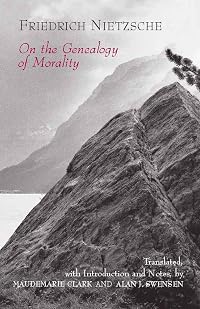
On the Genealogy of Morality
by Friedrich Nietzsche 
On This Page
Description
Written in response to a book on the origins of morality by his erstwhile friend Paul Rée, the three essays comprising The Genealogy of Morals - all three advancing the critique of Christian morality set forth in Beyond Good and Evil - are among Nietzsche's most sustained and cohesive work. In the first essay - starting from a linguistic analysis of words such as "good," "bad," and "evil" - Nietzsche sets up a contrast between what he calls "master" morality and "slave" morality and shows show more how strength and action have often been replaced by passivity and nihilism. The next essay, looking into the origins of guilt and punishment, shows how the concept of justice was born - and how internalization of this concept led to the development of what people called "the soul." In the third essay, Nietzsche dissects the meaning of ascetic ideals. It is not Nietzsche's intention to reject ascetic ideals, "slave" morality, or internalized values out of hand; his main concern is to show that culture and morality, rather than being eternal verities, are human-made. Whether or not you agree with all of his conclusions, his writing is of such clarity and brilliance that you will find reading The Genealogy of Morals nothing short of exhilarating. show lessTags
Recommendations





Member Recommendations

Member Reviews
Clásico Nietzsche, misógino, racista, cruel. Su repertorio habitual.
Por ejemplo, hablando de los cristianos:
No creo en lo que dice, demasiada filosofia he leido para que un autor en concreto me venga con dogmas. Pero hay que reconocer que estes de acuerdo o no con lo show more que dice, lo dice muy bien. Y por eso le doy buena puntuación. Argumentos bien hilados, lenguaje increíble, conceptos e insultos que nunca antes había escuchado. show less
Por ejemplo, hablando de los cristianos:
Among them, again, is that most loathsome species of the vain, the lying abortions, who make a point of representing "beautiful souls," and perchance of bringing to the market as "purity of heart" their distorted sensualism swathed in verses and other bandages;
the species of "self-comforters" and masturbators of their own souls. The sick man's will to represent some form or other of superiority, his instinct for crooked paths, which lead to a tyranny over the healthy.
No creo en lo que dice, demasiada filosofia he leido para que un autor en concreto me venga con dogmas. Pero hay que reconocer que estes de acuerdo o no con lo show more que dice, lo dice muy bien. Y por eso le doy buena puntuación. Argumentos bien hilados, lenguaje increíble, conceptos e insultos que nunca antes había escuchado. show less
Of all the books by or about Nietzsche, I think this particular edition of the Genealogy would be the best place for the novice to start. The introduction by Clark (a very well regraded Nietzsche scholar) is excellent and provides a workable framework for interpreting a text (and an author) that can often be difficult to decipher.
The scholarly apparatus is exhaustive; the editors provide end notes that cover nearly every page in the original text and help the reader to make sense of Nietzsche's sometimes unclear allusions and provide voluminous biographic and bibliographic detail covering both Nietzsche and the interlocutors he mentions in the text (as well as a few he merely alludes to).
As for the text itself, I think it is notable show more primarily for the genealogical analysis of the concepts of good/right-bad/wrong and for a glimpse of Nietzsche's "perspectivalist" epistemology in the third section.
These views have been highly influential (although not among philosophers as such) over the past century and anyone that wishes to understand the course and trajectory of 20th century thought should be aware of them. Nietzsche is a master stylist, so the reading is fun as well as thought provoking.
Of course, the central question, considering Nietzsche qua philosopher, is this: Does Nietzsche get thing right?
I think it's pretty clear that the answer is "no". Although his castigation of scientific atheism as an extension (perhaps the highest extension) of religious asceticism shows depth and brilliance, he doesn't ever give us any solid arguments for thinking that truth itself hinges on particular standards of evaluation. Nietzsche seems to me to be skeptical of the idea of truth as correspondence (the standard view) because it situates truth outside of life. It makes truth something that transcends individual human beings. Perhaps this is true, and given Nietzsche's rejection of any and all transcendent things it makes sense that he'd want to reject truth conceived of in this way. What isn't clear is that he CAN do this, that is, that his view is warranted. The fact that the correspondence of theory of truth has implications that Nietzsche finds repulsive is no reason for thinking that it's false.
Furthermore, without some notion of truth as correspondence, it's not clear that his earlier critique of moral concepts has any real bite. show less
The scholarly apparatus is exhaustive; the editors provide end notes that cover nearly every page in the original text and help the reader to make sense of Nietzsche's sometimes unclear allusions and provide voluminous biographic and bibliographic detail covering both Nietzsche and the interlocutors he mentions in the text (as well as a few he merely alludes to).
As for the text itself, I think it is notable show more primarily for the genealogical analysis of the concepts of good/right-bad/wrong and for a glimpse of Nietzsche's "perspectivalist" epistemology in the third section.
These views have been highly influential (although not among philosophers as such) over the past century and anyone that wishes to understand the course and trajectory of 20th century thought should be aware of them. Nietzsche is a master stylist, so the reading is fun as well as thought provoking.
Of course, the central question, considering Nietzsche qua philosopher, is this: Does Nietzsche get thing right?
I think it's pretty clear that the answer is "no". Although his castigation of scientific atheism as an extension (perhaps the highest extension) of religious asceticism shows depth and brilliance, he doesn't ever give us any solid arguments for thinking that truth itself hinges on particular standards of evaluation. Nietzsche seems to me to be skeptical of the idea of truth as correspondence (the standard view) because it situates truth outside of life. It makes truth something that transcends individual human beings. Perhaps this is true, and given Nietzsche's rejection of any and all transcendent things it makes sense that he'd want to reject truth conceived of in this way. What isn't clear is that he CAN do this, that is, that his view is warranted. The fact that the correspondence of theory of truth has implications that Nietzsche finds repulsive is no reason for thinking that it's false.
Furthermore, without some notion of truth as correspondence, it's not clear that his earlier critique of moral concepts has any real bite. show less
The word ought has its origins in the word owe. Whether or not this relationship survives translation I don't know, but why let semantics get in the way of a good idea. Reading Beyond Good and Evil before attempting this follow-up work would be the more logical option. But I doubt one can simply dip one's toe in to Nietzsche anyway - it is a case of diving in head first and trying to make sense of the turmoil. Nietzsche's racism reflects the tone of the times, and there is plenty of conflicting views to support the argument that his sister re-construed his work to fit comfortably with the Nazis. But in the end I felt Nietzsche's racism was as relevant to Nazism as Jack London's. It is interesting that he seems to support women's rights show more (remembering that J.S. Mill's On the Subjection of Women was published 18 years before), planes the edges off his Orientalism with Buddhism and Brahmanism, and doesn't appear so overjoyed at the "death of God" as Atheist's gleefully point out. Indeed, Nietzsche makes a point of saying that science is a more advanced form of the "ascetic ideal". The back cover of the work sums up Nietzsche's thesis as "culture and morality, rather than being eternal verities, are human-made". This is an oversimplification that reduces the depth of his work. Far be it for me to be an apologist for Nietzsche - the "intellectual" gatekeepers would never let such work be published today - but the brilliance is in its originality. To comprehend the thesis adequately, prior reading of Buddhism, Luther, Brahmanism, Kant, Spinoza, Goethe, Feuerbach, and Schopenhauer would be helpful but is not essential. However, a knowledge of the classics (at least Plato) is important. Nietzsche final words are that "man will wish Nothingness rather than not wish at all". I immediately thought of the maxim "if you fail to plan, you plan to fail". Probably the most useful idea from this work is that one needs to go back to first principles in establishing a philosophy - does or can truth exist? - (and even if we don't care to consciously develop a philosophy, the shepherds of the "herd mentality" will provide one for us without our knowledge or consent), and Nietzsche does so by regularly referring back to "Heracleitus" and Hesiod. I have already picked up the scent of the pre-Socratics and their importance in understanding the human-created chasm between philosophy and religion (and more recently, but less convincingly, between science and religion), and Nietzsche confirms this clue. Rather than the über-power of pre-Enlightenment Christian church and its priesthood driving the herd, Nietzsche foresaw ("forsooth"?) the pluralism of modern asceticism (which annoys me on Facebook, Twitter, and the news media any time I look). Admittedly, he was optimistic about this future, but then he didn't know what "the Internet" would say about him (how I loathe that saying!). So why don't I see the ascetic for what it is and just get off Facebook once again? Well. it's the guilt, you see. But you can't blame me - I didn't create it (Facebook or the guilt). show less
Clásico Nietzsche, misógino, racista, cruel. Su repertorio habitual.
Por ejemplo, hablando de los cristianos:
No creo en lo que dice, demasiada filosofia he leido para que un autor en concreto me venga con dogmas. Pero hay que reconocer que estes de acuerdo o no con lo show more que dice, lo dice muy bien. Y por eso le doy buena puntuación. Argumentos bien hilados, lenguaje increíble, conceptos e insultos que nunca antes había escuchado. show less
Por ejemplo, hablando de los cristianos:
Among them, again, is that most loathsome species of the vain, the lying abortions, who make a point of representing "beautiful souls," and perchance of bringing to the market as "purity of heart" their distorted sensualism swathed in verses and other bandages;
the species of "self-comforters" and masturbators of their own souls. The sick man's will to represent some form or other of superiority, his instinct for crooked paths, which lead to a tyranny over the healthy.
No creo en lo que dice, demasiada filosofia he leido para que un autor en concreto me venga con dogmas. Pero hay que reconocer que estes de acuerdo o no con lo show more que dice, lo dice muy bien. Y por eso le doy buena puntuación. Argumentos bien hilados, lenguaje increíble, conceptos e insultos que nunca antes había escuchado. show less
Divided into 3 essays. The first is reasonably clear but pretty objectionable and not too well argued, the second is a little less clear but a lot more interesting and more convincing, the third is the longest and meandering, not cohesive, sometimes contradictory and generally confusing. If it was just the first two or with a much edited third I'd probably consider it a 3 star thing. The first essay seems to be focused around a claim that the weak and downtrodden almost forced Christian ideas along the lines of "the meek will inherit the earth" onto the strong, ruining their more noble morality - this is bizarre in the sense that there's no reason to assume this, especially compared to the opposite. He refers to this negative morality show more as "Jewish" which is gross - he regularly talks about each "race" or "people" as a whole, as if the poor can poison a huge race of people, and his ideas about health in this sense are complete racist nonsense. The third essay is devoted to the "ascetic ideal", which he defines and then seemingly blames for all the world's evil, attributing things to it which make no sense and don't fit with his definition. In general I found that his ideas didn't fit together or make a coherent set - he often contradicts himself in short asides and seems to be addressing himself to things I don't really get.
On the plus side it's written pretty well - even when it doesn't form a coherent whole, his use of language means you can be pretty clear on what each sentence is saying without needing to read it many times over. He has quite a lot of interesting ideas, but scattered as they are, they're not really pleasant to try and extract from the rest of the text. I am absolutely sure my reading of the text was poor and I realise my review is gonna sound ignorant. I realise his importance and that a lot of people hold this in high regard and I'm sure if I read better and had more grounding in his other texts I'd get more out of it. Take this as one beginner at philosophy's attempt to understand and problems doing so.
Also dude really needs to learn about a lil thing called MATERIAL CONDITIONS show less
On the plus side it's written pretty well - even when it doesn't form a coherent whole, his use of language means you can be pretty clear on what each sentence is saying without needing to read it many times over. He has quite a lot of interesting ideas, but scattered as they are, they're not really pleasant to try and extract from the rest of the text. I am absolutely sure my reading of the text was poor and I realise my review is gonna sound ignorant. I realise his importance and that a lot of people hold this in high regard and I'm sure if I read better and had more grounding in his other texts I'd get more out of it. Take this as one beginner at philosophy's attempt to understand and problems doing so.
Also dude really needs to learn about a lil thing called MATERIAL CONDITIONS show less
Hi han llibres que et poden "canviar" la vida, aquest és un d'ells perque, llegit amb certa actitut, sotmet a qüestió conviccions i els seus fonaments. Obra imprescindible al pensament del Nietzsche i la Filosofia occidental.
"What clues does the study of language, in particular etymological research, provide for the history of the development of moral concepts?"
Such a great project - to historicise what other philosophers (even now) try to make ahistorical. Too bad Nietzsche himself cannot escape historicisation. Like all the race stuff. Yikes.
Such a great project - to historicise what other philosophers (even now) try to make ahistorical. Too bad Nietzsche himself cannot escape historicisation. Like all the race stuff. Yikes.
Members
- Recently Added By
Lists

Ten books that most shaped your view of history
91 works; 12 members

Top Five Books of 2020
982 works; 348 members

Jordan B. Peterson's Recommended Books
104 works; 5 members

Filosofía - Clásicos
217 works; 1 member

German Literature
518 works; 56 members

Blue Pyramid 1,276 Best Books of All Time
1,248 works; 32 members

Harold Bloom - The Western Canon: C. The Democratic Age
336 works; 15 members

How to Read a Book's Recommended Reading List
309 works; 10 members

Greatest Books, allegedly
484 works; 9 members

Books Referenced by Izetbegovic's Islam Between East and West
233 works; 2 members

Philosophy, Politics and Economics
61 works; 1 member

el
1,139 works; 1 member

In Our Time books
4,934 works; 2 members
Author Information

1,399+ Works 78,600 Members
The son of a Lutheran pastor, Friedrich Wilhelm Nietzsche was born in 1844 in Roecken, Prussia, and studied classical philology at the Universities of Bonn and Leipzig. While at Leipzig he read the works of Schopenhauer, which greatly impressed him. He also became a disciple of the composer Richard Wagner. At the very early age of 25, Nietzsche show more was appointed professor at the University of Basel in Switzerland. In 1870, during the Franco-Prussian War, Nietzsche served in the medical corps of the Prussian army. While treating soldiers he contracted diphtheria and dysentery; he was never physically healthy afterward. Nietzsche's first book, The Birth of Tragedy Out of the Spirit of Music (1872), was a radical reinterpretation of Greek art and culture from a Schopenhaurian and Wagnerian standpoint. By 1874 Nietzsche had to retire from his university post for reasons of health. He was diagnosed at this time with a serious nervous disorder. He lived the next 15 years on his small university pension, dividing his time between Italy and Switzerland and writing constantly. He is best known for the works he produced after 1880, especially The Gay Science (1882), Thus Spake Zarathustra (1883-85), Beyond Good and Evil (1886), On the Genealogy of Morals (1887), The Antichrist (1888), and Twilight of the Idols (1888). In January 1889, Nietzsche suffered a sudden mental collapse; he lived the last 10 years of his life in a condition of insanity. After his death, his sister published many of his papers under the title The Will to Power. Nietzsche was a radical questioner who often wrote polemically with deliberate obscurity, intending to perplex, shock, and offend his readers. He attacked the entire metaphysical tradition in Western philosophy, especially Christianity and Christian morality, which he thought had reached its final and most decadent form in modern scientific humanism, with its ideals of liberalism and democracy. It has become increasingly clear that his writings are among the deepest and most prescient sources we have for acquiring a philosophical understanding of the roots of 20th-century culture. (Bowker Author Biography) show less
Friedrich Nietzsche has a Legacy Library. Legacy libraries are the personal libraries of famous readers, entered by LibraryThing members from the Legacy Libraries group.
Some Editions
Awards and Honors
Notable Lists
Series
Belongs to Publisher Series
Work Relationships
Is contained in
The Philosophy of Nietzsche: Thus Spake Zarathustra; Beyond Good and Evil; The Genealogy of Morals; Ecce Homo; The Birth of Tragedy by Friedrich Nietzsche
Werke in drei Bänden, Bd.3, Jenseits von Gut und Böse und andere Schriften. by Friedrich Nietzsche (indirect)
Schlüsselwerke der Philosophie : die philosophische Basisbibliothek ; mehr als 20.000 Seiten! ; Logik, Ethik, Erkenntni by Mathias Bertram (indirect)
All Too Human/Beyond Good & Evil (Wordsworth Classics of World Literature) by Friedrich Wilhelm Nietzsche (indirect)
Beyond Good and Evil / Daybreak: Thoughts on the Prejudices of Morality by Friedrich Nietzsche (indirect)
Beyond Good and Evil / Ecce Homo: How One Becomes What One Is by Friedrich Wilhelm Nietzsche (indirect)
Friedrich Nietzsche: Sämtliche Werke (Kommentiert) mit verlinktem Inhaltsverzeichnis by Friedrich Nietzsche
Has as a study
Has as a student's study guide
Common Knowledge
- Canonical title*
- Over de genealogie van de moraal
- Original title
- Zur Genealogie der Moral: Eine Streitschrift
- Alternate titles*
- Genealogie der moraal (rug- en omslagtitel) (rug- en omslagtitel)
- Original publication date
- 1887-11
- First words
- Preface: Genealogy
We are unknown to ourselves, we men of knowledge—and with good reason. We have never sought ourselves—how could it happen that we should ever find ourselves?
On the Genealogy of Morals
These English psychologists, whom one has also to thank for the only attempts hitherto to arrive at a history of the origin of morality—they themselves are no easy riddle; I confess that, a... (show all)s living riddles, they even possess one essential advantage over their books—they are interesting! - Blurbers
- Leiter, Brian; Westphall, Kenneth R.
- Original language
- German
*Some information comes from Common Knowledge in other languages. Click "Edit" for more information.
Classifications
Statistics
- Members
- 3,805
- Popularity
- 4,193
- Reviews
- 31
- Rating
- (4.05)
- Languages
- 24 — Catalan, Chinese, Czech, Danish, Dutch, English, Estonian, Finnish, French, German, Greek, Hungarian, Italian, Japanese, Latvian, Norwegian (Bokmål), Norwegian, Polish, Portuguese, Romanian, Russian, Spanish, Swedish, Turkish
- Media
- Paper, Audiobook, Ebook
- ISBNs
- 177
- UPCs
- 1
- ASINs
- 54