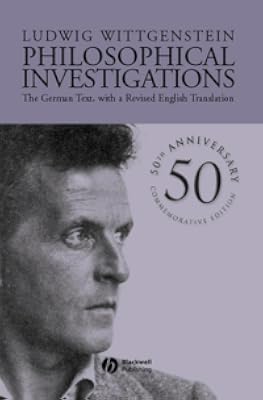
Philosophical Investigations
by Ludwig Wittgenstein
On This Page
Description
Philosophical Investigations - a landmark in 20th century philosophy - was published in 1953, two years after the death of its author. In the preface written in Cambridge in 1945 where he was professor of philosophy he states: 'Four years ago I had occasion to re-read my first book (the Tractatus Logico-Philosophicus) and to explain its ideas to someone. It suddenly seemed to me that I should publish those old thoughts and the new ones together: that the latter could be seen in the right show more light only by contrast with and against the background of my old way of thinking.' Philosophical Investigations was the result. It explores the concept of meaning, of understanding, of propositions, of logic, of states of consciousness and of many other topics. The fundamental ideas of the Tractatus are both expounded and criticised. This is the text of the third edition. show lessTags
Recommendations





Member Reviews
It's more than a little presumptuous to attempt a short review of Wittgenstein's Philosophical Investigations. After all, it's one of the few most important philosophical works of the twentieth century. This edition is sorely awaited by some, after years of close examination and criticism of the Anscombe translation.
First, the geeky stuff on the translation and editing. Like the Anscombe translation, this one with Hacker and Schulte joining their efforts to Anscombe's, presents the original German and the English translation on facing pages. As a reader with a spotty knowledge of German, this gives me the opportunity to refer to the original where the English seems obscure, ambiguous, or just plain impenetrable. If you're a student of show more Wittgenstein, Hacker and Schulte have helpfully addressed numerous, controversial aspects of Anscombe's translation -- many of these, such as the difficulty with the German "Satz" (translated relative to context by "sentence" or "proposition", two very different English words) and "Seele" ("soul" sometimes but "mind" others by context in English), are discussed in their Preface.
If you are a quasi-casual reader, many of these points of translation are probably less important than overall readability. And I think Hacker and Schulte have improved readability, updating the feel of Wittgenstein's writing, which is often colloquial, to something more modern.
They've also added over 20 pages of sometimes helpful footnotes, where additional information about the translation or about Wittgenstein's thoughts are enlightening. And they've recast "Part II" of the Investigations itself as "Philosophy of Psychology -- A Fragment" -- their reasoning for that is given in their Preface.
Like most great philosophical texts, no matter how many times I read the Investigations, it's different each time, and I feel foolish for having understood so little the previous time. The new translation offers a great excuse to give it another read.
There are many themes to pick up, including the great variety of linguistic behavior (as contrasted with naive views of language as representing or naming, or with Wittgenstein's own view in the Tractatus), the illusions of distinctive mental activities (such as "meaning" a word while uttering it, or translating the inner to the outer or public), and the general theme of philosophical problems arising when "language goes on holiday".
It's the last that continues to grab my attention, persistently through readings, with different remarks jumping out of the text each time. The simple view is that Wittgenstein thinks ordinary language (what we all say and do in practical contexts every day) is fine as it is, but that it's when we detach ordinary language from those practical contexts that we get in trouble. We fall into perplexing philosophical quandaries, supposing ourselves to really wonder whether the external world or other minds exist, or whether objects are material or ideal.
But philosophical exercises of language are exercises of language, after all. It's not as though we can simply say, "Don't do that" when philosophers speak, and point out that they've left the "ordinary" behind. It's not a simple mistake, and the line between the "ordinary" and the "philosophical" is crossed sometimes without special notice. And it's not even the exclusive province of professional philosophers (amateurs seem even more impressed than the professionals sometimes by their own metaphysical musings).
Certainly, there is more to say about the mistake that philosophers, amateur and professional, make. In particular, there is Wittgenstein's distinction between empirical remarks (remarks about facts in the world) and grammatical remarks (by contrast, remarks about how we speak or are to speak about those facts in the world). The philosopher mistakes the one for the other, thinking that, for example, by adopting what we call an idealist grammatical position (when we talk of objects in the world, we are really talking of mental or ideal objects) we have really discovered something about the objects and not just made a statement about how we should speak of them. Much more to say on this, of course -- which is why a short review is so presumptuous. In fact, it's Wittgenstein's thoughts on why we fall victim to such a misunderstanding that I puzzle most about. show less
First, the geeky stuff on the translation and editing. Like the Anscombe translation, this one with Hacker and Schulte joining their efforts to Anscombe's, presents the original German and the English translation on facing pages. As a reader with a spotty knowledge of German, this gives me the opportunity to refer to the original where the English seems obscure, ambiguous, or just plain impenetrable. If you're a student of show more Wittgenstein, Hacker and Schulte have helpfully addressed numerous, controversial aspects of Anscombe's translation -- many of these, such as the difficulty with the German "Satz" (translated relative to context by "sentence" or "proposition", two very different English words) and "Seele" ("soul" sometimes but "mind" others by context in English), are discussed in their Preface.
If you are a quasi-casual reader, many of these points of translation are probably less important than overall readability. And I think Hacker and Schulte have improved readability, updating the feel of Wittgenstein's writing, which is often colloquial, to something more modern.
They've also added over 20 pages of sometimes helpful footnotes, where additional information about the translation or about Wittgenstein's thoughts are enlightening. And they've recast "Part II" of the Investigations itself as "Philosophy of Psychology -- A Fragment" -- their reasoning for that is given in their Preface.
Like most great philosophical texts, no matter how many times I read the Investigations, it's different each time, and I feel foolish for having understood so little the previous time. The new translation offers a great excuse to give it another read.
There are many themes to pick up, including the great variety of linguistic behavior (as contrasted with naive views of language as representing or naming, or with Wittgenstein's own view in the Tractatus), the illusions of distinctive mental activities (such as "meaning" a word while uttering it, or translating the inner to the outer or public), and the general theme of philosophical problems arising when "language goes on holiday".
It's the last that continues to grab my attention, persistently through readings, with different remarks jumping out of the text each time. The simple view is that Wittgenstein thinks ordinary language (what we all say and do in practical contexts every day) is fine as it is, but that it's when we detach ordinary language from those practical contexts that we get in trouble. We fall into perplexing philosophical quandaries, supposing ourselves to really wonder whether the external world or other minds exist, or whether objects are material or ideal.
But philosophical exercises of language are exercises of language, after all. It's not as though we can simply say, "Don't do that" when philosophers speak, and point out that they've left the "ordinary" behind. It's not a simple mistake, and the line between the "ordinary" and the "philosophical" is crossed sometimes without special notice. And it's not even the exclusive province of professional philosophers (amateurs seem even more impressed than the professionals sometimes by their own metaphysical musings).
Certainly, there is more to say about the mistake that philosophers, amateur and professional, make. In particular, there is Wittgenstein's distinction between empirical remarks (remarks about facts in the world) and grammatical remarks (by contrast, remarks about how we speak or are to speak about those facts in the world). The philosopher mistakes the one for the other, thinking that, for example, by adopting what we call an idealist grammatical position (when we talk of objects in the world, we are really talking of mental or ideal objects) we have really discovered something about the objects and not just made a statement about how we should speak of them. Much more to say on this, of course -- which is why a short review is so presumptuous. In fact, it's Wittgenstein's thoughts on why we fall victim to such a misunderstanding that I puzzle most about. show less
“Language is a labyrinth of paths. You approach from one side and know your way about; you approach the same place from another side and no longer know your way about” (203).
Although this book is considered illustrative of the “late Wittgenstein,” in contrast to the “early Wittgenstein” of the Tractatus, I see a persistent concern with the use of language as a medium through which one acquires and understanding of the world. Whereas in the Tractatus it seems that Wittgenstein detailed the limits of language to express pictorial truths about the world, in Philosophical Investigations I see him talking about the potential of language to mean a great many things but that the truth conditions for meaning are there, to be show more established by the rules of use, expectation, and intention that we recognize as parts of common and specialized language-games. A critique of the premise of analytic logic is still here but without the frustration and futility. Instead, I see Wittgenstein embracing a kind of pragmatic sense of truth.
Although saying that we engage in language-games does suggest the possibility of back-sliding into a kind of relativistic “it’s all just language” view of reality, I find it more productive to think of Wittgenstein saying that language-games are reflecting a reality that is present regardless of our belief in it. Language guides our interactions with the world and with each other, allowing the expression and fulfillment of our intentions within the conditions of satisfaction that the world allows. The language is not a reflection of that reality but an instrument for dealing with it (141). And the more we try to isolate language and study it in isolation for use, the more confusing it becomes and with that also comes greater risk of deluding ourselves into thinking that we can reach a true understanding of reality through a study of language. “The confusions which occupy us arise when language is like an engine idling, not when it is doing work” (132).
The notion of language-games, situated uses of language, and the guiding functions of language are valuable concepts that we would do well to remember in an age when we can now use generative AI to mimic functional and transactional language use. Just think about how vacant AI-generated arguments are of either actual intention or motive. Or rather think of what remixed intention and motive is captured in the LLMs from which AI outputs are derived. Does AI really know what language-game it’s playing when it generates its content? Does that matter?
I do think that W’s use of numbers and number series sometimes confuses the point that language-games are interactive and that clarity and the ability to go on is worked out in the moment and with the guidance of other players. This interactivity is certainly implied in the treatment of language but it is often not apparent through the examples given. show less
Although this book is considered illustrative of the “late Wittgenstein,” in contrast to the “early Wittgenstein” of the Tractatus, I see a persistent concern with the use of language as a medium through which one acquires and understanding of the world. Whereas in the Tractatus it seems that Wittgenstein detailed the limits of language to express pictorial truths about the world, in Philosophical Investigations I see him talking about the potential of language to mean a great many things but that the truth conditions for meaning are there, to be show more established by the rules of use, expectation, and intention that we recognize as parts of common and specialized language-games. A critique of the premise of analytic logic is still here but without the frustration and futility. Instead, I see Wittgenstein embracing a kind of pragmatic sense of truth.
Although saying that we engage in language-games does suggest the possibility of back-sliding into a kind of relativistic “it’s all just language” view of reality, I find it more productive to think of Wittgenstein saying that language-games are reflecting a reality that is present regardless of our belief in it. Language guides our interactions with the world and with each other, allowing the expression and fulfillment of our intentions within the conditions of satisfaction that the world allows. The language is not a reflection of that reality but an instrument for dealing with it (141). And the more we try to isolate language and study it in isolation for use, the more confusing it becomes and with that also comes greater risk of deluding ourselves into thinking that we can reach a true understanding of reality through a study of language. “The confusions which occupy us arise when language is like an engine idling, not when it is doing work” (132).
The notion of language-games, situated uses of language, and the guiding functions of language are valuable concepts that we would do well to remember in an age when we can now use generative AI to mimic functional and transactional language use. Just think about how vacant AI-generated arguments are of either actual intention or motive. Or rather think of what remixed intention and motive is captured in the LLMs from which AI outputs are derived. Does AI really know what language-game it’s playing when it generates its content? Does that matter?
I do think that W’s use of numbers and number series sometimes confuses the point that language-games are interactive and that clarity and the ability to go on is worked out in the moment and with the guidance of other players. This interactivity is certainly implied in the treatment of language but it is often not apparent through the examples given. show less
This is one of the books I read again and again. I never grow tired of the brilliant analysis of the potentials and the limitations of any language. His arguments seem to apply equally well to human languages, to animal languages and to robot languages. I like his way of debunking most of the traditional philosophic lingo while discussing the central issues of philosophy. He demonstrates the superiority of the simple words over the convoluted crap most academics seem to love. Seeing the force of the simple words is totally exhilirating. Another great thing about the treatise is the insight that language is something evolution has given us as a bunch of tools crafted to help us out in different situations. That means language is not a show more consistent logical system. It is fragmented, and its various bits and pieces are governed by different logics. Even if this insight seems rather obvious it is a surprisingly efficient tool to eliminate a whole lot of paradoxes and dilemmas that are simply the effect of us using the logic of one compartment of language in another compartment where it does not apply. Refreshing as an early morning in March. show less
I found this book powerful when I first read it because I had just read the Tractatus and the contrast was challenged my mind. You enter into a philosophy where outside of human thought and speech there are no independent, objective points of support. Meaning and necessity are preserved only by the linguistic practices which embody them. This then is a world that seems not unlike the skeptical realms of those from at least Descartes onward that allow for no objective reality independent of one's mind.
For Wittgenstein it is not quite so simple as that, as he continually asks questions and in doing so creates a philosophy of process much more akin to that of Socrates than Descartes, Kant or any other modern - particularly the camp of the show more logical positivists where he once dwelt.
His questions center on words and language so we find ourselves asking: is language a real thing? Is there any knowledge of things as they are independent of our language? How can we look at knowing as understanding the nature of things? In this sense there are things (objects) in the world and we can develop an understanding of their nature. This will not necessarily be certain knowledge, but knowledge of a sort nonetheless. "For them after all it is not nonsense" to say that "there are physical objects." (37)
It would seem that statements are only meaningful if they ask questions - Wittgenstein would ask - but there are other points of view out there. show less
For Wittgenstein it is not quite so simple as that, as he continually asks questions and in doing so creates a philosophy of process much more akin to that of Socrates than Descartes, Kant or any other modern - particularly the camp of the show more logical positivists where he once dwelt.
His questions center on words and language so we find ourselves asking: is language a real thing? Is there any knowledge of things as they are independent of our language? How can we look at knowing as understanding the nature of things? In this sense there are things (objects) in the world and we can develop an understanding of their nature. This will not necessarily be certain knowledge, but knowledge of a sort nonetheless. "For them after all it is not nonsense" to say that "there are physical objects." (37)
It would seem that statements are only meaningful if they ask questions - Wittgenstein would ask - but there are other points of view out there. show less
With Wittgenstein there is a concern with the actual use of language – what is the problem and how we can illuminate/imagine a method for going forward. It is among other things a process. Observation precedes explanation and may yield only a description of the reality of a particular situation. (109) That means we should try to understand that Wittgenstein's own philosophical activity is like bringing words back to regular use (out/above/below the realm of “metaphysics”).
What is the process of trying to understand what it means to know something? Is there any conflict within a language game? There may be infinite variations in our everyday experiences; if so, how can we reach a resolution or should we seek that as a useful show more goal?
We should consider the use of comparison and noticing similarities. Sometimes that may bring insight. However the text often provides an invitation to enter into a dialog about the meaning of life and how one might understand the proper end of one's life. (language and dialog)
I am reminded of “the search” --- “What is the nature of the search . . . The search is what anyone would undertake if he were not sunk in the everydayness of his own life.” - Walker Percy
That is we are not looking for philosophical statements but the reality of what is here in everyday language. One wonders if this is a method for escaping the “everydayness” of life and the seeming incongruity of such a process? (117) One key for escaping the everydayness of life is recognizing the situation of a “fish out of water” and thinking in a way that you may become just that.
Our imagination may be a tool that allows recognition of just such a situation. (129) I personally am intrigued by the effect on my imagination of listening to music – different effects result from different types of music (Liszt or Ligeti). Whatever the means you may choose it is important to realize that language can do many things if we only look at the way we use words. We should aim to see clearly if possible. (Observation) show less
What is the process of trying to understand what it means to know something? Is there any conflict within a language game? There may be infinite variations in our everyday experiences; if so, how can we reach a resolution or should we seek that as a useful show more goal?
We should consider the use of comparison and noticing similarities. Sometimes that may bring insight. However the text often provides an invitation to enter into a dialog about the meaning of life and how one might understand the proper end of one's life. (language and dialog)
I am reminded of “the search” --- “What is the nature of the search . . . The search is what anyone would undertake if he were not sunk in the everydayness of his own life.” - Walker Percy
That is we are not looking for philosophical statements but the reality of what is here in everyday language. One wonders if this is a method for escaping the “everydayness” of life and the seeming incongruity of such a process? (117) One key for escaping the everydayness of life is recognizing the situation of a “fish out of water” and thinking in a way that you may become just that.
Our imagination may be a tool that allows recognition of just such a situation. (129) I personally am intrigued by the effect on my imagination of listening to music – different effects result from different types of music (Liszt or Ligeti). Whatever the means you may choose it is important to realize that language can do many things if we only look at the way we use words. We should aim to see clearly if possible. (Observation) show less
I get the impression that philosophy is no longer offered in most UK universities, especially philosophy of this calibre. Having studied philosophy to first degree level back in the 1960's, I think the overwhelming thing about Wittgenstein, apart from the general difficulty of coming to terms with what he was attempting to do, is his single-minded quest for clarity. In this book he takes this to the extreme by rejecting his own first philosophical writings (The Tractatus...) and putting this work in its place. Not many people would have the courage to do such a thing. I think his name will live on.
Although less dominant now than when I was a student, Ludwig Wittgenstein's thoughts from the "Tractatus" to the "Untersuchungen" influence all my philosophical thinking. As a student I could only afford the English translation of the 2nd edn and it is now a much worn volume, and I was delighted to buy this new 3rd edition. Even 'though it represents the second revision of Elizabeth Anscombe's thoughts on the German text, it is good to be able to compare her version with the original German.
It is a book that can be read in three ways. Sometimes I will read it from cover to cover. Other times one can read just a group of sections on a specific topic, say the rules for use being the meaning of a word. Lastly I can light my pipe, sit by show more the fire and read a few sections at random - it always generates new ideas. In this it has an unexpected affinity with a volume of poems.
Wittgenstein is not everybody's cup of tea, but he is mine, and if one is open-minded, this work, along with the Tractatus and the Remarks on Mathematics, has something to offer to all.
By the way, although LibraryThing classifies this work as German philodophy, Wittgenstein, like several Logical Positivists, was an Austrian. show less
It is a book that can be read in three ways. Sometimes I will read it from cover to cover. Other times one can read just a group of sections on a specific topic, say the rules for use being the meaning of a word. Lastly I can light my pipe, sit by show more the fire and read a few sections at random - it always generates new ideas. In this it has an unexpected affinity with a volume of poems.
Wittgenstein is not everybody's cup of tea, but he is mine, and if one is open-minded, this work, along with the Tractatus and the Remarks on Mathematics, has something to offer to all.
By the way, although LibraryThing classifies this work as German philodophy, Wittgenstein, like several Logical Positivists, was an Austrian. show less
Members
- Recently Added By
Published Reviews
Ludwig Wittgensteins Filosofiske undersøkelser er et av de mest banebrytende filosofiske verk fra det tjuende århundre. Hans bidrag til den analytiske og lingvistiske filosofien er uten sidestykke. Man tar neppe munnen for full ved å påstå at nærmest all moderne filosofi forholder seg til Wittgensteins arbeider - selv om ikke alle er seg påvirkningen like bevisst. Denne show more litterær-filosofiske perlen vil garantert få leseren til å se på språkets sammenheng med nye øyne.
"Filosofiens resultater består i avsløringen av et og annet eksempel på regulær nonsens og av de kulene som forstanden har skaffet seg ved å renne hodet mot språkets grense. På kulene kan vi avlese avsløringens verdi."
Fra Filosofiske undersøkelser
Filosofiske undersøkelser ble utgitt posthumt i 1953, og består hovedsakelig av tekster Wittgenstein skrev i perioden 1936-49. Tekstene representerer et radikalt brudd med hans tidlige verk, Tractatus Logico-Philosophicus, både på stil- og innholdsplanet. Mens han i Tractatus var ute etter å bevise, er han nå opptatt av å beskrive.
Gjennom en rekke løsrevne tekstbrokker bruker Wittgenstein metaforer og analogier i sitt forsøk på å vise hvordan språket virker i praksis. Disse undersøkelsene gir den filosofiske teksten et særegent, underlig og fremfor alt litterært preg. Derfor skiller verket seg også ut fra mer typiske filosofiske verker, som ofte rommer mye dogmatisme mellom permene. Filosofi, hevder Wittgenstein, er ikke annet enn et forsøk på å løse problemer som oppstår som et resultat av ordenes uklare mening. Nøkkelen til å løse disse problemene ligger i språkanalysen, og i en riktig bruk av språket. Wittgenstein lanserer begrepene "språkspill" og "regelfølging" for å beskrive noen av de tankemønstrene han forfekter i Filosofiske undersøkelser. "Et ords mening er dets anvendelse i språkspillet", er en setning som konkretiserer Wittgensteins filosofi.
Ludwig Josef Johann Wittgenstein (1889-1951) var en karismatisk og gåtefull person, og han er like myteomspunnet i dag som han var da han levde. Han ble født inn i en stor og holden familie i Wien som den yngste av åtte søsken, og fikk en kulturelt stimulerende oppvekst. Wittgenstein studerte først mekanikk i Berlin, noe som førte til en interesse for matematikk, og siden filosofi. Matematikeren og filosofen Gottlob Frege anbefalte den unge Wittgenstein å studere i Cambridge, hvor Bertrand Russell foreleste. Etter hvert konsentrerte han seg om logikk, og i 1922 ble det første av hans to hovedverk publisert med hjelp fra Russell; nemlig Tractatus.
Etter utgivelsen bestemte Wittgenstein seg for ikke å beskjeftige seg mer med filosofi. Han reiste tilbake til Østerrike, hvor han ble lærer i grunnskolen. I 1929 dro han imidlertid tilbake til Cambridge for å forelese ved Trinity College, og for å gjenoppta sitt virke som filosof. Der var han professor i filosofi fra 1939 til 1947, da han trakk seg fra stillingen for å konsentrere seg om å skrive. Innen 1949 hadde han skrevet det som senere ble til Filosofiske undersøkelser, hans andre hovedverk. De siste to årene av sitt liv tilbrakte han i henholdsvis Wien, Oxford og Cambridge, hvor han fortsatte å skrive inntil han døde av prostatakreft i 1951. show less
"Filosofiens resultater består i avsløringen av et og annet eksempel på regulær nonsens og av de kulene som forstanden har skaffet seg ved å renne hodet mot språkets grense. På kulene kan vi avlese avsløringens verdi."
Fra Filosofiske undersøkelser
Filosofiske undersøkelser ble utgitt posthumt i 1953, og består hovedsakelig av tekster Wittgenstein skrev i perioden 1936-49. Tekstene representerer et radikalt brudd med hans tidlige verk, Tractatus Logico-Philosophicus, både på stil- og innholdsplanet. Mens han i Tractatus var ute etter å bevise, er han nå opptatt av å beskrive.
Gjennom en rekke løsrevne tekstbrokker bruker Wittgenstein metaforer og analogier i sitt forsøk på å vise hvordan språket virker i praksis. Disse undersøkelsene gir den filosofiske teksten et særegent, underlig og fremfor alt litterært preg. Derfor skiller verket seg også ut fra mer typiske filosofiske verker, som ofte rommer mye dogmatisme mellom permene. Filosofi, hevder Wittgenstein, er ikke annet enn et forsøk på å løse problemer som oppstår som et resultat av ordenes uklare mening. Nøkkelen til å løse disse problemene ligger i språkanalysen, og i en riktig bruk av språket. Wittgenstein lanserer begrepene "språkspill" og "regelfølging" for å beskrive noen av de tankemønstrene han forfekter i Filosofiske undersøkelser. "Et ords mening er dets anvendelse i språkspillet", er en setning som konkretiserer Wittgensteins filosofi.
Ludwig Josef Johann Wittgenstein (1889-1951) var en karismatisk og gåtefull person, og han er like myteomspunnet i dag som han var da han levde. Han ble født inn i en stor og holden familie i Wien som den yngste av åtte søsken, og fikk en kulturelt stimulerende oppvekst. Wittgenstein studerte først mekanikk i Berlin, noe som førte til en interesse for matematikk, og siden filosofi. Matematikeren og filosofen Gottlob Frege anbefalte den unge Wittgenstein å studere i Cambridge, hvor Bertrand Russell foreleste. Etter hvert konsentrerte han seg om logikk, og i 1922 ble det første av hans to hovedverk publisert med hjelp fra Russell; nemlig Tractatus.
Etter utgivelsen bestemte Wittgenstein seg for ikke å beskjeftige seg mer med filosofi. Han reiste tilbake til Østerrike, hvor han ble lærer i grunnskolen. I 1929 dro han imidlertid tilbake til Cambridge for å forelese ved Trinity College, og for å gjenoppta sitt virke som filosof. Der var han professor i filosofi fra 1939 til 1947, da han trakk seg fra stillingen for å konsentrere seg om å skrive. Innen 1949 hadde han skrevet det som senere ble til Filosofiske undersøkelser, hans andre hovedverk. De siste to årene av sitt liv tilbrakte han i henholdsvis Wien, Oxford og Cambridge, hvor han fortsatte å skrive inntil han døde av prostatakreft i 1951. show less
added by kirstenlund
Lists

Filosofía - Clásicos
217 works; 1 member

Tablet Magazine's List of 101 Great Jewish Books
103 works; 9 members

Blue Pyramid 1,276 Best Books of All Time
1,248 works; 32 members

Art of Reading
188 works; 5 members

My List
302 works; 1 member

Nonfreudian/Nonjungian/Nonlacanian/NonD&G Psychological Analysis
36 works; 2 members

In Our Time books
4,934 works; 2 members
Author Information

164+ Works 17,540 Members
Born in Vienna, Ludwig Josef Johann Wittgenstein was educated at Linz and Berlin University. In 1908 he went to England, registering as a research student in engineering at the University of Manchester. There he studied Bertrand Russell's (see also Vol. 5) Principles of Mathematics by chance and decided to study with Russell at Cambridge show more University. From 1912 to 1913, he studied under Russell's supervision and began to develop the ideas that crystallized in his Tractatus. With the outbreak of World War I, he returned home and volunteered for the Austrian Army. During his military service, he prepared the book published in 1921 as the Tractatus, first translated into English in 1922 by C. K. Ogden. Wittgenstein emerged as a philosopher whose influence spread from Austria to the English-speaking world. Perhaps the most eminent philosopher during the second half of the twentieth century, Wittgenstein had an early impact on the members of the Vienna Circle, with which he was associated. The logical atomism of the Tractatus, with its claims that propositions of logic and mathematics are tautologous and that the cognitive meaning of other sorts of scientific statements is empirical, became the fundamental source of logical positivism, or logical empiricism. Bertrand Russell adopted it as his position, and A. J. Ayer was to accept and profess it 15 years later. From the end of World War I until 1926, Wittgenstein was a schoolteacher in Austria. In 1929 his interest in philosophy renewed, and he returned to Cambridge, where even G. E. Moore came under his spell. At Cambridge Wittgenstein began a new wave in philosophical analysis distinct from the Tractatus, which had inspired the rise of logical positivism. Whereas the earlier Wittgenstein had concentrated on the formal structures of logic and mathematics, the later Wittgenstein attended to the fluidities of ordinary language. His lectures, remarks, conversations, and letters made lasting imprints on the minds of his most brilliant students, who have long since initiated the unending process of publishing them. During his lifetime Wittgenstein himself never published another book after the Tractatus. However, he was explicit that the work disclosing the methods and topics of his later years be published. This work, Philosophical Investigations (1953), is esteemed to be his most mature expression of his philosophical method and thought. (Bowker Author Biography) show less
All Editions
Some Editions
Awards and Honors
Notable Lists
Series
Belongs to Publisher Series
ウィトゲンシュタイン全集 (8)
Paperbacks [Einaudi] (148)
Filozofické odkazy (Pravda). Rad B: Súčasná nemarxistická filozofia (1979, 2151. publikácia)
Work Relationships
Is contained in
Has as a reference guide/companion
Common Knowledge
- Canonical title
- Philosophical Investigations
- Original title
- Philosophische Untersuchungen
- Original publication date
- 1953; 1958 (2nd ed.) (2nd ed.); 2003 (3rd ed.) (3rd ed.); 2009 (revised 4th ed.) (revised 4th ed.)
- Epigraph
- The trouble about progress is that it always looks much greater than it really is.
Nestroy - First words*
- 1. Agustin, en las Confesiones (1.8): «Cuando ellos (los mayores) nombraban alguna cosa y consecuentemente con esa apelación se movían hacia algo, lo veía y comprendía que con los sonidos que pronunciaban llamaban... (show all) ellos a aquella cosa cuando pretendían señalarla. Pues lo que ellos pretendían se entresacaba de su movimiento corporal: cual lenguaje natural de todos los pueblos quec con mímica y juegos de ojos, con el movimiento del resto de los miembros y con el sonido de la voz hacen indicación de las afecciones del alma al apetecer, tener, rechazar o evitar cosas. Así, oyendo repetidamente las palabras colocadas en sus lugares apropiados en diferentes oraciones, colegía paulatinamente de qué cosas eran signos y, una vez adiestrada la lengua en esos signios, expresabaya con ellos mis deseos.»
- Quotations
- What is your aim in philosophy?—To shew the fly the way out of the fly-bottle.
- Last words*
- (Click to show. Warning: May contain spoilers.)Para la matemática es posible una investigación totalmente análoga a nuestra investigación de la psicología. Es tan poco una investigación matemática como la otra lo es psicológica. En ella no se calcula, por lo cual no es, por ejemplo, logística. Podría merecer el nombre de una investigación de los ‘funadmentos de la matemática’.
- Original language
- German
*Some information comes from Common Knowledge in other languages. Click "Edit" for more information.
Classifications
Statistics
- Members
- 3,850
- Popularity
- 4,126
- Reviews
- 25
- Rating
- (4.33)
- Languages
- 23 — Catalan, Czech, Danish, Dutch, English, Estonian, Finnish, French, German, Greek, Hebrew, Hungarian, Italian, Japanese, Latvian, Norwegian (Bokmål), Norwegian, Polish, Portuguese, Romanian, Spanish, Swedish, Turkish
- Media
- Paper, Audiobook, Ebook
- ISBNs
- 88
- ASINs
- 41