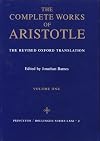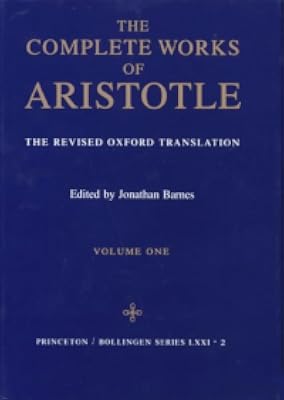
The Complete Works of Aristotle: The Revised Oxford Translation
by Aristotle
On This Page
Description
Jonathan Barnes taught at the universities of Oxford, Geneva, and Paris-Sorbonne, and has published extensively on ancient philosophy. This digital edition combines, for the first time, both volumes of The Complete Works of Aristotle: The Revised Oxford Translation, which is universally recognized as the standard English version. The Oxford Translation of Aristotle was originally published in twelve volumes between 1912 and 1954. The revised edition contains the substance of the original show more translation, slightly emended in light of recent scholarship; three of the original versions have been replaced by new translations; and a new and enlarged selection of fragments has been added. The aim of the translation remains the same: to make the surviving works of Aristotle readily accessible to English-speaking readers. "Praise for the previous edition: "A splendid achievement."" "Praise for the previous edition: "This new edition makes a landmark of scholarship available in a very usable form."" "Praise for the previous edition: "It is hard to picture a more attractive presentation of a philosopher's work for study or reference."". show lessTags
Recommendations




















Member Reviews
One of the foundation authors of my personal philosophy and perhaps the greatest thinker who ever lived. We only have what were notes to his lectures, yet reading them I feel the power of his mind is always present. The books included in this two-volume set range from the foundation of thinking of logic, scientific speculation on physics, psychology and astronomy, metaphysics, and moral guidelines with the Nicomachean Ethics perhaps the acme of his philosophy. I also especially enjoyed the five books on animals (history, parts, movement, progression, and generation). His powers of observation were unsurpassed and the connections that can be made between the books helps to develop a better understanding of his ideas. I would recommend show more Aristotle for those interested in the foundations of philosophy (along with the Dialogues of Plato). show less
Rated: D+
The New Lifetime Reading Plan: Number 13
OK, I'll confess. I'm not an Aristotle fan. I chose to read "Nicomachean Ethics", "Politics" and "Poetics" because it was on The New Lifetime Reading Plan by Clifton Fadiman. Obviously, around 350 B.C., basic concepts regarding alternative governments and their variations had not been thought through too well. Aristotle does a great job of reasoning through all of the good and bad points in a logical progression. He does the same with what makes a person "Happy" and the good, bad and ugly of tragedy vs. epic poetry. The granularity is excruciating and I found myself reading words just to read words.
Learned some things in "Ethics" about his view on temperaments. Loved what he says in show more "Politics, Book VII, Part 13": "This makes men fancy that external goods are the cause of happiness, yet we might as well say that a brilliant performance on the lyre was to be attributed to the instrument and not to the skill of the performer." His comments on poets (Homer, Aeschylus, Sophocles, Euripides) and their works shed a more contemporary critic. show less
The New Lifetime Reading Plan: Number 13
OK, I'll confess. I'm not an Aristotle fan. I chose to read "Nicomachean Ethics", "Politics" and "Poetics" because it was on The New Lifetime Reading Plan by Clifton Fadiman. Obviously, around 350 B.C., basic concepts regarding alternative governments and their variations had not been thought through too well. Aristotle does a great job of reasoning through all of the good and bad points in a logical progression. He does the same with what makes a person "Happy" and the good, bad and ugly of tragedy vs. epic poetry. The granularity is excruciating and I found myself reading words just to read words.
Learned some things in "Ethics" about his view on temperaments. Loved what he says in show more "Politics, Book VII, Part 13": "This makes men fancy that external goods are the cause of happiness, yet we might as well say that a brilliant performance on the lyre was to be attributed to the instrument and not to the skill of the performer." His comments on poets (Homer, Aeschylus, Sophocles, Euripides) and their works shed a more contemporary critic. show less
In reading Aristotle at this time I am focused on "Ethics and Politics" Nicomachean Ethics Book 1.
Paul on Mars Hill, the Aereogapus, Referenced man's groping after God. Certainly herein we find Aristotle in such activity as he endeavors to establish that singular "good" happiness
Paul on Mars Hill, the Aereogapus, Referenced man's groping after God. Certainly herein we find Aristotle in such activity as he endeavors to establish that singular "good" happiness
Ratings
Members
- Recently Added By
Lists

Western Canon
206 works; 2 members

Philosophy, Politics and Economics
61 works; 1 member

Book Titles Mentioned In Newberry Medal And Honor Books
884 works; 3 members

el
1,139 works; 1 member
Author Information

2,092+ Works 57,319 Members
Some Editions
Series
Belongs to Publisher Series
Common Knowledge
- Canonical title
- The Complete Works of Aristotle: The Revised Oxford Translation
- Epigraph*
- /
- Dedication*
- /
- First words*
- Introduction générale
La vie d'Aristote nous est assez bien connue dans ses grandes lignes, mais, et c'est là une règle générale concernant la biographie des grands hommes de l'Antiquité, elle est parasit... (show all)ée par un ensemble non négligeable d'anecdotes, certaines anciennes, d'autres médiévales. [...]
Remarque préliminaire
Ce volume marque une étape importante dans la grande aventure aristotélicienne qui a commencé à la fin des années 1980 sous l'égide des éditions Flammarion. Louis Audibert, alors di... (show all)recteur éditorial du département des sciences humaines, fort du succès des premières traductions de Platon – le Gorgias traduit par Monique Canto était paru en 1987 et s'était vendu à un nombre impressionnant, et inattendu, d'exemplaires dans la collection de poche « GF » –, consentit à « tenter » Aristote. [...]
Note sur cette édition
Il faut préciser en quel sens les œuvres d'Aristote ici traduites sont « complètes ». Tout ce qui a été transmis sous le nom d'Aristote n'a pas été retenu, mais seulement les tra... (show all)ités sur l'authenticité desquels un accord s'est fait parmi les spécialistes.
Introduction à l'Organon
Dans la classification traditionnelle des œuvres d'Aristote, qui est issue de l'édition d'Andronicos de Rhodes dont il a été question dans l'introduction générale de ce vol... (show all)ume, les éditeurs et interprètes ont pris l'habitude de réunir sous le nom d'Organon, « outil », « instrument », mais aussi « organe » au sens biologique du terme, les traités suivants : Catégories, Sur l'interprétation, Premiers Analytiques, Seconds Analytiques, Topiques et Les Réfutations sophistiques. - Original language
- Ancient Greek
*Some information comes from Common Knowledge in other languages. Click "Edit" for more information.
Classifications
Statistics
- Members
- 789
- Popularity
- 35,204
- Reviews
- 4
- Rating
- (4.42)
- Languages
- 5 — English, French, Greek (Ancient), Italian, Portuguese
- Media
- Paper, Ebook
- ISBNs
- 34
- ASINs
- 31