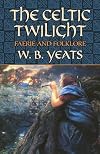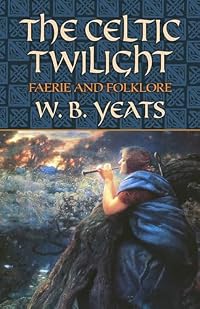
The Celtic twilight
by W. B. Yeats
On This Page
Description
W. B. Yeats was a towering figure in twentieth-century letters. Though best remembered as a poet and playwright, Yeats was insatiably curious and devoted much of his life to the study of folk literatures. This collection brings together an astounding array of Irish legends, fables, and fairy tales..
Tags
Recommendations














Member Reviews
This collection of Irish folklore feels somewhat repetitive in relation to the Yeats volume I read earlier and that took me two tries to finish. Maybe I would have had a different experience if I’d read this one first. And because the stories are filtered through Yeats’s retelling (we don’t experience the stories as first- or even third-person narrative; he’s always there telling the story), it kept me at a distance and I didn’t feel engaged with the stories.
This has such an evocative title, I've wanted to read it for decades. I'd expected it to be a lyrical celebration of the folkloric traditions of Ireland, and those parts of it that were that, I found the best. For the rest, it was a collection of brief outlines of fairly typical folkloric tales, interspersed with some slightly longer stories, some of which were interesting. A slightly disappointing read, but still worthwhile.
In his youth, Yeats was a member of the Golden Dawn, an occult society; he wrote this book during that time, and it's widely seen as a manifesto about his belief in faeries and magic and such. And it is that - but it's not what you think. When he says
A warning note: as he got older, Yeats grew out of his Golden Dawn days. By the time he reprinted Celtic Twilight (and two other short works) in Mythologies, he was embarrassed by some of his more imaginative points, and he ended up editing all the fun out of it. Mythologies will still do as a collection of Irish folklore, but it's not as weird and beautiful as it originally was. Here's my review of Mythologies, which doesn't really say anything you didn't just read. show less
"Let us go forth, the tellers of tales, and seize whatever prey the heart long for, and have no fear. Everything exists, everything is true, and the earth is only a little dust under our feet." (p. 4)he's saying that he believes in magic, yes, but his definition of "belief" is subtler than people give him credit for. He's talking about the power of myth in building culture and identity, and his book, broadly a collection of Irish folklore gathered from bars and washerwomen, will be about show more the impact of myth on the Irish character.
"You - you will make no terms with the spirits of fire and earth and air and water. You have made the Darkness your enemy. We - we exchange civilities with the world beyond." (p. 93)And that difference - that the Irish consider themselves allied with the faeries and imps that inhabit their land - does say something important about the Irish. Compare that statement to the array of superstitions cataloged in Tom Sawyer and Huck Finn, where anything and everything is a bad omen. And remember how Americans have historically felt about witches. We have a different, more fearful attitude toward the unknown. The quote above isn't about faeries; it's about the Irish.
A warning note: as he got older, Yeats grew out of his Golden Dawn days. By the time he reprinted Celtic Twilight (and two other short works) in Mythologies, he was embarrassed by some of his more imaginative points, and he ended up editing all the fun out of it. Mythologies will still do as a collection of Irish folklore, but it's not as weird and beautiful as it originally was. Here's my review of Mythologies, which doesn't really say anything you didn't just read. show less
Not what I was expecting from the title. Also very much a book for dipping into rather than reading straight through.
The renowned Irish poet W. B. Yeats was fascinated by the mystical and the supernatural, as well as Irish culture. The Celtic Twilight combines these interests with stories and commentary that both illustrate the inhabitants of the world of the Fae and examine their meaning in the contexts of individuals’ daily lives, societal belief systems, and Ireland’s history.
Tales of Irish folklore collected by W.B. Yeats in 1893, as told to him by friends and aquaintances - an interesting look at the traditions and superstitions of a bygone age.
Too rambly and full of Celtic angst for me. Stopped on p. 6.
Members
- Recently Added By
Lists

Books Read in 2018
4,360 works; 110 members
Author Information

829+ Works 25,296 Members
William Butler Yeats was born in Dublin, Ireland on June 13, 1865. He was a driving force behind the Irish Literary Revival and, along with Lady Gregory, Edward Martyn, and others, founded the Abbey Theatre, where he served as its chief playwright until the movement was joined by John Synge. Yeats' plays included The Countess Cathleen, The Land of show more Heart's Desire, Cathleen ni Houlihan, The King's Threshold, and Deirdre. Although a convinced patriot, Yeats deplored the hatred and the bigotry of the Nationalist movement, and his poetry is full of moving protests against it. He was appointed to the Irish Senate in 1922. He was awarded the Nobel Prize in Literature in 1923 for what the Nobel Committee described as "inspired poetry, which in a highly artistic form gives expression to the spirit of a whole nation." He is one of the few writers who completed their greatest works after being awarded the Nobel Prize. His poetry collections include The Wild Swans at Coole, Michael Robartes and the Dancer, The Tower, The Winding Stair and Other Poems, and Last Poems and Plays. He died on January 28, 1939 at the age of 73. (Bowker Author Biography) show less

William Butler Yeats has a Legacy Library. Legacy libraries are the personal libraries of famous readers, entered by LibraryThing members from the Legacy Libraries group.
Some Editions
Common Knowledge
- Canonical title
- The Celtic twilight
- Original title
- The Celtic twilight
- Original publication date
- 1893
- Epigraph
- Time drops in decay
Like a candle burnt out.
And the mountains and woods
Have their day, have their day;
But, kindly old rout
Of the fire-born moods,
You pass not away. - First words
- The host is riding from Knocknarea,
And over the grave of Clooth-na-bare; - Last words
- (Click to show. Warning: May contain spoilers.)And hope is less dear than the dew of the morn.
Classifications
Statistics
- Members
- 762
- Popularity
- 36,671
- Reviews
- 10
- Rating
- (3.81)
- Languages
- 5 — Chinese, English, French, Italian, Spanish
- Media
- Paper, Audiobook, Ebook
- ISBNs
- 69
- UPCs
- 1
- ASINs
- 22