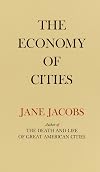
The Economy of Cities
by Jane Jacobs
On This Page
Description
In this book, Jane Jacobs, building on the work of her debut, The Death and Life of Great American Cities, investigates the delicate way cities balance the interplay between the domestic production of goods and the ever-changing tide of imports. Using case studies of developing cities in the ancient, pre-agricultural world, and contemporary cities on the decline, like the financially irresponsible New York City of the mid-sixties, Jacobs identifies the main drivers of urban prosperity and show more growth, often via counterintuitive and revelatory lessons. show lessTags
Recommendations













Member Reviews
This book is another example of Jane Jacobs’ clear and frequently different thinking. It provides some insights into the growth of cities that usually overlooked. As an example, one new idea here is that cities don’t happen because of agriculture, but that most advances in agriculture have been due to cities. I believe that her insights don’t get nearly enough attention. First they are sometime counterintuitive, and second they frequently disagree with experts. She doesn’t have a degree in a related area; she’s just a housewife with brains, eyes, and ideas; ideas that show many of the experts to be wrong. Then she has the audacity to give examples.
While her better known "The Death and Life of Great American Cities" can be show more thought of as the ‘what’ of cities, this one is the ‘how’ they grow, and is a must read if you desire that answer. show less
While her better known "The Death and Life of Great American Cities" can be show more thought of as the ‘what’ of cities, this one is the ‘how’ they grow, and is a must read if you desire that answer. show less
This isn't as well known as her classic The Death and Life of Great American Cities, but perhaps it should be. I have always been curious if further scholarship since its writing in the late '60s proved her hypothesis that agriculture came after settlements. She makes a convincing argument, based on archaeology of the time, that at trading posts/meeting places de facto seed trials might occur as well as the domestication of animals. Another interesting idea covered in the book is the role of import replacement in the economic growth of cities. She describes how this process of innovation and urban self-sufficiency occurs in urban regions with great clarity and readability.
I feel bad for books like these. Jacobs is so well known for The Death and Life of Great American Cities and her last, Dark Age Ahead, that most people overlook her work on economics. This book, The Economy of Cities, combined with her next, Cities and the Wealth of Nations are some of her best work.
When approaching this book, keep in mind that Jacobs is an empiricist. She does a lot of research for her books and tends to build up from many, many examples in order to prove her points. When her research comes against conventional wisdom or long-worshipped theory (e.g. Adam Smith's The Wealth of Nations), she has no problem providing counterexamples to swiftly dispatch old, dusty notions and better explain old generalities that had long show more been glossed over, without being fully understood. show less
When approaching this book, keep in mind that Jacobs is an empiricist. She does a lot of research for her books and tends to build up from many, many examples in order to prove her points. When her research comes against conventional wisdom or long-worshipped theory (e.g. Adam Smith's The Wealth of Nations), she has no problem providing counterexamples to swiftly dispatch old, dusty notions and better explain old generalities that had long show more been glossed over, without being fully understood. show less
Why did I read this book first published in 1969 in 2018? Because, while preparing the section on the future of a couple of books that I am writing, decided that actually would make sense to retrieve and read material that I saw quoted- and to see it alongside other material on mobility and the development of cities in Europe.
Actually, the key concept is useful for the definition of XXI century ecosystems, quite compact, and a fast and entertaining reading.
And the thesis of the author, that was unusual back then, actually makes sense when you are seeing "towns" as "separate motivational environments", and therefore the development of "support" structures whose size and existence is possible only if there is enough demand.
To bring back show more to the book: agriculture developed only after towns and villages developed, which is actually the same approach that, in business, I saw since the late 1980s (and in politics, while reviewing documents from Brussels that we received in the early 1980s).
Or: it makes sense to have shared, separated services if first you have enough entitities able to use those services, and that therefore see an economy of scale.
If you didn't sleep over the last decade, you probably heard more than once that some see as the future of states turning into the future of cities.
The author used extensively a fictional case (the development of a community in Turkey as precursor of one that was actually found), to show that not only cities grow, but also can lose abilities that they had before, shrink, and then grow again into something completely different.
Which, incidentally, is a known fact of history in Italy, were many important towns in Ancient Rome either disappeared or became irrelevant few centuries after the Fall of the Western Roman Empire- and never got back where they were.
[Review released on 2018-05-30] show less
Actually, the key concept is useful for the definition of XXI century ecosystems, quite compact, and a fast and entertaining reading.
And the thesis of the author, that was unusual back then, actually makes sense when you are seeing "towns" as "separate motivational environments", and therefore the development of "support" structures whose size and existence is possible only if there is enough demand.
To bring back show more to the book: agriculture developed only after towns and villages developed, which is actually the same approach that, in business, I saw since the late 1980s (and in politics, while reviewing documents from Brussels that we received in the early 1980s).
Or: it makes sense to have shared, separated services if first you have enough entitities able to use those services, and that therefore see an economy of scale.
If you didn't sleep over the last decade, you probably heard more than once that some see as the future of states turning into the future of cities.
The author used extensively a fictional case (the development of a community in Turkey as precursor of one that was actually found), to show that not only cities grow, but also can lose abilities that they had before, shrink, and then grow again into something completely different.
Which, incidentally, is a known fact of history in Italy, were many important towns in Ancient Rome either disappeared or became irrelevant few centuries after the Fall of the Western Roman Empire- and never got back where they were.
[Review released on 2018-05-30] show less
iconoclastic; comprehensive, yet very personal history of urban development
Professor Alison Wolf, specialist in the relationship between education and the labour market, has chosen to discuss Jane Jacobs’ The Economy of Cities , on FiveBooks (http://five-books.com) as one of the top five on her subject - Education and Society, saying that:
“…Jane Jacob’s argument was that cities, which in the early days were just small trading and administrative posts, generated agriculture, not vice versa. Cities are where the ideas all come from, where all the wealth comes from. They are also much more environmentally friendly because you use much less energy if you live in the city than if you live out in the countryside..…”.
The full interview is available here: http://thebrowser.com/books/interviews/alison-wolf
“…Jane Jacob’s argument was that cities, which in the early days were just small trading and administrative posts, generated agriculture, not vice versa. Cities are where the ideas all come from, where all the wealth comes from. They are also much more environmentally friendly because you use much less energy if you live in the city than if you live out in the countryside..…”.
The full interview is available here: http://thebrowser.com/books/interviews/alison-wolf
HB-4
Nov 11, 2020Catalan
Members
- Recently Added By
Lists

Books in the Bibliography of The Dawn of Everything by Graeber & Wengrow
478 works; 2 members
Author Information

16+ Works 7,930 Members
Jane Jacobs lives in Toronto. (Publisher Provided) Author and community activist Jane Jacobs was born in Scranton, Pennsylvania on May 4, 1916. She spent two years at Columbia University in the School of General Studies. She was interrogated by the U.S. government over her loyality to the country on March 25, 1952 and was arrested during a show more demonstration against the Vietnam War on April 10, 1968. She also helped defeat a plan, proposed by the New York City park commissioner Robert Moses, to build an expressway through Washington Square in the early 1960s. She moved to Toronto in 1969 partially because of her objection to the Vietnam War. She became a Canadian citizen in 1974. Her most influential book, The Death and Life of Great American Cities, is a critique of 1950's urban renewal policies which, according to her, destroyed communities and created isolated, unnatural urban spaces. She received numerous honors including a lifetime achievement award from the National Building Foundation in 2000 and was appointed to the Order of Canada in 1996. In 1997, the Jane Jacobs prize was created by the City of Toronto at the Jane Jacobs: Ideas That Matter conference. She died on April 25, 2006 at the age of 89. (Bowker Author Biography) show less
Awards and Honors
Notable Lists
Series
Belongs to Publisher Series
Vintage Books (V-584)
Common Knowledge
- Canonical title
- The Economy of Cities
- Original publication date
- 1969
- Important places
- New York, New York, USA; Detroit, Michigan, USA; Birmingham, England, UK; Manchester, England, UK
- Epigraph
- "I will tell the story as I go along
of small cities no less than of great.
Most of those that were great once
are small today; and those which in
my own lifetime have grown to greatness,
were small enough i... (show all)n the old days."
--HERODOTUS - Dedication
- To Betty, John, Jim & our mother & father
- First words
- This book is an outcome of my curiosity about why some cities grow and why others stagnate and decay.
- Last words
- (Click to show. Warning: May contain spoilers.)And many people in great, growing cities of the future will be engaged in the unroutine business of economic trial and error. They will be faced with acute practical problems which we cannot now imagine. They will add new work to older work.
Classifications
- Genres
- Economics, Sociology, Nonfiction, General Nonfiction, History, Politics and Government
- DDC/MDS
- 338.091732 — Society, government, & culture Economics Production Biography And History
- LCC
- HT321 .J32 — Social sciences Communities. Classes. Races Communities. Classes. Races Urban groups. The city. Urban sociology The city as an economic factor. City
- BISAC
Statistics
- Members
- 643
- Popularity
- 45,208
- Reviews
- 7
- Rating
- (4.15)
- Languages
- Catalan, English, Spanish
- Media
- Paper, Audiobook, Ebook
- ISBNs
- 7
- ASINs
- 4