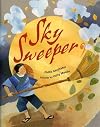
Sky Sweeper
by Phillis Gershator
On This Page
Description
Despite criticism for his lack of "accomplishments," Takiboki finds contentment sweeping flower blossoms and raking the sand and gravel in the monks' temple garden. Includes a note on the art and beauty of Japanese gardens.Tags
Recommendations










































Member Reviews
This book can teach readers two different life lessons. Takeboki needed a job as a young boy and found one as a flower keeper for the monks' temple. As time goes on Takeboki's family members tell him to find another job, but he says no he is happy doing flower keeper for the temple. Time really goes move on and Takeboki never finds a wife and has any children because he spends all his time at the temple. Eventually he passes and a butterfly comes back to visit the garden. At the end the monks never realized how much they relied on Takeboki to take care of the flower garden, and it started to not look as pretty as it once did. One life from this book is that as long as you're doing what you love that is all that matters, which is exactly show more what Takeboki did in the book. Another life lesson that can be taken from this book is that if you don't take time to enjoy things in life, it will pass you by and one day will be too late to finally enjoy it. show less
A man sweeps the garden of a temple for Buddhist monks from the time he is a boy. It is necessary work and he does it well. He doesn't need the appreciation of others; this is just as well since his family is disappointed that he doesn't want to be more important and the monks only realize his worth after he dies. But there is a heaven and the clouds need sweeping.
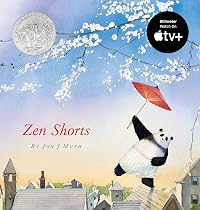
This reminds me a bit of Zen Shorts, although this isn't quite as compact and sharp. Quiet and lovely, not the sort of thing you see a lot of in picture books.
Story of a boy who gardens for Buddhist monks. He understands the value of his occupation even though noone else in his community does.
This book is an inspirational story probably best for third or higher. It is something you could read to younger children but they may not understand it fully. It is also having to do with budhists, keep this in mind.
Colleen Brind’Amour August 2007
Annotations for Center for Digital Literacy
Citation:
Gershator, Phillis. Sky Sweeper. Holly Meade, Illus. Farrar. Straus and Giroux, (2007)
Annotation:
Takeboki takes a job as the flower keeper for the monks as a young boy. He takes great pride in his work and does it with joy. Over the years, his family tries to get him to try something different, but Takeboki is happy to work in the garden, season after season, until he is an old man. The monks do not realize all Takeboki has done over the years until he is an old man and dies. The monks are reassured that although the flower keeper never heard “Thank You” from the monks, they are sure he heard the flowers. Takeboki leaves this world, but continues show more to find joy, tending the sky; thus, the title, Sky Sweeper. There is also an excellent Author’s Note at the end of the book. Here, the author describes her own personal experience with a Japanese garden, gives factual details about Japanese gardens and ties the story to traditional Buddhist beliefs.
Age recommendation:
I would recommend this book for children between the ages of 6 and 8 years old. Children in this age range are beginning to be more interested in the world beyond what they see everyday. The book provides an opportunity for this age group to expand their vocabulary by introducing unfamiliar words that are supported both by the text and illustrations. I think 6, 7 and 8 year old children would enjoy the theme of following your heart despite what others might think you should do.
Use:
I would use this book as a read aloud. It would fit in well when talking about Japanese culture, the seasons, job satisfaction and even peer pressure.
Art Work:
The collage illustrations are a great complement to this book. Holly Meade uses the folk art style to give the feeling of being in Japan. Double page spreads are used to give the reader a feel for the journey the main character is on. The illustrations are rich in color and texture. show less
Annotations for Center for Digital Literacy
Citation:
Gershator, Phillis. Sky Sweeper. Holly Meade, Illus. Farrar. Straus and Giroux, (2007)
Annotation:
Takeboki takes a job as the flower keeper for the monks as a young boy. He takes great pride in his work and does it with joy. Over the years, his family tries to get him to try something different, but Takeboki is happy to work in the garden, season after season, until he is an old man. The monks do not realize all Takeboki has done over the years until he is an old man and dies. The monks are reassured that although the flower keeper never heard “Thank You” from the monks, they are sure he heard the flowers. Takeboki leaves this world, but continues show more to find joy, tending the sky; thus, the title, Sky Sweeper. There is also an excellent Author’s Note at the end of the book. Here, the author describes her own personal experience with a Japanese garden, gives factual details about Japanese gardens and ties the story to traditional Buddhist beliefs.
Age recommendation:
I would recommend this book for children between the ages of 6 and 8 years old. Children in this age range are beginning to be more interested in the world beyond what they see everyday. The book provides an opportunity for this age group to expand their vocabulary by introducing unfamiliar words that are supported both by the text and illustrations. I think 6, 7 and 8 year old children would enjoy the theme of following your heart despite what others might think you should do.
Use:
I would use this book as a read aloud. It would fit in well when talking about Japanese culture, the seasons, job satisfaction and even peer pressure.
Art Work:
The collage illustrations are a great complement to this book. Holly Meade uses the folk art style to give the feeling of being in Japan. Double page spreads are used to give the reader a feel for the journey the main character is on. The illustrations are rich in color and texture. show less
Ratings
Members
- Recently Added By
Lists

A Child's Book Tour of Japan
58 works; 4 members
Author Information

48 Works 2,421 Members
All Editions
Awards and Honors
Awards
Classifications
- Genres
- Picture Books, Children's Books
- DDC/MDS
- 635.01 — Applied science & technology Agriculture Garden crops (Horticulture) modified standard subdivisions Philosophy and theory
- LCC
- PZ7 .G316 .S — Language and Literature Fiction and juvenile belles lettres Fiction and juvenile belles lettres Juvenile belles lettres
- BISAC
Statistics
- Members
- 77
- Popularity
- 410,528
- Reviews
- 6
- Rating
- (4.00)
- Languages
- English
- Media
- Paper
- ISBNs
- 1