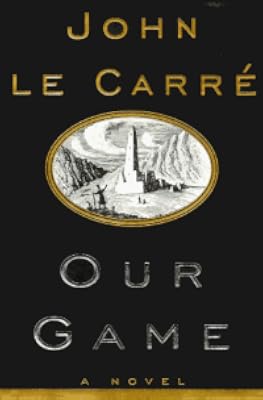
Our Game
by John le Carré
On This Page
Description
A romantic triangle on a retired British intelligence officer, his girl and the spy who stole her. It is told against the backdrop of the rebellion in Chechnya and the international intrigues surrounding it. A tale of the moral wastes of post-Cold War Europe in both East and West. By the author of The Night Manager.Tags
Recommendations












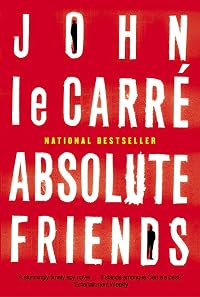





Member Recommendations

Tanya-dogearedcopy In both books, both experienced and naive characters get swept up in political crusades that end up being formative to their own respective characters.
Member Reviews
The next unread book on my shelf was a John Le Carré novel and Our Game proved to be an excellent novel if you sign up to the idea that British Intelligence was run by a bunch of public schoolboys who never really grew up. Come to think of it that is also a description of the British government over the last fifteen years or so. In addition to this the hero of the story is Tim Cranmer; a retired spy and I enjoy reading about retired individuals who can bring a more balanced view to the world in which they live.
Tim Cranmer like many public schoolboys gets rich due to his inheritance and so is not unduly worried when he is forced to retire from British Intelligence after the fall of the Berlin Wall. He is disturbed from his struggles in show more managing his English vineyard by a visit from the police who wish to interview him about the disappearance of Professor Larry Pettifer who they believe was a close friend of Tim. In fact Larry Pettifer was a double agent who Cranmer handled throughout his service as a spy: Pettifer had also seduced Cranmer's younger girlfriend (the beautiful Emma). Things get more difficult for Tim when he is summoned back to MI5 headquarters and discovers that they believe that he is implicated in a plot to embezzle millions of pounds from Russian oligarchs, that he would have known when he worked for the intelligence services. Tim realises he must use all his spy-craft to work for himself and track down Pettifer.
Le Carré introduces his readers to the wilds of the North Caucasus and the tribal Russian republics of Chechenia, Ossetia, and Ingushetia following the breakup of parts of the Soviet republic, (decent map supplied), this contrasts with the gentlemanly culture of the British intelligence service which takes up two thirds of the novel and is really Le Carré's forte. Cranmer's character is well presented: a man having to get back into harness with a world that he thought he had left behind; he is not a super-hero, but with a little luck and some skill manages to make some headway. There is perhaps no fool like an old fool and Tim comes close to realising this when he looks back on his relationship with Larry and his love for Emma.
Le Carré takes the violence out of thriller writing, but still manages to create enough tension and grittiness to make his stories feel real enough and he has a good story here. He also imbues a more balanced and nuanced view of international politics and the world of spying. The Russians are not all beastly savages and the Brits and the Americans are not as sure footed or as unprejudiced as their governments would have us believe. A criticism of Le Carré's approach is that perhaps he makes it all appear too much of a game, (hence the title of this book). In this novel there is a bit of a hole, character-wise, because we only get to meet Larry Pettifer through flashbacks from Tim Cranmer and information from other characters, and so as readers we only get second hand information on his aims, ambitions and his conscientiousness. Is he a selfish, grasping, crook or is he an idealistic, man-of-his-word trying to make the world a better place? The answer of course lies somewhere in between, but he remains an inconsistent character. When the adventure part of the story gets going it becomes a page turner, but there is much to enjoy in the internal and external politics of the police and intelligence agencies in the meantime and so 4 stars. show less
Tim Cranmer like many public schoolboys gets rich due to his inheritance and so is not unduly worried when he is forced to retire from British Intelligence after the fall of the Berlin Wall. He is disturbed from his struggles in show more managing his English vineyard by a visit from the police who wish to interview him about the disappearance of Professor Larry Pettifer who they believe was a close friend of Tim. In fact Larry Pettifer was a double agent who Cranmer handled throughout his service as a spy: Pettifer had also seduced Cranmer's younger girlfriend (the beautiful Emma). Things get more difficult for Tim when he is summoned back to MI5 headquarters and discovers that they believe that he is implicated in a plot to embezzle millions of pounds from Russian oligarchs, that he would have known when he worked for the intelligence services. Tim realises he must use all his spy-craft to work for himself and track down Pettifer.
Le Carré introduces his readers to the wilds of the North Caucasus and the tribal Russian republics of Chechenia, Ossetia, and Ingushetia following the breakup of parts of the Soviet republic, (decent map supplied), this contrasts with the gentlemanly culture of the British intelligence service which takes up two thirds of the novel and is really Le Carré's forte. Cranmer's character is well presented: a man having to get back into harness with a world that he thought he had left behind; he is not a super-hero, but with a little luck and some skill manages to make some headway. There is perhaps no fool like an old fool and Tim comes close to realising this when he looks back on his relationship with Larry and his love for Emma.
Le Carré takes the violence out of thriller writing, but still manages to create enough tension and grittiness to make his stories feel real enough and he has a good story here. He also imbues a more balanced and nuanced view of international politics and the world of spying. The Russians are not all beastly savages and the Brits and the Americans are not as sure footed or as unprejudiced as their governments would have us believe. A criticism of Le Carré's approach is that perhaps he makes it all appear too much of a game, (hence the title of this book). In this novel there is a bit of a hole, character-wise, because we only get to meet Larry Pettifer through flashbacks from Tim Cranmer and information from other characters, and so as readers we only get second hand information on his aims, ambitions and his conscientiousness. Is he a selfish, grasping, crook or is he an idealistic, man-of-his-word trying to make the world a better place? The answer of course lies somewhere in between, but he remains an inconsistent character. When the adventure part of the story gets going it becomes a page turner, but there is much to enjoy in the internal and external politics of the police and intelligence agencies in the meantime and so 4 stars. show less
This is a novel about how being a spy shapes you forever. It’s about the aftermath and what sacrificing your true identity means for the rest of your life. I was reminded of Restless by William Boyd and wondered how much of an effect this book had on his. Surely le Carre was an influence. What contemporary espionage writer is exempt?
It’s been a long time since I read one of le Carre’s more “hardcore” spy novels. The Smiley novels. The ones where hard men make hard decisions and get left out in the cold. This novel, while still perilous, is set a bit after active duty. We have handler and handled, betrayer and betrayed, seducer and seduced. Sure, it’s a bit quieter and more introspective than many a spy novel, but I think show more it’s more powerful as a result. The relationship between the two main characters Tim Cranmer and Larry Pettifer is the real focus. In some ways, they’re two sides of a single coin, but it’s not that cut and dried. Larry has always been contemptuous of Tim’s more staid personality and safer choices. His hedonism and arrogance make him an effective spy, but a really lousy friend. If they ever were friends. How much of either man’s personality is real? At times Tim’s third-person references made me really understand how much of a role it was for him, but Larry’s tear-away behavior made me think he thought his role all too real.
Spoilers !
Cranmer (I couldn’t help wondering what the significance of that name really was) is a man in retirement. He’s beginning a new life with a very young woman, also new. He’s inherited a sprawling estate and has been freshly relieved from his job at the “treasury”. Yeah, he’s a spy. A handler; and his handlee has also been newly put out to pasture. Too bad he’s only 30 miles away at a university, being the best terrible don on campus. Makes it very convenient to pop by for Sunday lunch. During those idyllic lunches on the estate, Larry succeeds in seducing the impressionable and sheltered Emma, Tim’s paramour. I can’t really describe her as more. She’s not really a fully-formed adult to Tim. He buys her clothes for heaven’s sake. What mature, independent woman is going to allow this? Instead Emma represents all objects of affection for Cranmer; lover, wife, child and madonna. No, Larry’s gung-ho, take-charge attitude toward the put-upon peoples of the southern Russian republics have Emma swooning at his feet and soon they’re both gone.
Larry started his career as a spy under Cranmer’s tutelage. Ostensibly, Tim feels responsible for changing Larry’s life and to some extent it’s true, but Larry has chosen his own course, serving as a double agent to Russia. With any double agent, you can’t really be sure where his loyalties lie. As the years press on, Larry becomes more and more sympathetic to the Chechen oppression and extermination by the Russians. In the end, it’s clear he and his accomplices have stolen a great deal of money from Moscow. It isn’t to feather his own nest though, but to fund a revolution against the Ossetians and their Russian overlords.
Naturally, Tim comes under suspicion as an accomplice from both his former employer and the local cops. I loved the tradecraft he devised to evade them in the immediate sense and also on the larger scale. Keeping the cops in the dark about the Office. The false identity ready to hand. The secret room in the church tower. Getting into Larry and Emma’s erstwhile safe house. Oh it was great. There is a lot of idealism and hope, danger and deceit. And of course le Carre’s writing has that lolloping grace it’s always had. He creates some great characters, sprinkles just enough back story into the main narrative and teases you with hints before giving you solid information. Altogether a really enjoyable novel that I’m ashamed took me 20 years to finally read. show less
It’s been a long time since I read one of le Carre’s more “hardcore” spy novels. The Smiley novels. The ones where hard men make hard decisions and get left out in the cold. This novel, while still perilous, is set a bit after active duty. We have handler and handled, betrayer and betrayed, seducer and seduced. Sure, it’s a bit quieter and more introspective than many a spy novel, but I think show more it’s more powerful as a result. The relationship between the two main characters Tim Cranmer and Larry Pettifer is the real focus. In some ways, they’re two sides of a single coin, but it’s not that cut and dried. Larry has always been contemptuous of Tim’s more staid personality and safer choices. His hedonism and arrogance make him an effective spy, but a really lousy friend. If they ever were friends. How much of either man’s personality is real? At times Tim’s third-person references made me really understand how much of a role it was for him, but Larry’s tear-away behavior made me think he thought his role all too real.
Spoilers !
Cranmer (I couldn’t help wondering what the significance of that name really was) is a man in retirement. He’s beginning a new life with a very young woman, also new. He’s inherited a sprawling estate and has been freshly relieved from his job at the “treasury”. Yeah, he’s a spy. A handler; and his handlee has also been newly put out to pasture. Too bad he’s only 30 miles away at a university, being the best terrible don on campus. Makes it very convenient to pop by for Sunday lunch. During those idyllic lunches on the estate, Larry succeeds in seducing the impressionable and sheltered Emma, Tim’s paramour. I can’t really describe her as more. She’s not really a fully-formed adult to Tim. He buys her clothes for heaven’s sake. What mature, independent woman is going to allow this? Instead Emma represents all objects of affection for Cranmer; lover, wife, child and madonna. No, Larry’s gung-ho, take-charge attitude toward the put-upon peoples of the southern Russian republics have Emma swooning at his feet and soon they’re both gone.
Larry started his career as a spy under Cranmer’s tutelage. Ostensibly, Tim feels responsible for changing Larry’s life and to some extent it’s true, but Larry has chosen his own course, serving as a double agent to Russia. With any double agent, you can’t really be sure where his loyalties lie. As the years press on, Larry becomes more and more sympathetic to the Chechen oppression and extermination by the Russians. In the end, it’s clear he and his accomplices have stolen a great deal of money from Moscow. It isn’t to feather his own nest though, but to fund a revolution against the Ossetians and their Russian overlords.
Naturally, Tim comes under suspicion as an accomplice from both his former employer and the local cops. I loved the tradecraft he devised to evade them in the immediate sense and also on the larger scale. Keeping the cops in the dark about the Office. The false identity ready to hand. The secret room in the church tower. Getting into Larry and Emma’s erstwhile safe house. Oh it was great. There is a lot of idealism and hope, danger and deceit. And of course le Carre’s writing has that lolloping grace it’s always had. He creates some great characters, sprinkles just enough back story into the main narrative and teases you with hints before giving you solid information. Altogether a really enjoyable novel that I’m ashamed took me 20 years to finally read. show less
I rarely feel as content as when I'm starting a new Le Carré. His gentle but persistent ratcheting of tension, laying out of mystery, I find thrilling. The largest part of this novel is all taut, claustrophobic tension — reminiscent of Tinker, Tailor, and Smiley's People. The small problem with Le Carré is that the later pay-off may not quite match the superlative build-up — either diverging too far from Le Carré's strengths (Honourable Schoolboy, Night Manager) or kinda petering out (I think... Russia House, maybe even Drummer Girl?). I feel that Our Game delivers on its promise — I enjoyed it immensely. It continues Le Carré's themes from the last few books — fall of communism, evils of — and the West's complicity in — show more the arms trade, and the West's moral culpability in not caring about the oppressed. Le Carré on top, angry, outraged form. Excellent. show less
Meh. Hasn't aged well. I remember being fairly captivated when I first read this, especially as it was timely with the global political situation. But life moves on, and now this is just another of LeCarre's post Smiley books. A disgruntled old agent finds something else to do.
Told in a series of flashbacks throughout the retirement of a handler Tim, and his double agent, Larry. Larry a former russian agent, now that the cold war is over, is disgruntled at being retired to a university in Bath. He starts being more interested in the eastern european countries - Chechnya, the Ukraine etc. When he suddenly disappears Tim is concerned but passes the problem back to the Office, and returns to his young girlfriend, and quiet winemaking. show more However the local police become involved as Larry's managed to abscond with several million, and Tim realises his girlfriend has gone too. The police are naturally suspicious of Tim and he tries to follow the convoluted logic of Larry's exploits both in memory and in real life.
The ending is uncharacteristically depressing, even from Le Carre. But Tim is dull and Larry not sufficiently featured to make up for the struggles. I never really cared for Tim and felt he deserved much of what comes to him. Other books of LeCarre have focused more on the Larry character which delivers the actiona dn pace required to carry the story through, this however drags as Tim stumbles from one 'revelation' to another.
Topical, but not the best of LeCarre's work. show less
Told in a series of flashbacks throughout the retirement of a handler Tim, and his double agent, Larry. Larry a former russian agent, now that the cold war is over, is disgruntled at being retired to a university in Bath. He starts being more interested in the eastern european countries - Chechnya, the Ukraine etc. When he suddenly disappears Tim is concerned but passes the problem back to the Office, and returns to his young girlfriend, and quiet winemaking. show more However the local police become involved as Larry's managed to abscond with several million, and Tim realises his girlfriend has gone too. The police are naturally suspicious of Tim and he tries to follow the convoluted logic of Larry's exploits both in memory and in real life.
The ending is uncharacteristically depressing, even from Le Carre. But Tim is dull and Larry not sufficiently featured to make up for the struggles. I never really cared for Tim and felt he deserved much of what comes to him. Other books of LeCarre have focused more on the Larry character which delivers the actiona dn pace required to carry the story through, this however drags as Tim stumbles from one 'revelation' to another.
Topical, but not the best of LeCarre's work. show less
Six-word review: Runaway lovers launch ex-spy's investigative odyssey.
Extended review:
Love, loss, and post-Cold-War intrigue featuring ethnic conflict in the North Caucasus region of the Russian federation.
I didn't know quite what to expect from le Carré. I'd always assumed he was hardcore when it came to spy novels, which are just not my genre. And I think he pretty much is. But here there was also a large helping of inner human drama, moral conflict, soul-searching, and ultimately something like redemption to elevate this novel above the level of routine cloak-and-dagger action.
The novel is a suspenseful story of a former Cold War agent's search for his longtime friend and colleague, who has apparently run off with the agent's show more girlfriend. Tim Cranmer's own doubts and questions and his lack of commitment to any ideal create layers of subterfuge and deception that lure us on to try to penetrate the puzzle, both of the escapees' movements and of the character himself. His application of spy tradecraft in the service of a personal mission interested me more than a motivation based in politics or commerce, where the side you're on seems fairly arbitrary and everyone's up to the same thing.
The author draws us in artfully, just as Cranmer is drawn in. As he begins to care about obscure ethnic combatants in the mountainous reaches of the Caucasus, so do I. Off I went to learn more about the setting and the background action. I had to look up the Republic of Ingushetia, which I'd never heard of, and do some reading about its history and geography. And I studied a map of the eastern half of Russia for a while. Abstractions such as statistics and names on a map became real-seeming people and places as Cranmer pursued the fugitive couple. The subtle shifting of his goal as time progresses adds an intriguing dimension to the focal character.
The ending was unexpected and surprisingly satisfying. show less
Extended review:
Love, loss, and post-Cold-War intrigue featuring ethnic conflict in the North Caucasus region of the Russian federation.
I didn't know quite what to expect from le Carré. I'd always assumed he was hardcore when it came to spy novels, which are just not my genre. And I think he pretty much is. But here there was also a large helping of inner human drama, moral conflict, soul-searching, and ultimately something like redemption to elevate this novel above the level of routine cloak-and-dagger action.
The novel is a suspenseful story of a former Cold War agent's search for his longtime friend and colleague, who has apparently run off with the agent's show more girlfriend. Tim Cranmer's own doubts and questions and his lack of commitment to any ideal create layers of subterfuge and deception that lure us on to try to penetrate the puzzle, both of the escapees' movements and of the character himself. His application of spy tradecraft in the service of a personal mission interested me more than a motivation based in politics or commerce, where the side you're on seems fairly arbitrary and everyone's up to the same thing.
The author draws us in artfully, just as Cranmer is drawn in. As he begins to care about obscure ethnic combatants in the mountainous reaches of the Caucasus, so do I. Off I went to learn more about the setting and the background action. I had to look up the Republic of Ingushetia, which I'd never heard of, and do some reading about its history and geography. And I studied a map of the eastern half of Russia for a while. Abstractions such as statistics and names on a map became real-seeming people and places as Cranmer pursued the fugitive couple. The subtle shifting of his goal as time progresses adds an intriguing dimension to the focal character.
The ending was unexpected and surprisingly satisfying. show less
Tim Cranmer is a retired intelligence agent living in Bath with his young sweetheart, Emma. The story opens with two detectives arriving at his door, questioning him about the disappearance of his friend (and former double agent), Larry Pettifer. Cranmer goes to the Office to gain more information. He finds himself suspected of assisting Larry in stealing a large sum of money from the Russians. Both Larry and Emma have disappeared. It is set in the 1990s, after the Cold War and at the beginning of the Russian Federation.
We are privy to Tim’s thoughts as he pieces together what has happened. I was riveted to this story. We find out about the conflicts in the Caucasus between Russia and Ingushetia. This is a piece of history that is not show more told often, and I feel I learned quite a bit.
It is a complex mix of espionage, love triangle, and politics. It mixes action sequences with analysis. It portrays two contrasting personalities. Larry is the idealist. Tim is the practical one. Emma has chosen one over the other, creating conflict among friends. I had not read anything by le Carre’ in quite a while, and this book reminds me of why I enjoy his writing so much.
4.5 show less
We are privy to Tim’s thoughts as he pieces together what has happened. I was riveted to this story. We find out about the conflicts in the Caucasus between Russia and Ingushetia. This is a piece of history that is not show more told often, and I feel I learned quite a bit.
It is a complex mix of espionage, love triangle, and politics. It mixes action sequences with analysis. It portrays two contrasting personalities. Larry is the idealist. Tim is the practical one. Emma has chosen one over the other, creating conflict among friends. I had not read anything by le Carre’ in quite a while, and this book reminds me of why I enjoy his writing so much.
4.5 show less
Tim is an early middle aged retired spy put out to pasture. The pasture happens to include his girlfriend, the young and very beautiful Emma, and an estate with an improbable English vineyard, and the frequent presence of Larry, the double agent against the Soviets that Tim ran for 20 years. Larry's gone missing, and Emma as well. Has Larry gone to the Soviets one last time? Or are he and Emma lovers, run away? Or both?
But I found Our Game to be different in nature to many Le Carre novels - I found it to be one of his most human and accessible novels, concerned not just with the betrayal of country but the onset of middle age and with it the fears and second-guessing that come with it. And possessed of a surprisingly lyrical tone
"I have show more invited him here for a clandestine meeting up here on the Mendip Hills, on this moonscape plateau nearer to the sky than to the earth, where the trees throw deadman's shadows on the whited lane and no cars pass."
Our game explores (as Le Carre always does) the geography and emotional landscape of betrayal and the familiarity that sometimes breeds contempt in those we've known for a long time. Our Game also manages to explore infidelity, middle aged self deception and ennui and what we owe our friends, even if they betray us. Recommended. show less
But I found Our Game to be different in nature to many Le Carre novels - I found it to be one of his most human and accessible novels, concerned not just with the betrayal of country but the onset of middle age and with it the fears and second-guessing that come with it. And possessed of a surprisingly lyrical tone
"I have show more invited him here for a clandestine meeting up here on the Mendip Hills, on this moonscape plateau nearer to the sky than to the earth, where the trees throw deadman's shadows on the whited lane and no cars pass."
Our game explores (as Le Carre always does) the geography and emotional landscape of betrayal and the familiarity that sometimes breeds contempt in those we've known for a long time. Our Game also manages to explore infidelity, middle aged self deception and ennui and what we owe our friends, even if they betray us. Recommended. show less
Members
- Recently Added By
Published Reviews
Mr. le Carré's great strength is that he is a master plotter. His premise of intelligence agents running amok since the end of the cold war is totally plausible, and the way he links his major characters through their professional roles is ingenious. After taking forever to get there, the reader comes across some 40 pages that are as taut and thrilling as any adventure story I have ever read. show more They just happen to consist of continuous narrative -- with no tricky flashbacks, very little psychologizing and no political lectures -- and they provide a momentum that lifts almost the entire last third of the novel. If only the first 200 pages were like that, former readers of Hotspur and Triumph (including this one) would be enthralled. show less
added by John_Vaughan
Lists

Best Spy Fiction
153 works; 102 members

Books Read in 2015
3,299 works; 129 members

Reading LIst
648 works; 1 member
Author Information

212+ Works 99,191 Members
David John Moore Cornwell was born in Poole, Dorsetshire, England in 1931. He attended Bern University in Switzerland from 1948-49 and later completed a B.A. at Lincoln College, Oxford. He taught at Eton from 1956-58 and was a member of the British Foreign Service from 1959 to 1964. He writes espionage thrillers under the pseudonym John le Carré. show more The pseudonym was necessary when he began writing, in the early 1960s because, at that time, he held a diplomatic position with the British Foreign Office and was not allowed to publish under his own name. When his third book, The Spy Who Came in from the Cold, became a worldwide bestseller in 1964, he left the foreign service to write full time. His other works include Call for the Dead; A Murder of Quality; Tinker, Tailor, Soldier, Spy; The Honourable Schoolboy; and Smiley's People. He has received numerous awards for his writing, including the Grand Master Award from the Mystery Writers of America in 1986 and the Diamond Dagger from the Crime Writers Association in 1988. In 2011 he accepted the Goethe Medal. And in 2020, he accepted the Olof Palme Prize. Ten of his books have been adapted for television and motion pictures including The Spy Who Came in from the Cold, The Russia House, The Constant Gardener, A Most Wanted Man, and Our Kind of Traitor. Le Carré's memoir, The Pigeon Tunnel: Stories from my Life, became a New York Times bestseller in 2016. In 2019, he published a spy thriller, Agent Running in the Field. John Le Carré died on December 12, 2020 from pneumonia at the age of 89. (Bowker Author Biography) John le Carre was born in 1931. After attending the univesities of Berne and Oxford, he spent five years in the British Foreign Service. He's the author of eighteen novels, translated into twenty-five languages. He lives in England. (Publisher Provided) show less
Some Editions
Awards and Honors
Awards
Distinctions
Series
Belongs to Publisher Series
Work Relationships
Is contained in
Common Knowledge
- Canonical title
- Our Game
- Original title
- Our Game
- Original publication date
- 1995
- People/Characters
- Tim Cranmer; Larry Pettifer
- Important places
- Somerset, England, UK
- Epigraph
- He who thinks of the consequences cannot be brave. Ingush proverb
Who gathers knowledge, gathers pain. Ecclesiastes
If I were living in the Caucasus, I would be writing fairy tales there
Chekhov, 1888 - First words
- Larry went officially missing from the world on the second Monday of October, at ten minutes past eleven, when he failed to deliver his opening lecture of the new academic year.
- Last words
- (Click to show. Warning: May contain spoilers.)Slinging it across my shoulder, I hastened after him down the slope.
- Original language
- English
Classifications
Statistics
- Members
- 2,769
- Popularity
- 6,649
- Reviews
- 34
- Rating
- (3.52)
- Languages
- 19 — Catalan, Czech, Danish, Dutch, English, Estonian, Finnish, French, German, Greek, Hungarian, Italian, Japanese, Korean, Norwegian (Bokmål), Romanian, Spanish, Swedish, Portuguese (Portugal)
- Media
- Paper, Audiobook, Ebook
- ISBNs
- 92
- ASINs
- 32