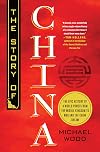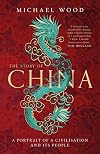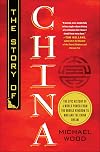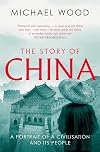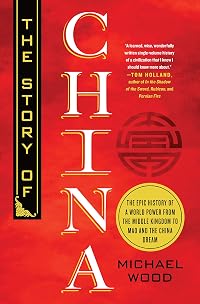
The Story of China: A Portrait of a Civilisation and Its People
by Michael Wood
On This Page
Description
Michael Wood has travelled the length and breadth of China, the world's oldest civilization and longest lasting state, to tell a thrilling story of intense drama, fabulous creativity, and deep humanity that stretches back thousands of years. After a century and a half of foreign invasion, civil war, and revolution, China has once again returned to center stage as a global superpower and the world's second largest economy. But how did it become so dominant? Wood argues that in order to show more comprehend the great significance of China today, we must begin with its history. The Story of China takes a fresh look at the Middle Kingdom in the light of the recent massive changes inside the country. Taking into account exciting new archeological discoveries, the book begins with China's prehistory-the early dynasties, the origins of the Chinese state, and the roots of Chinese culture in the age of Confucius. Wood looks at particular periods and themes that are now being reevaluated by historians, such as the renaissance of the Song with its brilliant scientific discoveries. He paints a vibrant picture of the Qing Empire in the 18th century, just before the European impact, a time when China's rich and diverse culture was at its height. Then, Wood explores the encounter with the West, the Opium Wars, the clashes with the British, and the extraordinarily rich debates in the late 19th century that pushed China along the path to modernity. Finally, he provides a clear up-to-date account of post-1949 China, including revelations about the 1989 crisis based on newly leaked inside documents, and fresh insights into the new order of President Xi Jinping. All woven together with landscape history and the author's own travel journals, The Story of China is the indispensable book about the most intriguing and powerful country on the world stage today.-- show lessTags
Recommendations







Member Reviews
A brilliantly told story of a spectacular nation and civilization. The author, who has produced documentaries and books on many major civilizations, including India's, has the rare ability of getting under the skin of his subjects,, and presenting them as an insider, almost. He is at his evocative best when he talks of the tragedy of loss in the collapse of successive regimes in China - especially the demise of the Han, the Tang, the Song, and the Ming, for instance. The sweeping survey of China's history reveals starkly this tragic quirk in this great civilization, that it destroys the best repeatedly even as it goes on to fashion itself anew. The question is, will this happen again in the current expression of its national genius.
This is my third reading of a general history of China. The other two being Odd Arne Westad's Restless Empire and Jonathon D Spences's The Search for Modern China. All three have their strengths. Wood's is epecially strong in the early empires; an area I usually avoid like the plague. Some might remember him from his PBS series on Alexander or on the Incas. His sense of the epic and how to tell its attending tales enriches and makes clearer those early years of China and their later effects. So, the first two thirds could be called lively and engaging with only the last part being pedestrian and not as fresh with the exception of a very wise conclusion. A solution to the pedestrian parts is to read the other noted histories.
Quotes: show more (page 198) “Nothing better illustrates the traditional Chinese reverence for the written word than the way Taizong went about the task of restoring the imperial library, which had been founded 1,000 years earlier. When his predecessor, his brother Taizu, came to the throne, there had been 12,000 scrolls in the imperial collection. Now, as Song rule expanded into the Yangtze valley in the 960s, though by no means a learned man himself, in the wake of his armies Taizong sent commissioners to towns and noble houses to save manuscripts, expanding the collection by four times. Then, in 976, Taizong built a new imperial library with a staff and directorate of books. He then instituted a nationwide search of books containing the lost learning of classical China. He told his librarians 'When we consider the old imperial library (from the Tang in 721, it listed 60,000 manuscripts) the loses have been great, a wide search is in order. We must look for the missing books; the message must be announced far and wide that if any government official has books we lack, he must bring them to the throne.'”
(page 478) “At the end of the 1950s, these misguided campaigns pushed China into the Great Famine. Recently, a period of relaxation in the opening of Chinese regional archives has revealed a flood of documentation right down to local party memos and even village petitions, and the broad picture, the scale of disaster across China, is now clear. Needless to say, the party did not leave an honest account of its own failures, constantly contradicting itself, rewriting the record, with lies, deception and self-delusion even in the face of a human disaster of such staggering proportions. But enough evidence is there to see that even if the party's figures are underestimates, this was the worst famine in Chinese history, Chinese journalist Yang Jisheng in his Tombstone-a book set beside Solzhenitsyn's Gulag Archipelago- estimates that 36 million people died. Others have put the figure higher still, which makes China's Great Famine by far the worst in human history.”
(page 539) “The Chinese intelligentsia has taken many blows since then, but despite the devastating attacks on civil society-even in the last few years-it has not been broken, and after thirty tumultuous years of the communist experiment, and the Reform and Opening Up period that followed, that hope remains. For China, there are still many paths to the future.” show less
Quotes: show more (page 198) “Nothing better illustrates the traditional Chinese reverence for the written word than the way Taizong went about the task of restoring the imperial library, which had been founded 1,000 years earlier. When his predecessor, his brother Taizu, came to the throne, there had been 12,000 scrolls in the imperial collection. Now, as Song rule expanded into the Yangtze valley in the 960s, though by no means a learned man himself, in the wake of his armies Taizong sent commissioners to towns and noble houses to save manuscripts, expanding the collection by four times. Then, in 976, Taizong built a new imperial library with a staff and directorate of books. He then instituted a nationwide search of books containing the lost learning of classical China. He told his librarians 'When we consider the old imperial library (from the Tang in 721, it listed 60,000 manuscripts) the loses have been great, a wide search is in order. We must look for the missing books; the message must be announced far and wide that if any government official has books we lack, he must bring them to the throne.'”
(page 478) “At the end of the 1950s, these misguided campaigns pushed China into the Great Famine. Recently, a period of relaxation in the opening of Chinese regional archives has revealed a flood of documentation right down to local party memos and even village petitions, and the broad picture, the scale of disaster across China, is now clear. Needless to say, the party did not leave an honest account of its own failures, constantly contradicting itself, rewriting the record, with lies, deception and self-delusion even in the face of a human disaster of such staggering proportions. But enough evidence is there to see that even if the party's figures are underestimates, this was the worst famine in Chinese history, Chinese journalist Yang Jisheng in his Tombstone-a book set beside Solzhenitsyn's Gulag Archipelago- estimates that 36 million people died. Others have put the figure higher still, which makes China's Great Famine by far the worst in human history.”
(page 539) “The Chinese intelligentsia has taken many blows since then, but despite the devastating attacks on civil society-even in the last few years-it has not been broken, and after thirty tumultuous years of the communist experiment, and the Reform and Opening Up period that followed, that hope remains. For China, there are still many paths to the future.” show less
Chinese history in not something that is studied with any depth here in the west. As a casual student of history, I have frequently attempted to do this on my own with mixed results. Most of the books that I have read are structured a lot like the history text books from which we learn our own history ... basically a list of dates, events and people on a timeline to memorize. Rarely do we see any attempt to explain the impact of these events on the social consciousness of the society in which they happen. This book not only provides an accessible survey of Chinese history, it compares and contrasts the social difference as well as presenting a reasonable hypothesis for why East and West have such divergent approaches to governance. Key show more to this examination are the references to contemporary western (greek/roman) philosophers and historians. From this I believe that I have a better understanding of the importance of conformity within eastern cultures, and how such could fall under the influence of such "Machiavellian" thought found within "The Book of Lord Shang." (Loc 1088/12%).
As expected given the time periods covered, this is a huge book packed with a great deal of information; some more interesting to me and some less so. I found myself skimming over a lot of the literary references in part because I had a hard time understanding how they reinforced or supported some of the authors points on Chinese culture. That still left a lot of material to slog through. The book is organized by dynasties (Xia, Shang, Zhou, Qin, Han, Tang, Song, Yuan, Ming, Qing) and interregnums (Warring States, Three Kingdoms, Five Dynasties, Taiping & Boxer Rebellions, etc.), highlighting the cultural contributions (and continuity) of each as well as the reasons for decline and inevitable fall (loss of the Mandate of Heaven). What I found most interesting was the intersection of the Confucian ideal of the sage-ruler and the evolution of rather autocratic rulers (almost as if they knew they didn't have what was needed and through increasing paranoia harshly suppressed any criticism). Criticism and/or failure of any kind seems detrimental to life (not just your own, but your entire family to the 9th degree). This all has something of a discordant feel to people raised within a modern western culture (aka me). For pivotal events ... such as Mao's revolution ... the author tries to show multiple viewpoints (from traditional history to how it played in the rural areas with the common man).
Over all I found this book to be significantly helpful in understanding the differences between the east and west world views and I highly recommend it.
I was given this free advance reader copy (ARC) ebook at my request and have voluntarily left this review.
#TheStoryofChina #NetGalley show less
As expected given the time periods covered, this is a huge book packed with a great deal of information; some more interesting to me and some less so. I found myself skimming over a lot of the literary references in part because I had a hard time understanding how they reinforced or supported some of the authors points on Chinese culture. That still left a lot of material to slog through. The book is organized by dynasties (Xia, Shang, Zhou, Qin, Han, Tang, Song, Yuan, Ming, Qing) and interregnums (Warring States, Three Kingdoms, Five Dynasties, Taiping & Boxer Rebellions, etc.), highlighting the cultural contributions (and continuity) of each as well as the reasons for decline and inevitable fall (loss of the Mandate of Heaven). What I found most interesting was the intersection of the Confucian ideal of the sage-ruler and the evolution of rather autocratic rulers (almost as if they knew they didn't have what was needed and through increasing paranoia harshly suppressed any criticism). Criticism and/or failure of any kind seems detrimental to life (not just your own, but your entire family to the 9th degree). This all has something of a discordant feel to people raised within a modern western culture (aka me). For pivotal events ... such as Mao's revolution ... the author tries to show multiple viewpoints (from traditional history to how it played in the rural areas with the common man).
Over all I found this book to be significantly helpful in understanding the differences between the east and west world views and I highly recommend it.
I was given this free advance reader copy (ARC) ebook at my request and have voluntarily left this review.
#TheStoryofChina #NetGalley show less
This is an incredible, epic read of Chinese history. Covering 4000 years of history is a daunting task, however the author does an excellent job of it. Breaking down the history into specific dynasties, Wood's makes you feel like you are there as history is being made. He manages to accomplish this not by reciting boring facts and dates, but by telling a story in each section.
This is not a book that you can plow through in one sitting. It requires your attention, and the reading of one chapter at a time, then taking time to digest it. But....you will come away with a much greater appreciation of China and it's people.
On a different note, as I read this, I was discussing the chapters with a Chinese student that we have hosted. She was show more very surprised, stating several times that she "did not know that"!
I highly recommend this book! show less
This is not a book that you can plow through in one sitting. It requires your attention, and the reading of one chapter at a time, then taking time to digest it. But....you will come away with a much greater appreciation of China and it's people.
On a different note, as I read this, I was discussing the chapters with a Chinese student that we have hosted. She was show more very surprised, stating several times that she "did not know that"!
I highly recommend this book! show less
Obviously a summary, it goes through the dynasties and interregnums, highlights key historical and cultural figures and includes occasional recent discoveries to hint at the depth and texture of the various periods. Useful as an introduction, that it doesn't even mention the one child policy gives an idea of how far it should be trusted as a guide.
This was an interesting title that I feel served as a useful introduction to the vast and frankly intimidating topic of Chinese history. The author admits at the outset that a complete historic overview is beyond the scope of this or any single volume. However, he intersperses his sweeping historical narrative with a wealth of primary sources, giving an excellent feel for the time and place of these events.
I would recommend this to anyone curious about Chinese history and wanting a very brief introduction, or anyone who enjoys well written, informative history books.
I would recommend this to anyone curious about Chinese history and wanting a very brief introduction, or anyone who enjoys well written, informative history books.
A well written book that did a great job in condensing 5,000 years if history into a single volume. The book is broken down chronologically into the main dynasties and a brief geo-political description is given, followed by a detail exposition of key aspects of life in China in ch era via the journals/diaries ect of certain individuals.
Members
- Recently Added By
Lists

2021 Long Reads
3 works; 1 member

Evan's Reading List 2021
16 works; 1 member

Library Non-Fiction
164 works; 1 member
Author Information

Common Knowledge
- Canonical title
- The Story of China: A Portrait of a Civilisation and Its People
- Original publication date
- 2020-11-17
Classifications
Statistics
- Members
- 328
- Popularity
- 96,963
- Reviews
- 8
- Rating
- (4.33)
- Languages
- English, Portuguese, Spanish
- Media
- Paper, Audiobook, Ebook
- ISBNs
- 11
- ASINs
- 6