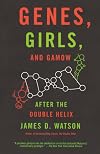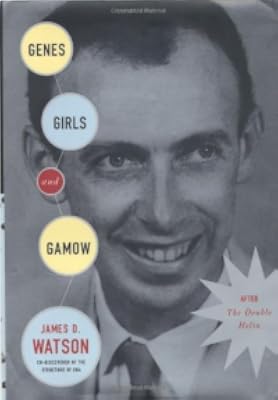
Genes, Girls, and Gamow: After the Double Helix
by James D. Watson
On This Page
Description
"How Jim Watson and Francis Crick deduced the double-helical structure of DNA first became known to the general public in 1968 through Watson's watershed The Double Helix." "Genes, Girls and Gamow takes up the story of Watson's life from where The Double Helix finishes, the announcement of the double helix in the journal Nature in April 1953. The diary-like entries describe with freshness and immediacy Watson adjusting to new-found fame, carrying out tantalizing experiments on the role of show more RNA in biology, and falling in love. The book is enlivened by copies of hand-written letters from the larger-than-life, Russian-born theoretician George Gamow, who had made major contributions to physics but, in this period, was also intrigued by genes, RNA, and the elusive genetic code."--Jacket. show lessTags
Recommendations
































Member Reviews
Girls, Genes, and Gamow, is not as good as the Double Helix, but is still an interesting account of some important years of genetic discoveries. It covers the years following the big discovery and the Nobel prize. Over these years he is occupied chasing more scientific discoveries, and girls. Watson spends part of his time in Cambridge England, and part of it in Cambridge Massachusetts, while trying to find out exactly what RNA is for, and trying to crack the genetic code. He starts the "RNA Tie Club", the members of which include Crick, Gamow, Richard Feynman, Melvin Calvin, Brenner, Edward Teller, and others, many of whom were also laureates. Gamow, a Russian, comes across as a particularly interesting character, and though a show more physicist, he is interested in cracking the protein code of DNA. He is quite close friends with Watson, and some of his amusing and amusingly illustrated letters are printed in this volume. Watson and Gamow seem to spend about as much time playing pranks and attending parties as they do doing science, but somehow still manage to keep up the pace with the discoveries, along with Crick.
Watson gets some hard criticism for his dislike of political correctness, but I think this comes mainly from an innate dislike of hypocrisy, which he cannot help, and nor should he. Watson comes across as more human here, especially in his often disastrous pursuit of girls. I felt sorry for him in places, but I don't think he is as unlikeable as some people think.
This book is not the first of his books that I would recommend, but I think that those who have read his other ones and enjoyed them will find it worth reading. show less
Watson gets some hard criticism for his dislike of political correctness, but I think this comes mainly from an innate dislike of hypocrisy, which he cannot help, and nor should he. Watson comes across as more human here, especially in his often disastrous pursuit of girls. I felt sorry for him in places, but I don't think he is as unlikeable as some people think.
This book is not the first of his books that I would recommend, but I think that those who have read his other ones and enjoyed them will find it worth reading. show less
Ratings
Members
- Recently Added By
Author Information

34+ Works 6,124 Members
James Dewey Watson James D. Watson was born on April 6, 1928. Watson was an extremely industrious student and entered the University of Chicago when he was only 15. He received his Bachelor of Science degree in Zoology four years later, and went on to earn a Ph.D. in the same subject at Indiana University. He was performing research at the show more University of Copenhagen in Denmark, when he first learned of the biomolecular research at the Cavendish Laboratory of Cambridge University in England. Watson joined Francis Crick in this work in 1951. At the age of 25, he and colleague Crick discovered the structure of DNA, the double helix. Watson went on to become a Senior Research Fellow in Biology at the California Institute of Technology, before returning to Cambridge in 1955. The following year he moved to Harvard University, where he became Professor of Biology, a post he held until 1976. Watson and Crick won the 1962 Nobel Laureate in Medicine for their discoveries concerning the molecular structure of nuclear acids and its significance for information transfer in living material. In 1968, Watson published his account of the DNA discovery, "The Double Helix." The book became an international best-seller. Watson became the Director and later President of the Cold Spring Harbor Laboratory. In 1988 he served as Director of the Human Genome Project at the National Institutes of Health, a massive project to decipher the entire genetic code of the human species. Watson has received many awards and medals for his work, along with the Nobel Prize, he has also received the Presidential Medal of Freedom. (Bowker Author Biography) show less
Common Knowledge
- Canonical title
- Genes, Girls, and Gamow: After the Double Helix
- Original title
- Genes, Girls, and Gamow: After the Double Helix
- Original publication date
- 2002
- People/Characters
- James D. Watson; George Gamow; Richard Feynman; Linus Pauling
Classifications
Statistics
- Members
- 190
- Popularity
- 172,730
- Reviews
- 1
- Rating
- (3.25)
- Languages
- 5 — Czech, English, German, Italian, Spanish
- Media
- Paper, Ebook
- ISBNs
- 12
- ASINs
- 4