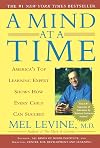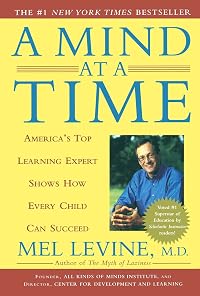
A Mind at a Time
by Mel Levine
On This Page
Description
Different Minds Learn Differently, writes Dr. Mel Levine, one of the best-known education experts and pediatricians in America today. And that's a problem for many children, because most schools still cling to a one-size-fits-all education philosophy. As a result, these children struggle because their learning patterns don't fit the schools they are in. In A Mind at a Time, Dr. Levine shows parents and others who care for children how to identify these individual learning patterns. He show more explains how parents and teachers can encourage a child's strengths and bypass the child's weaknesses. This type of teaching produces satisfaction and achievement instead of frustration and failure. Different brains are differently wired, Dr. Levine explains. There are eight fundamental systems, or components, of learning that draw on a variety of neurodevelopmental capacities. Some students are strong in certain areas and some are strong in others, but no one is equally capable in all eight. Using examples drawn from his own extensive experience, Dr. Levine shows how parents and children can identify their strengths and weaknesses to determine their individual learning styles. For example, some students are creative and write imaginatively but do poorly in history because weak memory skills prevent them from retaining facts. Some students are weak in sequential ordering and can't follow directions. They may test poorly and often don't do well in mathematics. In these cases, Dr. Levine observes, the problem is not a lack of intelligence but a learning style that doesn't fit the assignment. Drawing on his pioneering research and his work with thousands of students, Dr. Levine shows how parents and teachers can develop effective strategies to work through or around these weaknesses. "It's taken for granted in adult society that we cannot all be 'generalists' skilled in every area of learning and mastery. Nevertheless, we apply tremendous pressure to our children to be good at everything. They are expected to shine in math, reading, writing, speaking, spelling, memorization, comprehension, problem solving...and none of us adults can" do all this, observes Dr. Levine. Learning begins in school but it doesn't end there. Frustrating a child's desire to learn will have lifelong repercussions. This frustration can be avoided if we understand that not every child can do equally well in every type of learning. We must begin to pay more attention to individual learning styles, to individual minds, urges Dr. Levine, so that we can maximize children's learning potential. In A Mind at a Time he shows us how. show lessTags
Recommendations

















Member Reviews
This book altered the way I view my students.
America's top learning expert shows how every child can succeed
Interesting thoughts and ideas
From Publishers Weekly
Children have different ways of learning, argues Levine, a professor of pediatrics at the University of North Carolina Medical School and director of its Clinical Center for the Study of Development and Learning, so why do schools behave as though a one-size-fits-all education will work for everyone? Like Howard Gardner's Frames of Mind: The Theory of Multiple Intelligences (1983), Levine's book argues that our educational shortsightedness results in a loss of human potential on a grand scale, as kids who don't fit the mold are misclassified, stigmatized and then fail. If educators could assess differences more intelligently and redesign educational models to account for these differences, they would radically show more improve people's prospects for success in and out of school. Based on his work with children who have learning or behavioral problems, Levine has isolated eight areas of learning (the memory system, the language system, the spatial ordering system, the motor system, etc.). He provides chapters describing how each type of learning works and advises parents and teachers on how to help kids struggling in these areas. Levine emphasizes that all minds have some areas of giftedness and pleads for educators to "make a firm social and political commitment to neurodevelopmental pluralism." Such a plea may seem daunting, but Levine's compassionate, accessible text, framed around actual case studies, makes it seem do-able. This is a must-read for parents and educators who want to understand and improve the school lives of children.
Copyright 2002 Cahners Business Information, Inc. --This text refers to the Hardcover edition. show less
Children have different ways of learning, argues Levine, a professor of pediatrics at the University of North Carolina Medical School and director of its Clinical Center for the Study of Development and Learning, so why do schools behave as though a one-size-fits-all education will work for everyone? Like Howard Gardner's Frames of Mind: The Theory of Multiple Intelligences (1983), Levine's book argues that our educational shortsightedness results in a loss of human potential on a grand scale, as kids who don't fit the mold are misclassified, stigmatized and then fail. If educators could assess differences more intelligently and redesign educational models to account for these differences, they would radically show more improve people's prospects for success in and out of school. Based on his work with children who have learning or behavioral problems, Levine has isolated eight areas of learning (the memory system, the language system, the spatial ordering system, the motor system, etc.). He provides chapters describing how each type of learning works and advises parents and teachers on how to help kids struggling in these areas. Levine emphasizes that all minds have some areas of giftedness and pleads for educators to "make a firm social and political commitment to neurodevelopmental pluralism." Such a plea may seem daunting, but Levine's compassionate, accessible text, framed around actual case studies, makes it seem do-able. This is a must-read for parents and educators who want to understand and improve the school lives of children.
Copyright 2002 Cahners Business Information, Inc. --This text refers to the Hardcover edition. show less
2012 (my brief review can be found on the LibraryThing post linked)
http://www.librarything.com/topic/138560#3746058
http://www.librarything.com/topic/138560#3746058
not reviewed
Ratings
Members
- Recently Added By
Author Information
22 Works 1,451 Members
Dr. Mel Levine is a professor of pediatrics at the University of North Carolina Medical School and the director of the university's Clinical Center for the Study of Development and Learning
Awards and Honors
Distinctions
Common Knowledge
- Original publication date
- 2002
Classifications
- Genres
- Nonfiction, General Nonfiction
- DDC/MDS
- 370.1523 — Society, government, & culture Education Education Theory of education; Meaning; Aim Psychology applied to education Mental processes Learning
- LCC
- LB1060 .L487 — Education Theory and practice of education Theory and practice of education Educational psychology
- BISAC
Statistics
- Members
- 803
- Popularity
- 34,730
- Reviews
- 6
- Rating
- (3.82)
- Languages
- English, French, German, Italian
- Media
- Paper, Audiobook, Ebook
- ISBNs
- 16
- ASINs
- 5