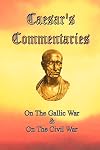
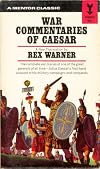
Caesar's War Commentaries
by Julius Caesar
On This Page
Description
"De Bello Gallico" and Other Commentaries (The War Commentaries of Julius Caesar: The War in Gaul and The Civil War)' is a collection of war writings by Julius Caesar. Included in this volume are the first hand recollections of one the most important figures in the history of human civilization, Julius Caesar. 'The Gallic War (Books 1-8)' and 'The Civil War (Books 1-3)' as translated by W. A. Macdevitt are included in this volume.Tags
Recommendations





















Member Reviews
It's a bit dry but it's fascinating to see what the rest of Europe was like 2000 years ago since we don't have many historical records other than these accounts written by foreigners.
Cæsar's celebrated description of his war in Gaul.and the Roman Civil War in which he took part. This is a classic nineeteenth-century translation with introduction by one of the best literary journalists of the time.
An English translation of Julius Caesar s third-person commentaries, originally written as two separate pieces, with his Gaul accounts from 58 to 50 BC and his accounts of the Civil War from 49 to 48 CE. By Martin Bladen (1680-1746), an English military officer and member of both the Irish and British Houses of Commons.
Bladen's translation, dedicated to Marlborough in commemoration of his own Caesar emulating victories, held its place throughout the 18th Century and, to an extent, does so even today; this, in part, is due to its excellent illustrations 'from the designs of Palladio - originating, of course, in continental printings of the 16th century. This English version appeared first in 1705, and was enlarged somewhat in later editions
Bladen's translation, dedicated to Marlborough in commemoration of his own Caesar emulating victories, held its place throughout the 18th Century and, to an extent, does so even today; this, in part, is due to its excellent illustrations 'from the designs of Palladio - originating, of course, in continental printings of the 16th century. This English version appeared first in 1705, and was enlarged somewhat in later editions
With an introduction, notes, a companion to Caesar and a vocabulary.
"your Latin & Greek should be kept up assiduously by reading at spare hours: and, discontinuing the desultory reading of the schools. I would advise you to undertake a regular course of history & poetry in both languages, in Greek, go first thro’ the Cyropaedia ... in Latin read Livy, Caesar, Sallust Tacitus, Cicero’s Philosophies, and some of his Orations, in prose ..." - Thomas Jefferson to Francis Eppes, 6 Oct. 1820
"we have now such excellent elementary books in every branch of science as to make , Start insertion,every, End, subject as plain as a teacher can make it. ... in Antient history the first 20. vols of the Universal history. / Gillies’s history of the world, / Gillies’s history of Greece. / Livy, Sallust, Caesar, show more Taeches, Suadonurs." - Thomas Jefferson to Joseph Echols, 23 May 1822
"In all cases I prefer original author to compilers. for a course of Antient history therefore, of Greece and Rome especially, I should advise the usual suite of Herodotus, Thucydides, Xenophon, Diodorus, Livy, Caesar, Suetonius, Tacitus and Dion, in their originals, if understood, and in translations if not." - Thomas Jefferson to George W. Lewis, 25 Oct. 1825 show less
"we have now such excellent elementary books in every branch of science as to make , Start insertion,every, End, subject as plain as a teacher can make it. ... in Antient history the first 20. vols of the Universal history. / Gillies’s history of the world, / Gillies’s history of Greece. / Livy, Sallust, Caesar, show more Taeches, Suadonurs." - Thomas Jefferson to Joseph Echols, 23 May 1822
"In all cases I prefer original author to compilers. for a course of Antient history therefore, of Greece and Rome especially, I should advise the usual suite of Herodotus, Thucydides, Xenophon, Diodorus, Livy, Caesar, Suetonius, Tacitus and Dion, in their originals, if understood, and in translations if not." - Thomas Jefferson to George W. Lewis, 25 Oct. 1825 show less
GUERRA DE LAS GALIAS
Con el nombre de Comentarios a la guerra de las Galias se conocen los siete libros que Julio César (100-44 a.C.) dedicó a relatar las campañas desarrolladas durante siete años (del 58 al 52) en las Galias, junto con las incursiones en Britania y en el territorio de los germanos: a cada año le corresponde un libro. Con La guerra de las Galias, Julio César pretendía extender la aureola de su fama narrando de una forma aparentemente aséptica la importancia y la dificultad de sus hazañas. Incluso los elogios y reconocimientos a sus lugartenientes eran un medio más de sumarlos a su causa y conservar su colaboración. Pero la verdadera finalidad de la obra es siempre ensalzar y magnificar unos logros bélicos que show more le permitieran rivalizar con Pompeyo.
Se suceden en el relato, tras una descripción geográfica de la Galia, la persecución de los helvecios, la invasión de los germanos y su derrota ante César en la gran batalla del nordeste de Vesantio, la victoria sobre los nervios a orillas del río Sabis, la de las flotas romanas sobre los vénetos, el cruce del Rin, la primera expedición contra Britania (frustrada) y la segunda, hasta más allá del Támesis, el sometimiento de los sublevados eburones de Ambriorix, el levantamiento galo en Cenabum (Orleans) bajo la dirección de Vercingétorix, jefe de los avernos, y su derrota a raíz de las hábiles tácticas de César (que ha regresado de la península Itálica, a la que ha marchado para hacer frente a graves disturbios políticos) y el dominio final sobre la provincia de la Galia Transalpina.
De estos comentarios no sólo interesan los alardes bélicos: la narración está punteada de numerosas descripciones geográficas (Galia, Britania...) y de costumbres de diversos pueblos (galos, germanos...), que aportan una gran amenidad a la lectura. El estilo, sobrio, casi marcial, claro y sin ornato, es el que corresponde a un soldado... show less
Con el nombre de Comentarios a la guerra de las Galias se conocen los siete libros que Julio César (100-44 a.C.) dedicó a relatar las campañas desarrolladas durante siete años (del 58 al 52) en las Galias, junto con las incursiones en Britania y en el territorio de los germanos: a cada año le corresponde un libro. Con La guerra de las Galias, Julio César pretendía extender la aureola de su fama narrando de una forma aparentemente aséptica la importancia y la dificultad de sus hazañas. Incluso los elogios y reconocimientos a sus lugartenientes eran un medio más de sumarlos a su causa y conservar su colaboración. Pero la verdadera finalidad de la obra es siempre ensalzar y magnificar unos logros bélicos que show more le permitieran rivalizar con Pompeyo.
Se suceden en el relato, tras una descripción geográfica de la Galia, la persecución de los helvecios, la invasión de los germanos y su derrota ante César en la gran batalla del nordeste de Vesantio, la victoria sobre los nervios a orillas del río Sabis, la de las flotas romanas sobre los vénetos, el cruce del Rin, la primera expedición contra Britania (frustrada) y la segunda, hasta más allá del Támesis, el sometimiento de los sublevados eburones de Ambriorix, el levantamiento galo en Cenabum (Orleans) bajo la dirección de Vercingétorix, jefe de los avernos, y su derrota a raíz de las hábiles tácticas de César (que ha regresado de la península Itálica, a la que ha marchado para hacer frente a graves disturbios políticos) y el dominio final sobre la provincia de la Galia Transalpina.
De estos comentarios no sólo interesan los alardes bélicos: la narración está punteada de numerosas descripciones geográficas (Galia, Britania...) y de costumbres de diversos pueblos (galos, germanos...), que aportan una gran amenidad a la lectura. El estilo, sobrio, casi marcial, claro y sin ornato, es el que corresponde a un soldado... show less
Mar 18, 2018 (Edited)Spanish
Members
- Recently Added By
Lists

Western Canon
206 works; 2 members
Author Information

Born into a noble family that had fallen from influence, Gaius Julius Caesar secured his future by allying himself early in his life with the popular general and senator, Gaius Marius. Although Caesar's refusal to divorce his wife Cordelia led him to flee Rome for a period, the political and military campaigns he conducted upon his return both show more renewed and increased his prominence. With Senators Crassus and Pompey, he formed the First Triumvirate in 60 and 59 B.C., and for the next 10 years served as governor of several Roman provinces. His decision to assume the position of Roman consul led to war, to an encounter in Egypt with Cleopatra, and ultimately to his position as dictator of Rome. His increasing popularity and power, brought about by the numerous reforms he initiated, led to his assassination by a group of conspirators who feared he would try to make himself king. Caesar left posterity his accounts of his campaigns in Gaul (modern France) and against his rival Pompey. Although the campaigns were self-serving in the extreme, they nevertheless provide an immensely valuable historical source for the last years of the Republic. His works mirror his character. He was an individual of outstanding genius and versatility: a brilliant soldier, a stylist whose lucidity reflects his clarity of vision, an inspiring leader, and a personality of hypnotically attractive charm. But the verdict of antiquity rests upon his single, altogether Roman, flaw-he could not bear to be the second man in the state. To preserve his position, he made war on his political enemies and brought down the Republic. Then, as he was incapable of restoring the republican regime, which had furnished his political contemporaries with a sense of freedom, power, and self-respect, he was stabbed to death by his own friends. (Bowker Author Biography) show less
Some Editions
Series
Belongs to Publisher Series
Work Relationships
Contains
Common Knowledge
- Canonical title
- Caesar's War Commentaries
- Original title
- De Bello Gallico, De Bello Civili
- Alternate titles
- Caesar's Commentaries (Spine) (Spine); War Commentaries of Julius Caesar
- Original publication date
- circa 50 BCE
- People/Characters
- Gaius Julius Caesar; Gnaeus Pompeius Magnus
- Important places
- Roman Empire; Gaul
- Important events
- Roman Civil War; War in Gaul
- Dedication
- To
ALFRED ARNOLD
Homini Coniunctissimo - First words
- There was fire in the older man's eyes as he handed the book to the tall youth.
--Preface (Dutton edition, 1958)
I. The year 102 ʙ.ᴄ., in which Gaius Julius Caesar was born, was one of destiny.
--Introduction (Dutton edition, 1958)
All Gaul is divided into three parts, one of which the Belgæ inhabit, the Aquitani another, those who in their own language are called Celts, in ours Gauls, the third.
(The War in Gaul)
When Caesar's letter was delivered to the consuls, they were with great difficulty, and a hard struggle of the tribunes, prevailed on to suffer it to be read to the senate; but the tribunes could not prevail, that any questio... (show all)n should be put to the senate on the subject of the letter.
(The Civil War) - Last words
- (Click to show. Warning: May contain spoilers.)[He wrote to the Senate urging that Pompey should resign, and offering to do the same: otherwise he was ready to defend himself and the republic.]
--The Gallic Wars, Dutton edition, 1958
His messengers were intercepted, and [17 Nov.] I had him put to death.
--The Civil War, Dutton edition, 1958 - Original language
- Latin
- Disambiguation notice
- This work is for those editions of Caesar's Commentaries that contain The War in Gaul (also called De Bello Gallico) and The Civil War. Please do not combine with works which contain other material.
Classifications
- Genres
- History, Nonfiction, General Nonfiction, Biography & Memoir
- DDC/MDS
- 944.01 — History & geography History of Europe France and Monaco France Early history -987
- LCC
- DC62 .C2 .W36 — History of Europe, Asia, Africa and Oceania France – Andorra – Monaco History of France History By period Early and medieval to 1515 Gauls. Celts. Franks
- BISAC
Statistics
- Members
- 536
- Popularity
- 55,654
- Reviews
- 8
- Rating
- (4.16)
- Languages
- 5 — English, French, Italian, Latin, Spanish
- Media
- Paper, Audiobook, Ebook
- ISBNs
- 43
- ASINs
- 39