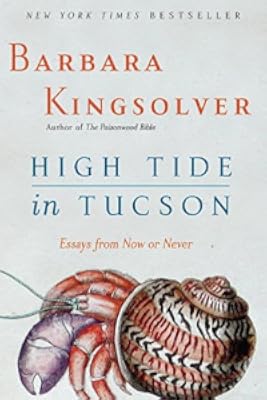
High Tide in Tucson: Essays from Now or Never
by Barbara Kingsolver
On This Page
Description
Barbara Kingsolver has entertained and touched the lives of legions of readers with her critically acclaimed and bestselling novels The Bean Trees, Animal Dreams, and Pigs in Heaven.In these twenty-five newly conceived essays, she returns once again to her favored literary terrain to explore the themes of family, community, and the natural world. With the eyes of a scientist and the vision of a poet, Kingsolver writes about notions as diverse as modern motherhood, the history of private show more property, and the suspended citizenship of humans in the animal kingdom. Her canny pursuit of meaning from an inscrutable world compels us to find instructions for life in surprising places: a museum of atomic bomb relics, a West African voodoo love charm, an iconographic family of paper dolls, the ethics of a wild pig who persistently invades a garden, a battle of wills with a two-year-old, or a troop of oysters who observe high tide in the middle of Illinois.In sharing her thoughts about the urgent business of being alive, kingsolver the essayist employs the same keen eyes, persuasive tongue, and understanding heart that characterize her acclaimed fiction. show lessTags
Recommendations






Member Reviews
I was initially a little jarred by this essay collection, as it covers subjects also discussed by [b:The World Until Yesterday: What Can We Learn from Traditional Societies?|15766601|The World Until Yesterday What Can We Learn from Traditional Societies?|Jared Diamond|https://images.gr-assets.com/books/1461046572s/15766601.jpg|21471299] in a very different manner. After Jared Diamond’s measured prose, Barbara Kingsolver seems disconcertingly folksy. When I adjusted to a different register, however, I came to really enjoy this book. Kingsolver’s writing style is compulsively readable, her commentary on life humane and thoughtful. The essays centre on her life experiences, covering feminism, motherhood, travel, nuclear weapons, the show more first Gulf War, and being a touring writer. The range is appealing and all tales are told amusingly, adroitly, and sympathetically. Given the length of each piece, the book is a light read but memorable for Kingsolver’s way with words and Buster the pet hermit crab. show less
I've tried reading Kingsolver's fiction, but found that it tends to be sentimental and didactic. To me her best strength is nonfiction. Her lyrical prose, which can seem glurgey when telling a fictional story, illuminates nonfiction subjects beautifully. Her ideas, on subjects from childrearing to evolutionary biology, just make so much sense. Kingsolver even convinced me, in an essay on playing keyboard for the writer-rock-band The Rock Bottom Remainders, of the importance of doing things you're bad at in public.
The only minor flaw here is an old-fashioned strain of environmentalism (the book came out in 1995) that places huge importance on endangered species but thinks nothing of living in an area so remote that even basic show more necessities are a long drive away. In this book Kingsolver is one of those old-time nature worshippers who can't understand that living surrounded by wildlife is the opposite of giving it a chance to survive and thrive by staying away. But she made up for that with her recent locavore memoir Animal, Vegetable, Miracle. Even though I didn't agree with all the essays in this book, I loved reading them all. show less
The only minor flaw here is an old-fashioned strain of environmentalism (the book came out in 1995) that places huge importance on endangered species but thinks nothing of living in an area so remote that even basic show more necessities are a long drive away. In this book Kingsolver is one of those old-time nature worshippers who can't understand that living surrounded by wildlife is the opposite of giving it a chance to survive and thrive by staying away. But she made up for that with her recent locavore memoir Animal, Vegetable, Miracle. Even though I didn't agree with all the essays in this book, I loved reading them all. show less
A collection of essays on topics close to home for the author; writing, motherhood, life, freedom, individuality and navigating adulthood to mention a few.
A book to make you think and challenge your thinking. I will never agree with all of her positions, but I don't need to. I do need to read them, because they give insight into other ways of thinking, and they do it in a beautifully written way. Her honesty about her struggles, how and why she thinks and believes the way she does, can only be met with a listening ear.
Then there are the topics we can agree on. Motherhood. The value of life. The joy of watching nature unfold around us. The complexity of people and their ways. When I read her writing on these topics it sounds like poetry show more or song in my ears. I love the way she uses language to enter one's soul. show less
A book to make you think and challenge your thinking. I will never agree with all of her positions, but I don't need to. I do need to read them, because they give insight into other ways of thinking, and they do it in a beautifully written way. Her honesty about her struggles, how and why she thinks and believes the way she does, can only be met with a listening ear.
Then there are the topics we can agree on. Motherhood. The value of life. The joy of watching nature unfold around us. The complexity of people and their ways. When I read her writing on these topics it sounds like poetry show more or song in my ears. I love the way she uses language to enter one's soul. show less
barbara kingsolver is one of those (few, for me) authors whom i read and think to myself, i'd really like to sit on the porch with a glass of wine some evening or a cup of tea some morning, and just talk with her. she is so fascinated by so many different things, and i love finding people like that. reading her writing, then, for me, is always an experience that makes me want to live more, to think more, to know more. i can't ask for more than that from a book. and she delivers every time.
"'If you never stepped on anybody's toes, you never been for a walk.'" (a quote from her grandfather)
and a quote among many that speaks to me as marcy and i step closer to our adoption: "...life with children always bursts to fullness in the narrowest show more passages..." show less
"'If you never stepped on anybody's toes, you never been for a walk.'" (a quote from her grandfather)
and a quote among many that speaks to me as marcy and i step closer to our adoption: "...life with children always bursts to fullness in the narrowest show more passages..." show less
Earlier this year, while in the midst of the high tide of our family's move, I spent several days sorting through piles of papers in our den. Work-related papers, school papers, recipes torn from magazines, writing ideas, artwork created when the kids were in preschool. You get the idea.
One of the papers that I came across was a page torn from an Oprah magazine (probably one circa 1998, as I threw away more than a decade's worth - I wish I was kidding - of such publications). It contained this quote, from "High Tide in Tucson" by Barbara Kingsolver:
"Every one of us is called upon, probably many times, to start a new life. A frightening diagnosis, a marriage, a move, loss of a job .... And onward full tilt we go, pitched and wrecked and show more absurdly resolute, driven in spite of everything to make good on a new shore. To be hopeful, to embrace one possibility after another - that is surely the basic instinct.... crying out: High tide! Time to move out into the glorious debris. Time to take this life for what it is." (pg. 15-16, "High Tide in Tucson")
That resonated with me so much in those darker days of just several months ago, and I knew I had to read High Tide in Tucson sooner rather than later.
And so, I hunkered down this holiday weekend with this collection of 25 essays (some of which Kingsolver previously published elsewhere, some of which were revised for the purposes of this collection) and I found myself absolutely entranced.
Barbara Kingsolver has a lyrical way with words and a style that is so warmly familiar, and oftentimes, dead-on funny. She's an absolute craftsman of the creative nonfiction form, and anyone who writes in that form or wants to hone their skills in that form would be wise to read her work. I think this collection would be invaluable for bloggers, actually. She speaks directly at her reader as she writes of many a varied topic here - the landscape (physical and emotional) of her childhood home of Kentucky; a beloved teacher; the deserts of Tucson that are her adopted home; a pet hermit crab; the myth of private property; a family of paper dolls; Hawaii; the javelinas (wild pigs) that descended each night on the family's desert home, and the life of a writer.
(If you are a writer, this collection is a must read, if only for "In Case You Ever Want to Go Home Again," "Jabberwocky," "The Forest in the Seeds," and the downright hilarious sampling of letters Kingsolver has received as an author, "Careful What You Let in the Door.")
The best thing I can do - the only thing I can do - in this review is to give you a sampling of Kingsolver's prose from High Tide in Tucson and let you judge for yourself just how good she is. And, this too: keep in mind that these words were written for a 1995 publication date. I think they ring true - even moreso, really - today, and that is the true mark of a writer for our time.
"I played with a set of paper dolls called 'The Family of Dolls,' four in number, who came with the factory-assigned names of Dad, Mom, Sis, and Junior. I think you know what they looked like, at least before I loved them to death and their heads fell off.
Now I've replaced the dolls with a life. I knit my days around my daughter's survival and happiness, and am proud to say her head is still on. But we aren't The Family of Dolls. Maybe you aren't either. And if not, even though you are statistically no oddity, it's probably been suggested to you in a hundred ways that yours isn't exactly a real family, but an imposter family, a harbinger of cultural ruin, a slapdash substitute - something like counterfeit money. Here at the tail end of our century, most of us are up to our ears in the noisy business of trying to support and love a thing called family. But there's a current in the air with ferocious moral force that finds its way even into political campaigns, claiming there is only one right way to do it, the Way It Has Always Been.
In the face of a thriving, particolored world, this narrow view is so pickled and absurd I'm astonished that it gets airplay."
(This is in 1995, people. Sixteen years ago. The times, they definitely ain't a changin'.)
"You can fool history sometimes, but you can't fool the memory of your intimates. And thank heavens, because in the broad valley between real life and propriety whole herds of important truths can steal away into the underbrush. I hold that valley to be my home territory as a writer." ("In Case you Ever Want to Go Home Again," pg. 36)
"To find oneself suddenly published is thrilling - that is a given. But how appalling it also felt I find hard to describe. Imagine singing at the top of your lungs in the shower as you always do, then one day turning off the water and throwing back the curtain to see there in your bathroom a crowd of people with videotape. I wanted to throw a towel over my head." ("In Case You Ever Want to Go Home Again," pg. 37)
(That's kind of how I feel sometimes when someone who I know in real life admits they've been reading my blog - when I hadn't known they've actually been doing so.)
For each of these quotes, I could have included ten more. But you get the idea. This is a fabulous, fabulous collection of essays. I can't imagine any better way to spend Thanksgiving weekend.
Except, perhaps, with Ms. Kingsolver herself at the table.
"Any family is a big empty pot, save for what gets thrown in. Each stew turns out different. Generosity, a resolve to turn bad back into good, and respect for variety - these things will nourish a nation of children. Name-calling and suspicion will not. My soup contains a rock or two of hard times, and maybe yours does too. I expect it's a heck of a bouillabaise." ("Stone Soup," pg. 145 of High Tide in Tucson) show less
One of the papers that I came across was a page torn from an Oprah magazine (probably one circa 1998, as I threw away more than a decade's worth - I wish I was kidding - of such publications). It contained this quote, from "High Tide in Tucson" by Barbara Kingsolver:
"Every one of us is called upon, probably many times, to start a new life. A frightening diagnosis, a marriage, a move, loss of a job .... And onward full tilt we go, pitched and wrecked and show more absurdly resolute, driven in spite of everything to make good on a new shore. To be hopeful, to embrace one possibility after another - that is surely the basic instinct.... crying out: High tide! Time to move out into the glorious debris. Time to take this life for what it is." (pg. 15-16, "High Tide in Tucson")
That resonated with me so much in those darker days of just several months ago, and I knew I had to read High Tide in Tucson sooner rather than later.
And so, I hunkered down this holiday weekend with this collection of 25 essays (some of which Kingsolver previously published elsewhere, some of which were revised for the purposes of this collection) and I found myself absolutely entranced.
Barbara Kingsolver has a lyrical way with words and a style that is so warmly familiar, and oftentimes, dead-on funny. She's an absolute craftsman of the creative nonfiction form, and anyone who writes in that form or wants to hone their skills in that form would be wise to read her work. I think this collection would be invaluable for bloggers, actually. She speaks directly at her reader as she writes of many a varied topic here - the landscape (physical and emotional) of her childhood home of Kentucky; a beloved teacher; the deserts of Tucson that are her adopted home; a pet hermit crab; the myth of private property; a family of paper dolls; Hawaii; the javelinas (wild pigs) that descended each night on the family's desert home, and the life of a writer.
(If you are a writer, this collection is a must read, if only for "In Case You Ever Want to Go Home Again," "Jabberwocky," "The Forest in the Seeds," and the downright hilarious sampling of letters Kingsolver has received as an author, "Careful What You Let in the Door.")
The best thing I can do - the only thing I can do - in this review is to give you a sampling of Kingsolver's prose from High Tide in Tucson and let you judge for yourself just how good she is. And, this too: keep in mind that these words were written for a 1995 publication date. I think they ring true - even moreso, really - today, and that is the true mark of a writer for our time.
"I played with a set of paper dolls called 'The Family of Dolls,' four in number, who came with the factory-assigned names of Dad, Mom, Sis, and Junior. I think you know what they looked like, at least before I loved them to death and their heads fell off.
Now I've replaced the dolls with a life. I knit my days around my daughter's survival and happiness, and am proud to say her head is still on. But we aren't The Family of Dolls. Maybe you aren't either. And if not, even though you are statistically no oddity, it's probably been suggested to you in a hundred ways that yours isn't exactly a real family, but an imposter family, a harbinger of cultural ruin, a slapdash substitute - something like counterfeit money. Here at the tail end of our century, most of us are up to our ears in the noisy business of trying to support and love a thing called family. But there's a current in the air with ferocious moral force that finds its way even into political campaigns, claiming there is only one right way to do it, the Way It Has Always Been.
In the face of a thriving, particolored world, this narrow view is so pickled and absurd I'm astonished that it gets airplay."
(This is in 1995, people. Sixteen years ago. The times, they definitely ain't a changin'.)
"You can fool history sometimes, but you can't fool the memory of your intimates. And thank heavens, because in the broad valley between real life and propriety whole herds of important truths can steal away into the underbrush. I hold that valley to be my home territory as a writer." ("In Case you Ever Want to Go Home Again," pg. 36)
"To find oneself suddenly published is thrilling - that is a given. But how appalling it also felt I find hard to describe. Imagine singing at the top of your lungs in the shower as you always do, then one day turning off the water and throwing back the curtain to see there in your bathroom a crowd of people with videotape. I wanted to throw a towel over my head." ("In Case You Ever Want to Go Home Again," pg. 37)
(That's kind of how I feel sometimes when someone who I know in real life admits they've been reading my blog - when I hadn't known they've actually been doing so.)
For each of these quotes, I could have included ten more. But you get the idea. This is a fabulous, fabulous collection of essays. I can't imagine any better way to spend Thanksgiving weekend.
Except, perhaps, with Ms. Kingsolver herself at the table.
"Any family is a big empty pot, save for what gets thrown in. Each stew turns out different. Generosity, a resolve to turn bad back into good, and respect for variety - these things will nourish a nation of children. Name-calling and suspicion will not. My soup contains a rock or two of hard times, and maybe yours does too. I expect it's a heck of a bouillabaise." ("Stone Soup," pg. 145 of High Tide in Tucson) show less
Subtitle: Essays From Now Or Never
Kingsolver was already a successful novelist when this collection of essays was published. She relates her thoughts on family, home, politics, nature, social issues and personal responsibility with humor, compassion, wit and integrity. Her training as a scientist is evident, as is her talent as a poet.
As she ponders what is meaningful in life and what one person’s impact may be, she takes the reader to a number of surprisingly diverse locations and situations: from a small village in West Africa (where she obtained a voodoo love charm), to her backyard (where she battled the wild pigs intent on digging up her lovingly tended plants), to a museum of atomic bomb relics (which she found both fascinating show more and horrifying), to a bird-watching hike in the Virginia mountains. She examines the impact of too much television, or the use of pesticides, against the natural wonder of nature and biodiversity.
As I did with Small Wonder, I read this through as I would a novel. But this collection is probably best enjoyed by reading a chapter/essay now and again. show less
Kingsolver was already a successful novelist when this collection of essays was published. She relates her thoughts on family, home, politics, nature, social issues and personal responsibility with humor, compassion, wit and integrity. Her training as a scientist is evident, as is her talent as a poet.
As she ponders what is meaningful in life and what one person’s impact may be, she takes the reader to a number of surprisingly diverse locations and situations: from a small village in West Africa (where she obtained a voodoo love charm), to her backyard (where she battled the wild pigs intent on digging up her lovingly tended plants), to a museum of atomic bomb relics (which she found both fascinating show more and horrifying), to a bird-watching hike in the Virginia mountains. She examines the impact of too much television, or the use of pesticides, against the natural wonder of nature and biodiversity.
As I did with Small Wonder, I read this through as I would a novel. But this collection is probably best enjoyed by reading a chapter/essay now and again. show less
This collection of essays is my first glimpse into Kingsolver’s writing. To be sure, she’s as good as it gets. Her language is vivid and descriptive, her style mixes sincerity and humor, and her subject matters are poignant yet imaginative. High Tide in Tucson is part memoir, part travel journal and part social commentary – and all enjoyable.
I especially liked the essays where she talked about her writing career. She laments how book writing has become a business like anything. She reminisces about her short foray with a rock band made up of other novelists, including Stephen King and Amy Tan (coincidentally, King describes this band in his memoir, On Writing). She also relives the moment when she gets her first book deal. I show more think, despite her success, Kingsolver is still a vulnerable writer, amazed at her success so far, which makes her so believable to me.
This book has definitely piqued my interest into Kingsolver’s fiction. However, I have one more Kingsolver essay collection to get to first, Small Wonders. show less
I especially liked the essays where she talked about her writing career. She laments how book writing has become a business like anything. She reminisces about her short foray with a rock band made up of other novelists, including Stephen King and Amy Tan (coincidentally, King describes this band in his memoir, On Writing). She also relives the moment when she gets her first book deal. I show more think, despite her success, Kingsolver is still a vulnerable writer, amazed at her success so far, which makes her so believable to me.
This book has definitely piqued my interest into Kingsolver’s fiction. However, I have one more Kingsolver essay collection to get to first, Small Wonders. show less
Members
- Recently Added By
Lists

Best Essay Collections
61 works; 24 members

1990s
309 works; 17 members

Blue Pyramid 1,276 Best Books of All Time
1,248 works; 32 members

Forty Days of Non-Fiction
16 works; 1 member

Short Nonfiction Collections
51 works; 4 members

Books Read in 2020
4,379 works; 123 members
Author Information

46+ Works 98,854 Members
Barbara Kingsolver was born on April 8, 1955 in Annapolis, Maryland and grew up in Eastern Kentucky. As a child, Kingsolver used to beg her mother to tell her bedtime stories. She soon started to write stories and essays of her own, and at the age of nine, she began to keep a journal. After graduating with a degree in biology form De Pauw show more University in Indiana in 1977, Kingsolver pursued graduate studies in biology and ecology at the University of Arizona in Tucson. She earned her Master of Science degree in the early 1980s. A position as a science writer for the University of Arizona soon led Kingsolver into feature writing for journals and newspapers. Her articles have appeared in a number of publications, including The Nation, The New York Times, and Smithsonian magazines. In 1985, she married a chemist, becoming pregnant the following year. During her pregnancy, Kingsolver suffered from insomnia. To ease her boredom when she couldn't sleep, she began writing fiction Barbara Kingsolver's first fiction novel, The Bean Trees, published in 1988, is about a young woman who leaves rural Kentucky and finds herself living in urban Tucson. Since then, Kingsolver has written other novels, including Holding the Line, Homeland, and Pigs in Heaven. In 1995, after the publication of her essay collection High Tide in Tucson: Essays from Now or Never, Kingsolver was awarded an Honorary Doctorate of Letters from her alma mater, De Pauw University. Her latest works include The Lacuna and Flight Behavior. Barbara's nonfiction book, Animal, Vegetable, Miracle was written with her family. This is the true story of the family's adventures as they move to a farm in rural Virginia and vow to eat locally for one year. They grow their own vegetables, raise their own poultry and buy the rest of their food directly from farmers markets and other local sources. (Bowker Author Biography) show less
Awards and Honors
Distinctions
Common Knowledge
- Original publication date
- 1995
- Important places
- Arizona, USA
- Dedication
- for Steven, and for every singing miracle
- First words
- When I told my mother I was making a book of my essays, many of which had been published previously in magazines, she responded with pure maternal advocacy: "Oh, good! I think there are some out there that I've missed." (Pref... (show all)ace)
A hermit crab lives in my house. (High Tide in Tucson) - Quotations
- We can still do everything we could do when we were twenty...except now it hurts
- Last words
- (Click to show. Warning: May contain spoilers.)High tide. (Reprise)
- Original language
- English
Classifications
Statistics
- Members
- 2,429
- Popularity
- 7,999
- Reviews
- 35
- Rating
- (4.05)
- Languages
- English
- Media
- Paper, Audiobook, Ebook
- ISBNs
- 13
- ASINs
- 15