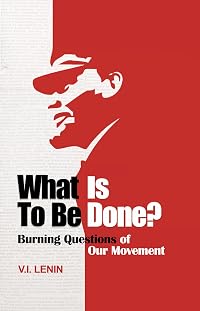
What Is to Be Done?: Burning Questions of Our Movement
by V. I. Lenin
On This Page
Description
2013 Reprint of 1929 Edition. Full facsimile of the original edition, not reproduced with Optical Recognition Software. In "What Is to Be Done?", Lenin argues that the working class will not spontaneously become political simply by fighting economic battles with employers over wages, working hours and the like. To convert the working class to Marxism, Lenin insists that Marxists should form a political party, or "vanguard", of dedicated revolutionaries to spread Marxist political ideas among show more the workers. The pamphlet partly precipitated the split of the Russian Social Democratic Labor Party (RSDLP) between Lenin's Bolsheviks and the Mensheviks and is perhaps the hallmark of Leninism. show lessTags
Recommendations































Member Reviews
Abbiamo capito, Vladimir: quei social-democratici non ti stan simpatici. I sindacati così così. Per prepararci sta rivoluzione invece hai niente da dirci di utile? Ah, no? Pazienza.
At this point this is more of a window into a slice of history, specifically inside the Social-Democratic Party, than it is a theoretical work that speaks to the current conditions. Still, I would recommend it to people interested in discussions around the topic of illegal work, something that(foolishly) doesn't receive much consideration inside the centers of global capitalism.
First published in early 1902, What Is to Be Done? remains a classic of Marxism on the building of the revolutionary party, which sets out the party's role as the organiser and director of the revolution. It was written as part of a conflict with the opportunism of the Economists, who emphasised 'bread and butter issues' rather than theory.
[he] would sit there on the phone
being [German]
for hours
it’s all [German] right
so many miles away
— Eileen Myles, A Working Life
On Social-Media-ism-Leninism
A distant acquaintance of mine, who I consider to be one of my intelligent alter egos, (though he doesn't think of me at all) went on to pursue a doctorate in History with a focus in critical theory, which I think is another way of saying he has read a lot of Adorno and is, presumably, talking German all the time on the telephone. On his social media, where he remains remarkably active despite an "academic" level of engagement, he is posting mostly about upcoming conferences; frequently mentioning pre-print editions of recent work from his colleagues, occasionally endorsing an show more insipid article from The Guardian, and sometimes treating us to a pithy insight in 280 characters or fewer. I am often wondering how his use of social media reflects his education in critical theory. Per Adorno, praxis is essentially oblique to theory, and Posting is neither one nor the other. Adorno was fond of the term "pseudoactivity," which describes a kind of political "signature gathering" that necessarily fails as a Politics, and which remains an accurate descriptor of what one might call, "Posting for Clout." On the other hand, my alter-ego's use of social media, in its hyper-conventional character, recollects Althusser's critique of the "Ideological State Apparatus," which, even as it trains the Marxist, is circumscribing his conditions of possibility via the disciplining apparatus of the academic labor market. (The ease with which the chief character in Lucky Jim obtains a lectureship is now read as the comedy of the hopelessly outdated.)
Adorno, whose work remains popular in these academic circles for being both prescient and touchingly quaint, lies in contrast with Lenin, who nobody appears to be reading at all. Yet among the highest grade of modern left wing voices we still often hear the phrase, "lend the economic struggle itself a political character" (35), as if they were trying, by happenstance, to wake the angry ghost of Lenin. As the historian's interest in Lenin has waned, (Lenin has been sneaking out of academic History, bit by bit, like someone leaving a bad holiday party), perhaps we have come to recognize that the remaining use-value in his work resides in the field of Sociology, which may have been its proper place all along.
Lenin as sociologist is (per Judith Butler), "taking up the tools where they lie" with respect to his discourse on print media in What is to be Done?. In this work, he is concerned with the enormous expenditures of time and energy put into printing physical copies of what are essentially "zines" of the early 20th century. A century later, technology has (per Virgina Woolf), "consumed all impediments," to the zine. Social media lies at the asymptotic limit at which there are as many zines as people, yet Lenin still sounds contemporary when he argues that, "They turn out to be excessively costly in regard to the expenditure of revolutionary forces" (92).
These local newspapers prove, in the majority of cases, to be unstable in their principles, devoid of political significance, extremely costly in regard to expenditure of revolutionary forces, and totally unsatisfactory from a technical point of view. These defects are not accidental; they are the inevitable outcome of the fragmentation which, on the one hand, explains the predominance of local newspapers in the period under review, and, on the other, is fostered by this predominance.
Though Lenin was primarily concerned with a "fragmentation" into discussion of local concerns, we are thinking about social media as perpetuating these concerns from the other extreme, in which it's possible to achieve remarkable conformity/centralization in messaging at the expense of a deterritorialized/fragmented center. (There is no central party coordinating the viral social media post except, perhaps, on the far right.) At the same time, social media is also reterritorializing/solidifying the domain of the individual user along the lines of disenfranchisement. (The archetypal lifecycle of the left-wing social media user begins with his engagement in pseudoactivity and ends with him not even voting.) Lenin's concern that the local paper will, "inevitably degenerate into actual concern with trivialities" (95), is the mirror image of social media's trivial engagement with "actual concerns" (e.g. climate), which it degenerates into pseudoactivity. ("Did you know that 10 corporations produce 90% of emissions?")
Yet perhaps the condition of possibility of a successful movement lies precisely (per Kierkegaard), "in making difficulties everywhere." Marx, in The Eighteenth Brumaire, remarks:
Bourgeois revolutions, rush onward rapidly from success to success, [. . .] then society relapses into a long fit of nervous reaction. Proletarian revolutions, criticize themselves constantly; constantly interrupt themselves in their own course; [. . .] constantly recoil in fear before the undefined monster magnitude of their own objectsIf a modern movement is possible, perhaps its condition results from following through on Lenin's repudiation of "amateurism," of "economism," and of "terrorism" (which is "One Weird Trick" as politics), and in the possibility also of a "slow" pacing, in the recognition that, "the movement itself must not by any means be regarded as a single act, but as a series of more or less powerful outbreaks rapidly alternating with periods of more or less complete calm" (113). That is, if one has not already acquiesced to an understanding of social media as always turning in a lethal movement of reaction. show less
Seguito dagli atti delle sedute del secondo congresso del partito operaio socialdemocratico russo (1903) e dagli scritti di Akimov, Aksel'rod, Bogdanov, Lenin, Martocv, Rajazanov, Plechanov, Vorovskij sul concetto di partito
The book that introduced me to Leninism.
Reviewed in the July 1970 issue of the Socialist Standard:
http://socialiststandardmyspace.blogspot.com/2007/02/lenins-what-is-to-be-done.h...
http://socialiststandardmyspace.blogspot.com/2007/02/lenins-what-is-to-be-done.h...
Members
- Recently Added By
Lists

Philip Ward's Lifetime Reading Plan
592 works; 22 members

All Things Russia
459 works; 11 members

Books Read in 2025
4,128 works; 98 members
Author Information

1,164+ Works 12,841 Members
Creator of the former Soviet Union, Vladimir Ilyich Lenin (family name Ulianov) was born on April 10, 1870 in Simbirsk (later Ulianovsk), Russia, the son of a schools inspector. Lenin received upper class education and obtained a law degree in 1891, but he was moved to oppose the czarist Russian government, partly due to the execution of his show more brother, Alexander, who had participated in a plot to assassinate the Russian emperor. For taking part in revolutionary activities, Lenin was eventually imprisoned, publishing his work, The Development of Capitalism in Russia, from prison in 1899. Three years later, his pamphlet "What Is to Be Done" became the model for Communist philosophy. Lenin helped the Bolshevist movement that overthrew the czarist government and brought an end to Russia's war against Germany. As head of the new government, he put land in the hands of the peasants and brought industry under government control. An assassination attempt in 1918 wounded him, and two strokes in 1922 forced him to severely curtail government duty. He retreated to his country home in Gorki, where he died on January 21, 1924. (Bowker Author Biography) show less
Some Editions
Series
Belongs to Publisher Series
Work Relationships
Common Knowledge
- Canonical title*
- Mitä on tehtävä?
- Original title
- Mitä on tehtävä?
- Original publication date
- 1903
*Some information comes from Common Knowledge in other languages. Click "Edit" for more information.
Classifications
- Genres
- Nonfiction, Politics and Government, General Nonfiction, History, Philosophy
- DDC/MDS
- 335.430947 — Society, government, & culture Economics Socialism and related systems Marxian systems Communism History, geographic treatment, biography Europe Eastern Europe Russia
- LCC
- HX314 .L342 — Social sciences Socialism. Communism. Anarchism Socialism. Communism. Anarchism
- BISAC
Statistics
- Members
- 968
- Popularity
- 27,378
- Reviews
- 11
- Rating
- (3.68)
- Languages
- 13 — Chinese, Dutch, English, Finnish, French, German, Italian, Norwegian (Bokmål), Portuguese, Russian, Spanish, Swedish, Turkish
- Media
- Paper, Audiobook, Ebook
- ISBNs
- 49
- ASINs
- 44