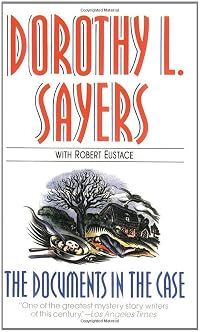
The Documents in the Case
by Dorothy L. Sayers, Robert Eustace
On This Page
Description
The bed was broken and tilted grotesquely sideways. Harrison was sprawled over in a huddle of soiled blankets. His mouth was twisted . . . Harrison had been an expert on deadly mushrooms. How was it then that he had eaten a large quantity of death-dealing muscarine? Was it an accident? Suicide? Or murder? The documents in the case seemed to be a simple collection of love notes and letters home. But they concealed a clue to the brilliant murderer who baffled the best minds in London. show more 'She combined literary prose with powerful suspense, and it takes a rare talent to achieve that. A truly great storyteller.' Minette Walters show lessTags
Recommendations
















Member Reviews
Although this isn't a Peter Wimsey story it's set in the same world (where Sir James Lubbock is the Home Office analyst). The story is told, firstly through letters, then through written statements, and finally in the first person. Its a story of suburban melodrama and eventually murder, and it's quite fascinating to see the story emerge from the multiple narrators, all of whom are unreliable, although eventually the focus coalesces to one sympathetic voice. The science is also fascinating, and is from the contribution by Robert Eustace, pen name for Dr Eustace Barton. Evidently Sayers was not satisfied with this work but I find it a worthy addition to her oevure.
An excellent example of the epistolary novel format where the story is gradually unveiled through letters and supporting documents rather than a prose narrative. Sayers presents distinctive voices and perspectives for each of the four main correspondents that establishes each as an unreliable narrator so you’re never quite sure where your sympathies should lie. The central mystery and solving of the crime itself takes a definite back seat to the human drama on offer here.
No Peter Wimsey this time. A narrative told by means of letters and witness statements, describing the relationships between the Harrisons and the artist and writer who move in above them. Mr Harrison eventually dies an horrific death from mushroom poisoning and the dossier is put together by his son in an attempt to persuade the Crown to prosecute the person he believes was responsible.
While it had its moments: the letters by Mrs Harrison and her companion are good, and I liked the way the common man was held consistently to view the artistic community with suspicion. However, I found the structure messy and the pace uneven. There were long passages musing the meaning of life and science versus religion etc which I skipped over.
While it had its moments: the letters by Mrs Harrison and her companion are good, and I liked the way the common man was held consistently to view the artistic community with suspicion. However, I found the structure messy and the pace uneven. There were long passages musing the meaning of life and science versus religion etc which I skipped over.
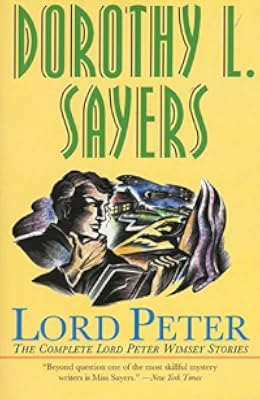
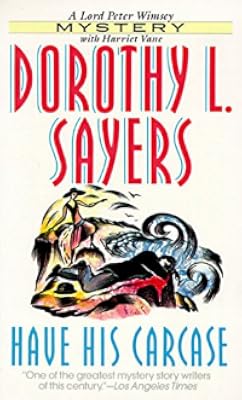
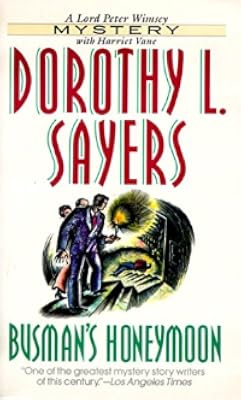
An "epistolary" novel, except that not every document is a letter. The front cover of the copy I checked out deceives with an image of Lord Peter.
No heroes to be found in this one. The narrators are all unreliable. Nobody really comes off well. The son is devoted and determined and despises the author. The author was fond of the dead man and dislikes everybody else, except his wife. etc. The adulterous letters are inexpressibly tedious.
Fun as a period piece; the mystery is resolved with the help of modern physics, which at the time was a very contemporary topic. Discussions of religion vs. science as is to be expected in a Dorothy Sayers novel.
No heroes to be found in this one. The narrators are all unreliable. Nobody really comes off well. The son is devoted and determined and despises the author. The author was fond of the dead man and dislikes everybody else, except his wife. etc. The adulterous letters are inexpressibly tedious.
Fun as a period piece; the mystery is resolved with the help of modern physics, which at the time was a very contemporary topic. Discussions of religion vs. science as is to be expected in a Dorothy Sayers novel.
Yet another book confirming my very high opinion of Dorothy Sayers. This is her take on an epistolary novel, although it's not composed of letters only. As the title suggests, the novel consists of a range of documents which together form a prosecution brief. As is so often the case with Sayers, the mystery is only a part of what the book is about. While there is a mystery, the point of it is the "how" rather than the "who". The novel is also a dissertation on creation and the origin of life. I will freely admit that the science largely went over my head, but it actually didn't matter. I understood enough to be impressed. And then there was the wit, the passion and that fierce intelligence which characterises Sayers. In short, I loved it.
A very different kind of work from the Lord Peter Wimsey novels, this book is presented as a dossier of materials prepared by the son of a murder victim in an effort to get justice for his father. It includes letters from a variety of different people, including the dead man’s wife, her companion, and their upstairs lodger, as well as individual statements. The variety of viewpoints challenges the reader as you feel yourself drawn to different characters at different times—and eventually learn that one witness has been institutionalized. By and large, most of the characters manage to present themselves as decent sorts, yet seen through each other’s eyes, they become a prig, an intellectual snob, a harridan, etc. It is more slow to show more develop than most mysteries; no one dies until halfway through, after some fairly elaborate stage setting. Still, for a reader who enjoys more intense character development, The Documents in the Case is both a satisfying mystery and something different from the usual entry in the genre. show less
Unlike her other mysteries, this one is told in an epistolary style, which sometimes doesn't work very well. In this case, though, it is pulled off to good effect.
Members
- Recently Added By
Lists

Crime and Mysteries to Read
746 works; 31 members

Survey of Mysteries and Crime Fiction
96 works; 17 members

British Mystery
469 works; 14 members

Murder Mysteries
57 works; 11 members

H.R.F. Keating's 100 Best Crime & Mystery Books
100 works; 8 members

Haycraft Queen Cornerstones
181 works; 3 members
Detective Stories
343 works; 5 members

Books You Bought in 2013
35 works; 3 members

Epistolary Books
105 works; 27 members

Books Read in 2013
1,630 works; 51 members

#MysteryBingo2021Gold(Original)
36 works; 1 member
#JustTheFacts2021Gold
60 works; 1 member

Favorite Epistolary Fiction
143 works; 144 members
Must Read Detective Stories (Nick Fuller)
278 works; 2 members
Author Information

281+ Works 70,889 Members
Dorothy Sayers's impressive reputation as a contemporary master of the classic detective story is eclipsed only by Agatha Christie's. Sayers was born in Oxford and attended Somerville College, where she received a B.A. in 1915 and an M.A. in 1920. During that period, Sayers worked as an instructor of modern languages at Hull High School for Girls show more in Yorkshire and as a reader for a publisher in Oxford. Her early literary work was in poetry; she published several volumes and served as an editor for the journal Oxford Poetry from 1917 to 1919. Sayers also worked as a copywriter for a major advertising firm in London. She was president of the Modern Language Association from 1939 to 1945 and of the Detection Club in the 1950s. Around 1920 Sayers developed the idea for her detective hero Lord Peter Wimsey, and she soon published her first mystery, Whose Body? (1923), in which Lord Peter is introduced. For the next dozen or so years, Sayers wrote prolifically about Wimsey, creating in the process what many critics of the genre consider to be the finest detective novels in the English language. Perhaps her most famous Wimsey mystery was The Nine Tailors (1934). Although Sayers essentially followed the classic form in her detective fiction---a formula in which the plot assumes a greater importance than do the characters---Sayers maintained that a detective hero's greatness depended on how effectively the character was portrayed. All but one of Sayers's mysteries feature Lord Peter Wimsey. By the late 1930s, Sayers had apparently tired of writing detective fiction. She stated in 1947 that she would write no more mysteries, that she wrote detective fiction only when she was young and in need of money. Thus saying, Sayers turned her attention to her early loves, medieval and religious literature, spending her remaining years lecturing on and translating Dante (see Vol. 2). (Bowker Author Biography) show less
31+ Works 1,842 Members
Some Editions
Awards and Honors
Notable Lists
Series
Belongs to Publisher Series
Work Relationships
Is contained in
Common Knowledge
- Canonical title
- The Documents in the Case
- Original title
- The Documents in the Case
- Original publication date
- 1930
- People/Characters
- George Harrison; Margaret Harrison; Paul Harrison; Harwood Lathom; Agatha Milsom; Jack Munting (show all 7); Lathom
- Important places
- Devon, England, UK
- First words
- My dear Olive,
Thank you very much for your letter and kind inquiries after my health. - Last words
- (Click to show. Warning: May contain spoilers.)The execution took place in Exeter Gaol, at 8 a.m. today, of Harwood Lathom, who was convicted in October of the murder of George Harrison at "The Shack," Manaton by poisoning him with muscarine.
- Original language
- English UK
- Canonical DDC/MDS
- 823.912
- Canonical LCC
- PR6037.A95
Classifications
Statistics
- Members
- 1,729
- Popularity
- 12,776
- Reviews
- 28
- Rating
- (3.71)
- Languages
- 7 — Danish, Dutch, English, French, German, Italian, Japanese
- Media
- Paper, Audiobook, Ebook
- ISBNs
- 36
- ASINs
- 42
