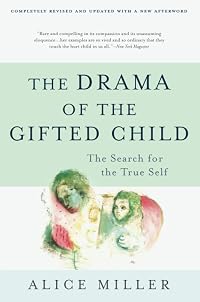
The Drama of the Gifted Child: The Search for the True Self
by Alice Miller
On This Page
Description
This bestselling book examines childhood trauma and the enduring effects it has on an individual's management of repressed anger and pain. Why are many of the most successful people plagued by feelings of emptiness and alienation? This wise and profound book has provided millions of readers with an answer--and has helped them to apply it to their own lives. Far too many of us had to learn as children to hide our own feelings, needs, and memories skillfully in order to meet our parents' show more expectations and win their "love." Alice Miller writes, "When I used the word 'gifted' in the title, I had in mind neither children who receive high grades in school nor children talented in a special way. I simply meant all of us who have survived an abusive childhood thanks to an ability to adapt even to unspeakable cruelty by becoming numb.... Without this 'gift' offered us by nature, we would not have survived." But merely surviving is not enough. The Drama of the Gifted Child helps us to reclaim our life by discovering our own crucial needs and our own truth. show lessTags
Recommendations















Member Reviews
Alice Miller nails it. Children who are prevented from developing an authentic self by narcissistic or otherwise harmful and inadequate parenting will find validation, solace, and guidance through the resulting pain, anger, and confusion. I wish the author had used a less misleading title.
I just finished this book and will revisit this review later.
I have been going to therapy for 4 years, starting with psychoanalysis and recently switching to modern CBT. I believe that the impact this book had on me was only made possible with the help of my wonderful therapists.
That said, this book unlocked something deep and important in me. I cried several times throughout reading it, and upon finishing, had the biggest and longest cry of my adult life. The rage, fear, and sadness that I had bottled up inside, the crying, lonely, abused boy inside of me, could finally express himself fully.
I believe that this process has only begun, and it will take many more months for that child in me to truly feel safe, seen, respected, and show more loved.
Thank you, Alice Miller, for this book. It has been life-changing.
My personal next step, and what I recommend for those who have finished reading this book, is to read about and understand what it means to forgive. If we do not forgive, we cannot truly move on. But the first step is understanding and acceptance, which this book helped me do. show less
I have been going to therapy for 4 years, starting with psychoanalysis and recently switching to modern CBT. I believe that the impact this book had on me was only made possible with the help of my wonderful therapists.
That said, this book unlocked something deep and important in me. I cried several times throughout reading it, and upon finishing, had the biggest and longest cry of my adult life. The rage, fear, and sadness that I had bottled up inside, the crying, lonely, abused boy inside of me, could finally express himself fully.
I believe that this process has only begun, and it will take many more months for that child in me to truly feel safe, seen, respected, and show more loved.
Thank you, Alice Miller, for this book. It has been life-changing.
My personal next step, and what I recommend for those who have finished reading this book, is to read about and understand what it means to forgive. If we do not forgive, we cannot truly move on. But the first step is understanding and acceptance, which this book helped me do. show less
The title here is a bit of a misnomer - 'Gifted Child' in this sense does not necessarily mean a child of academic gifts, but one with an attuned empathetic sense, and thus susceptible to emotional abuse. When this sense is combined with a deficiency or disorder on the part of the parent - anxiety, manic-depressive, etc., the child has to go to extreme lengths.
This creates two 'selves' - the 'true self' - that is, the child's own 'genuine' personality and needs, and the 'false self', complying, totally obedient, utterly withdrawn, willing to lie in order to present a false happy image. The true self is subsumed to the lie, or the false self. The personal needs are neglected.
Now what's the problem with all this, you ask? If a child is show more intelligent enough to perform on their own, and emotionally intelligent enough to perceive what their parents want, they may yet be ignored or blindsided in order for the parent to perform their own needs first, and the child's as secondary or auxiliary.
Such a book is extremely uncomfortable to read. Perhaps for many it hits too hard. Although there have been some (many?) superseding advances in developmental environmental psychology as well as the epigenetics of mental disorder and abuse, this is still a fascinating read. show less
This creates two 'selves' - the 'true self' - that is, the child's own 'genuine' personality and needs, and the 'false self', complying, totally obedient, utterly withdrawn, willing to lie in order to present a false happy image. The true self is subsumed to the lie, or the false self. The personal needs are neglected.
Now what's the problem with all this, you ask? If a child is show more intelligent enough to perform on their own, and emotionally intelligent enough to perceive what their parents want, they may yet be ignored or blindsided in order for the parent to perform their own needs first, and the child's as secondary or auxiliary.
Such a book is extremely uncomfortable to read. Perhaps for many it hits too hard. Although there have been some (many?) superseding advances in developmental environmental psychology as well as the epigenetics of mental disorder and abuse, this is still a fascinating read. show less
If you don’t understand how why you do the things you do, don’t write it off as “it’s just how you are.” There is an internal prize of higher value than anything material for those who bravely seek self understanding and acceptance.
I originally rated this 2 stars when I first read it. I found hard to follow. After it was recommended to me again, I gave it a 2nd chance. So glad I did; I would give it 6 or more stars if I could. I wasn’t 'ready' to read it before. I get it now and found it eye opening and fascinating. I’ll probably read it a 3rd time.
I originally rated this 2 stars when I first read it. I found hard to follow. After it was recommended to me again, I gave it a 2nd chance. So glad I did; I would give it 6 or more stars if I could. I wasn’t 'ready' to read it before. I get it now and found it eye opening and fascinating. I’ll probably read it a 3rd time.
I feel like Alice Miller makes a very strong case for her theses and for the most part I am convinced. The only criticism I have is, that she uses her theory so broadly at some points, that it seems to render large parts of psychological research on depression, aggression etc. obsolete. The human psyche is more complex than what she makes it to look like, is what I'm trying to say. But please don't be put off by my critique, it is a compelling read and her focus on the early child-parent-relationship and it's effects on child development is really eye-opening.
Not a book for new parents as it would scare them to death. Miller says all feelings, psychological make up all happen at the very ages of childhood. That you can trace one’s personality to events at the earliest ages. Furthermore you can’t correct these personality traits until the patient can come back to the true root event that defines that trait today. Makes it all seem hopeless. There was lots of good thought provoking material that makes one see how his actions are consistent and define him. Why you are like this and do this, well you need to remember way back to when you were in diapers to truly understand yourself.
Alice Miller gives the impression that she believes every child has been abused. Maybe so. I found this book confusing at times, such as when she connects war and child abuse without explanation. It also seems somewhat dated, in that she describes therapists who are unwilling to talk about childhood, whereas today that seems one of the most common topics. But the most frustrating part is that she continually refers to a four-step method that she does not explain until the last few pages of the book.
Members
- Recently Added By
Lists

Books on My Journey
18 works; 1 member

Favourite Books
1,820 works; 311 members

Books Read in 2014
2,344 works; 89 members

Blue Pyramid 1,276 Best Books of All Time
1,248 works; 32 members

Books Read in 2019
4,052 works; 108 members

Men's healing resources
750 works; 1 member
Author Information

23+ Works 6,147 Members
Some Editions
Series
Belongs to Publisher Series
suhrkamp taschenbuch (950)
Common Knowledge
- Canonical title
- The Drama of the Gifted Child: The Search for the True Self
- Original title
- Das Drama des begabten Kindes
- Original publication date
- 1979
- First words
- Experience has taught us that we have only one enduring weapon in our struggle against mental illness: the emotional discovery of the truth about the unique history of our childhood.
- Last words
- (Click to show. Warning: May contain spoilers.)Fortunately, at the same time, we now have the tools we need to truly understand ourselves, as we were and as we are.
(Click to show. Warning: May contain spoilers.)The child you have found by reading Drama will hopefully lead you to read the material on the Web site, to find the information you may need today and to benefit from it. - Afterword to the 2007 Edition - Original language
- German
- Canonical DDC/MDS
- 155.4; 155
- Canonical LCC
- RC569.5.C55M55313
Classifications
- Genres
- General Nonfiction, Nonfiction
- DDC/MDS
- 155.4 — Philosophy & psychology Psychology Differential and developmental psychology Childhood
- LCC
- RC569.5 .C55 .M55313 — Medicine Internal medicine Internal medicine Neurosciences. Biological psychiatry. Neuropsychiatry Psychiatry Psychopathology Personality disorders. Behavior problems
- BISAC
Statistics
- Members
- 2,872
- Popularity
- 6,327
- Reviews
- 29
- Rating
- (3.94)
- Languages
- 17 — Czech, Danish, Dutch, English, Finnish, French, German, Greek, Hungarian, Italian, Norwegian (Bokmål), Polish, Portuguese, Russian, Spanish, Swedish, Turkish
- Media
- Paper, Audiobook, Ebook
- ISBNs
- 75
- ASINs
- 35