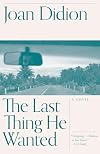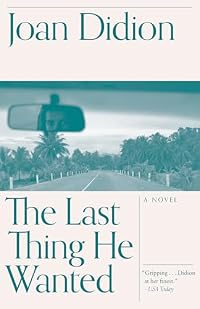
The Last Thing He Wanted
by Joan Didion
On This Page
Description
A woman journalist quits her job on a Washington paper to look after her father, living on a Caribbean island where he smuggles guns to rebels in Central America. When he falls sick, she takes over.Tags
Recommendations
















Member Reviews
I'm not sure I want to work as hard as this book requires I work. Not for pleasure reading, at any rate. And it doesn't work as informing reading either, because what I learned added little to the historic context I got off wiki.
Central history: mining of Nicaragua's export harbors by the US through CIA operatives planted in Costa Rica, Honduras etc. Done illegally under the Reagan administration, Oliver North the key figure, Barry Goldwater/the Senate Select Committee on Intelligence were kept out of the loop. (1979 was the Iran-Contra affair, where the US continued aid to the contras after claiming to cut it off - again, North at healm.)
The mines were meant to help the contras by disrupting trade (damaging and scaring ships, not show more destroying them) and adding aconomic pressure on the Sandanista government. (US doesn't care for Sandanista ties to Cuba & the Soviet Union.) This took place in 1984. Afterwards, Daniel Ortega elected and his Sandanista govt. continues to rule pretty much thereafter, and once US lifts trade embargo the contras cease fighting.
Rough story - which you can fully patch together only at the conclusion of the book, since it's not revealed chronologically or even logically:
Elena McMahon, daughter of Dick McMahon who is a life-long arms supplier w/o loyalties who nonetheless, it seems, works mostly for US interests. Had some involvement in Kennedy assassination and Cuba.
Elena: reporter for LA Herald. Then marries Wynn Janklow and becomes socialite housewife. Gets cancer. Divorces, puts daughter in boarding school and goes to work for some unnamed person's campaign. Her mom dies and she leaves campaign to care for demented father. Father requests she complete one last mission (the last thing he wanted); she flies arms to Costa Rica but instead of being paid gets stuck there, is moved to a small island, finds out her dad is dead, realizes now her own daughter is in danger, and waits on this unnamed island, becomes manager of small hotel to pass time, meets Treat Morrison, a DIA agent who is sent down to follow up on an FBI probe of Elena launched when she accidentally reveals phony passport given to her in course of shady business.
So that's the external plot. Internal: well, Elena has dreams that narrator says signify death by cancer. But I think the death is really the loss of identity thru marriage? So maybe cancer's the metaphor for that? And her eventual beating of cancer is the triumph of the self, the rejection of the not-her? And this becoming a leaver (leaves husband, considers leaving Catherine, leaves job) is part of the reclamation? Is the cancer the permission to make the changes?
Questions:
Are we supposed to know whose campaign she's on, does it matter, how would the reader figure it out and what does it mean?
What's with the narrator? Only slowly do you piece together that it was a fellow housewife/mom from Elena's married days, who also ends up being a reporter, who studies the whole incident. The narrator's chilly attitude about Elena underscores the bloodless nature of everyone in the book.
Who the fuck is Max Epperson? Very annoying.
Confrontation at Surfrider between Elena, Bob Weir and Paul - has Paul given Elena up?
This may be a case where literary fiction is as annoying as it's accused of being. The releasing of the story in convoluted swirls: occasionally intriguing and even captivating, more often annoying. Layers - convoluted circles within circles.
I guess in the end I admire the clearly brilliant development of this story but must conclude it was not a success, at least for a genre reader like myself. show less
Central history: mining of Nicaragua's export harbors by the US through CIA operatives planted in Costa Rica, Honduras etc. Done illegally under the Reagan administration, Oliver North the key figure, Barry Goldwater/the Senate Select Committee on Intelligence were kept out of the loop. (1979 was the Iran-Contra affair, where the US continued aid to the contras after claiming to cut it off - again, North at healm.)
The mines were meant to help the contras by disrupting trade (damaging and scaring ships, not show more destroying them) and adding aconomic pressure on the Sandanista government. (US doesn't care for Sandanista ties to Cuba & the Soviet Union.) This took place in 1984. Afterwards, Daniel Ortega elected and his Sandanista govt. continues to rule pretty much thereafter, and once US lifts trade embargo the contras cease fighting.
Rough story - which you can fully patch together only at the conclusion of the book, since it's not revealed chronologically or even logically:
Elena McMahon, daughter of Dick McMahon who is a life-long arms supplier w/o loyalties who nonetheless, it seems, works mostly for US interests. Had some involvement in Kennedy assassination and Cuba.
Elena: reporter for LA Herald. Then marries Wynn Janklow and becomes socialite housewife. Gets cancer. Divorces, puts daughter in boarding school and goes to work for some unnamed person's campaign. Her mom dies and she leaves campaign to care for demented father. Father requests she complete one last mission (the last thing he wanted); she flies arms to Costa Rica but instead of being paid gets stuck there, is moved to a small island, finds out her dad is dead, realizes now her own daughter is in danger, and waits on this unnamed island, becomes manager of small hotel to pass time, meets Treat Morrison, a DIA agent who is sent down to follow up on an FBI probe of Elena launched when she accidentally reveals phony passport given to her in course of shady business.
So that's the external plot. Internal: well, Elena has dreams that narrator says signify death by cancer. But I think the death is really the loss of identity thru marriage? So maybe cancer's the metaphor for that? And her eventual beating of cancer is the triumph of the self, the rejection of the not-her? And this becoming a leaver (leaves husband, considers leaving Catherine, leaves job) is part of the reclamation? Is the cancer the permission to make the changes?
Questions:
Are we supposed to know whose campaign she's on, does it matter, how would the reader figure it out and what does it mean?
What's with the narrator? Only slowly do you piece together that it was a fellow housewife/mom from Elena's married days, who also ends up being a reporter, who studies the whole incident. The narrator's chilly attitude about Elena underscores the bloodless nature of everyone in the book.
Who the fuck is Max Epperson? Very annoying.
Confrontation at Surfrider between Elena, Bob Weir and Paul - has Paul given Elena up?
This may be a case where literary fiction is as annoying as it's accused of being. The releasing of the story in convoluted swirls: occasionally intriguing and even captivating, more often annoying. Layers - convoluted circles within circles.
I guess in the end I admire the clearly brilliant development of this story but must conclude it was not a success, at least for a genre reader like myself. show less
It is in my nature to decline assessments of the writings of people to whom I look up in awe and gratitude for what they have given us. I liked this book a whole lot and intend to read it again in the not too distant future. It is a gem, IMHO!
A mystery within a mystery? Oh, you've heard that phrase before. Yes, it is a mystery and it treats of some people who are .... Oh, I'm going to stop there. It is brief, it is fascinating, and you are better off reading it cold. Enjoy!
A mystery within a mystery? Oh, you've heard that phrase before. Yes, it is a mystery and it treats of some people who are .... Oh, I'm going to stop there. It is brief, it is fascinating, and you are better off reading it cold. Enjoy!
Having never read Joan Didion before, I was expecting great things from her writing. The premise of this novel got my attention, yet I was unimpressed by the writing and had a hard time following the story. This would have been okay, if the character development had been really amazing, but that too fell flat. I don't think I'll be reading any more Didion any time soon.
I had to give up on this one out of sheer frustration after hitting Chapter 11 and realising I still had no idea what was going on. I didn't find myself engaging with either the characters, the plot or the writing style.
The Last Thing He Wanted is a political drama mixed with a romance. Not a great combination. Not some of Didion's best work.
"have read" is a stretch. [x] didion. "check that box", uncatalogue the remainder of her oeuvre.
One of the best books I've read. Loved it.
Members
- Recently Added By
Lists

Books Read in 2017
4,249 works; 129 members
Author Information

56+ Works 36,248 Members
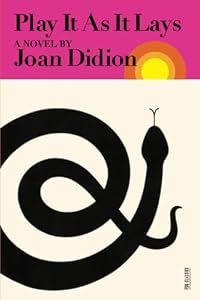
Born in Sacramento, California, on December 5, 1934, Joan Didion received a B.A. from the University of California, Berkeley in 1956. She wrote for Vogue from 1956 to 1963, and was visiting regent's lecturer in English at the University of California, Berkeley in 1976. Didion also published novels, short stories, social commentary, and essays. Her show more work often comments on social disorder. Didion wrote for years on her native California; from there her perspective broadened and turned to the countries of Central America and Southeast Asia. Her novels include Democracy (1984) and The Last Thing He Wanted (1996). Well known nonfiction titles include Slouching Towards Bethlehem (1968), The White Album (1979), The Year of Magical Thinking (2005) and Blue Nights (2011). In 1971 Joan Didion was nominated for the National Book Award in fiction for Play It As It Lays. In 1981 she received the American Book Award in nonfiction, and was nominated for a National Book Critics Circle Prize in nonfiction for The White Album. Didion has received a great deal of recognition for The Year of Magical Thinking, which was awarded the National Book Award for Nonfiction in 2005. In 2007, Didion received the National Book Foundation's annual Medal for Distinguished Contribution to American Letters. In 2009, Didion was awarded an honorary Doctor of Letters degree by Harvard University. On July 3, 2013 the White House announced Didion was one of the recipients of the National Medals of Arts and Humanities presented by President Barack Obama. (Bowker Author Biography) show less
Some Editions
Awards and Honors
Awards
Distinctions
Common Knowledge
- Canonical title*
- Det sista han ville
- Original title
- The Last Thing He Wanted
- Original publication date
- 1996
- Related movies
- The Last Thing He Wanted (2019 | IMDb)
- Dedication
- This books is for Quintana and for John
- First words
- Some real things have happened lately.
- Last words
- (Click to show. Warning: May contain spoilers.)I want those two to have been together all their lives. 23 Janurary 1996
*Some information comes from Common Knowledge in other languages. Click "Edit" for more information.
Classifications
Statistics
- Members
- 738
- Popularity
- 38,062
- Reviews
- 8
- Rating
- (3.42)
- Languages
- 5 — English, Italian, Portuguese, Spanish, Swedish
- Media
- Paper, Audiobook, Ebook
- ISBNs
- 17
- ASINs
- 8