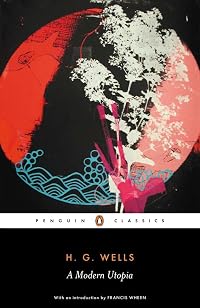
A Modern Utopia
by H. G. Wells
On This Page
Description
H. G. Wells' A Modern Utopia is a fusion of fiction and philosophy. In it Wells' explores his ideas for social change, the creation of a world state and of what would be needed to facilitate increases in overall human happiness. The people of this utopia have to plan for "a flexible common compromise, in which a perpetually novel succession of individualities may converge most effectually upon a comprehensive onward development." This is Wells' distinction from past conceptions of utopia, show more that its people aim to be Utopian and that they are essentially the same people that would exist in an ordinary society.. show less
Tags
Recommendations































Member Reviews
Suppose then for a moment, that there is an all-round inferior race; a Modern Utopia is under the hard logic of life, and it would have to exterminate such a race as quickly as it could. On the whole, the Fijian device [creating conditions that lead to "race suicide" from lack of reproduction] seems the least cruel. But Utopia would do that without any clumsiness of race distinction, in exactly the same manner, and by the same machinery, as it exterminates all its own defective and inferior strains; that is to say, as we have already discussed [...], by its marriage laws, and by the laws of minimum wage. That extinction need never be discriminatory. If any of the race did, after all, prove to be fit to survive, they would survive – show more they would be picked out with a sure and automatic justice from the over-ready condemnation of all their kind. (225)
I'm no Adam Roberts, but there are few significant Wells novels that I haven't read at this point. Out of the top twenty on LibraryThing (excluding omnibus editions), I've read fifteen. With A Modern Utopia, I can bring that number up to sixteen. I picked up A Modern Utopia and read it because of my chapter on eugenicist novels; I cap that chapter off with a reading of The War of the Worlds as an anti-eugenicist novel, so it seemed important to read Wells's later books where he advocates for eugenics. The two prominent ones were Anticipations (1901) and A Modern Utopia (1904-5), and since it was easier to get ahold of A Modern Utopia, I read it first even though it was published later.
In this book, Wells's narrator (clearly a fictionalized Wells) and a botanist friend (based, the "Note on the Text" in my Penguin edition tells me, on his friend Graham Wallas, a lecturer in political science) are spontaneously transported to Utopia, a planet exactly identical to Earth in geography and inhabitants, except that it is, well, a utopia. This allows Wells to expound what he think a utopia would look like, contrasting it against our world. So short passages about what the two characters are up to are interspersed with Wellsian discourse on an ideal society. Wells is smarter than many when it comes to thinking these kind of things through, and he wants you to know it; he highlights how he rejects the fallacies of people like Comte and Bellamy, and he recycles his joke about utopian cicerones from The Time Machine. It's all very worthy, and Wells deploys some wit, but you know, don't come here looking for another War of the Worlds or even Love and Mr Lewisham.
The key bits for me were from the section I quoted above, when Wells lays out his eugenics idea. The main thing you can say about it is that Wells is much less racist and good deal more "rational" than many of his contemporaries, and indeed, even himself back when he wrote Anticipations. After the bit I quoted above, he goes on to say probably no race is worse than any other when in utopian conditions, but we won't really know that until we've got some. English intellectual society was swimming in this stuff then, so it's not too surprising Wells couldn't see out of it, even if War of the Worlds would seem to indicate he ought to have been able to. I guess he gets further than many.
Wells does not convincingly lay out a utopia I feel like I'd actually want to live in, but then, who does? show less
I'm no Adam Roberts, but there are few significant Wells novels that I haven't read at this point. Out of the top twenty on LibraryThing (excluding omnibus editions), I've read fifteen. With A Modern Utopia, I can bring that number up to sixteen. I picked up A Modern Utopia and read it because of my chapter on eugenicist novels; I cap that chapter off with a reading of The War of the Worlds as an anti-eugenicist novel, so it seemed important to read Wells's later books where he advocates for eugenics. The two prominent ones were Anticipations (1901) and A Modern Utopia (1904-5), and since it was easier to get ahold of A Modern Utopia, I read it first even though it was published later.
In this book, Wells's narrator (clearly a fictionalized Wells) and a botanist friend (based, the "Note on the Text" in my Penguin edition tells me, on his friend Graham Wallas, a lecturer in political science) are spontaneously transported to Utopia, a planet exactly identical to Earth in geography and inhabitants, except that it is, well, a utopia. This allows Wells to expound what he think a utopia would look like, contrasting it against our world. So short passages about what the two characters are up to are interspersed with Wellsian discourse on an ideal society. Wells is smarter than many when it comes to thinking these kind of things through, and he wants you to know it; he highlights how he rejects the fallacies of people like Comte and Bellamy, and he recycles his joke about utopian cicerones from The Time Machine. It's all very worthy, and Wells deploys some wit, but you know, don't come here looking for another War of the Worlds or even Love and Mr Lewisham.
The key bits for me were from the section I quoted above, when Wells lays out his eugenics idea. The main thing you can say about it is that Wells is much less racist and good deal more "rational" than many of his contemporaries, and indeed, even himself back when he wrote Anticipations. After the bit I quoted above, he goes on to say probably no race is worse than any other when in utopian conditions, but we won't really know that until we've got some. English intellectual society was swimming in this stuff then, so it's not too surprising Wells couldn't see out of it, even if War of the Worlds would seem to indicate he ought to have been able to. I guess he gets further than many.
Wells does not convincingly lay out a utopia I feel like I'd actually want to live in, but then, who does? show less
https://fromtheheartofeurope.eu/a-modern-utopia-by-h-g-wells/
I have to admit that I had not really heard of this Wells novel before. Of course, like the original Utopia, the fictional framework is not the point; the books is about the ideal way to run a society, and what it might look like if you were to be transported to that society while on holiday in Switzerland, to discover that everyone you know on Earth has a parallel equivalent in the Utopia, except that of course they are happier.
Utopia is preserved by a caste of self-dubbed samurai who are devoted to keeping society fair. Wells is clear about the evils of racism, and the importance of equality for women; somewhat less convincing on a utopian vision of marriage, and downright show more weird on animals (no meat-eating, but no household pets either). To be honest, I did not find the ideas awfully interesting, though Beveridge claimed that they had inspired his vision of the welfare state.
The bit that did grab me was where the narrator meets his equivalent on Utopia. Jorge Luis Borges’ story “The Other” has fascinated me for many years – it’s the one where he meets his younger self, but discovers that in fact they don’t have much to say to each other. The interaction between the narrator and his double in A Modern Utopia is similarly awkward. Basically, we need other people for mental stimulation – our own thought processes are not different enough to be interesting.
Anyway, not my favourite Wells novel. show less
I have to admit that I had not really heard of this Wells novel before. Of course, like the original Utopia, the fictional framework is not the point; the books is about the ideal way to run a society, and what it might look like if you were to be transported to that society while on holiday in Switzerland, to discover that everyone you know on Earth has a parallel equivalent in the Utopia, except that of course they are happier.
Utopia is preserved by a caste of self-dubbed samurai who are devoted to keeping society fair. Wells is clear about the evils of racism, and the importance of equality for women; somewhat less convincing on a utopian vision of marriage, and downright show more weird on animals (no meat-eating, but no household pets either). To be honest, I did not find the ideas awfully interesting, though Beveridge claimed that they had inspired his vision of the welfare state.
The bit that did grab me was where the narrator meets his equivalent on Utopia. Jorge Luis Borges’ story “The Other” has fascinated me for many years – it’s the one where he meets his younger self, but discovers that in fact they don’t have much to say to each other. The interaction between the narrator and his double in A Modern Utopia is similarly awkward. Basically, we need other people for mental stimulation – our own thought processes are not different enough to be interesting.
Anyway, not my favourite Wells novel. show less
Wells was not satisfied with two previous books in which he had attempted to provide a blue print for a better more tolerant society for the future. [Anticipations of the Reaction of Mechanical and Scientific Progress upon Human life and Thought] and [Mankind in the Making] had both suffered from being preachy and decidedly dry in places. They had both had passages of interest, but struggled to hold my attention. In [A modern Utopia] published in 1905, Wells is at it again in his attempts to put the world to rights, but this time by including an element of fantasy and some sort of narrative he hoped to make his medicine more palatable. He is only partially successful. I found myself a good third of the way through the book before Wells show more caught my attention and then my imagination, he held it then pretty much towards the end and it made me think about his writing in general.
After the early great science fiction novels [The Time Machine] and [War of the Worlds] I have found Wells a slow starter. I don't know if it's me or Wells, but I suspect it is a bit of both, but it seems that Wells gradually warms to his task and only when he is in full flow does his writing take off into something more special. Patience is needed and also a familiarisation with a writing style that can be a little condescending - it is always clear that Wells knows best. Wells introduces [A Modern Utopia] with a note to the reader, which is an attempt by Wells to take the reader into his confidence, but here that preachy tone is at its worst, he says:
"If you are not already a little interested and open-minded with regard to social and political questions, and a little exercised in self examination, you will find neither interest nor pleasure here. If your mind is "made up" upon such issues your time will be wasted on these pages. And even if you are a willing reader you may require a little patience for the peculiar method I have this time adopted."
The method Wells adopts is to imagine 'The Owner of the Voice' (a caricature of H G himself) and a botanist friend starting to walk down from one of the high Swiss Alpine passes. They have indulged in a good lunch and their heads are swimming a little as they look down at the world below and as they start to walk Wells realises that everything has changed and that they are on another planet. They have transposed themselves to earth's sister planet somewhere beyond the star Sirius; it is a planet that is identical to earth but has developed differently. The whole planet is an Utopia and Wells makes great play on the fact that his Utopia could only work if it was planet wide; one government, one society, universal education, a world unity, world wide travelling, a freedom of sale and purchase and a tolerant society. As they walk down into the first valley we learn that the botanist is suffering from an unrequited love and his only concern is to win the woman of his desire away from an abusive partner. He provides a counterpoint to the other voice (Wells) being completely wrapped up in his own affairs and hardly noticing the changed world around him and when they discover that there are doubles of everybody on Earth on Utopia then his concerns turn even more inwards as he searches for the love of his life. This extremely thin narrative is interspersed with the real author describing the society of Utopia as it is revealed to them by the people they meet. Wells meets his double who of course belongs to the ruling class. This thin framework to the novel is under continual strain and while it does introduce an element of fantasy it does not satisfy.
The meat of the book is of course a description of Utopia and the Utopians and chapters like "Concerning Freedom" and "Utopian Economics" allow Wells to expound on his vaguely socialist ideas which we may be familiar with, from his earlier books. It is when we get to the chapters on "Women in Utopia" and "Race in Utopia" that we find that Wells has become much more progressive in his views. Equality for women is now embraced and in a marked change of tack Wells goes into great lengths to expound his views on racial equality. It is the chapter entitled Samurai that causes modern readers the most concern. Wells saw a ruling class that that he labelled as Samurai, they would be of a certain mind and intelligence that could be tested from an early age and would be earmarked as a distinct ruling class, who would have a secure grasp on the reigns of power. As Samurai's tended to marry others of the same class then their children were more likely to be Samurai's themselves and Wells saw them as becoming an hereditary elite, although not exclusively so. The Samurai ruling class is just one element of The Utopian society that seems to lack the freedoms that we might wish to see and Wells cannot help but go into details that make his society appear as dangerously regulated as Thomas More's Utopia; for example here is a regime that the Samurai's must comply with:
Save in specified exceptional circumstances, the samurai must bathe in cold water, and the men must shave every day, they have precise directions in such matters, the body must be in health, the skin and muscles and nerves in perfect tone, or the samurai must go to the doctors of the order and give implicit obedience to the regime prescribed. They must sleep alone at least four nights out of five and they must eat with and talk to anyone in their fellowship who cares for their conversation for an hour at least at the nearest club house of the samurai, once on three chosen days in every week. Every month they must buy and read faithfully through at least one book that has been published in the last five years...........
It was perhaps Wells' idea that for two weeks of the year every Samurai must take themselves off into the wilds of the natural world without weapons or maps on a sort of survival course, that caught the attention of some members of the public in England and America and despite Well's strenuous denials that he should not be taken seriously in this respect; clubs were formed on his ideas of the way of the Samurai. How far Wells courted controversy is difficult to say, I am rather inclined to believe that he just got carried away with his ideas and rarely had second thoughts.
Well's imagination, his mind overflowing with concepts and ideas are not lacking in [A Modern Utopia] and it his ability to express them with wit and enthusiasm that makes this book worth reading. Who can resist thinking about his critiques of his own society, such as;
Work as a moral obligation is the morality of slaves
or his views on religious toleration and his ideas that religion or what we might call spiritualism should be a private thing:
A man may no more reach God through a priest than love his wife through a priest
Wells says in his introduction that he will not publish any more books on his ideas for Utopia or how the world should develop, but of course as we know he could not leave it alone and much more was to follow. In [A Modern Utopia] he tried something different, linking his critique of modern society with an element of fantasy. It was not entirely successful, but today is a worthwhile read for anybody interested in Utopias or H G Wells and at times it is entertaining. I would rate it at 3.5 stars. show less
After the early great science fiction novels [The Time Machine] and [War of the Worlds] I have found Wells a slow starter. I don't know if it's me or Wells, but I suspect it is a bit of both, but it seems that Wells gradually warms to his task and only when he is in full flow does his writing take off into something more special. Patience is needed and also a familiarisation with a writing style that can be a little condescending - it is always clear that Wells knows best. Wells introduces [A Modern Utopia] with a note to the reader, which is an attempt by Wells to take the reader into his confidence, but here that preachy tone is at its worst, he says:
"If you are not already a little interested and open-minded with regard to social and political questions, and a little exercised in self examination, you will find neither interest nor pleasure here. If your mind is "made up" upon such issues your time will be wasted on these pages. And even if you are a willing reader you may require a little patience for the peculiar method I have this time adopted."
The method Wells adopts is to imagine 'The Owner of the Voice' (a caricature of H G himself) and a botanist friend starting to walk down from one of the high Swiss Alpine passes. They have indulged in a good lunch and their heads are swimming a little as they look down at the world below and as they start to walk Wells realises that everything has changed and that they are on another planet. They have transposed themselves to earth's sister planet somewhere beyond the star Sirius; it is a planet that is identical to earth but has developed differently. The whole planet is an Utopia and Wells makes great play on the fact that his Utopia could only work if it was planet wide; one government, one society, universal education, a world unity, world wide travelling, a freedom of sale and purchase and a tolerant society. As they walk down into the first valley we learn that the botanist is suffering from an unrequited love and his only concern is to win the woman of his desire away from an abusive partner. He provides a counterpoint to the other voice (Wells) being completely wrapped up in his own affairs and hardly noticing the changed world around him and when they discover that there are doubles of everybody on Earth on Utopia then his concerns turn even more inwards as he searches for the love of his life. This extremely thin narrative is interspersed with the real author describing the society of Utopia as it is revealed to them by the people they meet. Wells meets his double who of course belongs to the ruling class. This thin framework to the novel is under continual strain and while it does introduce an element of fantasy it does not satisfy.
The meat of the book is of course a description of Utopia and the Utopians and chapters like "Concerning Freedom" and "Utopian Economics" allow Wells to expound on his vaguely socialist ideas which we may be familiar with, from his earlier books. It is when we get to the chapters on "Women in Utopia" and "Race in Utopia" that we find that Wells has become much more progressive in his views. Equality for women is now embraced and in a marked change of tack Wells goes into great lengths to expound his views on racial equality. It is the chapter entitled Samurai that causes modern readers the most concern. Wells saw a ruling class that that he labelled as Samurai, they would be of a certain mind and intelligence that could be tested from an early age and would be earmarked as a distinct ruling class, who would have a secure grasp on the reigns of power. As Samurai's tended to marry others of the same class then their children were more likely to be Samurai's themselves and Wells saw them as becoming an hereditary elite, although not exclusively so. The Samurai ruling class is just one element of The Utopian society that seems to lack the freedoms that we might wish to see and Wells cannot help but go into details that make his society appear as dangerously regulated as Thomas More's Utopia; for example here is a regime that the Samurai's must comply with:
Save in specified exceptional circumstances, the samurai must bathe in cold water, and the men must shave every day, they have precise directions in such matters, the body must be in health, the skin and muscles and nerves in perfect tone, or the samurai must go to the doctors of the order and give implicit obedience to the regime prescribed. They must sleep alone at least four nights out of five and they must eat with and talk to anyone in their fellowship who cares for their conversation for an hour at least at the nearest club house of the samurai, once on three chosen days in every week. Every month they must buy and read faithfully through at least one book that has been published in the last five years...........
It was perhaps Wells' idea that for two weeks of the year every Samurai must take themselves off into the wilds of the natural world without weapons or maps on a sort of survival course, that caught the attention of some members of the public in England and America and despite Well's strenuous denials that he should not be taken seriously in this respect; clubs were formed on his ideas of the way of the Samurai. How far Wells courted controversy is difficult to say, I am rather inclined to believe that he just got carried away with his ideas and rarely had second thoughts.
Well's imagination, his mind overflowing with concepts and ideas are not lacking in [A Modern Utopia] and it his ability to express them with wit and enthusiasm that makes this book worth reading. Who can resist thinking about his critiques of his own society, such as;
Work as a moral obligation is the morality of slaves
or his views on religious toleration and his ideas that religion or what we might call spiritualism should be a private thing:
A man may no more reach God through a priest than love his wife through a priest
Wells says in his introduction that he will not publish any more books on his ideas for Utopia or how the world should develop, but of course as we know he could not leave it alone and much more was to follow. In [A Modern Utopia] he tried something different, linking his critique of modern society with an element of fantasy. It was not entirely successful, but today is a worthwhile read for anybody interested in Utopias or H G Wells and at times it is entertaining. I would rate it at 3.5 stars. show less
This was a rather strange, yet appealing, novel. The setting of the utopia is the thread that weaves all the components of the story together. It is written like a non-fiction treatise and this is the framework through which we read the work. The narrator imparts a personalized, but professional, P.O.V through which he relates the advent.
3.25 stars- worth reading, but VERY different.
3.25 stars- worth reading, but VERY different.
My reaction to reading this in 1996.
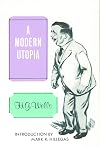
“Introduction”, Mark R. Hillegas -- Hillegas, author of a critical study on Wells and the “anti-utopians”, relates the influence of A Modern Utopia on social, political, and literary thought. (George Orwell is quoted talking about Wells’ influence on him.). Hillegas also briefly talks about some of the most notable features of Wells. Written in 1967, this introduction is confident that the world is moving closer to Wells vision of a socialist utopia.
A Modern Utopia, H. G. Wells -- This is the most pleasant to read of any utopia I’ve seen and also the most convincing and tempting utopia to actually live in. Still, it’s ideas are doomed to failure.
Fredrick Hayek demolished the theory show more behind Wells’ socialist World State, and the actual experience of socialist countries also points to its unworkability. Also, Wells exhibits once again his curious dual nature about the nature of man. As an avid student of evolution and probably (I don’t know for sure) one of the earliest practioneers of what is now called evolutionary psychology, he had a deep pessimism about man’s basic nature (for instance, note the end of his The Island of Dr. Moreau) yet his later novels seem determined to evoke largely unconvincing transformations in human nature and society. After explaining how racism and tribalism are inherent in man’s nature, Wells simply laments, at book's end, that it only requires an act of will to bring about the World State. However, it is, I would argue, man’s very nature that makes that act of will improbable or doomed to fail. In Wells' defense, the very end of the book has Wells admitting his vision is not the one that will triumph, is just one vision of a better world and calls for man to dream, in stolen moments from our trivial lives, of a better world.
Literarily, this book is interesting on several counts.
First, it is not really a novel. Wells presents his utopia wittily, tongue in cheek as a thought experiment, a world he and his companion are mystically transported to, but Wells constantly refers to the contemporary world too (as Utopians are wont).
Second, Wells is quite well versed in Utopian literature going all the way back to Plato’s The Republic. He spends time commenting on other utopian conceptions. He argues that the Greek attitude towards slavery is simply explained not by a “Greek mind” but by the technological realities of the time: a certain level of civilization required slave labor; thus, classic writers had to come up with justifications why some had to be slaves. Wells also notes that earlier Utopians were not concerned with maximizing human freedom but rather virtue. Wells’ World State tries to allow a great latitude of human freedom and individuality (thus making it more palatable than his successors). He also notes that early Utopians present (with the possible exception of William Morris’ News from Nowhere) societies lacking any real individualities. Wells’ narrative doesn’t make that mistake. One of the books comedic touches (I’ve come to the conclusion Wells’ had a flair for comedy) is the encounter with a dissatisfied, pretentious, nature-loving inhabitant of Utopia. The narrator is also accompanied by a botanist who seems unremittingly disinterested in his journey through the World State and given to babbling about his tortured romantic life. William Morris also is specifically blasted for his hostility towards technology. Wells slyly notes that “If toil is a blessing, never was blessing so effectually disguised.” (Wells, while noting that work is necessary to civilization, takes rightful exception to the idea that there is an inherent virtue in toiling all the time and that leisure is decadent. However, his World State has few who lead lives of pure leisure.)
Third, Wells does not pretend – unlike other Utopians – to have created a stable, perfect world. There exist, in this world, the lazy, incompetent, and stupid and prison islands – with societies organized by the convicts – for the violent and drug-addled. Wells’, while showing a world of relatively healthy people, no war, no poverty, little disease, is careful to state at the opening that he postulates no change, as other Utopians do, in man’s basic nature. He says the “Will to Live” is the cause of all good and evil. Rather, he postulates that by allowing humans the opportunity and freedom to satisfy basic drives like hunger and sex, other drives – like self-sacrifice and creativity – will build utopia. He rather unconvincingly thinks that most will choose to do something other than sate themselves on food and sex. I think rather more people are lazy and uncurious than he supposed. On the other hand, like Wells, I think that circumstances and, especially, bad education do dull energy and curiosity. (And, to be fair, Wells still shows such people in his Utopia. Wells’ life of energetically, through education, lifting himself from a life of mean beginnings certainly colored his ideas in this regard.)
Wells’ Utopia is based on his theory of uniqueness – right down to the notion – since supplanted by physics if it hadn’t already been invalidated in 1905 – that even no two atoms are identical. (This notion is expanded in an appendix which is a reprint of an earlier philosophical reprint.) Hence, Wells’ forsakes the logic of yes-no in his Utopia. His is a philosophy of quantitative and not qualitative difference thus Wells allows some personal property as extension of an individual but allows for very limited inheritance and no right to own real property. Sexual freedom is present, but evolutionist Wells controls reproduction by only allowing those married and men earning above the minimum wage to reproduce – however, he never really stipulates a penalty for those who don’t do this. Wells would be horrified at his political descendants of the American welfare state paying people to have illegitimate children while being poor. Wells postulates, as a socialist, some limited free enterprise and world-wide, centralized control of labor and the ends it is channeled to. He, predictably, supports a vast body of public scientific research while wryly noting that in our world inventors (this is less true now) are regarded as ignorant and foolish while the exploiters of their inventions are revered. Wells, supporter of women's’ rights, surprisingly lists all sorts of physical, emotional, and intellectual reasons why women are inferior and less capable of supporting themselves than men hence the State helps them. A sort of multiple marriage is possible in marriage laws.
The rulers of Utopia are the “samurai”, a group of voluntary nobility (specifically likened to the Knights Templar) with their own, more restrictive code of behavior. They are quasi-hereditary since children tend to follow their parents into the Samurai. Wells spends some time blasting contemporary society. Womens’ fashions are criticized, and Wells seems torn between ‘free-love” (a term I don’t recall seeing here) and the distraction that sex and romantic love provide. He criticizes public sports. (Wells’ would probably be somewhat displeased at our distracting, uncreative, unintellectual entertainment distractions of today.) In fact, the Samurai are forbidden to play public games because the aristocracy of Wells’ day were “athletic prostitute[s]”. Public games bred the “vanity, trickery, and self-assertion of the common actor”. (Actors are another profession Wells’ criticizes. It's unclear if drama exists in his World State. As for “self-assertion”, I suspect Wells could be self-assertive himself.) In his Utopia, sports are a private matter and people find it rather “puerile” to spend the time to become expert in sports. Wells, son of a professional cricketer, specifically mentions cricket in this passage.
Wells devotes a whole chapter to criticizing the contemporary passion for race theories and eugenics. Though a firm believer in what we would now term evolutionary psychology, he regards as nonsense the idea that a better race of man can be deliberately bred. His control of reproduction arises from population concerns and not allowing the economic burden of child raising to fall entirely on the state. However, his reproduction laws are designed to weed out possible genetic factors for laziness or idiocy as well. He also thinks they will bind children closer to parents. Wells takes the tack that all people’s probably having something unique to give the World State and that no race is genetically superior. However, he says that if it could be shown that a certain group is manifestly inferior in all counts that he would approve of genocide – a kinder sort though of not allowing them to produce. The State, to Wells, is there for the good of the species while allowing as much freedom as possible to the individual. Wells’ also says Utopia will “kill all deformed and monstrous and evilly diseased births”, so he is not adverse to practicing some of the worst eugenic ideas. In Wells' defense, birth defects were not as easily alleviated via technology then.
This edition is annoying because it omits the pictures of the original, and evidently, some of the text that appears on the same pages as those pictures.
This is probably one of the few utopias where the narrator has to go to work. show less
“Introduction”, Mark R. Hillegas -- Hillegas, author of a critical study on Wells and the “anti-utopians”, relates the influence of A Modern Utopia on social, political, and literary thought. (George Orwell is quoted talking about Wells’ influence on him.). Hillegas also briefly talks about some of the most notable features of Wells. Written in 1967, this introduction is confident that the world is moving closer to Wells vision of a socialist utopia.
A Modern Utopia, H. G. Wells -- This is the most pleasant to read of any utopia I’ve seen and also the most convincing and tempting utopia to actually live in. Still, it’s ideas are doomed to failure.
Fredrick Hayek demolished the theory show more behind Wells’ socialist World State, and the actual experience of socialist countries also points to its unworkability. Also, Wells exhibits once again his curious dual nature about the nature of man. As an avid student of evolution and probably (I don’t know for sure) one of the earliest practioneers of what is now called evolutionary psychology, he had a deep pessimism about man’s basic nature (for instance, note the end of his The Island of Dr. Moreau) yet his later novels seem determined to evoke largely unconvincing transformations in human nature and society. After explaining how racism and tribalism are inherent in man’s nature, Wells simply laments, at book's end, that it only requires an act of will to bring about the World State. However, it is, I would argue, man’s very nature that makes that act of will improbable or doomed to fail. In Wells' defense, the very end of the book has Wells admitting his vision is not the one that will triumph, is just one vision of a better world and calls for man to dream, in stolen moments from our trivial lives, of a better world.
Literarily, this book is interesting on several counts.
First, it is not really a novel. Wells presents his utopia wittily, tongue in cheek as a thought experiment, a world he and his companion are mystically transported to, but Wells constantly refers to the contemporary world too (as Utopians are wont).
Second, Wells is quite well versed in Utopian literature going all the way back to Plato’s The Republic. He spends time commenting on other utopian conceptions. He argues that the Greek attitude towards slavery is simply explained not by a “Greek mind” but by the technological realities of the time: a certain level of civilization required slave labor; thus, classic writers had to come up with justifications why some had to be slaves. Wells also notes that earlier Utopians were not concerned with maximizing human freedom but rather virtue. Wells’ World State tries to allow a great latitude of human freedom and individuality (thus making it more palatable than his successors). He also notes that early Utopians present (with the possible exception of William Morris’ News from Nowhere) societies lacking any real individualities. Wells’ narrative doesn’t make that mistake. One of the books comedic touches (I’ve come to the conclusion Wells’ had a flair for comedy) is the encounter with a dissatisfied, pretentious, nature-loving inhabitant of Utopia. The narrator is also accompanied by a botanist who seems unremittingly disinterested in his journey through the World State and given to babbling about his tortured romantic life. William Morris also is specifically blasted for his hostility towards technology. Wells slyly notes that “If toil is a blessing, never was blessing so effectually disguised.” (Wells, while noting that work is necessary to civilization, takes rightful exception to the idea that there is an inherent virtue in toiling all the time and that leisure is decadent. However, his World State has few who lead lives of pure leisure.)
Third, Wells does not pretend – unlike other Utopians – to have created a stable, perfect world. There exist, in this world, the lazy, incompetent, and stupid and prison islands – with societies organized by the convicts – for the violent and drug-addled. Wells’, while showing a world of relatively healthy people, no war, no poverty, little disease, is careful to state at the opening that he postulates no change, as other Utopians do, in man’s basic nature. He says the “Will to Live” is the cause of all good and evil. Rather, he postulates that by allowing humans the opportunity and freedom to satisfy basic drives like hunger and sex, other drives – like self-sacrifice and creativity – will build utopia. He rather unconvincingly thinks that most will choose to do something other than sate themselves on food and sex. I think rather more people are lazy and uncurious than he supposed. On the other hand, like Wells, I think that circumstances and, especially, bad education do dull energy and curiosity. (And, to be fair, Wells still shows such people in his Utopia. Wells’ life of energetically, through education, lifting himself from a life of mean beginnings certainly colored his ideas in this regard.)
Wells’ Utopia is based on his theory of uniqueness – right down to the notion – since supplanted by physics if it hadn’t already been invalidated in 1905 – that even no two atoms are identical. (This notion is expanded in an appendix which is a reprint of an earlier philosophical reprint.) Hence, Wells’ forsakes the logic of yes-no in his Utopia. His is a philosophy of quantitative and not qualitative difference thus Wells allows some personal property as extension of an individual but allows for very limited inheritance and no right to own real property. Sexual freedom is present, but evolutionist Wells controls reproduction by only allowing those married and men earning above the minimum wage to reproduce – however, he never really stipulates a penalty for those who don’t do this. Wells would be horrified at his political descendants of the American welfare state paying people to have illegitimate children while being poor. Wells postulates, as a socialist, some limited free enterprise and world-wide, centralized control of labor and the ends it is channeled to. He, predictably, supports a vast body of public scientific research while wryly noting that in our world inventors (this is less true now) are regarded as ignorant and foolish while the exploiters of their inventions are revered. Wells, supporter of women's’ rights, surprisingly lists all sorts of physical, emotional, and intellectual reasons why women are inferior and less capable of supporting themselves than men hence the State helps them. A sort of multiple marriage is possible in marriage laws.
The rulers of Utopia are the “samurai”, a group of voluntary nobility (specifically likened to the Knights Templar) with their own, more restrictive code of behavior. They are quasi-hereditary since children tend to follow their parents into the Samurai. Wells spends some time blasting contemporary society. Womens’ fashions are criticized, and Wells seems torn between ‘free-love” (a term I don’t recall seeing here) and the distraction that sex and romantic love provide. He criticizes public sports. (Wells’ would probably be somewhat displeased at our distracting, uncreative, unintellectual entertainment distractions of today.) In fact, the Samurai are forbidden to play public games because the aristocracy of Wells’ day were “athletic prostitute[s]”. Public games bred the “vanity, trickery, and self-assertion of the common actor”. (Actors are another profession Wells’ criticizes. It's unclear if drama exists in his World State. As for “self-assertion”, I suspect Wells could be self-assertive himself.) In his Utopia, sports are a private matter and people find it rather “puerile” to spend the time to become expert in sports. Wells, son of a professional cricketer, specifically mentions cricket in this passage.
Wells devotes a whole chapter to criticizing the contemporary passion for race theories and eugenics. Though a firm believer in what we would now term evolutionary psychology, he regards as nonsense the idea that a better race of man can be deliberately bred. His control of reproduction arises from population concerns and not allowing the economic burden of child raising to fall entirely on the state. However, his reproduction laws are designed to weed out possible genetic factors for laziness or idiocy as well. He also thinks they will bind children closer to parents. Wells takes the tack that all people’s probably having something unique to give the World State and that no race is genetically superior. However, he says that if it could be shown that a certain group is manifestly inferior in all counts that he would approve of genocide – a kinder sort though of not allowing them to produce. The State, to Wells, is there for the good of the species while allowing as much freedom as possible to the individual. Wells’ also says Utopia will “kill all deformed and monstrous and evilly diseased births”, so he is not adverse to practicing some of the worst eugenic ideas. In Wells' defense, birth defects were not as easily alleviated via technology then.
This edition is annoying because it omits the pictures of the original, and evidently, some of the text that appears on the same pages as those pictures.
This is probably one of the few utopias where the narrator has to go to work. show less
This was slow going and a little sloggy in parts but I enjoyed it overall. I've read enough Wells this year to be interested in the way this fits in with his novels, both early and late. I always enjoy his ideas about overlapping worlds or worlds that exist similtaneously.
...started an interesting book of Wells', 'A modern Utopia'. Being interested in an author is a very different thing from liking him, isn't it?
- from a 27 August 1917 letter to his father, in The collected letters of C.S. Lewis, volume I
- from a 27 August 1917 letter to his father, in The collected letters of C.S. Lewis, volume I
Members
- Recently Added By
Lists

Bibliography of New World Utopias by Paul Kagan
53 works; 2 members
Author Information

1,554+ Works 108,808 Members
H. G. Wells was born in Bromley, England on September 21, 1866. After a limited education, he was apprenticed to a draper, but soon found he wanted something more out of life. He read widely and got a position as a student assistant in a secondary school, eventually winning a scholarship to the Royal College of Science in South Kensington, where show more he studied biology. He graduated from London University in 1888 and became a science teacher. He also wrote for magazines. When his stories began to sell, he left teaching to write full time. He became an author best known for science fiction novels and comic novels. His science fiction novels include The Time Machine, The War of the Worlds, The Wonderful Visit, The Island of Doctor Moreau, The Invisible Man, The First Men in the Moon, and The Food of the Gods. His comic novels include Love and Mr. Lewisham, Kipps: The Story of a Simple Soul, The History of Mr. Polly, and Tono-Bungay. He also wrote several short story collections including The Stolen Bacillus, The Plattner Story, and Tales of Space and Time. He died on August 13, 1946 at the age of 79. (Bowker Author Biography) show less
Some Editions
Series
Belongs to Publisher Series
Common Knowledge
- Canonical title
- A Modern Utopia
- Original title
- A Modern Utopia
- Alternate titles*
- Ein modernes Utopia
- Original publication date
- 1905
- Original language*
- Englisch
*Some information comes from Common Knowledge in other languages. Click "Edit" for more information.
Classifications
Statistics
- Members
- 461
- Popularity
- 66,105
- Reviews
- 8
- Rating
- (3.11)
- Languages
- 6 — English, Finnish, French, German, Italian, Spanish
- Media
- Paper, Ebook
- ISBNs
- 93
- ASINs
- 14