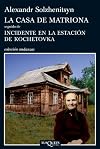
We Never Make Mistakes
by Aleksandr Solzhenitsyn
On This Page
Description
In "An Incident at Krechetovka Station," a Red Army lieutenant named Zotov is confronted by a disturbing straggler soldier and must decide what to do with him. He ultimately sends him to a miserable imprisonment because the poor wretch doesn't know the previous name of the city of Stalingrad. "Matryona's House" is the tale of an old peasant woman, whose tenacious struggle against cold, hunger, and greedy relatives is described by a young man who only understands her after her death.Tags
Recommendations

























Member Reviews
In short this is a collection of two novella's - Incident at Krechetovka Station and Matryona's House. The first is set at the start of WWII and the other a few years after, both look at the system in Russia at those times and how people's lives are affected. I'm actually surprised that they were published in Russia in 1963. Solzhenitsyn is an amazing writer and the translation by Paul Blackstock seems to be very good.
In Incident at Krechetovka Station we basically follow a day at the eponymous station as a young officer. Lieutenant Zotov, deals with the routing of trains and the "stragglers" from the front lines. This gives a vivid picture of the time and the worries of the young Soviet officer.
In Matryona's House it is 1953 and a show more young man looks for work as a teacher and ends up boarding at Matryona's house. An elderly woman who believes in the system and helps out her neighbours but finds that she has less and less.
Both stories point out the flaws in the Soviet system. Both stories have their tragic side but Solzhenitsyn creates believable characters in an impossible situation. I will definitely be reading more of his work. show less
In Incident at Krechetovka Station we basically follow a day at the eponymous station as a young officer. Lieutenant Zotov, deals with the routing of trains and the "stragglers" from the front lines. This gives a vivid picture of the time and the worries of the young Soviet officer.
In Matryona's House it is 1953 and a show more young man looks for work as a teacher and ends up boarding at Matryona's house. An elderly woman who believes in the system and helps out her neighbours but finds that she has less and less.
Both stories point out the flaws in the Soviet system. Both stories have their tragic side but Solzhenitsyn creates believable characters in an impossible situation. I will definitely be reading more of his work. show less
I liked Cancer Ward so much that when I saw this in a used bookstore it absolutely had to come home with me. And since I'd read Cancer Ward during a previous Dewey's readathon, I decided this collection of two stories was a perfect way to start my readathon morning.
The first story, "An Incident at Krechstovka Station" took a while to get going for me, but as it unfolds it depicts a young lieutenant struggling with duty and ideals while making impossible decisions on too little information.
The second, "Matryona's House," was easier to jump into from the start -- a depiction of the greed and meanness in a small Soviet village -- centered around Matryona, the kind of simple woman easily despised for not being as self-serving as the show more despisers are.
I found both stories moving, and remain impressed by Solzhenitsyn's gift for characterization. show less
The first story, "An Incident at Krechstovka Station" took a while to get going for me, but as it unfolds it depicts a young lieutenant struggling with duty and ideals while making impossible decisions on too little information.
The second, "Matryona's House," was easier to jump into from the start -- a depiction of the greed and meanness in a small Soviet village -- centered around Matryona, the kind of simple woman easily despised for not being as self-serving as the show more despisers are.
I found both stories moving, and remain impressed by Solzhenitsyn's gift for characterization. show less
This book includes two of Solzhenitsyn's early novellas: "An Incident at Krechetovka Station" and "Matryona's House." The first one concerns a solicitous young army lieutenant who's been relegated to the oversight of traincar routing at a rail station during World War II. Disappointed to not be stationed at the front yet very much focused on his tedious work, the lieutenant's drab daily life is suddenly upended by the appearance of a mysterious straggler in his office. Intrigued at first, the lieutenant must decide what to do with this man. The piece is highly atmospheric, evoking strong images of the cold rainy rail station and the peculiar strained relationships between the army personnel and civilians working there. It offers a show more satisfying slice-of-life narrative about life in parts of Russia during this time of the War.
The second novella is a first-person account of a former prisoner who seeks and gains a teaching post in rural Russia in order to get in touch with the heart of his country. He takes up residence in an old woman's peasant cottage. The story follows his experiences living there, as the details of the life of his ailing landlady slowly unfold. As with most of Solzhenitsyn's work, this novella can be read as a commentary on certain segments of Russian society, and perhaps even extrapolated to humanity as a whole. In this case, Solzhenitsyn makes strong points on the way that this village operates, and how the old woman's relatives treat her and react to her nature.
This was a quick read and I really enjoyed it, although it's not as complex as some of his later works. The one odd aspect to this book is the translation. I hate to make this criticism, given the difficulty of translation in general, and in particular that of Russian to English. However, in the translator's preface, he notes "an attempt has been made to retain as much of the flavor of the original as possible in colloquial American English without sacrificing accuracy." In some cases, it is this colloquial American English that seems comically out of place. But this is only a minor complaint and didn't take away from the force of the work. I only mention it because it caused me to laugh a little in unexpected places. show less
The second novella is a first-person account of a former prisoner who seeks and gains a teaching post in rural Russia in order to get in touch with the heart of his country. He takes up residence in an old woman's peasant cottage. The story follows his experiences living there, as the details of the life of his ailing landlady slowly unfold. As with most of Solzhenitsyn's work, this novella can be read as a commentary on certain segments of Russian society, and perhaps even extrapolated to humanity as a whole. In this case, Solzhenitsyn makes strong points on the way that this village operates, and how the old woman's relatives treat her and react to her nature.
This was a quick read and I really enjoyed it, although it's not as complex as some of his later works. The one odd aspect to this book is the translation. I hate to make this criticism, given the difficulty of translation in general, and in particular that of Russian to English. However, in the translator's preface, he notes "an attempt has been made to retain as much of the flavor of the original as possible in colloquial American English without sacrificing accuracy." In some cases, it is this colloquial American English that seems comically out of place. But this is only a minor complaint and didn't take away from the force of the work. I only mention it because it caused me to laugh a little in unexpected places. show less
These two novellas are rare Solzhenitsyn stories that were published in the Soviet Union. The first one is the more surprising for that, being an account of how Soviet beauracracy and inefficiency during WWII cause an Army officer running a railroad switching line to retreat from the pity and liking he had shown to a straggler soldier, lost from his unit, instead arresting the man on suspicion of espionage, but always after wondering if he'd made the wise - or merely the safe decision. The second story is a short and sad one about an old woman, sick and pensionless, whose sudden death gives rise to squabbles among her survivors over her property, while a boarder reflects that her brand of generosity and simple virtue were what made life show more worth living, and what Russia could not live without. Good stories, both. show less
I didn't quite get the incident story but I really liked matryona.sphere books
8432222461
«La casa de Matriona» narra la vida de una mujer campesina rusa que encarna la resistencia moral frente a la dureza del sistema soviético. Su casa, símbolo de dignidad y sacrificio, se convierte en el eje de un conflicto que revela la mezquindad burocrática y la fragilidad de la bondad humana.
«Nunca cometemos errores» presenta un episodio aparentemente menor en una estación ferroviaria, donde un malentendido administrativo expone la arbitrariedad del poder y la vulnerabilidad del individuo ante la maquinaria estatal.
Ambos relatos pertenecen al periodo en que Solzhenitsyn depura su estilo hacia una narrativa moral, directa y sin adornos. La fuerza de su escritura reside en la observación minuciosa de la vida cotidiana y en la show more capacidad de elevar situaciones triviales a parábolas éticas. La edición española ofrece una traducción fluida y respetuosa con el tono original, aunque sin notas que contextualicen los elementos culturales soviéticos. Como volumen de una serie de literatura contemporánea, cumple su función divulgativa, pero sin aspirar a una edición crítica.
---
VALORACIÓN
Puntuación: 4/5.
La edición reúne dos relatos fundamentales del periodo soviético tardío, donde Solzhenitsyn depura su estilo hacia una prosa austera, moral y de fuerte carga testimonial. La traducción es correcta y la edición de Seix Barral, aunque sobria, mantiene buena legibilidad. Resta medio punto la ausencia de aparato crítico y la presentación material típica de la serie, funcional pero no especialmente cuidada. show less
«Nunca cometemos errores» presenta un episodio aparentemente menor en una estación ferroviaria, donde un malentendido administrativo expone la arbitrariedad del poder y la vulnerabilidad del individuo ante la maquinaria estatal.
Ambos relatos pertenecen al periodo en que Solzhenitsyn depura su estilo hacia una narrativa moral, directa y sin adornos. La fuerza de su escritura reside en la observación minuciosa de la vida cotidiana y en la show more capacidad de elevar situaciones triviales a parábolas éticas. La edición española ofrece una traducción fluida y respetuosa con el tono original, aunque sin notas que contextualicen los elementos culturales soviéticos. Como volumen de una serie de literatura contemporánea, cumple su función divulgativa, pero sin aspirar a una edición crítica.
---
VALORACIÓN
Puntuación: 4/5.
La edición reúne dos relatos fundamentales del periodo soviético tardío, donde Solzhenitsyn depura su estilo hacia una prosa austera, moral y de fuerte carga testimonial. La traducción es correcta y la edición de Seix Barral, aunque sobria, mantiene buena legibilidad. Resta medio punto la ausencia de aparato crítico y la presentación material típica de la serie, funcional pero no especialmente cuidada. show less
May 11, 2026Spanish
Members
- Recently Added By
Lists

Russian Literature
184 works; 35 members
Author Information

351+ Works 44,545 Members
Aleksandr Solzhenitsyn was born on December 11, 1918 in Kislovodsk in the northern Caucusus Mountains. He received a degree in physics and math from Rostov University in 1941. He served in the Russian army during World War II but was arrested in 1945 for writing a letter criticizing Stalin. He spent the next decade in prisons and labor camps and, show more later, exile, before being allowed to return to central Russia, where he worked as a high school science teacher. His first novel, One Day in the Life of Ivan Denisovich, was published in 1962. In 1970, he was awarded the Nobel Prize for Literature. In 1974, he was arrested for treason and exiled following the publication of The Gulag Archipelago. He moved to Switzerland and later the U. S. where he continued to write fiction and history. When the Soviet Union collapsed, he returned to his homeland. His other works include The First Circle and The Cancer Ward. He died due to a heart ailment on August 3, 2008 at the age of 89. (Bowker Author Biography) show less
Some Editions
Series
Belongs to Publisher Series
Work Relationships
Is contained in
Common Knowledge
- Canonical title*
- We Never Make Mistakes
- Original title
- Matrjonin dvor; Slučaj na stantsii Krečetovka
- Original publication date
- 1963
- First words
- "Hello. Is this the dispatcher?"
- Original language
- Russian
*Some information comes from Common Knowledge in other languages. Click "Edit" for more information.
Classifications
- Genres
- General Fiction, Fiction and Literature
- DDC/MDS
- 891.7344 — Literature & rhetoric Literatures of other languages East Indo-European and Celtic literatures Russian and East Slavic languages Russian fiction USSR 1917–1991 Late 20th century 1917–1991
- LCC
- PG3488 .O4 .W4 — Language and Literature Slavic languages and literatures. Baltic languages. Albanian language Slavic. Baltic. Albanian Russian literature Individual authors and works 1961-2000
- BISAC
Statistics
- Members
- 376
- Popularity
- 82,929
- Reviews
- 7
- Rating
- (3.90)
- Languages
- 9 — Catalan, English, French, Indonesian, Italian, Norwegian (Nynorsk), Russian, Spanish, Turkish
- Media
- Paper, Ebook
- ISBNs
- 14
- ASINs
- 5