The House of Rust
by Khadija Abdalla Bajaber
On This Page
Description
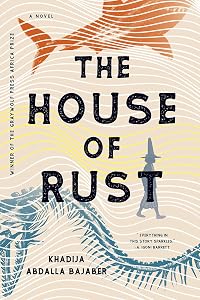
When Aisha's fisherman father goes missing, she takes to the sea on a skeleton boat to rescue him. Guided by a talking scholar's cat, who sparks her interest in the mysterious House of Rust, she encounters three monsters hidden beneath the waves. All Aisha wants is for things to return to normal. But a showdown with the father of all sharks looms, and at home, things only grow stranger.Tags
Recommendations





Member Reviews
"Every day people are dying and being born, only men can leave those who depend on them behind and still be called brave. A woman is not praised when she suffers, she is praised for suffering in silence."
This debut novel by Kenyan author Khadija Abdalla Bajaber is a fascinating blend of allegory, fable, and coming of age, set in the author's hometown of Mombasa. Here Islamic faith abuts African myth, traditional storytelling has a rich history, and the sea is omnipresent and both watches and bears watching.
Aisha is the only child of Ali, a fisherman who is at sea more than at home, drawn by a compulsion to go beyond the boundaries even other fisherman are careful not to cross. Her mother having died when she was young, Aisha is allowed show more at first to accompany her father, but she fails some unspoken test and is thereafter relegated to shore and her grandmother's company. This is an uneasy pairing, as her grandmother wants her to be a docile, obedient girl eager for marriage, none of which are things that Aisha can be. When Ali fails to return from one of his fishing trips, his mother gives him five days in which to reappear or she will have him declared dead. Aisha, however, is determined to find him and bring him back.
The first half of the book is about Aisha's quest on a boat made of bones conjured by a talking cat. She faces three trials which comprise a sort of rite of passage. The novel could have ended at this point with a tidy, if fantastical, coming of age story, but instead the author explores Aisha's life after her adventure. Although Aisha was always regarded as unusual, now she has been changed in ways that make even the local wildlife wary of her. How does one live after such an adventure? What does one owe one's family and village, and what must one do to be true to oneself?
I enjoyed this unusual novel, and with the exception of a transition period between the two halves of the book, I thought the writing was interesting and fresh. The author uses local words and phrases which reinforces the sense of place. I became invested in the characters and part of me hopes the author writes a sequel so that we may learn more about Hamza and the mysterious House of Rust and Aisha's journey's out into the wider world. A promising debut novel.
The House of Rust was the inaugural winner of the Graywolf Press African Fiction Prize. Awarded to a manuscript by an author residing primarily in Africa, the award was founded "to facilitate direct access to publishing in the United States for a new generation of African writers." show less
This debut novel by Kenyan author Khadija Abdalla Bajaber is a fascinating blend of allegory, fable, and coming of age, set in the author's hometown of Mombasa. Here Islamic faith abuts African myth, traditional storytelling has a rich history, and the sea is omnipresent and both watches and bears watching.
Aisha is the only child of Ali, a fisherman who is at sea more than at home, drawn by a compulsion to go beyond the boundaries even other fisherman are careful not to cross. Her mother having died when she was young, Aisha is allowed show more at first to accompany her father, but she fails some unspoken test and is thereafter relegated to shore and her grandmother's company. This is an uneasy pairing, as her grandmother wants her to be a docile, obedient girl eager for marriage, none of which are things that Aisha can be. When Ali fails to return from one of his fishing trips, his mother gives him five days in which to reappear or she will have him declared dead. Aisha, however, is determined to find him and bring him back.
The first half of the book is about Aisha's quest on a boat made of bones conjured by a talking cat. She faces three trials which comprise a sort of rite of passage. The novel could have ended at this point with a tidy, if fantastical, coming of age story, but instead the author explores Aisha's life after her adventure. Although Aisha was always regarded as unusual, now she has been changed in ways that make even the local wildlife wary of her. How does one live after such an adventure? What does one owe one's family and village, and what must one do to be true to oneself?
I enjoyed this unusual novel, and with the exception of a transition period between the two halves of the book, I thought the writing was interesting and fresh. The author uses local words and phrases which reinforces the sense of place. I became invested in the characters and part of me hopes the author writes a sequel so that we may learn more about Hamza and the mysterious House of Rust and Aisha's journey's out into the wider world. A promising debut novel.
The House of Rust was the inaugural winner of the Graywolf Press African Fiction Prize. Awarded to a manuscript by an author residing primarily in Africa, the award was founded "to facilitate direct access to publishing in the United States for a new generation of African writers." show less
That novel was delightful. It was not what I expected - in an attempt to find a parallel in known works of fiction, the publisher (and some of the blurbers) sold the story somewhat short - while I can see why they used these comparisons, they need a qualification (which is missing) and can attract readers who may not care for much of the story.
Aisha is not the normal girl from Mombassa, Kenya - she has Hadhrami ancestry, her mother's birth was shrouded (and so was her short life because of that) in scandal and her father treated her like a boy early in her life, taking her to the sea with him. Until he stopped and now Aisha needs to behave like a girl under the tutelage of her grandmother. Which is not how she would like to spend her show more life. And one day, her father does not come back from the sea. What follows is an adventure across the Indian ocean as no other - because in the world of Aisha, all mythical figures are alive and well and in order to save her father, she needs to defeat monsters and dead ships and sunken statues. But that is not her first touch with the magical - the talking cat which help her find a boat has this distinction. Neither is the sea journey the whole story - it ends in the middle of the book and once she is back in Mombassa, things get even weirder.
The book is full of the fantastical - from the sea monsters and the talking cat to the man who can cut the sea from a man's heart and the talking crows and the djinn (or something like that anyway) who finally decides to check who Aisha is. And if this was all this story was about, it would have been a nice fantasy novel. But Khadija Abdalla Bajaber treats that as if it is part of normal life so she builds Aisha and her family's life in the novel, showing us a glimpse of the real Mombassa (the author, just like Aisha is Hadhrami), with all its weirdness, with its mix of Kenyan and Arab culture, with the expectations of a woman at the verge of womanhood (although part of the reason why Aisha does not seem to have options is because she does not like to study and is not overly religious - her grandmother reminds her of that and the fact that if she cared for either, the family would have found the money). But all Aisha wants is the ocean.
I don't know much about Kenyan, Mombassan (because it appears that it has its own - supplementing the bigger national one) or Hadhrami mythologies. I am not sure which parts of the tale came from old legends and which came from the author's imagination. I recognized a few things (the stolen shadow, the sunken statue) but I am sure I missed a lot of references. But it ultimately does not matter. It is a coming of age story steeped into myths and reality; colored by the ocean and Mombassa.
The novel won't be for everyone - its blend of fantastical and real can get too mixed-up for most people's tastes. Although if one wants, one can read some of what happens as an allegory - although I am not sure all the fantastical elements can be carried that way - you will lose something of the tale if you try. But at the bottom of all this is the story of a girl who wants something different from what she can have - and is ready to fight for it.
The novel won the inaugural Graywolf Press African Fiction Prize in 2018 (it is given for a manuscript written in English or a non-published translation into English). Graywolf expect to publish the winner for 2019 later this year and if is anything like this one in quality, I really want to read it. show less
Aisha is not the normal girl from Mombassa, Kenya - she has Hadhrami ancestry, her mother's birth was shrouded (and so was her short life because of that) in scandal and her father treated her like a boy early in her life, taking her to the sea with him. Until he stopped and now Aisha needs to behave like a girl under the tutelage of her grandmother. Which is not how she would like to spend her show more life. And one day, her father does not come back from the sea. What follows is an adventure across the Indian ocean as no other - because in the world of Aisha, all mythical figures are alive and well and in order to save her father, she needs to defeat monsters and dead ships and sunken statues. But that is not her first touch with the magical - the talking cat which help her find a boat has this distinction. Neither is the sea journey the whole story - it ends in the middle of the book and once she is back in Mombassa, things get even weirder.
The book is full of the fantastical - from the sea monsters and the talking cat to the man who can cut the sea from a man's heart and the talking crows and the djinn (or something like that anyway) who finally decides to check who Aisha is. And if this was all this story was about, it would have been a nice fantasy novel. But Khadija Abdalla Bajaber treats that as if it is part of normal life so she builds Aisha and her family's life in the novel, showing us a glimpse of the real Mombassa (the author, just like Aisha is Hadhrami), with all its weirdness, with its mix of Kenyan and Arab culture, with the expectations of a woman at the verge of womanhood (although part of the reason why Aisha does not seem to have options is because she does not like to study and is not overly religious - her grandmother reminds her of that and the fact that if she cared for either, the family would have found the money). But all Aisha wants is the ocean.
I don't know much about Kenyan, Mombassan (because it appears that it has its own - supplementing the bigger national one) or Hadhrami mythologies. I am not sure which parts of the tale came from old legends and which came from the author's imagination. I recognized a few things (the stolen shadow, the sunken statue) but I am sure I missed a lot of references. But it ultimately does not matter. It is a coming of age story steeped into myths and reality; colored by the ocean and Mombassa.
The novel won't be for everyone - its blend of fantastical and real can get too mixed-up for most people's tastes. Although if one wants, one can read some of what happens as an allegory - although I am not sure all the fantastical elements can be carried that way - you will lose something of the tale if you try. But at the bottom of all this is the story of a girl who wants something different from what she can have - and is ready to fight for it.
The novel won the inaugural Graywolf Press African Fiction Prize in 2018 (it is given for a manuscript written in English or a non-published translation into English). Graywolf expect to publish the winner for 2019 later this year and if is anything like this one in quality, I really want to read it. show less
There was far more in this book than I had prepared myself to read, and I may have missed some. There's a wonderful confluence of mythology and bildungsroman that questions both while centering a compelling heroine. Really special. Could maybe use some structural editing or just a more focused reader.
It has been so long since I read a book as fresh in its view of life, father child relationships, fantasy, and coming of age. Structurally interesting, free of cliche, imaginativee, whimsical and takes its beautiful little story very seriously. I enjoyed seeing the tale not just end at the journey, but show how it forever impacted the life of our peotagonist. I would reccomend this over and over. My only critique: the prose was beautiful but it often became repetitive describing certain things.
A girl goes to rescue her father from the sea, and accomplishing that sets her on a new path.
This story is interesting due to its strong unusual elements and its unique emphasis on more familiar elements, making it worth reading. It is not a polished or entirely coherent story, and some aspects seem like late add-ons, however early they were introduced into the text.
This story is interesting due to its strong unusual elements and its unique emphasis on more familiar elements, making it worth reading. It is not a polished or entirely coherent story, and some aspects seem like late add-ons, however early they were introduced into the text.
Wow! What a great book. Magical realism, the soul of a city revealed in both it human and non-human inhabitants, a quest and soul searching by a strong female lead,...Everything I love to read in a book. And a new African woman writer showing me a culture and history I would never know if I stuck to reading the Western canon. I can't wait to see what Bajaber comes up with next. Thanks to Graywolf Press for publishing authors like her.
This is enchanting and adventurous and gorgeously written. I love the talking animals, the frequent peppering of local wisdom and sayings, and the ultimate granting of a girl's wish to go her own way.
Members
- Recently Added By
Lists

Best African and African diaspora books
111 works; 4 members

Cats in Fiction
209 works; 9 members

Childhood: Books for or about children in different cultures around the wor
345 works; 18 members

Random Internet Recommendations
18 works; 1 member
Author Information
2 Works 183 Members
Awards and Honors
Common Knowledge
- Canonical title
- The House of Rust
- Original publication date
- 2021
- People/Characters
- Aisha
- Important places
- Mombasa, Kenya
- Dedication
- For Mombasa
I thought you were trying to kill me.
It has been a privelege. - First words
- When Aisha was younger her father used to take her out to sea.
- Quotations
- Every day people are dying and being born, only men can leave those who depend on them behind and still be called brave. A woman is not praised when she suffers, she is praised for suffering in silence.
Aisha forced the wound her rage and fear had slashed to knit itself; practiced little hands stitched back her composure efficiently, as they had done thousands of times before. Then, shutting the door of her heart closed, she... (show all) sat down again. - Last words
- (Click to show. Warning: May contain spoilers.)And eager, and afraid, and whole of heart, she went to meet it.
- Blurbers
- Link, Kelly; Barrett, A. Igoni; Anders, Charlie Jane; Patel, Shailja; Tshuma, Novuyo Rosa; Moore, Wayetu
- Original language
- English
Classifications
- Genres
- General Fiction, Fiction and Literature, Fantasy
- DDC/MDS
- 890.00 — Literature & rhetoric Literatures of other languages Literatures of other specific languages and language families
- LCC
- PR9381.9 .B35 .H68 — Language and Literature English English Literature English literature: Provincial, local, etc.
- BISAC
Statistics
- Members
- 179
- Popularity
- 183,067
- Reviews
- 10
- Rating
- (3.75)
- Languages
- English
- Media
- Paper, Audiobook, Ebook
- ISBNs
- 3
- ASINs
- 2