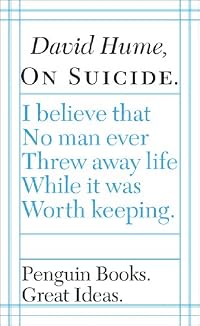
On Suicide
by David Hume
On This Page
Description
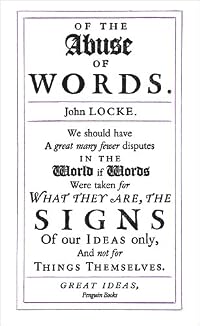
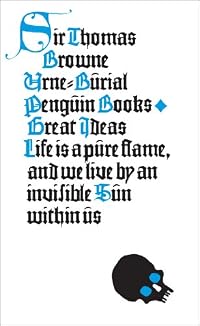
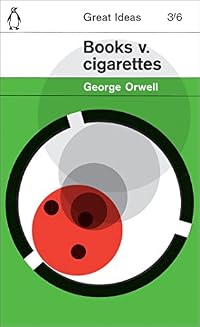
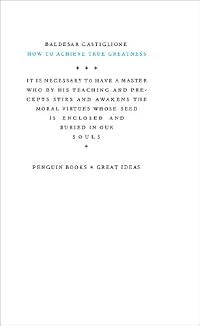
Throughout history, some books have changed the world. They have transformed the way we see ourselves - and each other. They have inspired debate, dissent, war and revolution. They have enlightened, outraged, provoked and comforted. They have enriched lives - and destroyed them. Now Penguin brings you the works of the great thinkers, pioneers, radicals and visionaries whose ideas shook civilization and helped make us who we are. One of the most important thinkers ever to write in English, show more the Empiricist David Hume liberated philosophy from the superstitious constraints of religion; here, he argues that all are free to choose between life and death, considers the nature of personal taste and succinctly criticises common philosophies of the time. show lessTags
Recommendations






Member Reviews
A short yet punchy essay, in which David Hume smacks down the position of the clergy upon suicide.
Is suicide a 'sin'? Far from that! If the laws of Nature are subjected to the will of a God, then nothing should let us presuppose that such laws don't, also, regulate human nature and our passions. Far from being an act going against the sanctity of life, then, suicide, as a reflection of our passion, should be seen as an act also subjected to the laws of God. Why, then, condemn it? He goes even further, by arguing that what is blasphemous is, on the contrary, to think that considering that a mere human being taking such decision is supposedly going against the natural laws set by God is to imply that, such human being mustn't have show more received his faculty to decide from such God, or, at least, that he embodies passions which are not subjected to its divine will.
From a purely theological/ atheist perspective, this is a brilliant reasoning, demonstrating how easy it is to argue for anything and its contrary when relying solely upon the supposed will of a God; a God we know nothing about for sure (let alone if it exists in the first place!) yet that we attribute with our own prejudices so as to try and resolve ethical questions. As a purely theological exercise in counter-arguing clerical positions, then, this is a powerful read. But...
But what about the ethical relevance of such an argument? David Hume, of course, doesn't make the apology of suicide! Nevertheless, he defends it here as a choice we ought to respect instead of condemn. Fair enough. But is it really a choice? Are people reaching the point of killing themselves really acting following a rational decision, or, are they feeling so desperate and hopeless that they feel death is their only way out? We no longer live in a society condemning suicide as a 'sin'; it doesn't mean we have to accept it as a 'choice'.
A short read, outdated (in my opinion) when it comes to how we ought to see what suicide really entails, but, nevertheless, a great demonstration of Hume's powerful intellect. show less
Is suicide a 'sin'? Far from that! If the laws of Nature are subjected to the will of a God, then nothing should let us presuppose that such laws don't, also, regulate human nature and our passions. Far from being an act going against the sanctity of life, then, suicide, as a reflection of our passion, should be seen as an act also subjected to the laws of God. Why, then, condemn it? He goes even further, by arguing that what is blasphemous is, on the contrary, to think that considering that a mere human being taking such decision is supposedly going against the natural laws set by God is to imply that, such human being mustn't have show more received his faculty to decide from such God, or, at least, that he embodies passions which are not subjected to its divine will.
From a purely theological/ atheist perspective, this is a brilliant reasoning, demonstrating how easy it is to argue for anything and its contrary when relying solely upon the supposed will of a God; a God we know nothing about for sure (let alone if it exists in the first place!) yet that we attribute with our own prejudices so as to try and resolve ethical questions. As a purely theological exercise in counter-arguing clerical positions, then, this is a powerful read. But...
But what about the ethical relevance of such an argument? David Hume, of course, doesn't make the apology of suicide! Nevertheless, he defends it here as a choice we ought to respect instead of condemn. Fair enough. But is it really a choice? Are people reaching the point of killing themselves really acting following a rational decision, or, are they feeling so desperate and hopeless that they feel death is their only way out? We no longer live in a society condemning suicide as a 'sin'; it doesn't mean we have to accept it as a 'choice'.
A short read, outdated (in my opinion) when it comes to how we ought to see what suicide really entails, but, nevertheless, a great demonstration of Hume's powerful intellect. show less
I found this book difficult to read as there are 300 suicides of mental health Service users per year and the whole suicide thing affects me greatly. Not the normal engagement I get even with a difficult and demanding text.
Ratings
Members
- Recently Added By
Lists

Guttabois
27 works; 1 member
Author Information

414+ Works 17,869 Members
David Hume was born in Edinburgh to a minor Scottish noble family, raised at the estate of Ninewells, and attended the University of Edinburgh for two years until he was 15. Although his family wished him to study law, he found himself unsuited to this. He studied at home, tried business briefly, and after receiving a small inheritance traveled to show more France, settling at La Fleche, where Descartes had gone to school. There he completed his first and major philosophical work, A Treatise of Human Nature (1739--40), published in three volumes. Hume claimed on the title page that he was introducing the experimental method of reasoning into moral subjects, and further that he was offering a new way of seeing the limits of human knowledge. Although his work was largely ignored, Hume gained from it a reputation as a philosophical skeptic and an opponent of traditional religion. (In later years he was called "the great infidel.") This reputation led to his being rejected for professorships at both Edinburgh and Glasgow. To earn his living he served variously as the secretary to General St. Clair, as the attendant to the mad Marquis of Annandale, and as the keeper of the Advocates Library in Edinburgh. While holding these positions, he wrote and published a new version of his philosophy, the two Enquiries, and many essays on social, political, moral, and literary subjects. He also began his six-volume History of England from the Roman Invasion to the Glorious Revolution (1754--62), the work that made him most famous in his lifetime. Hume retired from public life and settled in Edinburgh, where he was the leading figure in Scottish letters and a good friend to many of the leading intellectuals of the time, including Adam Smith and Benjamin Franklin. During this period, he completed the Dialogues Concerning Natural Religion, which he had been working on for more than 25 years. Hume first worked on the Dialogues in the middle of his career, but put them aside as too provocative. In his last years he finished them and they were published posthumously in 1779. They are probably his best literary effort and have been the basis for continuous discussion and debate among philosophers of religion. Toward the end of Hume's life, his philosophical work began to be taken seriously, and the skeptical problems he had raised were tackled by philosophers in Scotland, France, and finally Germany, where Kant claimed that Hume had awakened him from his dogmatic slumbers. Hume was one of the most influential philosophers of modern times, both as a positive force on skeptical and empirical thinkers and as a philosopher to be refuted by others. Interpreters are still arguing about whether he should be seen as a complete skeptic, a partial skeptic, a precursor of logical positivism, or even a secret believer. (Bowker Author Biography) show less
Series
Belongs to Publisher Series
Great Ideas II (34)
Penguin Great Ideas (34)
Work Relationships
Is abridged in
Common Knowledge
- Canonical title
- On Suicide
Classifications
Statistics
- Members
- 249
- Popularity
- 129,873
- Reviews
- 2
- Rating
- (3.45)
- Languages
- English
- Media
- Paper, Ebook
- ISBNs
- 2
- ASINs
- 2