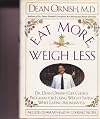
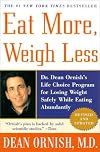
Eat More, Weigh Less
by Dean Ornish
On This Page
Description
The phenomenal New York Times bestseller -- now revised and updated for a new century. Eat more, weigh less? How is this possible? Because as this groundbreaking work clearly shows, it's not just how much you eat, it's primarily what you eat. Most diets rely on small portion sizes to reduce calories sufficiently. You feel hungry and deprived. Dr. Ornish's revolutionary program takes a new approach, one scientifically based on the type of food rather than the amount of food. Abundance rather show more than hunger and deprivation. So you can eat more frequently, eat a greater quantity of food-and still lose weight and keep it off. Simply. Safely. Easily. With 250 delicious low-fat recipes by some of the country's most celebrated chefs. Dr. Ornish's program is a medically proven approach that can help you improve your health and well-being, not just lose weight. It's also about learning how to begin healing emotional pain, loneliness, and isolation in your life, providing nourishment not only for your body but also for your soul. His program has given millions of people new hope and new choices. show lessTags
Recommendations

Member Reviews
This is a very, very restricted diet, yet very much not a fad diet. It's actually backed by science, and Doctor Ornish actually is well known in the medical community for being able to reverse blockages to the heart using diet, instead of surgery or drugs. So this actually isn't snake oil, but rooted in science, and the focus of the diet isn't actually losing weight, but getting healthy. The down side? Well, this diet bans meat, poultry, fish and seafood--which may be fine for vegetarians, but hard on the rest of us. He also bans avocados and nuts and seeds--which would also be hard on vegetarians. And is arguably unnecessary, because as noted in a review of the diet on WebMD:
Frank Hu, MD, PhD, assistant professor of medicine at the show more Harvard School of Public Health, is critical of how severely fat is limited on the diet. "The data from numerous studies show that it is the type of fat, rather than the total amount, which is related to cardiovascular health," he says. "Polyunsaturated and monounsaturated oils actually protect against cardiovascular incidents." For example, Hu says, Ornish advocates limiting the consumption of fish and nuts, and Hu adds, "There is strong evidence that the fat in them is protective against coronary heart disease in both epidemiological studies and clinical trials."
Translation--salmon and walnuts are good for you! Still, this is much, much healthier than most diets out there, it doesn't require calorie counting, and even if you decide not to rigidly follow it, this book offers tasty and healthy recipes for Appetizers, Salads, Soups, Main Courses and Side Dishes, Pasta, Pizza, Bread, Rice and other grain dishes and Desserts. So recommended, even if with a grain of the proverbial salt. show less
Frank Hu, MD, PhD, assistant professor of medicine at the show more Harvard School of Public Health, is critical of how severely fat is limited on the diet. "The data from numerous studies show that it is the type of fat, rather than the total amount, which is related to cardiovascular health," he says. "Polyunsaturated and monounsaturated oils actually protect against cardiovascular incidents." For example, Hu says, Ornish advocates limiting the consumption of fish and nuts, and Hu adds, "There is strong evidence that the fat in them is protective against coronary heart disease in both epidemiological studies and clinical trials."
Translation--salmon and walnuts are good for you! Still, this is much, much healthier than most diets out there, it doesn't require calorie counting, and even if you decide not to rigidly follow it, this book offers tasty and healthy recipes for Appetizers, Salads, Soups, Main Courses and Side Dishes, Pasta, Pizza, Bread, Rice and other grain dishes and Desserts. So recommended, even if with a grain of the proverbial salt. show less
It's a bad idea to follow this diet. The body needs more protein and fat than he recommends. He's really just another animal activist in Dr.'s clothing. (Don't get me wrong. I am all for the ethical treatment of animals, but keep that bias out of my nutritional information.)
Vegetable Gumbo, p. 238, delightful blend, "Serves 4" means serves 12, could use a roux even if counterproductive and more salt/celery.
Ratings
Members
- Recently Added By
Author Information

18+ Works 1,908 Members
Dean Ornish was born on July 16, 1953. He received a B.A. in humanities from the University of Texas in Austin and a M.D. from the Baylor College of Medicine. His research has been published in the Journal of the American Medical Association, Lancet, and the American Journal of Cardiology. He is the author of several books including Love and show more Survival: 8 Pathways to Intimacy and Health; Dr. Dean Ornish's Program for Reversing Heart Disease; Eat More, Weigh Less: Dr. Dean Ornish's Life Choice Program for Losing Weight Safely While Eating Abundantly; and Stress, Diet and Your Heart: A Lifetime Program for Healing Your Heart Without Drugs or Surgery. (Bowker Author Biography) show less
Awards and Honors
Distinctions
Common Knowledge
- Canonical title
- Eat More, Weigh Less
Classifications
- Genres
- Nonfiction, Food & Cooking, Health & Wellness, General Nonfiction
- DDC/MDS
- 641.5635 — Applied Science & Technology Home economics & family management Food, Cooking & Recipes / Meals, Picnics Cooking; cookbooks Cooking, Specialized Situations Healthy Cooking Low calorie foods
- LCC
- RM237.7 .O76 — Medicine Therapeutics. Pharmacology Therapeutics. Pharmacology Diet therapy. Dietary cookbooks
- BISAC
Statistics
- Members
- 548
- Popularity
- 53,925
- Reviews
- 3
- Rating
- (3.58)
- Languages
- English, Indo-European (Other)
- Media
- Paper, Audiobook, Ebook
- ISBNs
- 8
- ASINs
- 12