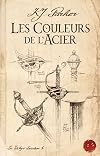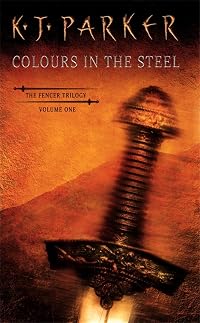
On This Page
Description
An epic novel of blood, betrayal, and intrigue. . .Perimadeia is the famed Triple City and the mercantile capital of the known world. Behind its allegedly impregnable walls, everything is available-including information that will allow its enemies to plan one of the most devastating sieges of all time.
The man called upon to defend Perimadeia is Bardas Loredan, a fencer-at-law, weary of his work and the world. For Loredan is one of the surviving members of Maxen's Pitchfork, the legendary show more band of soldiers who waged war on the Plains tribes, rendering an attack on Perimadeia impossible. Until now, that is.
But Loredan has problems of his own. In a city where court cases are settled by lawyers arguing with swords not words, enemies are all too easily made. And by winning one particular case, Loredan has unwittingly become the target of a young woman bent on revenge. The last thing he needs is the responsibility of saving a city. show less
Tags
Recommendations
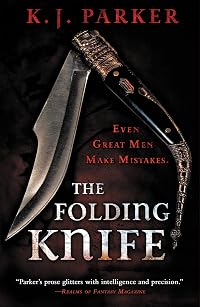
Member Recommendations
Member Reviews
“Put the steel into the fire and watch it change colour; straw to orange to brown to purple to green to black. According to some smiths he’d talked to, there’s a certain point at which something happens to heated steel. Make it hot enough and the flexibility changes to cutting hardness, at which point the skill lies in tempering it, quenching the heat with skill and care in such a way that the steel stays hard without becoming brittle. It’s a delicate business, the perfect balance of fire and water; […] Blood, they say, puts something into the steel at that crucial moment of tempering, an extra touch of hardness on the outside of the metal that doesn’t effect the flexibility and resilience of the core.”
In “The Colours in show more the Steel” by K. J. Parker
There's a strong argument that realism is a divergence from philosophy. But SF is firmly in the realm of allegory, which is pretty much philosophy’s most powerful tool. Is Parker’s work really offering something new SF-wise? Well, it's a thought. But I suspect people are doing the Parker a disservice by calling his SF "a" Philosophy-Without-Magic. If it is anything, like a nebula, it is the birthplace of Something-Different-in-SF (especially in Fantasy). In fact all Parker’s work could be seen as SF turned serious: Did the Zoroastrians really believe that Ahura Mazda was fighting his equivalent dark side or did they take it to be a great tale? Did the early post-vedic Hindus sincerely think the new god Krishna was a metaphor or literally believe he had a weapon (the chakra) that could even today beat any light sabre? Do those who purport to belong to the Jedi as a religion really come from too far away, or too near in time for many of us to take them seriously? Yes, SF throws up possibilities that would otherwise not occur to us, but so did mythology, and so I'd like to invert the usual argument and suggest not that Parker’s work is the new SF, but contemporary-SF is the outdated SF… I recall reacting strongly to a review a decade ago that asserted that SF is 'fundamentally non-philosophical'. I think I’ve shown in a lot of my reviews on Parker’s work, it can quite easily be argued the other way. Certainly old style sensawunda relates to epiphanies in other forms and the grandeur of space opera frequently uses spiritual language & imagery even when the author is a Fantasist like Parker is.
Still don’t know what The Principle is…maybe in the next volumes.
NB: As far as I know, this is the first time Parker uses something akin to Magic in one of his works (“Philosophy-With-Only-a-Little-Bit-of-Magic”). That being said, there’s not magicking to the plot…just a nudge here and there. True to form, Parker’s “Magic” is not much to speak of. It’s more about metallurgy tinged with a fantasy setting…
SF = Speculative Fiction. show less
In “The Colours in show more the Steel” by K. J. Parker
There's a strong argument that realism is a divergence from philosophy. But SF is firmly in the realm of allegory, which is pretty much philosophy’s most powerful tool. Is Parker’s work really offering something new SF-wise? Well, it's a thought. But I suspect people are doing the Parker a disservice by calling his SF "a" Philosophy-Without-Magic. If it is anything, like a nebula, it is the birthplace of Something-Different-in-SF (especially in Fantasy). In fact all Parker’s work could be seen as SF turned serious: Did the Zoroastrians really believe that Ahura Mazda was fighting his equivalent dark side or did they take it to be a great tale? Did the early post-vedic Hindus sincerely think the new god Krishna was a metaphor or literally believe he had a weapon (the chakra) that could even today beat any light sabre? Do those who purport to belong to the Jedi as a religion really come from too far away, or too near in time for many of us to take them seriously? Yes, SF throws up possibilities that would otherwise not occur to us, but so did mythology, and so I'd like to invert the usual argument and suggest not that Parker’s work is the new SF, but contemporary-SF is the outdated SF… I recall reacting strongly to a review a decade ago that asserted that SF is 'fundamentally non-philosophical'. I think I’ve shown in a lot of my reviews on Parker’s work, it can quite easily be argued the other way. Certainly old style sensawunda relates to epiphanies in other forms and the grandeur of space opera frequently uses spiritual language & imagery even when the author is a Fantasist like Parker is.
Still don’t know what The Principle is…maybe in the next volumes.
NB: As far as I know, this is the first time Parker uses something akin to Magic in one of his works (“Philosophy-With-Only-a-Little-Bit-of-Magic”). That being said, there’s not magicking to the plot…just a nudge here and there. True to form, Parker’s “Magic” is not much to speak of. It’s more about metallurgy tinged with a fantasy setting…
SF = Speculative Fiction. show less
This must be one of the most prosaic epic fantasy novels I've ever read, a matter-of-fact, down-to-earth novel set in an imaginary world. So much so that a significant conceit, lawyers fencing to the death to decide court cases, is an anomaly albeit taken for granted by the natives but regarded as barbaric and inexplicable by outsiders.
Bardas Loredan is one of the fencing lawyers, on the brink of giving it up and founding a school of his own. A succesfully fought case, however, brings a curse on his head and ensnares assorted characters in its resolution. Meanwhile, Temrai of the Plainspeople comes to stay in the city and learn its ways. Then his father dies and he goes home to become Chief and returns with an a horde thousands strong show more to put his learning to use in razing the city to the ground. Bardas Loredan is put in charge of the city's defence.
It would be wrong to say that this books is free of passion and drama. Passions drive the plots, with plenty of revenge and hate under the surface, friendships are formed and there's even a suggestion of hidden attraction, but even the most driven of characters rolls up their sleeves and gets to to work learning or building or trading or fighting. And there is plenty of drama, what with fights to the death and sieges and battles and politics, but most of the people involved are pros and they go about their business with a mixture of detachment and diligence. Between Martin's High Romance with blood and mud and Abercrombie's deeply embedded cyncism comes this: Parker's workaday world.
It's terrifically readable and refreshing in its lack of need to grapple with genre conventions, putting them to work instead and making them earn their way. Highly enjoyable. show less
Bardas Loredan is one of the fencing lawyers, on the brink of giving it up and founding a school of his own. A succesfully fought case, however, brings a curse on his head and ensnares assorted characters in its resolution. Meanwhile, Temrai of the Plainspeople comes to stay in the city and learn its ways. Then his father dies and he goes home to become Chief and returns with an a horde thousands strong show more to put his learning to use in razing the city to the ground. Bardas Loredan is put in charge of the city's defence.
It would be wrong to say that this books is free of passion and drama. Passions drive the plots, with plenty of revenge and hate under the surface, friendships are formed and there's even a suggestion of hidden attraction, but even the most driven of characters rolls up their sleeves and gets to to work learning or building or trading or fighting. And there is plenty of drama, what with fights to the death and sieges and battles and politics, but most of the people involved are pros and they go about their business with a mixture of detachment and diligence. Between Martin's High Romance with blood and mud and Abercrombie's deeply embedded cyncism comes this: Parker's workaday world.
It's terrifically readable and refreshing in its lack of need to grapple with genre conventions, putting them to work instead and making them earn their way. Highly enjoyable. show less
So, when I read my first Parker book, I immediately ordered the rest, because I was so entranced by the clockwork intricacy of the plotting. Then I read the rest of that trilogy (the Engineer trilogy), and another book besides, and then the other Parker trilogy sat on my shelf for years. I spent most of a semester trying to get through this one, and it’s time to admit defeat (50 pages from the end). Parker has one story to tell, which she sets in a fantasy world—fantasy in that there are resonances with cultures we have, but not exact correspondences; whether magic actually exists is always left rather unclear. It’s really well done, but so grim and joyless that it’s like a really well done root canal. Either fate or human show more folly, if they can be disentangled, always sweep the characters towards depressing outcomes; they know they’re causing awful damage but do it anyway, disclaiming responsibility; all the intricacy of the plotting is just an engine of pain stamping out people who will do the same thing to someone else fifty years on in the name of revenge or justice or greed or even just by accident. It’s mechanistic, but not in a steampunk way; deterministic, but not in a way that lets anyone off the hook for their choices, so you get the worst of both worlds; and just profoundly depressing and anti-humanistic. Maybe it is my nature, but I don’t need to devote any more time to this view of the world. show less
A page-turner with an interesting initial idea for me. Trial by combat means that you can hire lawyers (fencers-at-law) to argue your case for you. Parker moved too quickly from this interesting idea to revenge and siege for me.
Such a frustrating story, because you want both sides to win, and you know they can't. And yet so very enjoyable.
It's interesting, I've basically read Parker's 3 trilogies in reverse order of when they were published, and there are so many themes in this book that s/he apparently liked so much that she wanted to explore them at much greater length in the others. (the biggest one being, of course, the effects of more sophisticated technology on medieval-ish societies, but also: blacksmithing, swordfighting, military camaraderie, revenge, past misdeeds coming back to haunt you in ironic ways, bossy women, the invention of explosives, calmly competent engineers, mysterious not-really magic, etc.)
And bonus: this one actually passes the show more Bechdel Test! show less
It's interesting, I've basically read Parker's 3 trilogies in reverse order of when they were published, and there are so many themes in this book that s/he apparently liked so much that she wanted to explore them at much greater length in the others. (the biggest one being, of course, the effects of more sophisticated technology on medieval-ish societies, but also: blacksmithing, swordfighting, military camaraderie, revenge, past misdeeds coming back to haunt you in ironic ways, bossy women, the invention of explosives, calmly competent engineers, mysterious not-really magic, etc.)
And bonus: this one actually passes the show more Bechdel Test! show less
Having read K. J. Parker's "The Seige" trilogy some time ago, i thought i'd go back to the beginning and begin to give his whole back catalogue a good read at.
Colours in the Steel is K. J. Parker's first book in his first ever triology: "The Fencer". And guess what, it's really good.
There's just so much going on in this book to keep you enthralled and entertained, with lots of great characters that you can really get on board with, and lots of action as well.
If you haven't read a good castle/walled-city seige story, then i would suggest you give " The Seige" trilogy a go to start with, because it's just soooo good. And if you enjoy that, which you're bound to do, then you've got this story waiting in the wings to satisfy your show more appetite for more. Because one thing is for sure, K. J. Parker does write a really good seige story.
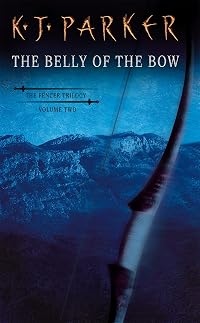
And with all that written i'm going to dive straight into the second book, Belly of the Bow. show less
Colours in the Steel is K. J. Parker's first book in his first ever triology: "The Fencer". And guess what, it's really good.
There's just so much going on in this book to keep you enthralled and entertained, with lots of great characters that you can really get on board with, and lots of action as well.
If you haven't read a good castle/walled-city seige story, then i would suggest you give " The Seige" trilogy a go to start with, because it's just soooo good. And if you enjoy that, which you're bound to do, then you've got this story waiting in the wings to satisfy your show more appetite for more. Because one thing is for sure, K. J. Parker does write a really good seige story.
And with all that written i'm going to dive straight into the second book, Belly of the Bow. show less
Colours in the Steel by KJ Parker, proved to be a good read. It’s Parker’s first novel, and the first book of the Fencer trilogy (followed by The Belly of the Bow and The Proof House). It was first published in 1998, but it doesn’t read like a fantasy that’s more than a decade old.
In the Triple City of Perimadeia, the outcome of court cases are determined by the two advocates fighting each other with swords, often to the death. Bardas Loredan is one such fencer-at-law, and the fact that he’s been practicing his profession for more than ten years indicates that he’s good at it. Temrai is the son of the chief of the plains people, Perimadeia’s on-and-off enemies, and he has come to the Triple City to make swords in its show more arsenal. Alexius is the city’s Patriarch, the head of the Order which studies the Principle, which is sort of like magic but much more like philosophy. Then there’s Venart and Vetriz, brother and sister traders from the Island, who keep on bumping into Loredan and Alexius…
For rest of review see: http://iansales.com/2010/05/02/fantasy-challenge-4-colours-in-the-steel-kj-parke... show less
In the Triple City of Perimadeia, the outcome of court cases are determined by the two advocates fighting each other with swords, often to the death. Bardas Loredan is one such fencer-at-law, and the fact that he’s been practicing his profession for more than ten years indicates that he’s good at it. Temrai is the son of the chief of the plains people, Perimadeia’s on-and-off enemies, and he has come to the Triple City to make swords in its show more arsenal. Alexius is the city’s Patriarch, the head of the Order which studies the Principle, which is sort of like magic but much more like philosophy. Then there’s Venart and Vetriz, brother and sister traders from the Island, who keep on bumping into Loredan and Alexius…
For rest of review see: http://iansales.com/2010/05/02/fantasy-challenge-4-colours-in-the-steel-kj-parke... show less
Members
- Recently Added By
Lists

Jean's Sci Fi/Fantasy Reading list
189 works; 12 members
Author Information

166+ Works 26,336 Members
Series

Belongs to Publisher Series
Gallimard, Folio SF (367)
Work Relationships
Is contained in
Common Knowledge
- Canonical title
- Colours in the Steel
- Original title
- Colours in the Steel
- Original publication date
- 1998
- People/Characters
- Bardas Loredan; Gorgas Loredan
- Important places
- Perimadeia
- Dedication
- For my father,
who made me want to make things. - First words
- It was just a run-of-the-mill shipping dispute, nothing more; a disagreement over the interpretation of a poorly worded contract, some minor discrepancies in various bills of lading, coinciding with a notorious grey area in t... (show all)he mercantile statutes.
- Last words
- (Click to show. Warning: May contain spoilers.)'I've always wanted to go to Scona.'
Classifications
Statistics
- Members
- 534
- Popularity
- 56,166
- Reviews
- 8
- Rating
- (3.69)
- Languages
- 5 — Dutch, English, French, German, Italian
- Media
- Paper, Ebook
- ISBNs
- 12
- ASINs
- 4