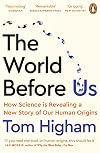
The World Before Us: How Science is Revealing a New Story of Our Human Origins
by Tom Higham
On This Page
Description
"A fascinating investigation of the origin of humans based on incredible new discoveries and advanced scientific technology. Fifty thousand years ago, Homo sapiens was not the only species of humans in the world. There were also Neanderthals in what is now Europe, the Near East, and parts of Eurasia; Hobbits (H. floresiensis) on the island of Flores in Indonesia; Denisovans in Siberia and eastern Eurasia; and H. luzonensis in the Philippines. Tom Higham investigates what we know about these show more other human species and explores what can be learned from the genetic links between them and us. He also looks at whether H. erectus may have survived into the period when our ancestors first moved into Southeast Asia. Filled with thrilling tales of recent scientific discoveries, this book offers an engaging synopsis of our current understanding of human origins and raises new and interesting possibilities--particularly concerning what contact, if any, these other species might have had with us prior to their extinction"-- show lessTags
Recommendations




Member Reviews
Tom Higham gives us a fascinating, absorbing history of our species and our genus. We're the last genus Homo species standing, but 50,000 years ago, we were not alone.
Not so long ago, we thought that 50,000 years ago, there were homo sapiens and homo neanderthalensis, and that Neanderthals died out because Sapiens were smarter and more adaptable, and perhaps more deadly to our cousins than they to us. We met in Europe, and they went extinct.
Then recovery and analysis of ancient DNA advanced dramatically, and we got some major surprises.
Among those discoveries is that Neanderthals were not just our cousins, but our very close cousins. Close enough cousins that they sometimes mated and produced offspring, defying our usual understanding show more of "separate species," and some of those offspring were fertile with other homo sapiens. Enough of them were fertile with other homo sapiens that modern humans who are not from sub-Saharan Africa have on average about 1-2% Neanderthal DNA. Neanderthals died out as a separate species, but some of their genes, and their traits, are still with us.
But that was just the beginning.
In a cave in the Altai Mountains in Siberia, remains were discovered of Neanderthals, modern humans, and, to the astonishment and delight of archaeologists, a previously unknown human species. DNA from the pinky finger of a girl, at least thirteen years old at the time of her death, showed that she was a first-generation hybrid of a Neanderthal mother and a father of the species we now call Denisovan. Other Denisovan remains have been found, but we don't yet know this species as well as we know Neanderthals.
But we do know they also interbred with homo sapiens. Denisovan genes may be why Tibetans are relatively well adapted to life at high altitudes. East Asians and Pacific Islanders may have as much as 4 to 5 percent Denisovan DNA.
These were our close relatives, close enough both genetically and in geographic proximity that we interbred with them, at least sometimes, and produced at least some fertile offspring. They weren't the only other humans still sharing the planet with us 50,000 years ago. We've also found homo florensiensis, the "hobbits" of the island of Flores in Indonesia, and homo luzonensis, another small genus homo species, found on the island of Luzon in the Philippines. Homo erectus, previously thought to have been extinct well before this, may also, based on recent evidence, have survived in the islands of Southeast Asia as late as 50,000 years ago.
But DNA recovery and analysis continues to advance, and there are hints of possible other species of genus homo whom we have not yet recovered any fossils of.
My account of this is superficial and dry; Higham's is exciting, rich with fascinating detail and the human experience of finding this evidence, and highly readable.
Highly recommended.
I bought this audiobook. show less
Not so long ago, we thought that 50,000 years ago, there were homo sapiens and homo neanderthalensis, and that Neanderthals died out because Sapiens were smarter and more adaptable, and perhaps more deadly to our cousins than they to us. We met in Europe, and they went extinct.
Then recovery and analysis of ancient DNA advanced dramatically, and we got some major surprises.
Among those discoveries is that Neanderthals were not just our cousins, but our very close cousins. Close enough cousins that they sometimes mated and produced offspring, defying our usual understanding show more of "separate species," and some of those offspring were fertile with other homo sapiens. Enough of them were fertile with other homo sapiens that modern humans who are not from sub-Saharan Africa have on average about 1-2% Neanderthal DNA. Neanderthals died out as a separate species, but some of their genes, and their traits, are still with us.
But that was just the beginning.
In a cave in the Altai Mountains in Siberia, remains were discovered of Neanderthals, modern humans, and, to the astonishment and delight of archaeologists, a previously unknown human species. DNA from the pinky finger of a girl, at least thirteen years old at the time of her death, showed that she was a first-generation hybrid of a Neanderthal mother and a father of the species we now call Denisovan. Other Denisovan remains have been found, but we don't yet know this species as well as we know Neanderthals.
But we do know they also interbred with homo sapiens. Denisovan genes may be why Tibetans are relatively well adapted to life at high altitudes. East Asians and Pacific Islanders may have as much as 4 to 5 percent Denisovan DNA.
These were our close relatives, close enough both genetically and in geographic proximity that we interbred with them, at least sometimes, and produced at least some fertile offspring. They weren't the only other humans still sharing the planet with us 50,000 years ago. We've also found homo florensiensis, the "hobbits" of the island of Flores in Indonesia, and homo luzonensis, another small genus homo species, found on the island of Luzon in the Philippines. Homo erectus, previously thought to have been extinct well before this, may also, based on recent evidence, have survived in the islands of Southeast Asia as late as 50,000 years ago.
But DNA recovery and analysis continues to advance, and there are hints of possible other species of genus homo whom we have not yet recovered any fossils of.
My account of this is superficial and dry; Higham's is exciting, rich with fascinating detail and the human experience of finding this evidence, and highly readable.
Highly recommended.
I bought this audiobook. show less
Very informative and a great read, even if I was very much out of my depth more than once. I will be following Tom Higham from now on.
Ratings
Members
- Recently Added By
Published Reviews
ThingScore 75
... The book gets off to a shaky start, as the opening chapters are overstuffed with unnecessary detail that isn't immediately explained. For example, Higham repeatedly mentions nuclear and mitochondrial DNA, but doesn't explain them until chapter 5 - although at one point there is an apologetic footnote directing readers to that part.
However, once past these bumps the book settles into a show more lively groove. Higham devotes whole chapters, sometimes multiple chapters, to each extinct hominim group. He packs in startling discoveries, impressive insights and the occasional debunking of a foolish idea.
Higham's personal involvement means he has lots of good stories. ... show less
However, once past these bumps the book settles into a show more lively groove. Higham devotes whole chapters, sometimes multiple chapters, to each extinct hominim group. He packs in startling discoveries, impressive insights and the occasional debunking of a foolish idea.
Higham's personal involvement means he has lots of good stories. ... show less
added by Cynfelyn
Lists

Science: Life
4 works; 1 member
Author Information
2 Works 119 Members
Common Knowledge
- Original title
- The World Before Us: How Science is Revealing a New Story of Our Human Origins
- Original publication date
- 2021
- People/Characters
- Neanderthals; Denisovans; Homo floresiensis; Homo sapiens
Classifications
- Genres
- Anthropology, Science & Nature, Nonfiction, General Nonfiction, History
- DDC/MDS
- 569.9 — Natural sciences & mathematics Fossils & Dinosaurs Fossil Mammalia Hominidae
- LCC
- GN282 .H54 — Geography, Anthropology and Recreation Anthropology Anthropology Physical anthropology. Somatology Human evolution Fossil man. Human paleontology
- BISAC
Statistics
- Members
- 118
- Popularity
- 275,282
- Reviews
- 2
- Rating
- (4.08)
- Languages
- English, Portuguese, Spanish, Turkish
- Media
- Paper, Audiobook, Ebook
- ISBNs
- 12
- ASINs
- 4