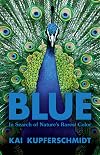
Blue : in search of nature's rarest color
by Kai Kupferschmidt
On This Page
Description
"A globe-trotting quest to find blue in the natural world-and to understand our collective obsession with this bewitching color"--Tags
Recommendations























Member Recommendations
Member Reviews
Rating: 5* of five
The Publisher Says: A globe-trotting quest to find blue in the natural world—and to understand our collective obsession with this bewitching color
Blue is a rare color—natural blue, that is. From morpho butterflies in the rain forest to the blue jay flitting past your window, vanishingly few living things are blue—and most that appear so are doing sleight of hand with physics or complex chemistry. Flowers modify the red pigment anthocyanin to achieve their blue hue. Even the blue sky above us is a trick of the light.
Yet this hard-to-spot accent color in our surroundings looms large in our affections. Science journalist Kai Kupferschmidt has been fascinated by blue since childhood. His quest to find and understand show more his favorite color and its hallowed place in our culture takes him to a gene-splicing laboratory in Japan, a volcanic lake in Oregon, and to Brandenburg, Germany—home of the last Spix’s macaws. From deep underground where blue minerals grow into crystals to miles away in space where satellites gaze down at our “blue marble” planet, wherever we do find blue, it always has a story to tell.
I RECEIVED A DRC FROM THE PUBLISHER VIA EDELWEISS+. THANK YOU.
My Review: Where do you fall on this infographic?
A solid plurality of the world's people are fondest of the color blue. (Red's my choice.) The amazing thing is, this is a really rare color whether as a pigment...a substance that stays blue even when altered...or as a structural color, when the way a surface reflects and/or refracts light causes the eye to perceive it as blue.
Blue light is rare on the surface of the Earth. Green is, as I imagine you can suss out, the most common color of light down here. That's how plants can afford to reflect it, so we see their leaves as green.
Cornflower blue is a very satisfying color, but I still prefer the stem myownself. The Table of Contents gives you a good, solid feel for this book's modus operandi. You're going to see beautiful images throughout, of course, but they're llustrating concepts about color, how it is made, seen, and used in the natural world.
Rocks are the primary sources of blue pigments. They are not always stable in their blueness, with many things impacting that stability. The kind of light and the amount and humidity of air the pigments are exposed to can impact the stability of the color perceived by our eyes.
Animals apearing blue to our eyes are using structural color, the kind that relies on properties of the surface of the animal to show as blue. Changing a factor in the environment, or simply moving one's angle of view, will cause the color to change or disappear.
The surface now being scratched, I hope you can appreciate the subtle way a color comes to exist in your mind is the actual subject of this book. Kai Kupferschmidt is a science journalist based in Berlin, with degrees in molecular biomedicine, so he's a reliable guide to the science he's discussing. What he isn't is a boring writer. He's equally facile at disccussing Picasso's Blue Period and how our eyes do the work of showing us color.
This book gets my vote for going into the stocking of young artists, biologists, physicists...reall, anyone who loves blue, likes learning, and can appreciate a beautiful browsing book that also repays solid reading time. show less
The Publisher Says: A globe-trotting quest to find blue in the natural world—and to understand our collective obsession with this bewitching color
Blue is a rare color—natural blue, that is. From morpho butterflies in the rain forest to the blue jay flitting past your window, vanishingly few living things are blue—and most that appear so are doing sleight of hand with physics or complex chemistry. Flowers modify the red pigment anthocyanin to achieve their blue hue. Even the blue sky above us is a trick of the light.
Yet this hard-to-spot accent color in our surroundings looms large in our affections. Science journalist Kai Kupferschmidt has been fascinated by blue since childhood. His quest to find and understand show more his favorite color and its hallowed place in our culture takes him to a gene-splicing laboratory in Japan, a volcanic lake in Oregon, and to Brandenburg, Germany—home of the last Spix’s macaws. From deep underground where blue minerals grow into crystals to miles away in space where satellites gaze down at our “blue marble” planet, wherever we do find blue, it always has a story to tell.
I RECEIVED A DRC FROM THE PUBLISHER VIA EDELWEISS+. THANK YOU.
My Review: Where do you fall on this infographic?
A solid plurality of the world's people are fondest of the color blue. (Red's my choice.) The amazing thing is, this is a really rare color whether as a pigment...a substance that stays blue even when altered...or as a structural color, when the way a surface reflects and/or refracts light causes the eye to perceive it as blue.
Blue light is rare on the surface of the Earth. Green is, as I imagine you can suss out, the most common color of light down here. That's how plants can afford to reflect it, so we see their leaves as green.
Cornflower blue is a very satisfying color, but I still prefer the stem myownself. The Table of Contents gives you a good, solid feel for this book's modus operandi. You're going to see beautiful images throughout, of course, but they're llustrating concepts about color, how it is made, seen, and used in the natural world.
Rocks are the primary sources of blue pigments. They are not always stable in their blueness, with many things impacting that stability. The kind of light and the amount and humidity of air the pigments are exposed to can impact the stability of the color perceived by our eyes.
Animals apearing blue to our eyes are using structural color, the kind that relies on properties of the surface of the animal to show as blue. Changing a factor in the environment, or simply moving one's angle of view, will cause the color to change or disappear.
The surface now being scratched, I hope you can appreciate the subtle way a color comes to exist in your mind is the actual subject of this book. Kai Kupferschmidt is a science journalist based in Berlin, with degrees in molecular biomedicine, so he's a reliable guide to the science he's discussing. What he isn't is a boring writer. He's equally facile at disccussing Picasso's Blue Period and how our eyes do the work of showing us color.
This book gets my vote for going into the stocking of young artists, biologists, physicists...reall, anyone who loves blue, likes learning, and can appreciate a beautiful browsing book that also repays solid reading time. show less
A look at the history and science behind the color blue.
I really enjoyed this book. While it is very history and science based it is written in such an digestible and approachable way, and so well paced that it was an easy read.
One of my favorite sections was where he goes over the effect of color in our language and how it can influence how we see the world, another was the discussion about the struggles to introduce blue in to plants, not just the technical struggle by why it has been deemed worth doing in the first place.
As I type this I keep thinking of other favorites sections, there was so much to learn in this book. Even if you couldn't take it all in, each section has something in it that can grab you and make you see the show more world in a different way.
I would LOVE to see this author cover more colors, or any topic really, in this way. show less
I really enjoyed this book. While it is very history and science based it is written in such an digestible and approachable way, and so well paced that it was an easy read.
One of my favorite sections was where he goes over the effect of color in our language and how it can influence how we see the world, another was the discussion about the struggles to introduce blue in to plants, not just the technical struggle by why it has been deemed worth doing in the first place.
As I type this I keep thinking of other favorites sections, there was so much to learn in this book. Even if you couldn't take it all in, each section has something in it that can grab you and make you see the show more world in a different way.
I would LOVE to see this author cover more colors, or any topic really, in this way. show less
Quite a lovely book. It certainly captured me. Kai Kupferschmidt was fascinated by the colour blue and asks the question why is this colour so rare in nature. He actually explores the phenomenon of blue in a number of way. There seem to be a limited number of ways in which blue is created so that we can detect it: One is as the result of certain atoms absorbing all the other colours from white light...meaning they reflect the wavelengths that we perceive as blue. The second is via the diffraction of white light into its various various components. The third is via fine grids (for example on the backs of beetles) which effectively act as interference grids and reflect just the blue wavelengths. First as the colour of minerals and show more crystals.
Generally, I found the book quite fascinating and informative though I was a bit disappointed by his explanation of the rainbow phenomenon. The diagram on p55. The text is talking about second rainbows but the diagram is really only about a single rainbow. I’ve always found diagrams like this unhelpful because it doesn’t really indicate that our eye is simultaneously received diffracted and reflected light from millions of small drops which are constantly being replaced by identical drops from above. And we are also receiving light from drops which are behind the front layer. Anyway, I think Feynman explains this phenomena much better somewhere in his writings.
I was also interested in the psychology of colour and whether we were all perceiving the same blue. I found it interesting that people from all cultures can see blue though they may describe it differently. I constantly run into this in Japan where I say the light has changed to green and my Japanese wife corrects me and says it’s blue. (Well it’s actually a kind of turquoise).
Happy to give the book four stars.
And I’ve included some extracts below: basically to help med remember what I’ve read. But maybe it will serve as a summary for others.
“Under the pyramid lies the burial chamber of Djoser, surrounded by miles of tunnels, some of them lined with thousands of tiles with a bluish-green shine: perhaps the first blue made by man. The Egyptians mixed white pebbles, sandstone, copper ore, and soda into a powder. When water is added, a paste is produced that becomes a kind of ceramic in the kiln, with a solid (mostly white) core and a shining blue glazed outer layer.
Blue ceramics were merely the beginning. There still wasn't a truly blue pigment that could be painted on walls, for example. For that, the Egyptians had to develop their blue arts even more. Around the time of Djoser's rule they finally succeeded in producing the first artificial pigment: Egyptian blue......There are no records in Egypt of how the colour was made. It was only a thousand years later that the Roman Vitruvius put a formula down on paper: sand, copper (probably in the form of metal filings or the mineral malachite, and soda, ground down, mixed, and fired in a kiln.
In the visible spectrum, which lies between these two regions [ultra violet and intra-red] , light possesses just enough energy to stimulate electrons, the negatively charged elementary particles surrounding the atom's nucleus. When that happens, a specific amount of energy is taken on by an electron.....that is, a certain wavelength of light is absorbed—and the light that is reflected back, which reaches the eye, is missing this wavelength, so it is no longer white. That's why the world is colourful.
Basically, this happens in two ways. On the one hand, electrons can be sitting on various energy levels. Just as a person can stand on only one rung of a ladder or another, but not between them, electrons can only exist on certain energy levels. Depending on which atom is involved and which atoms surround it, different amounts of energy are needed to raise an electron from one level to the next. The distances between the rungs vary...... When light falls on matter, each electron can absorb the specific amount of energy it needs to reach the next energy level.
The sulfur that gives ultramarine its colour was also the reason for the pigment's decline. Producing ultramarine releases tons of sulfur compounds into the atmosphere: These are very harmful to the environment, and many countries have ceased making the colour as a result.
Dobson is studying the transition zone between the upper and the lower mantle, about 310 miles (500 km) beneath our feet. The pressure at that depth is two hundred thousand times greater than the pressure on the surface of Earth. Dobson can create this pressure in the university basement with a machine called a multi-anvil cell. If he puts the most abundant elements of the earth's mantle into the press, a mineral called ringwoodite is formed. It makes up about 80 percent of the transition zone. It's an important object of Dobson's studies. And it just so happens to be a deep, luminous blue...... As with Prussian blue, the colour is caused by bivalent and trivalent atoms of iron pushing electrons to and fro.
Many of the scientists I've spoken to don't talk about blue pigments, but about "red-absorbing" ones.
And that's just the beginning.
In the midday sun, the cornflower reflects a light that's quite different from the light at twilight, and yet to us it looks equally blue throughout the day. How can that be?
One reason for the confusion is that the processing of visual information in our brains is not conscious. We have the feeling that we are looking immediately and directly into the blue. Our mind is transparent, philosophers say. We simply see "the blue" with no awareness of the process of seeing itself.
When a rainbow appears in the sky, you can often spy a second, weaker rainbow above it, the colours reversed. A rainbow occurs when the light in the raindrops is reflected and refracted.
The second rainbow is formed by light that is reflected for a second time on the inside of the drop before emerging.
With a prism Newton showed that he could separate sunlight into the colours of the rainbow and then put them back together to make white light. What had previously been simply "white light" was suddenly a spectrum of colour. Newton divided it up into seven colours: red, orange, yellow, green, blue, indigo, and violet.
Newton probably added indigo just to get to seven colours.
The scientific genius was also a mystic, and to him the number seven seemed more in harmony with the universe (at that time seven planets were known, and the seven notes of the musical scale had mystical significance). Today the colour indigo has disappeared from many representations of the rainbow, and the number of colours has been reduced to six:
In 1800 the astronomer William Herschel was trying to measure how warm the various colours in the spectrum are, and, to his surprise, he found that the thermometer showed the highest temperature when he placed it beside the red light, that is, outside the visible spectrum. Clearly there were additional, invisible rays beyond red. Herschel had discovered infrared radiation.
the rays that leave the Sun as white light reach us with some of their blue portion missing. That's why the Sun looks yellow. And the sky is blue for us because that diffracted blue light is scattered across the sky and reaches us from all directions. Physicists talk of "stray light." The American writer Rebecca Solnit calls it
"the light that got lost."
To be precise, only a small portion of the blue light is scattered across the sky. And the light that is most readily dispersed has wavelengths that are even shorter than violet light. This light falls in the ultraviolet range. So we are surrounded by UV light, which is why you can get a sunburn even in the shade..... Once it arrives on Earth's surface, the sunlight finally falls on a cornflower at the edge of a field. Part of the red light is absorbed by the blossom, and the rest is reflected. This light, which contains the whole spectrum of visible light apart from the red portion, then hits the cornea of our eye
As a result of Helmholtz's experiments, the three-colour theory became widely accepted. Indeed, humans do have three different types of cones. For simplicity's sake these are called the red, green, and blue cones. In reality, however, they react most strongly to yellow-green, emerald-green, and blue-violet light.
Why do the cones react to light of different wavelengths or different colours? The light sensor, the retinal, is always the same molecule, but the opsin, which it is bound to, differs slightly in the three types of cones. The retinal is a little like the chromium ions in the emerald and the ruby that absorb light of different wavelengths because their environments differ somewhat.
But there is a second effect that is related to the structure of the eye. The task of the lens is to focus the rays of light in such a way that a sharp image appears on the retina. Just as blue light is more intensely scattered across the sky, its refraction by the lens is more intense. For this reason the eye cannot focus sharply on both red and blue at the same time. That is why it is so unpleasant to read red writing on a blue background.
In order to focus sharply on a blue object, the eye has to relax the little ring-shaped muscle around the lens so it becomes flat-ter. It is the same movement that is needed to focus on a faraway object. Our brain does this automatically. However, it may have the subconscious effect of making us associate the colour blue with distance.
it was not until 2002, seventy-five years after Keeler's publication, that scientists finally published confirmation of this in the journal Science: A few nerve cells in the outer layer of the retina, called ganglion cells, possess a light sensor, the molecule melanopsin. It reacts to blue light.
These cells do not contribute to vision, but they do help to coordinate countless other processes in the body. One of these is the reflex that causes the pupil to narrow when too much light shines into the eye. Another is our inner clock.
The bacteria flourished in places where red or blue light hit the alga. Clearly, oxygen was being made in those spots. But the part of the alga on which green and yellow light fell did not seem to attract the bacteria. No photosynthesis took place there.
Plants really do not use green light. And yet more of the Sun's energy arrives on the surface of Earth in the green range than in any other part of the spectrum. Wouldn't it be more efficient for plants to use that light? Or to simply absorb all light, which would make them black?
Astonishingly, that is a question scientists have not found the answer to yet. To be more precise: They have plenty of answers, but it is not clear which one of them, if any, is the right one.
Besides green chlorophyll, a number of other classes of pigments are found in plants. The betalains, for example, colour beets, the fly agaric, and bougainvillea red.
A much larger class is the carotenoids. They give the carrot its colour and make tomatoes and bell peppers appear red.
Carotenoids are the source of the yellow in corn, bananas, and buttercups. They are also present in tree leaves. For most of the year, the green of the many chlorophyll molecules outshines the carotenoids. Only when the chlorophyll is broken down in autumn do the yellow molecules become visible.
And then there are the anthocyanins, perhaps the most splendid of plant pigments. They colour cherries and corn poppies, but also raspberries, strawberries, and cranberries. And they are the reason for the red fall foliage. In autumn the trees reduce the amount of chlorophyll in their leaves and at the same time start to produce anthocyanins...... It appears to be extremely difficult for nature to produce a molecule that absorbs red light, which is what would be needed to appear blue. Neither chlorophylls nor betalains nor carotenoids occur in blue flowers. In fact, among all the pigments in the plant kingdom, there is only one group that is capable of colouring a blossom blue: the anthocyanins.
Willstätter [around 1913] succeeded in doing the same with the red rose. He found something astonishing: The pigment he isolated [cyanidin] was the same one he had found in the cornflower. But how could the blue of the cornflower and the red of the rose come from the same pigment?...... Willstätter suspected the cell sap in the vacuole of the rose was more acidic than the cornflower's, and that that difference in pH value was the source of the different colours:........ The puzzle of cornflower blue, too, was eventually solved using X-rays [in 2006]. The scientists found an elaborate molecular com-plex: six molecules of cyanidin and six copigment molecules arranged around one atom of iron and one of magnesium, like the spokes of a wheel. This was the secret of the flower's blue colour.
Many other plants create their blue blooms using the same recipe: six molecules of anthocyanin, six molecules of a copig-ment, and two ions of a metal. That is how the deep blue of Mexican sage and baby blue eyes comes about—as well as the coveted blue of the common dayflower
In the decades after Willstätter's death, it turned out he had not been entirely mistaken: Some plants do indeed change their pH value in order to appear blue.
The morning glory (Ipomoea tricolour) is a sky-blue climbing plant native to Mexico. It owes its name to the fact that it opens its blossoms only briefly in the morning. But while it does, its blossoms change their colour, from red to blue. Scientists have been able to show that in order to do this, the plant shifts the pH value in the cells housing the pigment from 6.6 to 7.7.
Delphinidin is behind many of the best-known blues in the world, like that of the gentian. If there is a molecule for "blossom blue," delphinidin is it..... The delphinidin molecule differs from cyanidin in just one small detail: It carries an additional oxygen atom in one place.
For the plant, this oxygen atom is like a little hook that additional atoms can be attached to. This way, the plant can embellish the molecule, building one that is bluer and more complicated.
In 1928, scientists in a Scottish dye factory noticed that a blue powder was occasionally formed during the production of the white chemical phthalimide. Their investigation eventually led to an astonishing discovery: Because there was a crack in the inner glass lining of a steel container, the chemicals sometimes came into contact with iron and formed the blue substance.
The pigment had all the qualities one could desire: It was easy to produce and had a strong colour that was long lasting. As early as 1929, the company started commercial production of the pigment: phthalocyanine.
It was five years later that scientists worked out the formula, and it happened to be similar to that of chlorophyll. Humanity had found a new blue, and today it is almost as ubiquitous as the green of the leaves. Phthalocyanine is probably the most widespread blue dye.
There was astonishing agreement between the speakers of most languages when they were asked to indicate the best example of a colour. Languages with fewer colour words did indeed divide the spectrum up more broadly, but they still had boundaries occurring in the same places as languages with more colour words-they just had fewer boundaries. It was as if the spectrum had predetermined breaking points at which it was most likely to divide into different colours.
And there was one additional pattern that Kay and Berlin found: Languages with only three colour words generally distinguished between black, white, and red. Yellow and green tended to come next. Only after that was blue named as a colour in its own right. It was the same order that Geiger had suggested following his study of classical sources.
A further experiment was to ask twenty-five indigenous people to name a set of 330 coloured chips and record the results. This study, which became known as the World Color Survey, actually worked, and in 2009 the researchers presented data from 110 languages—from Abidji in Ivory Coast to Zapotec in Mexico.
In this large sample of languages there were divergences and exceptions, and the boundaries between colours were not exactly the same in some of them. But the data essentially confirmed what Kay and Berlin had already formulated forty years before:
There were some areas of the colour spectrum that humans gave names to sooner than others. But why?
Pollia condensata, also called the marble berry, is a shrub that grows across large parts of Africa. And it was the incredible intensity of the berries' hue that initially gave Rudall and other biologists the idea that it might be an example of a structural colour. The physicist Silvia Vignolini, who chaired the conference I would attend in Cambridge later that year, has decoded the origin of the colour: The surface of the berry consists of cells with thick walls, and these walls consist of layers of tightly packed cellulose threads. Each layer is rotated slightly with respect to the one below it, creating a kind of spiral, and that arrangement allows it to reflect blue light more than any other.
But not only that: Each cell on the surface of the marble berry creates a slightly different colour, and it is out of these innumerable tiny dots that the captivating blue is composed.
The stability of structural colours is one of their most intriguing characteristics. The sight of the shining Pollia berries was almost uncanny. While pigments lose their intensity after just a short time, or disappear completely, the tiny structures that create interference colours can be preserved over years-millions of years [in fossils]..... While they're alive, the beetles generate their colours through a series of thin layers of material, similar to the way the peacock's feathers produce blue. Through the pressure that occurs during the process of petrification, these layers are pressed closer to one another, creating a shift in the wavelength of light they reflect and turning green beetles into blue ones.
Many a fossil that appears blue today wasn't blue at all when it was a living creature. show less
Generally, I found the book quite fascinating and informative though I was a bit disappointed by his explanation of the rainbow phenomenon. The diagram on p55. The text is talking about second rainbows but the diagram is really only about a single rainbow. I’ve always found diagrams like this unhelpful because it doesn’t really indicate that our eye is simultaneously received diffracted and reflected light from millions of small drops which are constantly being replaced by identical drops from above. And we are also receiving light from drops which are behind the front layer. Anyway, I think Feynman explains this phenomena much better somewhere in his writings.
I was also interested in the psychology of colour and whether we were all perceiving the same blue. I found it interesting that people from all cultures can see blue though they may describe it differently. I constantly run into this in Japan where I say the light has changed to green and my Japanese wife corrects me and says it’s blue. (Well it’s actually a kind of turquoise).
Happy to give the book four stars.
And I’ve included some extracts below: basically to help med remember what I’ve read. But maybe it will serve as a summary for others.
“Under the pyramid lies the burial chamber of Djoser, surrounded by miles of tunnels, some of them lined with thousands of tiles with a bluish-green shine: perhaps the first blue made by man. The Egyptians mixed white pebbles, sandstone, copper ore, and soda into a powder. When water is added, a paste is produced that becomes a kind of ceramic in the kiln, with a solid (mostly white) core and a shining blue glazed outer layer.
Blue ceramics were merely the beginning. There still wasn't a truly blue pigment that could be painted on walls, for example. For that, the Egyptians had to develop their blue arts even more. Around the time of Djoser's rule they finally succeeded in producing the first artificial pigment: Egyptian blue......There are no records in Egypt of how the colour was made. It was only a thousand years later that the Roman Vitruvius put a formula down on paper: sand, copper (probably in the form of metal filings or the mineral malachite, and soda, ground down, mixed, and fired in a kiln.
In the visible spectrum, which lies between these two regions [ultra violet and intra-red] , light possesses just enough energy to stimulate electrons, the negatively charged elementary particles surrounding the atom's nucleus. When that happens, a specific amount of energy is taken on by an electron.....that is, a certain wavelength of light is absorbed—and the light that is reflected back, which reaches the eye, is missing this wavelength, so it is no longer white. That's why the world is colourful.
Basically, this happens in two ways. On the one hand, electrons can be sitting on various energy levels. Just as a person can stand on only one rung of a ladder or another, but not between them, electrons can only exist on certain energy levels. Depending on which atom is involved and which atoms surround it, different amounts of energy are needed to raise an electron from one level to the next. The distances between the rungs vary...... When light falls on matter, each electron can absorb the specific amount of energy it needs to reach the next energy level.
The sulfur that gives ultramarine its colour was also the reason for the pigment's decline. Producing ultramarine releases tons of sulfur compounds into the atmosphere: These are very harmful to the environment, and many countries have ceased making the colour as a result.
Dobson is studying the transition zone between the upper and the lower mantle, about 310 miles (500 km) beneath our feet. The pressure at that depth is two hundred thousand times greater than the pressure on the surface of Earth. Dobson can create this pressure in the university basement with a machine called a multi-anvil cell. If he puts the most abundant elements of the earth's mantle into the press, a mineral called ringwoodite is formed. It makes up about 80 percent of the transition zone. It's an important object of Dobson's studies. And it just so happens to be a deep, luminous blue...... As with Prussian blue, the colour is caused by bivalent and trivalent atoms of iron pushing electrons to and fro.
Many of the scientists I've spoken to don't talk about blue pigments, but about "red-absorbing" ones.
And that's just the beginning.
In the midday sun, the cornflower reflects a light that's quite different from the light at twilight, and yet to us it looks equally blue throughout the day. How can that be?
One reason for the confusion is that the processing of visual information in our brains is not conscious. We have the feeling that we are looking immediately and directly into the blue. Our mind is transparent, philosophers say. We simply see "the blue" with no awareness of the process of seeing itself.
When a rainbow appears in the sky, you can often spy a second, weaker rainbow above it, the colours reversed. A rainbow occurs when the light in the raindrops is reflected and refracted.
The second rainbow is formed by light that is reflected for a second time on the inside of the drop before emerging.
With a prism Newton showed that he could separate sunlight into the colours of the rainbow and then put them back together to make white light. What had previously been simply "white light" was suddenly a spectrum of colour. Newton divided it up into seven colours: red, orange, yellow, green, blue, indigo, and violet.
Newton probably added indigo just to get to seven colours.
The scientific genius was also a mystic, and to him the number seven seemed more in harmony with the universe (at that time seven planets were known, and the seven notes of the musical scale had mystical significance). Today the colour indigo has disappeared from many representations of the rainbow, and the number of colours has been reduced to six:
In 1800 the astronomer William Herschel was trying to measure how warm the various colours in the spectrum are, and, to his surprise, he found that the thermometer showed the highest temperature when he placed it beside the red light, that is, outside the visible spectrum. Clearly there were additional, invisible rays beyond red. Herschel had discovered infrared radiation.
the rays that leave the Sun as white light reach us with some of their blue portion missing. That's why the Sun looks yellow. And the sky is blue for us because that diffracted blue light is scattered across the sky and reaches us from all directions. Physicists talk of "stray light." The American writer Rebecca Solnit calls it
"the light that got lost."
To be precise, only a small portion of the blue light is scattered across the sky. And the light that is most readily dispersed has wavelengths that are even shorter than violet light. This light falls in the ultraviolet range. So we are surrounded by UV light, which is why you can get a sunburn even in the shade..... Once it arrives on Earth's surface, the sunlight finally falls on a cornflower at the edge of a field. Part of the red light is absorbed by the blossom, and the rest is reflected. This light, which contains the whole spectrum of visible light apart from the red portion, then hits the cornea of our eye
As a result of Helmholtz's experiments, the three-colour theory became widely accepted. Indeed, humans do have three different types of cones. For simplicity's sake these are called the red, green, and blue cones. In reality, however, they react most strongly to yellow-green, emerald-green, and blue-violet light.
Why do the cones react to light of different wavelengths or different colours? The light sensor, the retinal, is always the same molecule, but the opsin, which it is bound to, differs slightly in the three types of cones. The retinal is a little like the chromium ions in the emerald and the ruby that absorb light of different wavelengths because their environments differ somewhat.
But there is a second effect that is related to the structure of the eye. The task of the lens is to focus the rays of light in such a way that a sharp image appears on the retina. Just as blue light is more intensely scattered across the sky, its refraction by the lens is more intense. For this reason the eye cannot focus sharply on both red and blue at the same time. That is why it is so unpleasant to read red writing on a blue background.
In order to focus sharply on a blue object, the eye has to relax the little ring-shaped muscle around the lens so it becomes flat-ter. It is the same movement that is needed to focus on a faraway object. Our brain does this automatically. However, it may have the subconscious effect of making us associate the colour blue with distance.
it was not until 2002, seventy-five years after Keeler's publication, that scientists finally published confirmation of this in the journal Science: A few nerve cells in the outer layer of the retina, called ganglion cells, possess a light sensor, the molecule melanopsin. It reacts to blue light.
These cells do not contribute to vision, but they do help to coordinate countless other processes in the body. One of these is the reflex that causes the pupil to narrow when too much light shines into the eye. Another is our inner clock.
The bacteria flourished in places where red or blue light hit the alga. Clearly, oxygen was being made in those spots. But the part of the alga on which green and yellow light fell did not seem to attract the bacteria. No photosynthesis took place there.
Plants really do not use green light. And yet more of the Sun's energy arrives on the surface of Earth in the green range than in any other part of the spectrum. Wouldn't it be more efficient for plants to use that light? Or to simply absorb all light, which would make them black?
Astonishingly, that is a question scientists have not found the answer to yet. To be more precise: They have plenty of answers, but it is not clear which one of them, if any, is the right one.
Besides green chlorophyll, a number of other classes of pigments are found in plants. The betalains, for example, colour beets, the fly agaric, and bougainvillea red.
A much larger class is the carotenoids. They give the carrot its colour and make tomatoes and bell peppers appear red.
Carotenoids are the source of the yellow in corn, bananas, and buttercups. They are also present in tree leaves. For most of the year, the green of the many chlorophyll molecules outshines the carotenoids. Only when the chlorophyll is broken down in autumn do the yellow molecules become visible.
And then there are the anthocyanins, perhaps the most splendid of plant pigments. They colour cherries and corn poppies, but also raspberries, strawberries, and cranberries. And they are the reason for the red fall foliage. In autumn the trees reduce the amount of chlorophyll in their leaves and at the same time start to produce anthocyanins...... It appears to be extremely difficult for nature to produce a molecule that absorbs red light, which is what would be needed to appear blue. Neither chlorophylls nor betalains nor carotenoids occur in blue flowers. In fact, among all the pigments in the plant kingdom, there is only one group that is capable of colouring a blossom blue: the anthocyanins.
Willstätter [around 1913] succeeded in doing the same with the red rose. He found something astonishing: The pigment he isolated [cyanidin] was the same one he had found in the cornflower. But how could the blue of the cornflower and the red of the rose come from the same pigment?...... Willstätter suspected the cell sap in the vacuole of the rose was more acidic than the cornflower's, and that that difference in pH value was the source of the different colours:........ The puzzle of cornflower blue, too, was eventually solved using X-rays [in 2006]. The scientists found an elaborate molecular com-plex: six molecules of cyanidin and six copigment molecules arranged around one atom of iron and one of magnesium, like the spokes of a wheel. This was the secret of the flower's blue colour.
Many other plants create their blue blooms using the same recipe: six molecules of anthocyanin, six molecules of a copig-ment, and two ions of a metal. That is how the deep blue of Mexican sage and baby blue eyes comes about—as well as the coveted blue of the common dayflower
In the decades after Willstätter's death, it turned out he had not been entirely mistaken: Some plants do indeed change their pH value in order to appear blue.
The morning glory (Ipomoea tricolour) is a sky-blue climbing plant native to Mexico. It owes its name to the fact that it opens its blossoms only briefly in the morning. But while it does, its blossoms change their colour, from red to blue. Scientists have been able to show that in order to do this, the plant shifts the pH value in the cells housing the pigment from 6.6 to 7.7.
Delphinidin is behind many of the best-known blues in the world, like that of the gentian. If there is a molecule for "blossom blue," delphinidin is it..... The delphinidin molecule differs from cyanidin in just one small detail: It carries an additional oxygen atom in one place.
For the plant, this oxygen atom is like a little hook that additional atoms can be attached to. This way, the plant can embellish the molecule, building one that is bluer and more complicated.
In 1928, scientists in a Scottish dye factory noticed that a blue powder was occasionally formed during the production of the white chemical phthalimide. Their investigation eventually led to an astonishing discovery: Because there was a crack in the inner glass lining of a steel container, the chemicals sometimes came into contact with iron and formed the blue substance.
The pigment had all the qualities one could desire: It was easy to produce and had a strong colour that was long lasting. As early as 1929, the company started commercial production of the pigment: phthalocyanine.
It was five years later that scientists worked out the formula, and it happened to be similar to that of chlorophyll. Humanity had found a new blue, and today it is almost as ubiquitous as the green of the leaves. Phthalocyanine is probably the most widespread blue dye.
There was astonishing agreement between the speakers of most languages when they were asked to indicate the best example of a colour. Languages with fewer colour words did indeed divide the spectrum up more broadly, but they still had boundaries occurring in the same places as languages with more colour words-they just had fewer boundaries. It was as if the spectrum had predetermined breaking points at which it was most likely to divide into different colours.
And there was one additional pattern that Kay and Berlin found: Languages with only three colour words generally distinguished between black, white, and red. Yellow and green tended to come next. Only after that was blue named as a colour in its own right. It was the same order that Geiger had suggested following his study of classical sources.
A further experiment was to ask twenty-five indigenous people to name a set of 330 coloured chips and record the results. This study, which became known as the World Color Survey, actually worked, and in 2009 the researchers presented data from 110 languages—from Abidji in Ivory Coast to Zapotec in Mexico.
In this large sample of languages there were divergences and exceptions, and the boundaries between colours were not exactly the same in some of them. But the data essentially confirmed what Kay and Berlin had already formulated forty years before:
There were some areas of the colour spectrum that humans gave names to sooner than others. But why?
Pollia condensata, also called the marble berry, is a shrub that grows across large parts of Africa. And it was the incredible intensity of the berries' hue that initially gave Rudall and other biologists the idea that it might be an example of a structural colour. The physicist Silvia Vignolini, who chaired the conference I would attend in Cambridge later that year, has decoded the origin of the colour: The surface of the berry consists of cells with thick walls, and these walls consist of layers of tightly packed cellulose threads. Each layer is rotated slightly with respect to the one below it, creating a kind of spiral, and that arrangement allows it to reflect blue light more than any other.
But not only that: Each cell on the surface of the marble berry creates a slightly different colour, and it is out of these innumerable tiny dots that the captivating blue is composed.
The stability of structural colours is one of their most intriguing characteristics. The sight of the shining Pollia berries was almost uncanny. While pigments lose their intensity after just a short time, or disappear completely, the tiny structures that create interference colours can be preserved over years-millions of years [in fossils]..... While they're alive, the beetles generate their colours through a series of thin layers of material, similar to the way the peacock's feathers produce blue. Through the pressure that occurs during the process of petrification, these layers are pressed closer to one another, creating a shift in the wavelength of light they reflect and turning green beetles into blue ones.
Many a fossil that appears blue today wasn't blue at all when it was a living creature. show less
Indigo. Ultramarine. Lapis Lazuli. Prussian blue. Throughout human history, we have sought to emulate the colors of sea and sky—but the process has been more challenging than with any other hue. For decades, botanists have labored unsuccessfully to create a blue rose; the results of early chemists sometimes turned out to be toxic. Why is blue different than all other colors? It appears only rarely in nature: in the feathers of prized birds or on certain flower petals. And yet, when we look closely, the blue often disappears. The answers have to do with how our eyes work, the molecular structure of various elements, and even human language itself. This fascinating book delves into art, chemistry, biology, physics, geology, history, and show more literature in order to elucidate the beautiful mysterious color blue. Richly illustrated (as it should be) with gorgeous colors and helpful diagrams, as well as quotes from poetry and prose, the book also contains a surprising personal revelation at the end.
Disclosure: I received a gratis copy of this title to review it for Seattle Book Review. show less
Disclosure: I received a gratis copy of this title to review it for Seattle Book Review. show less
Blue: In Search of Nature's Rarest Color by Kai Kupferschmidt is a very highly recommended well-balanced historical, societal, and scientific examination of the color blue.
The color blue is special. It is the favorite color of many people. We see it in the sky and the ocean. Blue is unique in nature and causes pause and awe when we discovered it by happenstance in rocks, birds, and flowers. It is captured in art and crafts but it is also a rare color in the natural world. The color blue and how we see it can be explained through physics, chemistry, and biology, but our reaction to it is personal. Kupferschmidt sets out in Blue to explain the color through science, but also follow the historical and natural appearance of the color. The show more art world has long searched for a blue pigment to use in painting.
True blue is rare. Ancient Egyptians perfected the first blue ceramic glaze and it was revered. Civilizations have continually looked for a source of the color blue. Interestingly enough, Kupferschmidt first introduces us to chemist Mas Subramanian, a chemist who in 2009 created the first new blue pigment in 200 years. The color was immediately lauded by industries and artists. It is called "Yin Min" based on its components: yttrium oxide, indium oxide, and manganese oxide. There have been other discoveries of blue, for example indigo from India and Prussian blue which is also a created pigment.
Kupferschmidt covers the world in his quest to find blue, follow the various uses of blue in societies, and explain scientifically the how and why of the color. The chemistry of blue and the various ways people have tried to create it is covered. He also follows how humans versus other animals see blue biologically. And then there is the long quest to develop a blue rose.
If you enjoy excellent scientific writing, you will relish this book. The photographs are gorgeous. (My review edition didn't have color photos and I immediately went online to find photos to see everything blue mentioned. The photos make an excellent case to buy a copy of the book.) There is a table of blues and where they occur in animal, vegetable and mineral. What made my heart beat faster was the fact that: "While we’ve been up here on the planet’s surface, doing everything we can for thousands of years to produce new blue pigments from Earth’s minerals, there is - below our feet, unimaginable and inaccessible - a gigantic reservoir of blue stone." What a wonderful, awe-inspiring fact. Originally published in Germany as Blau, the English edition was translated by Mike Mitchell.
Disclosure: My review copy was courtesy of The Experiment in exchange for my honest opinion.
http://www.shetreadssoftly.com/2021/05/blue-in-search-of-natures-rarest-color.ht...
https://www.goodreads.com/review/show/3991761426 show less
The color blue is special. It is the favorite color of many people. We see it in the sky and the ocean. Blue is unique in nature and causes pause and awe when we discovered it by happenstance in rocks, birds, and flowers. It is captured in art and crafts but it is also a rare color in the natural world. The color blue and how we see it can be explained through physics, chemistry, and biology, but our reaction to it is personal. Kupferschmidt sets out in Blue to explain the color through science, but also follow the historical and natural appearance of the color. The show more art world has long searched for a blue pigment to use in painting.
True blue is rare. Ancient Egyptians perfected the first blue ceramic glaze and it was revered. Civilizations have continually looked for a source of the color blue. Interestingly enough, Kupferschmidt first introduces us to chemist Mas Subramanian, a chemist who in 2009 created the first new blue pigment in 200 years. The color was immediately lauded by industries and artists. It is called "Yin Min" based on its components: yttrium oxide, indium oxide, and manganese oxide. There have been other discoveries of blue, for example indigo from India and Prussian blue which is also a created pigment.
Kupferschmidt covers the world in his quest to find blue, follow the various uses of blue in societies, and explain scientifically the how and why of the color. The chemistry of blue and the various ways people have tried to create it is covered. He also follows how humans versus other animals see blue biologically. And then there is the long quest to develop a blue rose.
If you enjoy excellent scientific writing, you will relish this book. The photographs are gorgeous. (My review edition didn't have color photos and I immediately went online to find photos to see everything blue mentioned. The photos make an excellent case to buy a copy of the book.) There is a table of blues and where they occur in animal, vegetable and mineral. What made my heart beat faster was the fact that: "While we’ve been up here on the planet’s surface, doing everything we can for thousands of years to produce new blue pigments from Earth’s minerals, there is - below our feet, unimaginable and inaccessible - a gigantic reservoir of blue stone." What a wonderful, awe-inspiring fact. Originally published in Germany as Blau, the English edition was translated by Mike Mitchell.
Disclosure: My review copy was courtesy of The Experiment in exchange for my honest opinion.
http://www.shetreadssoftly.com/2021/05/blue-in-search-of-natures-rarest-color.ht...
https://www.goodreads.com/review/show/3991761426 show less
I had started this book months ago and set it aside for some challenge or another, and just finally picked it back up. This book is a wide-ranging treatise on the color blue, from the history of dyes, language, why blue is so rare in nature, how color vision works. I have long been interested in most of these topics, so a considerable amount of this book was not new to me. I still enjoyed reading it though, and I really enjoyed the book design. There are many, many color illustrations, full splash pages of variegated blue, headers in blue text. If you love blue, this would be worth at least paging through!
I was surprised to be sent this ARC since I don’t review a lot of nonfiction, but it was a joy to read. If you are interested in chemistry, art, or history then this book about the color blue might be up your alley. There is a lot of chemistry throughout the book as the author goes into detail about how certain paint shades of blue were discovered over the years. There is also a discussion about the blue and how the word is used in different cultures. It also goes over the chemistry of blue in flowers and animals. This is a translation from a German edition that came out a few years ago and I am glad it was made available to English readers. This would be a great gift book for a science loving person in your life.
Digital review copy show more provided by the publisher through Edelweiss show less
Digital review copy show more provided by the publisher through Edelweiss show less
Members
- Recently Added By
Lists

Science: Earth
109 works; 1 member
Author Information
2 Works 135 Members
Common Knowledge
- Canonical title
- Blue : in search of nature's rarest color
- Original title
- Blau
- Original publication date
- 2019
- Epigraph*
- Glücklich
die ihr
betrunken sein könnt
vom Blau des
Himmels!
Kurt Marti - Original language*
- Deutsch
*Some information comes from Common Knowledge in other languages. Click "Edit" for more information.
Classifications
Statistics
- Members
- 128
- Popularity
- 255,255
- Reviews
- 10
- Rating
- (4.26)
- Languages
- English, German
- Media
- Paper, Audiobook, Ebook
- ISBNs
- 8
- ASINs
- 4