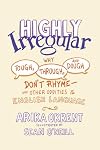
Highly Irregular: Why Tough, Through, and Dough Don't Rhyme―And Other Oddities of the English Language
by Arika Okrent
On This Page
Description
"Perhaps you're reading a book and stop to puzzle over absurd spelling rules, or you hear someone talking and get stuck on an expression, or your kid quizzes you on homework. Suddenly you ask yourself, "Wait, why do we do it this way?" You think about it, try to explain it, and keep running into walls. It doesn't conform to logic. It doesn't work the way you'd expect it to. There doesn't seem to be any rule at all. In Highly Irregular, Arika Okrent answers these questions and many more. show more Along the way she tells the story of the many influences--from invading French armies to stubborn Flemish printers--that made our language the way it is today"-- show lessTags
Recommendations









Member Recommendations

Member Reviews
I have been really enjoying Arika Okrent's new book on the weird and wonderful (did I mention weird?) little nooks and crannies of our English tongue.
If you ever wondered why a thing can be "uncouth" but never "couth", why we can name someone the "Sexiest Man Alive" but not the Sexiest Man 'Blond' and why "could", "would" and "should" have those silly silent L's -- this is a book for you.
The book is subtitled, "What the Hell, English?" and the tone ranges from wryly exasperated to down right "WTF?". The charming little cartoon illustrations add a lot.
A Fun book to pick and read at random or to sit down and read right through it, which is what I did.
Why Clifford is a Big, Red, Dog and not a Red, Big Dog is covered in here too. (And show more try explaining THAT to a non native speaker!).
For Word Nerds. I suspect there are a lot of us around here. show less
If you ever wondered why a thing can be "uncouth" but never "couth", why we can name someone the "Sexiest Man Alive" but not the Sexiest Man 'Blond' and why "could", "would" and "should" have those silly silent L's -- this is a book for you.
The book is subtitled, "What the Hell, English?" and the tone ranges from wryly exasperated to down right "WTF?". The charming little cartoon illustrations add a lot.
A Fun book to pick and read at random or to sit down and read right through it, which is what I did.
Why Clifford is a Big, Red, Dog and not a Red, Big Dog is covered in here too. (And show more try explaining THAT to a non native speaker!).
For Word Nerds. I suspect there are a lot of us around here. show less
The book is structured as a hodgepodge: six broad sections with pithy titles as "Blame the Barbarians" or "Blame the Printing Press", each comprising 5-15 essays. Essays are short and focus on a puzzling aspect of standard English given other, more generally applicable rules. For instance, it's unquestionably proper English to say "ate" and not "eated", yet many verbs employ the -ed suffix for the past tense, so "ate" draws attention. From the hodgepodge, however, emerges the outline of the Story of English. I don't recall it after reading this book any better than after reading others, but this one is extremely entertaining. I'll likely dip into it again.
All she leaves out is the influence of Barbarians and of Latin, unless she nodded to that with "French" and "snobs".
Latin influenced English in two waves separated by 100 years: Viking incursions (Old Norse) predominated in the interval, and I was surprised at the observation that Celtic languages had little to no influence on English. The first wave of Latin was characterised by Roman conquest which left the subjugated peoples to speak their own language, so had less impact than the second, which focused on converting them and so employed Roman alphabet for local languages in writing. (Seemingly a third wave is arguable, noted below.)
Again to my surprise, the Norman invasion's influence on English was not because ruling classes imposed French upon the lower classes, but because the Francophone aristocracy eventually adopted English as their own, subsequently imposing French language rules for spelling and such. Evidently this is when (?) Ecclesiastic Latin made its mark, as well. show less
The answer to most "Why does English do this?" questions will be a variation onshow more
things we have already seen here: old habits getting reinforced while new habits take over, unnoticeable slow drifts in pronunciation, the practice of extending or borrowing or creating in order to get something useful, reusing materials at hand in new ways, the drive to get more emotional impact, the need to look smart, impress, send social signals, express national pride. It will be because of the old Germanic layer, the French upheaval, the consolidating force of the printing press, the purposeful manipulation done by snobs, or the natural tendencies of our human language endowment. [143-44]
All she leaves out is the influence of Barbarians and of Latin, unless she nodded to that with "French" and "snobs".
Latin influenced English in two waves separated by 100 years: Viking incursions (Old Norse) predominated in the interval, and I was surprised at the observation that Celtic languages had little to no influence on English. The first wave of Latin was characterised by Roman conquest which left the subjugated peoples to speak their own language, so had less impact than the second, which focused on converting them and so employed Roman alphabet for local languages in writing. (Seemingly a third wave is arguable, noted below.)
Again to my surprise, the Norman invasion's influence on English was not because ruling classes imposed French upon the lower classes, but because the Francophone aristocracy eventually adopted English as their own, subsequently imposing French language rules for spelling and such. Evidently this is when (?) Ecclesiastic Latin made its mark, as well. show less
Taking a roughly chronological approach Okrent explores the the various reasons for quirks of the English language from "barbarians," through the French, the printing press, language snobs, and modern usage. There's some fun tidbits in here like why the phrase "How dare you?" works, pointing out the relics of Old English that still hang out in modern English, and, of course, why words that look like they should rhyme absolutely don't. As outlined in the introduction, the book can be read straight through or readers can go hop about to particular issues of interest to them. As a result, readers who opt to go straight through might run into similar explanations more than once (the Great Vowel Shift was explained twice that I noticed). The show more illustrations from O'Neill add some fun to what can be occasionally dense text as Okrent can get a bit heavy with phonetic and linguistic theory. If you're a language and word nerd, you'll likely have a good time with this one but English language learners would need to be pretty advanced to get much out of this. show less
I always love a good book about why English seems to make no sense. Okrent breaks down English's oddities into conflicts of words usage changing among the different languages of various invaders of Britain, the biggest being the Norman invasion which lead to centuries of the elite speaking French while the commoners spoke English. The introduction of the printing press lead to attempts of standardization for words that previously had no standard spelling, but localized so that they didn't always end up logically applied. Then in the 19th century, classically trained scholars tried to apply the standards of Greek and Latin to the unruly English language, causing more problems in the long run. Event today English is evolving and changing show more in weird ways while still oddly being a successful means of communication among people who use the language. The book is broken up into short chapters so it can be read all at once or broken up to be read at one's leisure. show less
Ratings
Members
- Recently Added By
Author Information

2+ Works 1,082 Members
Classifications
- Genres
- Nonfiction, General Nonfiction, Reference, History
- DDC/MDS
- 421.52 — Language English & Old English languages Writing system, phonology, phonetics of standard English Phonology. phonetics, spelling Spelling and pronunciation
- LCC
- PE1141 .O35 — Language and Literature English language English Modern English
- BISAC
Statistics
- Members
- 134
- Popularity
- 243,115
- Reviews
- 4
- Rating
- (3.80)
- Languages
- English
- Media
- Paper, Ebook
- ISBNs
- 5
- ASINs
- 1