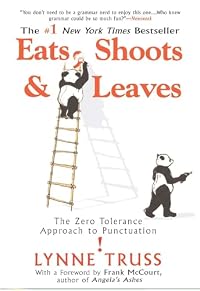
Eats, Shoots & Leaves: The Zero Tolerance Approach to Punctuation
by Lynne Truss
On This Page
Description
We all know the basics of punctuation. Or do we? A look at most neighborhood signage tells a different story. Through sloppy usage and low standards on the internet, in email, and now text messages, we have made proper punctuation an endangered species. In Eats, Shoots & Leaves, former editor Lynne Truss dares to say, in her delightfully urbane, witty, and very English way, that it is time to look at our commas and semicolons and see them as the wonderful and necessary things they are. This show more is a book for people who love punctuation and get upset when it is mishandled. From the invention of the question mark in the time of Charlemagne to George Orwell shunning the semicolon, this lively history makes a powerful case for the preservation of a system of printing conventions that is much too subtle to be mucked about with. show lessTags
Recommendations











Member Recommendations
Voracious_Reader Fun with grammar. Easy read for a nonprofessional technician.
31
CGlanovsky Learn to appreciate an underappreciated facet of print and language
EerierIdyllMeme I was very impressed by Mantel's writing style, and I think a big part of it is her use of punctuation. Mantel uses the comma like whatever the opposite of a stupid person is. But in particular, if you were worried that the semicolon was dead, Mantel wields it with such precision that it is clearly indispensable.
04

Member Reviews
My Achilles heel as a writer has always been commas. I hate them! At the newspaper where I used to work at I once had an editor tell me to start putting commas in wherever I didn’t have them and to delete all the ones I’d already put in.
Truss’ funny little book is a great rundown of the importance of punctuation. She includes lots of great anecdotes about funny punctuation mistakes, but also really helpful tips. I’ve always been particularly annoyed when people write “it’s” and mean “its.” I’m sure many other writers have their own grammatical pet peeves and she touches on most of them.
One point Truss makes, which I really agree with, is the importance of maintaining correct grammar in the new mediums we use. If show more texting, email and blogging have become our main forms of written communication (more than books, newspaper and magazines) then we shouldn’t be lax in the way we write. The fact that our way of communicating is changing so rapidly puts a stronger importance in making sure that communication is the best that it can be.
BOTTOM LINE: An entertaining and informative look at punctuation. Pick it up if you share her disdain for a misplaced apostrophe. show less
Truss’ funny little book is a great rundown of the importance of punctuation. She includes lots of great anecdotes about funny punctuation mistakes, but also really helpful tips. I’ve always been particularly annoyed when people write “it’s” and mean “its.” I’m sure many other writers have their own grammatical pet peeves and she touches on most of them.
One point Truss makes, which I really agree with, is the importance of maintaining correct grammar in the new mediums we use. If show more texting, email and blogging have become our main forms of written communication (more than books, newspaper and magazines) then we shouldn’t be lax in the way we write. The fact that our way of communicating is changing so rapidly puts a stronger importance in making sure that communication is the best that it can be.
BOTTOM LINE: An entertaining and informative look at punctuation. Pick it up if you share her disdain for a misplaced apostrophe. show less
Eats, Shoots & Leaves is not your ordinary grammar book. Yes, it does contain examples of how to properly use a comma, a colon, and a semi-colon as well as how to properly use an apostrophe. But, if that's really all the reader is looking for, then I would advise buying another book that's more akin to a handbook.
What Lynne Truss does in this text is provide a wonderful historical perspective for how our punctuation marks came to be and how their usage was formed and has changed historically. In addition, Truss laments the state to which punctuation, and thus, writing skills have sunk over the last few decades. She offers us both this historical perspective on punctuation as well as her lament with great humor and aplomb.
Overall I would show more give the book 4 out of 5 stars. It doesn't quite reach the 5 star mark for me because I think that she fails to look at the internet and email as anything but a negative communication tool. Truss, especially in her last chapter, takes the Internet to task and comments that she agrees with Truman Capote, that what is done online is merely typing, not writing. In thus doing, she separates the cognitive act of writing from the act of pressing keys on a keyboard as if what qualifies as writing can only be done with pen or pencil. And in so doing, she fails to acknowledge the hundreds of studies in the field of Computers and Writing (a sub-discipline of English and Composition or Rhetoric and Composition) that examine the writing via computer and the profound pedagogical advances in computer-mediated communication.
While I appreciate Truss' call for us, as sticklers of punctuation and grammar, to "fight like tigers to preserve our punctuation", I think that she carries her derision of Internet based communications too far. show less
What Lynne Truss does in this text is provide a wonderful historical perspective for how our punctuation marks came to be and how their usage was formed and has changed historically. In addition, Truss laments the state to which punctuation, and thus, writing skills have sunk over the last few decades. She offers us both this historical perspective on punctuation as well as her lament with great humor and aplomb.
Overall I would show more give the book 4 out of 5 stars. It doesn't quite reach the 5 star mark for me because I think that she fails to look at the internet and email as anything but a negative communication tool. Truss, especially in her last chapter, takes the Internet to task and comments that she agrees with Truman Capote, that what is done online is merely typing, not writing. In thus doing, she separates the cognitive act of writing from the act of pressing keys on a keyboard as if what qualifies as writing can only be done with pen or pencil. And in so doing, she fails to acknowledge the hundreds of studies in the field of Computers and Writing (a sub-discipline of English and Composition or Rhetoric and Composition) that examine the writing via computer and the profound pedagogical advances in computer-mediated communication.
While I appreciate Truss' call for us, as sticklers of punctuation and grammar, to "fight like tigers to preserve our punctuation", I think that she carries her derision of Internet based communications too far. show less
Characters: The apostrophe, the comma, the semi-colon, the colon, the dash, and the hyphen
Plot: Of course, there is no plot. But there is plenty of passion as well as lots of laughs. I confess I am one of those people who was not at all intrigued by the glowing reviews of this little book, a book starring, after all, the apostrophe, the comma, the semi-colon, the colon, the dash, and the hyphen. How interesting could it be? Even though my mother was a true stickler who read every book with a pencil in hand, who corrected the text even in library books, and who, furthermore, sent letters to the authors about the mistakes she found, I have never been overly bothered by a lapsed comma or misplaced apostrophe. I correct it mentally, of show more course, like all normal people do, and then move on with my life. But this book is wonderful! It’s not just about punctuation: it’s about the history of punctuation; it’s full of anecdotes about George Bernard Shaw, James Thurber, George Orwell and others; it’s so totally British as well, having been left as Ms. Truss wrote it and not edited for us Yanks; and it’s hilariously informative, a combination not usually associated with books about punctuation. Pick this book up and read any page—and I do mean any page: from the dedication, the Acknowledgements, the Foreward, Publisher’s Note, Preface, and/or Introduction—and you will be hooked, entertained and informed in short order. show less
Plot: Of course, there is no plot. But there is plenty of passion as well as lots of laughs. I confess I am one of those people who was not at all intrigued by the glowing reviews of this little book, a book starring, after all, the apostrophe, the comma, the semi-colon, the colon, the dash, and the hyphen. How interesting could it be? Even though my mother was a true stickler who read every book with a pencil in hand, who corrected the text even in library books, and who, furthermore, sent letters to the authors about the mistakes she found, I have never been overly bothered by a lapsed comma or misplaced apostrophe. I correct it mentally, of show more course, like all normal people do, and then move on with my life. But this book is wonderful! It’s not just about punctuation: it’s about the history of punctuation; it’s full of anecdotes about George Bernard Shaw, James Thurber, George Orwell and others; it’s so totally British as well, having been left as Ms. Truss wrote it and not edited for us Yanks; and it’s hilariously informative, a combination not usually associated with books about punctuation. Pick this book up and read any page—and I do mean any page: from the dedication, the Acknowledgements, the Foreward, Publisher’s Note, Preface, and/or Introduction—and you will be hooked, entertained and informed in short order. show less
Never before have I read a book about grammar or punctuation that regularly made me laugh out loud until I picked up this book. Although it is about grammar and punctuation it, in a way, reads like a great memoir. I had so much fun reading this book that I’m sad that it’s over. I can’t believe I’m writing this even as I’m writing it. This book makes me glad and somewhat proud that I care about such things at all.
Several things made me laugh out loud. The story of the gentleman who was hanged on a comma was just terrific. I can’t believe that someone actually tried to argue that he didn’t commit treason based upon the comma placement in the law. It was absolutely hilarious. Who could have thought that a punctuation mark show more might have created a technicality like that? Can you imagine hanging all your hopes on that? Poor, poor fellow. In addition to the stories, I often laughed when Truss later used them in her examples. She told the story of a pen pal she had from Michigan (that caught my attention). She didn’t have a high opinion of this American because of her penmanship and grammar, but looking back as an adult, she has deep remorse for the way she wrote to her. After the story she moved on and I had put the forsaken Michigander out of my mind. At the end of the chapter she used her pen pal in an example that made me laugh out loud and startle my children. How wonderful is that for a book about punctuation?
As much as I loved this book, I am certain that my writing would not live up to Truss’ standards. I don’t know that I ever will necessarily, but I’ve taken a lot out of this book about writing in general. I hope that I will continue to grow in my writing as a result. I am equally glad that there are people who put so much thought and energy into punctuation as I am that I’m not one of them.
http://literatehousewife.wordpress.com/2008/05/30/73-eats-shoots-leaves/ show less
Several things made me laugh out loud. The story of the gentleman who was hanged on a comma was just terrific. I can’t believe that someone actually tried to argue that he didn’t commit treason based upon the comma placement in the law. It was absolutely hilarious. Who could have thought that a punctuation mark show more might have created a technicality like that? Can you imagine hanging all your hopes on that? Poor, poor fellow. In addition to the stories, I often laughed when Truss later used them in her examples. She told the story of a pen pal she had from Michigan (that caught my attention). She didn’t have a high opinion of this American because of her penmanship and grammar, but looking back as an adult, she has deep remorse for the way she wrote to her. After the story she moved on and I had put the forsaken Michigander out of my mind. At the end of the chapter she used her pen pal in an example that made me laugh out loud and startle my children. How wonderful is that for a book about punctuation?
As much as I loved this book, I am certain that my writing would not live up to Truss’ standards. I don’t know that I ever will necessarily, but I’ve taken a lot out of this book about writing in general. I hope that I will continue to grow in my writing as a result. I am equally glad that there are people who put so much thought and energy into punctuation as I am that I’m not one of them.
http://literatehousewife.wordpress.com/2008/05/30/73-eats-shoots-leaves/ show less
I'll admit I have many pet peeves – too many when I start to think about it. One of them is misused punctuation, which is especially prominent on handmade signs, be it at the front of grocery stores, on marquees, wherever. (A documentary I watched recently showed a sign inviting "employee's and families" to an event. Argh!) Lynne Truss shares that pet peeve, but unlike me she went and wrote a book about it. I could never have done so, since outside of obvious things like possessive apostrophes, I'm not very stringent with punctuation, especially commas. Truss is very strict in the use of punctuation, but also very clear, commonsensical and funny. The title, the cover and the "punctuation repair kit" inside the cover clearly indicate show more her sense of humor. Every so often I pick up a book on writing to improve my own. I'm glad I came across this one in a used bookstore. Even after reading it I keep it on my shelf at work as a handy reference when doubts about punctuation use spring up. show less
SUPER FUNNY, and also, I learnt stuff like how the commas are super important and if you move them around, they might create new biblical interpretations: For example
“verily, I say unto thee, This day thou shalt be with me in Paradise.”
vs
“Verily I say unto thee this day, Thou shalt be with me in Paradise.” (P74, Truss)
The former the comma after “thee” is the Protestant interpretation of the Bible which skips over the concept of Purgatory, while the second with the comma after “they” means to Catholics that Paradise is promised sometime later, after Purgatory. The placement of the comma changes the meaning of the religious text. The more you know!
“verily, I say unto thee, This day thou shalt be with me in Paradise.”
vs
“Verily I say unto thee this day, Thou shalt be with me in Paradise.” (P74, Truss)
The former the comma after “thee” is the Protestant interpretation of the Bible which skips over the concept of Purgatory, while the second with the comma after “they” means to Catholics that Paradise is promised sometime later, after Purgatory. The placement of the comma changes the meaning of the religious text. The more you know!
Every person who possesses an ounce of passion on any subject needs (1) friends who share similar passions and/or (2) a self-help book. Eats, Shoots & Leaves is my self-help book. Thank you, Lynne Truss, for reminding me that I'm not the only one who wants to start a murderous rampage when someone misuses an apostrophe. But most of all, thank you for encouraging—no, demanding—sticklers to unite. Language is a living, changing thing, but that doesn't mean it has to deteriorate back to the caveman days.
Members
- Recently Added By
Published Reviews
ThingScore 50
The first punctuation mistake in “Eats, Shoots & Leaves: The Zero Tolerance Approach to Punctuation” (Gotham; $17.50), by Lynne Truss, a British writer, appears in the dedication, where a nonrestrictive clause is not preceded by a comma. It is a wild ride downhill from there.
added by SR510
When [Truss] stops straining at lawks-a-mussy chirpiness and analyzes punctuation malpractice, she is often persuasive
added by Shortride
The passion and fun of her arguments are wonderfully clear. Here is someone with abiding faith in the idea that ''proper punctuation is both the sign and the cause of clear thinking.''
added by Shortride
Lists

Good Books for Word Geeks
16 works; 6 members

Great Books About Language
73 works; 48 members

The Telegraph's 110 Best Books: The Perfect Library
101 works; 18 members

Unread books
1,063 works; 82 members

What're you reading? ..Words, words words.
11 works; 2 members

2000s decade
85 works; 7 members
Female Author
1,235 works; 67 members

Books Read in 2014
2,341 works; 86 members
Craft Books
41 works; 1 member

Read
293 works; 4 members

Books With Numbers in the Title
308 works; 13 members

Books Read in 2010
631 works; 11 members

Funny Books
33 works; 2 members

unread and uncatalogued
48 works; 1 member

Non-Fiction
68 works; 1 member
Author Information

Lynne Truss was born on May 31, 1955, in Kingston upon Thames, England. She is an English writer and journalist. Her book Eats, Shoots & Leaves: The Zero Tolerance Approach to Punctuation was a best-seller in 2003. Truss received a first-class honors degree in English Language and Literature from University College London in 1977. After show more graduation, she worked for the Radio Times as a sub-editor before moving to the Times Higher Education Supplement as the deputy literary editor in 1978. From 1986 to 1990, she was the literary editor of The Listener and was an arts and books reviewer for The Independent on Sunday before joining The Times in 1991. She currently reviews books for The Sunday Times. She has also written numerous books including Tennyson's Gift; Going Loco; Eats, Shoots and Leaves: The Zero Tolerance Approach to Punctuation; and Talk to the Hand: The Utter Bloody Rudeness of the World Today, or Six Good Reasons to Stay Home and Bolt the Door. (Bowker Author Biography) show less
Some Editions
Awards and Honors
Awards
Distinctions
Work Relationships
Has the (non-series) sequel
Has the adaptation
Is an expanded version of
Is parodied in
Is replied to in
Has as a supplement
Common Knowledge
- Canonical title
- Eats, Shoots & Leaves: The Zero Tolerance Approach to Punctuation
- Original title
- Eats, Shoots & Leaves
- Alternate titles*
- Kaznit' nelzya pomilovat'
- Original publication date
- 2003
- Dedication
- To the memory of the striking Bolshevik printers of St Petersburg who, in 1905, demanded to be paid the same rate for punctuation marks as for letters, and thereby directly precipitated the first Russian Revolution
- First words
- Either this will ring bells for you, or it won't.
- Quotations
- On the page, punctuation performs its grammatical function, but in the mind of the reader it does more than that. It tells the reader how to hum the tune.
But I can't help feeling that our punctuation system, which has served the written word with grace and ingenuity for centuries, must not be allowed to disappear without a fight.
A panda walks into a cafe.
He orders a sandwich, eats it, then draws a gun and fires two shots in the air.
"Why?" asks the confused waiter, as the panda makes towards the exit. The panda produces a badly punctuated ... (show all)wildlife manual and tosses it over his shoulder.
"I'm a panda," he says at the door. "Look it up."
The waiter turns to the relevant entry and, sure enough, finds an explanation.
"Panda. Large black-and-white bear-like mammal, native to China. Eats, shoots and leaves." - Last words
- (Click to show. Warning: May contain spoilers.)It really does.
- Blurbers
- McCourt, Frank; Lederer, Richard; Lipton, James; Walsh, John; Williams, Nigel; Humphrys, John (show all 17); Vine, Sarah; Eagleton, Terry; Turner, E. S.; Hartston, William; Kenny, Mary; Madely, Richard; Skapinker, Michael; Rosenthal, Tom; Hensher, Philip; Maslin, Janet; Sutherland, John
- Original language
- English
- Canonical LCC
- PE1450
- Disambiguation notice
- This is not the same work as:
1. "Eats, Shoots and Leaves: Why, Commas Do Make a Difference!", which is the children's version of the book;
2. the various calendars inspired by this book;
3. "Eats, Shoot... (show all)s and Leaves: Cutting a Dash", which is a recording of a radio show associated with the book.
*Some information comes from Common Knowledge in other languages. Click "Edit" for more information.
Classifications
Statistics
- Members
- 16,648
- Popularity
- 401
- Reviews
- 343
- Rating
- (3.80)
- Languages
- 8 — Dutch, English, German, Italian, Japanese, Korean, Russian, Chinese, traditional
- Media
- Paper, Audiobook, Ebook
- ISBNs
- 29
- ASINs
- 39