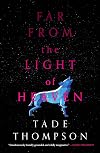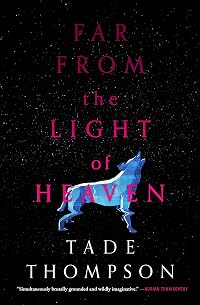
Far from the Light of Heaven
by Tade Thompson
On This Page
Description
The colony ship Ragtime docks in the Lagos system, having traveled light-years to bring one thousand sleeping souls to a new home among the stars. But when first mate Michelle Campion rouses, she discovers some of the sleepers will never wake. Answering Campion's distress call, investigator Rasheed Fin is tasked with finding out who is responsible for these deaths. Soon a sinister mystery unfolds aboard the gigantic vessel, one that will have repercussions for the entire system--from the show more scheming politicians of Lagos station, to the colony planet Bloodroot, to other far-flung systems, and indeed to Earth itself. show lessTags
Recommendations








Member Reviews
Thompson, Tade. Far from the Light of Heaven. Orbit, 2021.
Tade Thompson, an English MD who grew up in Nigeria, has been publishing fiction for more than a decade, but he first came to my attention with Rosewater, which won the 2019 Arthur C. Clarke Award. Far from the Light of Heaven is his first space opera, and it is a worthy effort indeed. Shell Campion, the inexperienced captain of the interstellar passenger ship Ragtime, is woken from hibernation early. She finds her AI rebooting and missing its personality overlays. She also discovers that more than 30 of her passengers are dead and that their bodies are being dismembered by the robotic cleaning staff. The mining colony planet the ship is approaching sends up an investigator and show more his android partner. Then, the really strange things start to happen. Thompson says in an afternote what drew him to the story was the idea of a spaceship as the perfect setting for a closed-room mystery. (It is. Mur Lafferty’s Six Wake is an especially good example.) But Thompson also gives his story depth that lies outside the usual genre tropes—a presentation of the interaction between corporate power, government, and colonialism, with all its attendant evils. Nicely creepy. 4 stars. show less
Tade Thompson, an English MD who grew up in Nigeria, has been publishing fiction for more than a decade, but he first came to my attention with Rosewater, which won the 2019 Arthur C. Clarke Award. Far from the Light of Heaven is his first space opera, and it is a worthy effort indeed. Shell Campion, the inexperienced captain of the interstellar passenger ship Ragtime, is woken from hibernation early. She finds her AI rebooting and missing its personality overlays. She also discovers that more than 30 of her passengers are dead and that their bodies are being dismembered by the robotic cleaning staff. The mining colony planet the ship is approaching sends up an investigator and show more his android partner. Then, the really strange things start to happen. Thompson says in an afternote what drew him to the story was the idea of a spaceship as the perfect setting for a closed-room mystery. (It is. Mur Lafferty’s Six Wake is an especially good example.) But Thompson also gives his story depth that lies outside the usual genre tropes—a presentation of the interaction between corporate power, government, and colonialism, with all its attendant evils. Nicely creepy. 4 stars. show less
Well done locked room mysteries are always fun to read. So when this novel protagonist wakes up on a spaceship that is supposed to have 1001 sleeping people on board (1000 passengers and her as the first mate) and the computer tells her that she has only 969 passengers, there is obviously something wrong - the ship doors were never opened so the 31 missing people need to be somewhere. Then their status gets upgraded to murdered - she finds them - in the waste disposal are, cut in parts. Noone is supposed to be awake so... what happened?
That's how the novel opens - and it gets crazier from there. But let's roll back for a minute and meet the characters.
Michelle 'Shell' Campion is on her first interstellar trip as the first mate on the show more Ragtime. She has a history with deep space - her father, a legendary astronaut, got lost there on his last trip. The ship has an AI that does all the work - she is there just in case - so she sleeps the 10 years between Earth and Bloodroot (a colony reached after jumping through a line of Dyson gates). Being told more than once in the first chapter that the AI never breaks makes one expect it to break... or there won't be a story after all. So here she is - first trip, 31 missing passengers, a crazy AI who seems to have broken (but that was impossible, right?) and on top of everything she sees a wolf in the corridors.
Meanwhile down on Bloodroot, they decide to send an investigator, Rasheed Fin, with his trusty Artificial companion Salvo, to investigate the deaths. The problem is that Fin is the black sheep of his department, on suspension for the last year after an accident (which is why they send him) and he really does not do well with people. Neither does Shell. And with both of them with different objectives (he is looking for a murdered, she is trying to shoulder the responsibility for the passengers so she is staying upbeat and positive and what's not), they make a very unlikely team.
The novel reads almost campy, almost like a satire of a science fiction novel in places and yet it fits somehow. It ends up working - it takes awhile to stop rolling your eyes at the single-mindedness of Fin and Shell - but it all has a point.
And the there is the station that holds the gate - Lagos. There is a governor but he is sidelined and the real power rests with the Secretary - whose only objective is not to lose money (and to stay in power). Everyone is scared of her (except the governor) and she really hates problems. A ship that passed through her space and ended up in such a mess before it is officially out of her space? That's a problem. So she decides to solve it - not my figuring out how anyone died (she does not care) but by making sure Lagos will get paid for the transit - in any way possible. Meanwhile the governor has his own plan because he happens to be Shell's godfather...
Add to all that another rogue AI, a very wealthy man who seems to have pissed off everyone in the world, an experimental unit on the ship which is never supposed to be opened until the ship gets back to Earth and an alien form that is different from what you expect (or anyone thinks) and the novel packs a lot in a relatively short text. But it does not feel overwritten or too crowded. Thomson even manages to squeeze in a love story (which feels like it is written by a 10 years old - but the see my note about the novel sounding almost campy in places).
As usual, who the murderer is turns out to be the least interesting part of the story. The why of the murders is a lot more interesting. The aftermath of it ends up being most of the story (and a lot of it is gory and weird enough to make me wonder if that should not be classified as horror and not science fiction... or a cross between them anyway). And somewhere in all that story, the author managed to show that humans will be humans even when we go across the stars - both in our greatest hours and our lowest. Especially at our lowest. And he leaves a door for a sequel - the story finished but humanity, which apparently expanded without wars in space (how did we manage that?), seems to finally have brought weapons to space... and Bloodroot got some pretty interesting new inhabitants.
I liked the writing. I really liked the ability of the author to take elements that do not fit together, throw them together, make fun of them and somehow end up with a serious action. That novel should not have worked - both Fin and Shell should not have worked as characters (not to mention some of the supporting cast), not the way they are written. The whole novel should have collapsed. And yet, somehow it did not. I suspect that not everyone will like this style but it seems to be working for me so I am off checking what else this author had written. show less
That's how the novel opens - and it gets crazier from there. But let's roll back for a minute and meet the characters.
Michelle 'Shell' Campion is on her first interstellar trip as the first mate on the show more Ragtime. She has a history with deep space - her father, a legendary astronaut, got lost there on his last trip. The ship has an AI that does all the work - she is there just in case - so she sleeps the 10 years between Earth and Bloodroot (a colony reached after jumping through a line of Dyson gates). Being told more than once in the first chapter that the AI never breaks makes one expect it to break... or there won't be a story after all. So here she is - first trip, 31 missing passengers, a crazy AI who seems to have broken (but that was impossible, right?) and on top of everything she sees a wolf in the corridors.
Meanwhile down on Bloodroot, they decide to send an investigator, Rasheed Fin, with his trusty Artificial companion Salvo, to investigate the deaths. The problem is that Fin is the black sheep of his department, on suspension for the last year after an accident (which is why they send him) and he really does not do well with people. Neither does Shell. And with both of them with different objectives (he is looking for a murdered, she is trying to shoulder the responsibility for the passengers so she is staying upbeat and positive and what's not), they make a very unlikely team.
The novel reads almost campy, almost like a satire of a science fiction novel in places and yet it fits somehow. It ends up working - it takes awhile to stop rolling your eyes at the single-mindedness of Fin and Shell - but it all has a point.
And the there is the station that holds the gate - Lagos. There is a governor but he is sidelined and the real power rests with the Secretary - whose only objective is not to lose money (and to stay in power). Everyone is scared of her (except the governor) and she really hates problems. A ship that passed through her space and ended up in such a mess before it is officially out of her space? That's a problem. So she decides to solve it - not my figuring out how anyone died (she does not care) but by making sure Lagos will get paid for the transit - in any way possible. Meanwhile the governor has his own plan because he happens to be Shell's godfather...
Add to all that another rogue AI, a very wealthy man who seems to have pissed off everyone in the world, an experimental unit on the ship which is never supposed to be opened until the ship gets back to Earth and an alien form that is different from what you expect (or anyone thinks) and the novel packs a lot in a relatively short text. But it does not feel overwritten or too crowded. Thomson even manages to squeeze in a love story (which feels like it is written by a 10 years old - but the see my note about the novel sounding almost campy in places).
As usual, who the murderer is turns out to be the least interesting part of the story. The why of the murders is a lot more interesting. The aftermath of it ends up being most of the story (and a lot of it is gory and weird enough to make me wonder if that should not be classified as horror and not science fiction... or a cross between them anyway). And somewhere in all that story, the author managed to show that humans will be humans even when we go across the stars - both in our greatest hours and our lowest. Especially at our lowest. And he leaves a door for a sequel - the story finished but humanity, which apparently expanded without wars in space (how did we manage that?), seems to finally have brought weapons to space... and Bloodroot got some pretty interesting new inhabitants.
I liked the writing. I really liked the ability of the author to take elements that do not fit together, throw them together, make fun of them and somehow end up with a serious action. That novel should not have worked - both Fin and Shell should not have worked as characters (not to mention some of the supporting cast), not the way they are written. The whole novel should have collapsed. And yet, somehow it did not. I suspect that not everyone will like this style but it seems to be working for me so I am off checking what else this author had written. show less
This book is quite, quite bad, and for much of it I couldn’t understand why. I mean, I am fully aware of how hard it is to write a science fiction mystery, and because I love that subgenre, I have experienced a lot of the possible failure modes for it. But this book is *so* bad at doing what it set out to do that it’s astonishing. It never tries to be science fiction, asking “what if” and explaining why and doing the worldbuilding. It never tries to be a mystery, setting up a problem and then taking the reader through the solving of it. Instead, it’s a bumbling, stumbling React Plot (characters have no agency and only react to plot devices as they arrive) inside a spaceship, with no reason for it to be there. I was mystified; show more it was so bad that it wasn’t even clear what Thompson was *trying* to do.
Then I read the Afterword, and it all became clear. Thompson committed that most embarrassing of authorial errors: he wrote something in an existing genre without bothering to *read* in the genre first, and decided he was doing something groundbreaking and new, when actually he was reinventing the wheel. (Worse, his particular wheel is essentially a triangle made of sandstone: completely useless and disintegrating.) The entire Afterword is him saying, well, I wanted to set something in space, but without reading any science fiction, because it’s so unrealistic and boring, and then listing off some facts he learned in his research that — uh, everyone who reads hard science fiction already knows. Because every hard SF author knows them, too. Thompson is really proud of himself for doing something that has been done before, done frequently, and done so, so much better.
So, yeah, this book just sucks. I’m leaving out a lot of the ways, because at the end of the day, this book never had a chance. And I’m just — sad and frustrated, because it’s a cool idea with cool characters that the author let down completely. show less
Then I read the Afterword, and it all became clear. Thompson committed that most embarrassing of authorial errors: he wrote something in an existing genre without bothering to *read* in the genre first, and decided he was doing something groundbreaking and new, when actually he was reinventing the wheel. (Worse, his particular wheel is essentially a triangle made of sandstone: completely useless and disintegrating.) The entire Afterword is him saying, well, I wanted to set something in space, but without reading any science fiction, because it’s so unrealistic and boring, and then listing off some facts he learned in his research that — uh, everyone who reads hard science fiction already knows. Because every hard SF author knows them, too. Thompson is really proud of himself for doing something that has been done before, done frequently, and done so, so much better.
So, yeah, this book just sucks. I’m leaving out a lot of the ways, because at the end of the day, this book never had a chance. And I’m just — sad and frustrated, because it’s a cool idea with cool characters that the author let down completely. show less
Good sci-fi mysteries are hard to find and not a lot of authors tackle them. Tade Thompson has added a really interesting entry into this genre with Far From The Light of Heaven. Shell Campion comes from an astronaut family. Freshly graduated from training she is first officer on a transport ship. Her duties, if all goes well, are to do nothing. AI’s captain the ship and they have never failed. Until now.
Shell awakes to find the ship, Ragtime, has arrived at the colony world Bloodroot but the AI is barely functioning. In addition, 31 of the 1000 sleeping passengers are dead. An investigator from Bloodroot, Fin, is sent to investigate. Shell is trying to keep the ship operating while Fin and his partner, Salvo, try to find a murderer. show more Someone, or something, is working against them. It’s a race to save the ship and solve the crime before an already bad situation takes a turn for the worse.
Thompson does a great job building both characters and suspense. The characters are complex and grow over the course of the novel. The perspective shifts between a number of perspectives which aids both in developing the characters and the central mystery. He reveals more and more about the relationship between earth, the colony, and the local space station, as well as a very realistic look at space travel. The pacing from the first half of the book is quite different from the latter half as a mystery that was slowly played to begin is filled in much faster in the latter half. The excitement factor definitely ratches up at the end.
The human, artificial intelligence, and alien characters all hold your attention. There is a lot of emotional depth to these characters and you really grow to care about them. The mystery, ultimately, becomes secondary to the arc that these characters go through. Despite some uneven pacing, this is a book with a lot of suspense and it will have you thinking long after you reach the last page.
I was provided a copy of this book by the publisher. show less
Shell awakes to find the ship, Ragtime, has arrived at the colony world Bloodroot but the AI is barely functioning. In addition, 31 of the 1000 sleeping passengers are dead. An investigator from Bloodroot, Fin, is sent to investigate. Shell is trying to keep the ship operating while Fin and his partner, Salvo, try to find a murderer. show more Someone, or something, is working against them. It’s a race to save the ship and solve the crime before an already bad situation takes a turn for the worse.
Thompson does a great job building both characters and suspense. The characters are complex and grow over the course of the novel. The perspective shifts between a number of perspectives which aids both in developing the characters and the central mystery. He reveals more and more about the relationship between earth, the colony, and the local space station, as well as a very realistic look at space travel. The pacing from the first half of the book is quite different from the latter half as a mystery that was slowly played to begin is filled in much faster in the latter half. The excitement factor definitely ratches up at the end.
The human, artificial intelligence, and alien characters all hold your attention. There is a lot of emotional depth to these characters and you really grow to care about them. The mystery, ultimately, becomes secondary to the arc that these characters go through. Despite some uneven pacing, this is a book with a lot of suspense and it will have you thinking long after you reach the last page.
I was provided a copy of this book by the publisher. show less
I love the concept for this: a locked room mystery set in space. I love locked room mysteries, and so I was excited about this one. I ended up reading it in one marathon session before bed, so while there are undoubtedly things I missed I did enjoy the book as a whole. I was certainly caught up in the mystery enough to not want to put the book down.
I really liked the writing style and the Afrofuturism aspect of the world building. The main characters were also a lot of fun, though I wanted more from the AI ship, Ragtime. (I didn't get it due to plot reasons. Alas.) There were other things I liked less, though. For example, I had hoped that the mystery side of the story would follow mystery genre conventions better, where you are able to show more pick up clues as to the whodunnit before the reveal. This book however, was much more rooted in the science fiction genre—where mysteries are not something that the reader could theoretically solve. show less
I really liked the writing style and the Afrofuturism aspect of the world building. The main characters were also a lot of fun, though I wanted more from the AI ship, Ragtime. (I didn't get it due to plot reasons. Alas.) There were other things I liked less, though. For example, I had hoped that the mystery side of the story would follow mystery genre conventions better, where you are able to show more pick up clues as to the whodunnit before the reveal. This book however, was much more rooted in the science fiction genre—where mysteries are not something that the reader could theoretically solve. show less
There's a lot to love about this work, and the concept and characters sucked me in immediately. Some of Thompson's scenes and images are also so viscerally compelling, it's impossible to look away, and journeying through the story was a fascinating experience that bridged genres and sped me through a world I fell in love with learning about. I will say that the pacing felt rushed toward the end, partly because it suddenly felt like a bunch of POVs were fighting for attention, and some of what I'd loved about the book got left behind in the chaos. I do think this story and the characters could easily have been two books, and been better for the extra time/content involved. I also found that I wished Thompson would focus on different show more details of world-building than the ones I would have loved to hear about--BUT, when I read his Afterword post-story, that shed a lot of light and context on his choices, and added to the reading experience in general.
Much as I have small quibbles with the book, including the cover feeling a bit like false advertising, the read was a fun one, and I'm looking forward to trying more of Thompon's work sometime in the future. show less
Much as I have small quibbles with the book, including the cover feeling a bit like false advertising, the read was a fun one, and I'm looking forward to trying more of Thompon's work sometime in the future. show less
[b:Far from the Light of Heaven|57007657|Far from the Light of Heaven|Tade Thompson|https://i.gr-assets.com/images/S/compressed.photo.goodreads.com/books/1621781827l/57007657._SY75_.jpg|89199128] is a maelstrom of a novel that accelerates with incredible speed into a survival thriller. It is set aboard a colony spaceship named Ragtime, where the first mate awakes to find things have gone horribly wrong. From then on there is never a moment of calm, as danger after danger rears its head. One of the small group who end up aboard thinks he is in a murder mystery, but has very little time or energy to actually investigate. Given the fast pace of the narrative, I was hooked swiftly and found the book very difficult to put down. Thompson show more throws in plenty of fascinating world-building and intriguing character details, but there is little time to dwell upon them. In 350 pages the reader hardly has time to breathe, let alone the cast.
I was amused that two of the cover quotes call the book space opera, while in the afterword Thompson specifically says that it isn't. I'm inclined to take him at his word, although I would consider [b:Far from the Light of Heaven|57007657|Far from the Light of Heaven|Tade Thompson|https://i.gr-assets.com/images/S/compressed.photo.goodreads.com/books/1621781827l/57007657._SY75_.jpg|89199128] hard sci-fi. The plot is too tightly focused to have an operatic quality, I guess. The settings and character motivations provide interesting commentary on colonialism, inequality, and economic exploitation, albeit briefly. Thompson is an imaginative and adept sci-fi writer and I enjoyed this standalone novel a lot. However it didn't have the same impact on me as his brilliant [b:Rosewater|38362809|Rosewater (The Wormwood Trilogy, #1)|Tade Thompson|https://i.gr-assets.com/images/S/compressed.photo.goodreads.com/books/1534300082l/38362809._SX50_.jpg|51884865] trilogy due to the incredible pace of events. I would have liked to learn more about the characters and setting, particularly the planet Bloodroot and the Lambers.Among my outstanding questions is how Fin tracks Lambers so well? Is it due to his later connection with Joké? The ending is well-judged, but I'd love a sequel set on Bloodroot and space station Lagos. The fallout from all the mayhem leaves a lot that could be explored.
I think the general lesson of the plot is a sensible one: don't get on a spaceship with the richest man in the solar system, as people who he exploited to become the richest man in the solar system will undoubtedly try to kill him. And collateral damage is hard to avoid when using a feral military AI as an assassination weapon. The AIs were impressively unsettling, I must say, as was the biotech that rapidly took over Ragtime. I do love weird future technology gone wrong and spaceship-horror vibes akin to the Danny Boyle film Sunshine. show less
I was amused that two of the cover quotes call the book space opera, while in the afterword Thompson specifically says that it isn't. I'm inclined to take him at his word, although I would consider [b:Far from the Light of Heaven|57007657|Far from the Light of Heaven|Tade Thompson|https://i.gr-assets.com/images/S/compressed.photo.goodreads.com/books/1621781827l/57007657._SY75_.jpg|89199128] hard sci-fi. The plot is too tightly focused to have an operatic quality, I guess. The settings and character motivations provide interesting commentary on colonialism, inequality, and economic exploitation, albeit briefly. Thompson is an imaginative and adept sci-fi writer and I enjoyed this standalone novel a lot. However it didn't have the same impact on me as his brilliant [b:Rosewater|38362809|Rosewater (The Wormwood Trilogy, #1)|Tade Thompson|https://i.gr-assets.com/images/S/compressed.photo.goodreads.com/books/1534300082l/38362809._SX50_.jpg|51884865] trilogy due to the incredible pace of events. I would have liked to learn more about the characters and setting, particularly the planet Bloodroot and the Lambers.
Members
- Recently Added By
Lists

Diversity in Fantasy and Science Fiction
219 works; 33 members

SFFKit 2022
5 works; 1 member

Books Set in Outer Space
39 works; 9 members

Best Books With Aliens
67 works; 10 members

Books Read in 2022
5,168 works; 111 members

Fiction Published in 2021
27 works; 1 member

Books Set on Extraterrestrial Planets
27 works; 5 members
Author Information

28+ Works 3,344 Members
Some Editions
Awards and Honors
Awards
Work Relationships
Was inspired by
Common Knowledge
- Original publication date
- 2021-10
- People/Characters
- Michelle Campion 'Shell'; Ragtime; Rasheed Fin; Salvo; Lawrence Biz; Joké Biz (show all 9); Yan Maxwell; Jeremiah Brisbane; Carmilla
- Important places
- Ragtime (ship); Space Station Lagos; Bloodroot (planet); Tehani mining station, Earth
- Epigraph
- Space is the Brink of Death
Anonymous graffiti in the oldest service duct of Space Station Daedalus, 2077. - Dedication
- To Beth.
I'm getting there. - First words
- There is no need to know what no one will ask.
- Last words
- (Click to show. Warning: May contain spoilers.)And from this she cannot run.
- Blurbers
- Tchaikovsky, Adrian; Reynolds, Alastair; Wells, Martha
- Original language
- English
Classifications
Statistics
- Members
- 411
- Popularity
- 75,455
- Reviews
- 20
- Rating
- (3.45)
- Languages
- English, German
- Media
- Paper, Audiobook, Ebook
- ISBNs
- 10
- ASINs
- 3