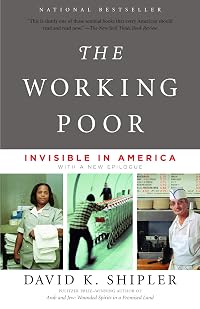
The Working Poor: Invisible in America
by David K. Shipler
On This Page
Description
An intimate portrait of poverty-level working families from a range of ethnic backgrounds in America reveals their legacy of low-paying, dead-end jobs, dysfunctional parenting, and substance abuse and charges the government with failing to provide adequate housing, health care, and education. From the author of the Pulitzer Prize winning Arab and Jew, a new book that presents a searing, intimate portrait of working American families struggling against insurmountable odds to escape poverty. show more As David K. Shipler makes clear in this powerful, humane study, the invisible poor are engaged in the activity most respected in American ideology hard, honest work. But their version of the American Dream is a nightmare: low-paying, dead-end jobs; the profound failure of government to improve upon decaying housing, health care, and education; the failure of families to break the patterns of child abuse and substance abuse. Shipler exposes the interlocking problems by taking us into the sorrowful, infuriating, courageous lives of the poor white and black, Asian and Latino, citizens and immigrants. We encounter them every day, for they do jobs essential to the American economy. We meet drifting farmworkers in North Carolina, exploited garment workers in New Hampshire, illegal immigrants trapped in the steaming kitchens of Los Angeles restaurants, addicts who struggle into productive work from the cruel streets of the nation's capital--each life another aspect of a confounding, far-reaching urgent national crisis. And unlike most works on poverty, this one delves into the calculations of some employers as well--their razor-thin profits, their anxieties about competition from abroad, their frustrations in finding qualified workers. This impassioned book not only dissects the problems, but makes pointed, informed recommendations for change. It is a book that stands to make a difference. show lessTags
Recommendations
























Member Recommendations

Member Reviews
If you don't know much about poverty, this book may prove useful to you, but go in with eyes open. Shipler is at his best when he's letting the poor folks he speaks to speak for themselves. However, he is very much a liberal, and while he's talking with poor people we also get sympathetic interviews with bosses, managers, job trainers, "tough love" social workers, and the like. He praises people who shape themselves (and allow themselves to be shaped) into well-behaved, obedient workers set on climbing into higher levels of workplace hierarchy. His solution for the plight of the working poor is very much reformist and government-centered - the poor should overwhelm the rich at the voting booth, and his critique of how successful that show more has been/could be is nonexistent. The answer comes not from below - from poor people organizing themselves and building power - but from government programs, corporations, politicians, and benevolent gentry such as himself and his target audience. Capitalism needs to be changed, but is essentially good. It depends on poverty - Shipler says so quite uncritically - the issue for him is that the poor are treated better and given the opportunity to get ahead so others may replace them. If any of this made you cringe, you might be better off finding something with a little more teeth. show less
Let me begin by saying this book was not an easy read for me. The author holds little back in describing the lives of the working poor, which can feel depressing, unsettling, and at times even hopeless.
Nevertheless, David Shipler's The Working Poor is a powerful lesson of empathy. He forces his readers to see life through the eyes on those on margins of society. His goal is to highlight America's disregard for the working poor and make visible those we often overlook. Each chapter focuses on a different barrier for those at the financial bottom, painting a picture of the nature of poverty and the issues that keep so many down. However, he does so, not as much from the ivory tower of academics but rather through interviews with people show more from all over the country. Throughout the book, Shipler tells people's stories, describing what life is like being poor. Poverty is not simply because of bad decisions (although this is definitely a contributor). Nor is it simply the consequence of a corrupt system. The reasons for poverty are intensely complex, and only through a holistic system of supports (including kinship, housing, healthcare, transportation, education, a fair wage, etc.) does anyone rise from poverty.
The lessons he writes about are for all to consider. And sadly, those who need to hear this message the most will not read this book. Nevertheless, for a superb summary, look to: http://tamarackcommunity.ca/downloads/vc/work_poor_invisible_in_US.pdf show less
Nevertheless, David Shipler's The Working Poor is a powerful lesson of empathy. He forces his readers to see life through the eyes on those on margins of society. His goal is to highlight America's disregard for the working poor and make visible those we often overlook. Each chapter focuses on a different barrier for those at the financial bottom, painting a picture of the nature of poverty and the issues that keep so many down. However, he does so, not as much from the ivory tower of academics but rather through interviews with people show more from all over the country. Throughout the book, Shipler tells people's stories, describing what life is like being poor. Poverty is not simply because of bad decisions (although this is definitely a contributor). Nor is it simply the consequence of a corrupt system. The reasons for poverty are intensely complex, and only through a holistic system of supports (including kinship, housing, healthcare, transportation, education, a fair wage, etc.) does anyone rise from poverty.
The lessons he writes about are for all to consider. And sadly, those who need to hear this message the most will not read this book. Nevertheless, for a superb summary, look to: http://tamarackcommunity.ca/downloads/vc/work_poor_invisible_in_US.pdf show less
Hey, everyone! Looking for an antidote to all this doom-and-gloom market news? Need a little feel-good pick-me-up?
This ain't it.
Allow me to summarize the pith of this book: Bad choices + no safety net * societal indifference = entrenched, inescapable poverty. And even the bad decisions are decisions that seem to be made for people, rather than by them. Abuse as children, crumbling schools, parents who can't advocate for their kids, unreliable transportation, bad habits ... it's just a long, long laundry list of tragedy. And most of them could be fixed with just a bit of coordination and a bit of help. (Not to say a BAILOUT, since those aren't for people, right? You just keep your head down, wage slave, and keep working. Nothing to see show more over here.)
But really, who hasn't needed help in their lives? Who hasn't made some bad decisions and needed to be bailed out? That's where your reliable friends and family come in. I speak from the position of ineffable privilege, since I had NONE of these poverty risk factors (totally stable, affluent upbringing), and managed to make absolutely NO stupid teenage decisions to derail my march to the Ivy League.
But I digress. Even I, with advantages a-plenty -- personal, parental, educational, societal -- made some stupid decisions as a young independent and needed to be Bailed Out by my parents with cash. Had I no safely net, no one to help me out, these silly, easily-made errors would likely be dogging me and my credit rating still. Stupid, easily fixed, and yet somehow we let families be crushed by this for generations.
This book took a much different tone than Nickel and Dimed, although it covers a lot of the same ground. It did a much better job, I think, in examining the many factors that contribute to entrenched poverty, and doesn't canonize any of the people it pictures, the way Barbara Ehrenreich's book did a little. Not a quick read, and not uplifting -- it left me more disheartened with the problem than Fired Up, Ready To Go -- but still, compelling.
Another thing this book taught me: I am the only middle-class American that cleans my own house. Even my robot slave Scooba went all SkyNet on me and I mop my own floor. Seriously, a chapter of this book was devoted to the unhealthy stressors of poverty, which included cleaning one's own house. Once people claw their way above the poverty line, apparently their first call is to the Merry Maids. show less
This ain't it.
Allow me to summarize the pith of this book: Bad choices + no safety net * societal indifference = entrenched, inescapable poverty. And even the bad decisions are decisions that seem to be made for people, rather than by them. Abuse as children, crumbling schools, parents who can't advocate for their kids, unreliable transportation, bad habits ... it's just a long, long laundry list of tragedy. And most of them could be fixed with just a bit of coordination and a bit of help. (Not to say a BAILOUT, since those aren't for people, right? You just keep your head down, wage slave, and keep working. Nothing to see show more over here.)
But really, who hasn't needed help in their lives? Who hasn't made some bad decisions and needed to be bailed out? That's where your reliable friends and family come in. I speak from the position of ineffable privilege, since I had NONE of these poverty risk factors (totally stable, affluent upbringing), and managed to make absolutely NO stupid teenage decisions to derail my march to the Ivy League.
But I digress. Even I, with advantages a-plenty -- personal, parental, educational, societal -- made some stupid decisions as a young independent and needed to be Bailed Out by my parents with cash. Had I no safely net, no one to help me out, these silly, easily-made errors would likely be dogging me and my credit rating still. Stupid, easily fixed, and yet somehow we let families be crushed by this for generations.
This book took a much different tone than Nickel and Dimed, although it covers a lot of the same ground. It did a much better job, I think, in examining the many factors that contribute to entrenched poverty, and doesn't canonize any of the people it pictures, the way Barbara Ehrenreich's book did a little. Not a quick read, and not uplifting -- it left me more disheartened with the problem than Fired Up, Ready To Go -- but still, compelling.
Another thing this book taught me: I am the only middle-class American that cleans my own house. Even my robot slave Scooba went all SkyNet on me and I mop my own floor. Seriously, a chapter of this book was devoted to the unhealthy stressors of poverty, which included cleaning one's own house. Once people claw their way above the poverty line, apparently their first call is to the Merry Maids. show less
You could either pick up The Working Poor and feel really good about your own situation (if you are employed and are living well within your means) or you could read it and feel absolutely terrible for a myriad of reasons; you feel guilty about your well-off situation or you, yourself are feeling the stress of mounting debt and the growing impossibility of making ends meet. Shipler takes an unflinching look at the men and women trying to stay afloat financially as well as emotionally when they are mired in a variety of debts. He interviews men and women from all walks of life; the good, the bad, and the ugly. You have no choice but to feel something for these people. The myriad of emotions range from pity to disgust and everything in show more between. show less
This book is nearly 10 years old now, so parts are certainly a little out of date (especially the section on healthcare in the final chapter). For the most part, though, what is most depressing is how little things have changed.
Whether the poor are native born or immigrant, white, black, Asian, or Hispanic, they face a stream of bureaucratic, housing, childcare, transportation, and healthcare crises--and one of which can cause an employment crisis. Meanwhile, the schools failed many of them and are, in turn, failing their children (often because the parents don't trust teachers and administration based on their own experiences). Hunger and chronic seemingly minor health conditions (especially asthma and allergies, as well as learning show more disabilities and poor eyesight) can strongly affect a student's ability to learn--things that, for even a slightly more prosperous family, would be solvable. Allergies and asthma can be helped by moving to a roach- and carpet-free apartment, glasses fix vision problems, and demanding proper school services help with learning problems. Many of the poor cannot simply do these things without risking jobs due to transportation or missed wages from time off.
Social services are often weak--but many do not even receive what they qualify for. The hoops that require jumping can be arduous (and require more time off work), and staff can be rude and difficult and shame recipients.
Drugs and alcohol pull many of the working poor farther down--as do the childrearing practices employed by overtired and hungry parents. Shipler discusses how patchy services do not help because everything is interconnected--a child's asthma results on missed school, lack of health insurance results in no meds and worse attacks and more missed school, a doctor's appt results in hours lost at work (or a job lost), and the coackroaches in the cheap apartment are the root of all of these issues. But the family cannot move because there is nowhere else for them to go that is on a busline and moving is expensive.
So, still an interesting book, if a bit out of date due to its age. Also, depressing. show less
Whether the poor are native born or immigrant, white, black, Asian, or Hispanic, they face a stream of bureaucratic, housing, childcare, transportation, and healthcare crises--and one of which can cause an employment crisis. Meanwhile, the schools failed many of them and are, in turn, failing their children (often because the parents don't trust teachers and administration based on their own experiences). Hunger and chronic seemingly minor health conditions (especially asthma and allergies, as well as learning show more disabilities and poor eyesight) can strongly affect a student's ability to learn--things that, for even a slightly more prosperous family, would be solvable. Allergies and asthma can be helped by moving to a roach- and carpet-free apartment, glasses fix vision problems, and demanding proper school services help with learning problems. Many of the poor cannot simply do these things without risking jobs due to transportation or missed wages from time off.
Social services are often weak--but many do not even receive what they qualify for. The hoops that require jumping can be arduous (and require more time off work), and staff can be rude and difficult and shame recipients.
Drugs and alcohol pull many of the working poor farther down--as do the childrearing practices employed by overtired and hungry parents. Shipler discusses how patchy services do not help because everything is interconnected--a child's asthma results on missed school, lack of health insurance results in no meds and worse attacks and more missed school, a doctor's appt results in hours lost at work (or a job lost), and the coackroaches in the cheap apartment are the root of all of these issues. But the family cannot move because there is nowhere else for them to go that is on a busline and moving is expensive.
So, still an interesting book, if a bit out of date due to its age. Also, depressing. show less
David K. Shipler tackles this difficult subject with compassion and honesty. This is not one of those books that is boring to read, with endless facts and figures. Shipler engages his readers with his conversational style of writing. He introduces us to some of the working poor, tells us of their hardships and their victories.
Most people are not poor because they are stupid or lazy. Many of us, in fact, are one bad choice or one serious illness away from being part of the working poor. This book sheds light on a subject that has too long been swept under the carpet. I believe everyone in the U.S. should read this one.
Most people are not poor because they are stupid or lazy. Many of us, in fact, are one bad choice or one serious illness away from being part of the working poor. This book sheds light on a subject that has too long been swept under the carpet. I believe everyone in the U.S. should read this one.
A well written journalistic take on the losers of the American Dream. The poor and the immigrants (an overlapping group) are people much talked about but hardly ever listened to. Shipler gives these unheards a voice and presents their broken lives. Often, a little leniency, a little cash and a little thought could avert major disasters. But nobody cares. Their employers seem much more interested in creating a surplus proletarian army; the bureaucracy is time-starved and stingy and banks and insurers increase shareholder values instead of providing community services. Shipler presents his subjects in a sympathetic and upbeat way. Ever the American optimist - quite a contrast to Zola's misérables.
Nowhere in the First World does poverty show more carry such a stigma of failure than in the US. Nowhere can you see so much poor people working at menial jobs: Shoe shiners, porters, shopping greeters, ... The lack of labour protection, decent minimal wages and mandatory health insurance has created a sub-proletariat without an escape hatch. In the 19th century, some rose from railsplitter to lawyer to president. In the 21st century, it is nearly impossible to acquire the necessary knowledge and skills. Twenty percent of Americans believe to be in the top one percent of income earners and a further twenty percent expect to reach that exclusive group in their lifetime. The poor could shatter the faulty math (a US global specialty) and are shunned aside. Poor public services, poor schools and little political interest. Local church and charity activities may alleviate the suffering, but only a rejuvenated New Deal could really make a difference. Unfortunately, the poor don't vote and do not count in the American (multi-)millionaire democracy.
Shipler enlightens his readers about the problems of the invisible and the unheard: Abuse and bad parenting, malnutrition, disease, bad schooling, the lack of a safety net and connections ... Every unhappy family is unhappy in its own way. Solutions can only be systemic and require attention and care - not a forte of American bureaucracy. This brings me to the only negative point of this book: Shipler is a journalist not a social scientist. A framework would have helped to sort the anecdotes into categories and develop some hypotheses. The sweeping essay of the final chapter is only a first step in the right direction. A pointer to further reading is also missing. Overall, a good, important book that more Americans should read. show less
Nowhere in the First World does poverty show more carry such a stigma of failure than in the US. Nowhere can you see so much poor people working at menial jobs: Shoe shiners, porters, shopping greeters, ... The lack of labour protection, decent minimal wages and mandatory health insurance has created a sub-proletariat without an escape hatch. In the 19th century, some rose from railsplitter to lawyer to president. In the 21st century, it is nearly impossible to acquire the necessary knowledge and skills. Twenty percent of Americans believe to be in the top one percent of income earners and a further twenty percent expect to reach that exclusive group in their lifetime. The poor could shatter the faulty math (a US global specialty) and are shunned aside. Poor public services, poor schools and little political interest. Local church and charity activities may alleviate the suffering, but only a rejuvenated New Deal could really make a difference. Unfortunately, the poor don't vote and do not count in the American (multi-)millionaire democracy.
Shipler enlightens his readers about the problems of the invisible and the unheard: Abuse and bad parenting, malnutrition, disease, bad schooling, the lack of a safety net and connections ... Every unhappy family is unhappy in its own way. Solutions can only be systemic and require attention and care - not a forte of American bureaucracy. This brings me to the only negative point of this book: Shipler is a journalist not a social scientist. A framework would have helped to sort the anecdotes into categories and develop some hypotheses. The sweeping essay of the final chapter is only a first step in the right direction. A pointer to further reading is also missing. Overall, a good, important book that more Americans should read. show less
Members
- Recently Added By
Author Information

11+ Works 2,846 Members
Journalist and author David K. Shipler was born on December 3, 1942 in Orange, N. J. He was schooled at Dartmouth College and Columbia University's Russian Institute. Shipler was a foreign correspondent for the New York Times and a former senior associate at the Carnegie Foundation for International Peace. Over ten years of work went into show more Shipler's book, A Country of Strangers: Blacks and Whites in America. He won the Pulitzer Prize for his novel, Arab and Jew: Wounded Spirits in a Promised Land. (Bowker Author Biography) show less
Awards and Honors
Awards
Distinctions
Classifications
- Genres
- Sociology, Economics, Nonfiction, General Nonfiction
- DDC/MDS
- 305.5690973 — Society, government, & culture Social sciences, sociology & anthropology Social group - Age, Gender, Ethnicity People by social and economic levels Lower, alienated, excluded classes Poor people History, geographic treatment, biography
- LCC
- HC110 .P6 .S48 — Social sciences Economic history and conditions Economic history and conditions By region or country
- BISAC
Statistics
- Members
- 1,461
- Popularity
- 16,099
- Reviews
- 23
- Rating
- (4.00)
- Languages
- Chinese, English, Japanese
- Media
- Paper, Audiobook, Ebook
- ISBNs
- 5
- ASINs
- 8