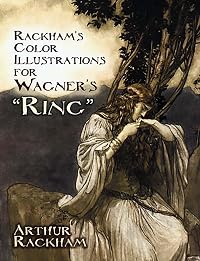
Rackham's Color Illustrations for Wagner's "Ring"
by Arthur Rackham (Illustrator)
On This Page
Description
By the time he created these images, Rackham was England's leading illustrator, famous throughout the world for his interpretations of fairy tales and myths. These illustrations from the original 1911 and 1912 editions, widely regarded as the greatest representations of Wagner's drama, constitute Rackham's masterworks. 64 full-page color images and 9 vignettes.Tags
Recommendations




















Member Reviews
Most of Rackham's fairytale drawings have a quiet intensity, due to his somber palettes and twisting lines, but none so intense as his interpretations of Wagner's Ring trilogy. His style perfectly conveys the Nordic and Germanic themes of the story and gives the cast of characters a quite fitting loft heroic style that is reminiscent of the Operatic stage and the mythic sagas. Most wonderfully represented, in my opinion, are the mysterious Rhinemaidens, whose task it is to safeguard the Rhinegold. They have an eerily etheric quality that really only Rackham could produce, as few could have balanced the lightness of water sprites so carefully with the harsher (and thematically darker) tones of the Rhine. Also quite stunning - though show more admittedly grotesque - are the Nibelung. The gnarled little men are truely frightening to behold, and I am sure that they were one of the inspirations behind Tolkien's (and Peter Jackson's/Alan Lee's interpretation of) Smeagol/Gollum - albeit without the mass of bristling hair. It is no wonder that contemporary collectors lauded this group of paintings as superb, since they break the self-imposed boundaries of youthful subject matter that have been Rackham's forté previously as well as being obvious examples of his true artistic merit. show less
This book is a gem containing the full set of Arthur Rackham’s 1909-1911 illustrations of the legendary Richard Wagner’s “Der Ring des Nibelungen” or “The Nibelung’s Ring”, more commonly “The Ring” in the operatic world. These 64 watercolor illustrations cover the tetralogy of the prologue (Das Rheingold) followed by three “days” – Die Walkure (The Valkyrie), Siegfried, and Die Gotterdammerung (The Twilight of the Gods).
By the publication time of these 64 illustrations, Rackham (British) was well recognized in his profession. Having started in the field of graphic journalism in 1893 (before photos can be printed, news graphics were drawn), his fame first arrived in 1900 with his edition of Grimm’s Fairy Tales show more and was farther strengthened by his 1905 Washington Irving’s Rip van Winkle. In the “Ring”, Rackham had the freedom to translate this operatic giant into a nearly self-explanatory, not-for-children (as Rackham had said) set of images with all the ferocity, wickedness, wretchedness, desperation, and heroism that each character represented. The women, in particular, are outstanding. Brunnhilde, as the introduction of the Valkyries in Die Walkure in Act II, was full of strength and courage, yet undeniably beautiful. Freia, the goddess of youth, in Das Rheingold, Scene II, had a pouty, youthful beauty that is simply perfect. I did notice that his interpretation of beauty is much slimmer and fitted than the art in a similar era; admittedly, it’s what I prefer.
While I was vaguely familiar of this story, it was a pleasure to re-ponder on the influence that Wagner’s “Ring” had on Tolkien and the parallels to other literature such as the Excalibur. One of these days, I’ll clear my calendar and park my butt down to watch this tetralogy at the Opera House!
One quote from the Introduction – on youth and C.S. Lewis:
“…Rackham held that the work was strictly for adults. As he wrote to a young admirer, the illustrations ‘are not well suited for those lucky people who haven’t yet finished the delightful adventure of growing up.’ Nevertheless, C.S. Lewis, who was thirteen when the second volume was published, later wrote of it in ‘Surprised by Joy’, ‘His pictures, which seemed to me then to be the very music made visible, plunged me a few fathoms deeper into my delight. I have seldom coveted anything as I coveted that book…’” show less
By the publication time of these 64 illustrations, Rackham (British) was well recognized in his profession. Having started in the field of graphic journalism in 1893 (before photos can be printed, news graphics were drawn), his fame first arrived in 1900 with his edition of Grimm’s Fairy Tales show more and was farther strengthened by his 1905 Washington Irving’s Rip van Winkle. In the “Ring”, Rackham had the freedom to translate this operatic giant into a nearly self-explanatory, not-for-children (as Rackham had said) set of images with all the ferocity, wickedness, wretchedness, desperation, and heroism that each character represented. The women, in particular, are outstanding. Brunnhilde, as the introduction of the Valkyries in Die Walkure in Act II, was full of strength and courage, yet undeniably beautiful. Freia, the goddess of youth, in Das Rheingold, Scene II, had a pouty, youthful beauty that is simply perfect. I did notice that his interpretation of beauty is much slimmer and fitted than the art in a similar era; admittedly, it’s what I prefer.
While I was vaguely familiar of this story, it was a pleasure to re-ponder on the influence that Wagner’s “Ring” had on Tolkien and the parallels to other literature such as the Excalibur. One of these days, I’ll clear my calendar and park my butt down to watch this tetralogy at the Opera House!
One quote from the Introduction – on youth and C.S. Lewis:
“…Rackham held that the work was strictly for adults. As he wrote to a young admirer, the illustrations ‘are not well suited for those lucky people who haven’t yet finished the delightful adventure of growing up.’ Nevertheless, C.S. Lewis, who was thirteen when the second volume was published, later wrote of it in ‘Surprised by Joy’, ‘His pictures, which seemed to me then to be the very music made visible, plunged me a few fathoms deeper into my delight. I have seldom coveted anything as I coveted that book…’” show less
I either love or hate Wagner on any given day, but this is hands down the best experience I've run into for the ring cycle - lovely art, and no screaming.
Ratings
Members
- Recently Added By
Author Information

Arthur Rackham was born in London, England. At the age of 18, he worked as a clerk at the Westminster Fire Office and began studying part-time at the Lambeth School of Art. In 1892 he left his job and started working for The Westminster Budget as a reporter and illustrator. His first book illustrations were published in 1893 in To the Other Side show more by Thomas Rhodes, but his first serious commission was in 1894 for The Dolly Dialogues, the collected sketches of Anthony Hope, who later went on to write The Prisoner of Zenda. Book illustrating then became Rackham's career for the rest of his life. Rackham invented his own unique technique which resembled photographic reproduction; he would first sketch an outline of his drawing, then lightly block in shapes and details. Afterwards he would add lines in pen and India ink, removing the pencil traces after it had dried. With color pictures, he would then apply multiple washes of color until transparent tints were created. Arthur Rackham died in 1939 of cancer in his home in Limpsfield, Surrey. (Bowker Author Biography) show less
All Editions
Series
Belongs to Publisher Series
Work Relationships
Was inspired by
Common Knowledge
- Original publication date
- 1979
Classifications
Statistics
- Members
- 216
- Popularity
- 151,512
- Reviews
- 3
- Rating
- (4.38)
- Languages
- English
- Media
- Paper, Ebook
- ISBNs
- 2
- UPCs
- 1
- ASINs
- 3