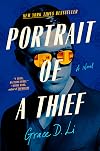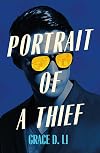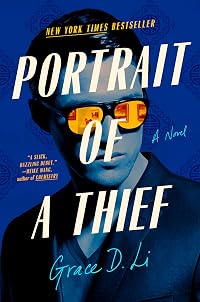
Portrait of a Thief
by Grace D. Li
On This Page
Description
INSTANT NEW YORK TIMES BESTSELLERAn Edgar Award Nominee for Best First Novel
Longlisted for the Center for Fiction's First Novel Prize
Named a New York Times Best Crime Novel of 2022
Named A Most Anticipated Book of 2022 by *Marie Claire* *Washington Post* *Vulture* *NBC News* *Buzzfeed* *Veranda* *PopSugar* *Paste* *The Millions* *Bustle* *Crimereads* Goodreads* *Bookbub* *Boston.com* and more!
"The thefts are engaging and surprising, and the narrative brims with international intrigue. show more Li, however, has delivered more than a straight thriller here, especially in the parts that depict the despair Will and his pals feel at being displaced, overlooked, underestimated, and discriminated against. This is as much a novel as a reckoning."
—New York Times Book Review
Ocean's Eleven meets The Farewell in Portrait of a Thief, a lush, lyrical heist novel inspired by the true story of Chinese art vanishing from Western museums; about diaspora, the colonization of art, and the complexity of the Chinese American identity
History is told by the conquerors. Across the Western world, museums display the spoils of war, of conquest, of colonialism: priceless pieces of art looted from other countries, kept even now.
Will Chen plans to steal them back.
A senior at Harvard, Will fits comfortably in his carefully curated roles: a perfect student, an art history major and sometimes artist, the eldest son who has always been his parents' American Dream. But when a mysterious Chinese benefactor reaches out with an impossible—and illegal—job offer, Will finds himself something else as well: the leader of a heist to steal back five priceless Chinese sculptures, looted from Beijing centuries ago.
His crew is every heist archetype one can imagine—or at least, the closest he can get. A con artist: Irene Chen, a public policy major at Duke who can talk her way out of anything. A thief: Daniel Liang, a premed student with steady hands just as capable of lockpicking as suturing. A getaway driver: Lily Wu, an engineering major who races cars in her free time. A hacker: Alex Huang, an MIT dropout turned Silicon Valley software engineer. Each member of his crew has their own complicated relationship with China and the identity they've cultivated as Chinese Americans, but when Will asks, none of them can turn him down.
Because if they succeed? They earn fifty million dollars—and a chance to make history. But if they fail, it will mean not just the loss of everything they've dreamed for themselves but yet another thwarted attempt to take back what colonialism has stolen.
Equal parts beautiful, thoughtful, and thrilling, Portrait of a Thief is a cultural heist and an examination of Chinese American identity, as well as a necessary critique of the lingering effects of colonialism. show less
Tags
Recommendations













Member Reviews
Okay, this book is perfect. It manages to provide a really insightful commentary on colonialism, art, and Western museums along with the complexity of diaspora and identity, and... a heist out of all my heist movie watching dreams. And it's queer? I will be throwing this book at everyone I know.
This book really frustrated me because it had so much potential. I'm writing this a few weeks after finishing it, so I hope I get the details right. It's a "thriller" about a group of college students who are contracted by a Chinese firm to steal back Chinese antiquities from western museums. The group are extremely incompetent and have never done any kind of heist before, but somehow they are offered 50 million dollars ! (imagine Dr. Evil with his pinky up) to get these items back on behalf of some Chinese billionaire.
I had some issues with this book. The implausible plot is one thing, but on its own that could have been kind of fun and humorous. My main issues had to do with the characters and the extremely problematic way the theme show more of museums and their histories of colonialism was handled. (It's a good topic, and one that a novelist should do justice to! In fact, I just read Tania James's novel Loot, and she does a pretty great job, though it's about private collectors, not museums.)
The characterization is an issue that many readers have raised: these five Chinese American college students are all basically interchangeable. It was hard to keep track of whose thoughts were whose, and even harder to care. The characters are bland, indistinguishable, privileged, and don't do much to illuminate the diversity of the Chinese diaspora in the US (they all go to Ivy or near-Ivy schools, for one thing). A few reviews suggest there are some subtle clues about differences in class, language, and city/region of origin, but those are not made apparent to a European American (or presumably any non-Chinese/Chinese American) readership. Also, with the exception of Daniel the characters are all unlikeable/irritating for various reasons, and their motivations are not well developed at all.
But my bigger problem is just that this book is historically and conceptually lazy. It really makes me wonder what they are teaching in the art history department at Duke! (Just kidding, it's an outstanding art history department--but the author seems to have walked away from her education there with a really simplistic understanding of the history of museums.)
First of all, NO, "all" items in western museums are not "stolen"! Many of them were purchased completely legally. Is there a lot of work to do on figuring out which ones? Yes. But to perpetuate this chestnut is really dishonest. Millions (probably more like tens of millions?!) of items in museums around the world were acquired under legal circumstances.
Second, the book does little to differentiate among strata of "illegal" acquisition. For every smash-and-grab job like the destruction of the Summer Palace (the book's subject), there are more complex situations. Please do not lump these all together! It's very possible to make a cogent case for the return of (say) the Parthenon Marbles while acknowledging that the circumstances are VERY different to how the Benin bronzes (on view just downstairs from them) were acquired. It's not like Lord Elgin ran in with a ski mask on and dashed off with 2000 years of Greek patrimony in the middle of the night lol. The Summer Palace and the Benin Punitive Expedition were looting. But many artifacts that were problematically acquired were not looted in the way Li wants you to think they were. It's not all the same. But this book acts like it's all the same.
Finally, the focus on China as a poor-me wronged party was kind of overdone. The Chinese government under Mao and Communism actively sought to destroy its own cultural patrimony. Buddhist temples and unique artifacts were smashed to rubble in the Cultural Revolution--no Britons required. The book also ignores China's historical/ongoing repression against subject peoples. China got off with a major hall pass, while the author assumes all European countries are/were basically evil empires. (I am in NO way justifying or apologizing for European imperialism. But China was/is an empire, too. It's not *just* a white person thing to dominate other cultures/peoples and destroy/take their nice things. I'm also not saying that a country that does bad things shouldn't complain about having bad things done to it. But more nuance addressing China's difficult histories would have been nice.)
I think with a little more nuance around these issues, this could have been a fun read, and the necessary suspension of disbelief would have been more willing. I am kind of sad, because I am looking for a fun novel of ideas about museums that I can assign to my students, and I thought this would fit the bill. But I think I would spend too much time correcting the misperceptions for it to be useful. show less
I had some issues with this book. The implausible plot is one thing, but on its own that could have been kind of fun and humorous. My main issues had to do with the characters and the extremely problematic way the theme show more of museums and their histories of colonialism was handled. (It's a good topic, and one that a novelist should do justice to! In fact, I just read Tania James's novel Loot, and she does a pretty great job, though it's about private collectors, not museums.)
The characterization is an issue that many readers have raised: these five Chinese American college students are all basically interchangeable. It was hard to keep track of whose thoughts were whose, and even harder to care. The characters are bland, indistinguishable, privileged, and don't do much to illuminate the diversity of the Chinese diaspora in the US (they all go to Ivy or near-Ivy schools, for one thing). A few reviews suggest there are some subtle clues about differences in class, language, and city/region of origin, but those are not made apparent to a European American (or presumably any non-Chinese/Chinese American) readership. Also, with the exception of Daniel the characters are all unlikeable/irritating for various reasons, and their motivations are not well developed at all.
But my bigger problem is just that this book is historically and conceptually lazy. It really makes me wonder what they are teaching in the art history department at Duke! (Just kidding, it's an outstanding art history department--but the author seems to have walked away from her education there with a really simplistic understanding of the history of museums.)
First of all, NO, "all" items in western museums are not "stolen"! Many of them were purchased completely legally. Is there a lot of work to do on figuring out which ones? Yes. But to perpetuate this chestnut is really dishonest. Millions (probably more like tens of millions?!) of items in museums around the world were acquired under legal circumstances.
Second, the book does little to differentiate among strata of "illegal" acquisition. For every smash-and-grab job like the destruction of the Summer Palace (the book's subject), there are more complex situations. Please do not lump these all together! It's very possible to make a cogent case for the return of (say) the Parthenon Marbles while acknowledging that the circumstances are VERY different to how the Benin bronzes (on view just downstairs from them) were acquired. It's not like Lord Elgin ran in with a ski mask on and dashed off with 2000 years of Greek patrimony in the middle of the night lol. The Summer Palace and the Benin Punitive Expedition were looting. But many artifacts that were problematically acquired were not looted in the way Li wants you to think they were. It's not all the same. But this book acts like it's all the same.
Finally, the focus on China as a poor-me wronged party was kind of overdone. The Chinese government under Mao and Communism actively sought to destroy its own cultural patrimony. Buddhist temples and unique artifacts were smashed to rubble in the Cultural Revolution--no Britons required. The book also ignores China's historical/ongoing repression against subject peoples. China got off with a major hall pass, while the author assumes all European countries are/were basically evil empires. (I am in NO way justifying or apologizing for European imperialism. But China was/is an empire, too. It's not *just* a white person thing to dominate other cultures/peoples and destroy/take their nice things. I'm also not saying that a country that does bad things shouldn't complain about having bad things done to it. But more nuance addressing China's difficult histories would have been nice.)
I think with a little more nuance around these issues, this could have been a fun read, and the necessary suspension of disbelief would have been more willing. I am kind of sad, because I am looking for a fun novel of ideas about museums that I can assign to my students, and I thought this would fit the bill. But I think I would spend too much time correcting the misperceptions for it to be useful. show less
But in the end, I couldn't, because there are other serious problems with this book. The five-person rotating point of view is incredibly wearying, especially since every single character's point
The whole thing was just a chore to read. I'm sad, because I wanted to love this book, but it is fully not for me.
“Art could be beauty, but it was also power. Look, it demanded, and don’t turn away.”
~
What a deep, yet fun and thrilling story. We meet five Chinese American college kids who are given an offer to “return” artifacts to China, the catch is they have to steal them from famous museums. I really enjoy the depth we get to see in each character, their past and present, fears and desires. The heists bring unexpected challenges to their lives and relationships, and we get to see how they overcome these speed bumps on their way. The ending took me by surprise, but overall the author has woven some deeper topics into an exciting storyline.
~
What a deep, yet fun and thrilling story. We meet five Chinese American college kids who are given an offer to “return” artifacts to China, the catch is they have to steal them from famous museums. I really enjoy the depth we get to see in each character, their past and present, fears and desires. The heists bring unexpected challenges to their lives and relationships, and we get to see how they overcome these speed bumps on their way. The ending took me by surprise, but overall the author has woven some deeper topics into an exciting storyline.
By now, it should be no surprise to anyone that I love a good heist/con story, so when I heard of Portrait of a Thief, I just knew I had to read it.
I loved that this was not just a heist book (which, anyway would have been enough for me!), but it was also a fascinating character exploration AND a critique of Western imperialism and its lingering effects today. As five Chinese American students set out to retrieve ancient Chinese artefacts from Western museums in order to return them to the Chinese people, they didn't just take me along on their highly illegal and dangerous quest but also kickstarted some deeper reflections on art, museums and colonialism.
The characters were great, and I loved how well each of them was characterised as show more an individual. The alternating POVs worked really well to give us an insight into each character's thoughts, motivation, fears and desires, and I really enjoyed the wide spectrum of experiences that was portrayed here. Will, Irene, Lily, Alex and Daniel all come from different backgrounds and experience their culture and their relationship with both America and China differently, with all their complexity and sometimes contradictions, reflecting the many, many experiences of people who call more than one country "home".
But their struggle with identity isn't limited to their sense of belonging, and I loved how universal some of the characters' reflections felt: from following your passions to the pressures coming from social and family expectations to discovering and accepting who you really are, I could recognise many of my own conversations with friends and loved ones. Of course, I didn't try robbing several museums as a way of working through this but I enjoyed seeing our protagonists undertake this journey.
Where this book fell a bit short for me though was in the pacing. Although I loved the introspection, several passages felt very repetitive, with characters going over the same things over and over again. The heist planning sections were similarly slow and surprisingly underwhelming, with most being resolved with a quick Zoom call, and I missed some of the excitement that is typically found in this genre. Of course none of it is realistic, nor would I want it to be, but I would have enjoyed this even more if there had been a slightly faster pace and fewer repetitions. I did like the references to the pandemic and lockdowns, which were handled very delicately and helped ground the story in simil-reality, and the banter between various characters made me smile more than once.
Overall, Portrait of a Thief is a fantastic debut. Despite some minor flaws, it's an incredibly well-written and thoughtful heist novel that is sure to spark some brilliant discussions on a wide range of themes.
I received an e-arc of this book from the publisher via NetGalley in exchange for my honest review. This did not affect my opinion of the book in any way. show less
I loved that this was not just a heist book (which, anyway would have been enough for me!), but it was also a fascinating character exploration AND a critique of Western imperialism and its lingering effects today. As five Chinese American students set out to retrieve ancient Chinese artefacts from Western museums in order to return them to the Chinese people, they didn't just take me along on their highly illegal and dangerous quest but also kickstarted some deeper reflections on art, museums and colonialism.
The characters were great, and I loved how well each of them was characterised as show more an individual. The alternating POVs worked really well to give us an insight into each character's thoughts, motivation, fears and desires, and I really enjoyed the wide spectrum of experiences that was portrayed here. Will, Irene, Lily, Alex and Daniel all come from different backgrounds and experience their culture and their relationship with both America and China differently, with all their complexity and sometimes contradictions, reflecting the many, many experiences of people who call more than one country "home".
But their struggle with identity isn't limited to their sense of belonging, and I loved how universal some of the characters' reflections felt: from following your passions to the pressures coming from social and family expectations to discovering and accepting who you really are, I could recognise many of my own conversations with friends and loved ones. Of course, I didn't try robbing several museums as a way of working through this but I enjoyed seeing our protagonists undertake this journey.
Where this book fell a bit short for me though was in the pacing. Although I loved the introspection, several passages felt very repetitive, with characters going over the same things over and over again. The heist planning sections were similarly slow and surprisingly underwhelming, with most being resolved with a quick Zoom call, and I missed some of the excitement that is typically found in this genre. Of course none of it is realistic, nor would I want it to be, but I would have enjoyed this even more if there had been a slightly faster pace and fewer repetitions. I did like the references to the pandemic and lockdowns, which were handled very delicately and helped ground the story in simil-reality, and the banter between various characters made me smile more than once.
Overall, Portrait of a Thief is a fantastic debut. Despite some minor flaws, it's an incredibly well-written and thoughtful heist novel that is sure to spark some brilliant discussions on a wide range of themes.
I received an e-arc of this book from the publisher via NetGalley in exchange for my honest review. This did not affect my opinion of the book in any way. show less
Will Chen is an art history senior at Harvard when he witnesses a theft and then takes something they left behind himself. He is contacted by China Poly and asked to steal back 5 Chinese art treasures that were plundered by the West for 50 million dollars. He assembles a team of 4 additional Chinese- American, junior and senior college students (Irene Chen, Daniel Liang, Alex Huang, and Lily Wu--all with specific skills) to help. These students are all seeking something that they are unable to articulate in the beginning. This is a coming of age or finding yourself novel in addition to the information about plundered Chinese art.
There was a little of everything in this--I got the heist story I wanted and the college age protagonists coming of age as well. The book is told via all five viewpoints. Will and Irene (siblings), Lily (roommate), Daniel (old friend) and Alex (former Bostonian working in Silicon Valley) All of them are chose by Will for the unique skills they will bring to the table. Will is the artist/art historian, with Daniel perhaps next in knowing the most about Summer Palace art, its' looting by invaders and how these pieces wind up in galleries around the world. Irene summed up what I had been thinking toward the end of the book, just how did they think this was all going to work out? It's not one heist, but five and patterns emerge quickly, show more including another group of thieves intent on reclaiming much of the Summer Palace art on their own. Definitely an engrossing read about cultural identity as well as their own identities as Chinese and Chinese-Americans. show less
Members
- Recently Added By
Lists

Fiction: Crime, Detective, Mystery
350 works; 3 members

Books published and read in 2022
82 works; 5 members

Top Five Books of 2022
736 works; 272 members

Art heist books at PPL
122 works; 1 member
Author Information

2 Works 883 Members
Some Editions
Awards and Honors
Awards
Distinctions
Notable Lists
RUSA CODES Listen List (Listen-Alike – Listen-Alike to "Con/Artist: The Life and Crimes of the World’s Greatest Art Forger" – 2024)
Common Knowledge
- Canonical title
- Portrait of a Thief
- Original publication date
- 2022
- Blurbers
- Woodworth, Al; Wilkinson, Lauren; Sutanto, Jesse Q.; Wang, Weike; Lim, Roselle; Rogers, Morgan Callan (show all 7); Dawson, Delilah S.
- Original language
- English
Classifications
Statistics
- Members
- 881
- Popularity
- 30,725
- Reviews
- 26
- Rating
- (3.17)
- Languages
- English
- Media
- Paper, Audiobook, Ebook
- ISBNs
- 10
- ASINs
- 3