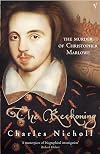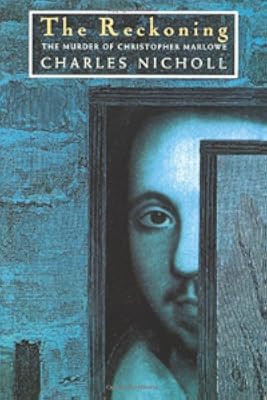
The Reckoning: The Murder of Christopher Marlowe
by Charles Nicholl
On This Page
Description
"In 1593 the brilliant and controversial young playwright Christopher Marlowe was stabbed to death in a Deptford lodging-house. The circumstances were shady, the official account - a violent quarrel over the bill, or "recknynge"--Long regarded as dubious." "The Reckoning is the first full-length investigation of the killing, tracing Marlowe's shadowy political dealings, his involvement in covert intelligence work, and the charges of heresy and homosexuality against him. There is critical new show more evidence about his three companions on that last day in Deptford and about the sinister role of the informer, Richard Baines. More important, The Reckoning is an enthralling revelation of the extraordinary underworld of Elizabethan crime and espionage, a "secret theater" in which nearly every historical figure familiar to us, from hack poet to Queen's high minister, seems to have played a part. Here, in a tour de force of precise scholarship and dazzling ingenuity, Charles Nicholl penetrates four centuries of obscurity to reveal not only a complex and unsettling story of entrapment and betrayal, chimerical plot and sordid felonies, but also a fascinating vision of the underside of an entire culture."--Jacket. show lessTags
Recommendations










Member Reviews
This is a real-life murder mystery set in the shadowy world of spies, provocateurs, and double agents. “Everybody knows” that Christopher Marlowe, the leading English playwright as Shakespeare was starting out, was killed, not yet thirty, in a tavern brawl. Sometimes what everyone knows isn’t true. Nicholl’s tireless research uncovered much new evidence about those with Marlowe on that fateful early summer day in 1593; he adds this to material that had previously turned up but hadn’t found its way into Marlowe biographies. While Nicholl admits that we may never know exactly what happened, we can be sure of what did not happen: neither the tavern brawl of popular legend nor the mishap in which Marlowe was the aggressor and his show more slayer acted in self-defense, as the version hastily adopted at the inquest would have it. Instead, Nicholl builds the case that Marlowe seems to have been the (not so innocent) pawn of a ferocious power struggle between the Earl of Essex and Sir Walter Ralegh (as Nicholl spells the name). Seems plausible, but unproven.
In the course of the fast-moving tale, we encounter freethinkers, occultists, poets, and recusants. Behind them all sits an aging queen with no heirs, along with the various noblemen whose ill-fortune it was to have a claim to the soon-to-be vacant throne.
Takeaway from the book: Poets are not necessarily nice people. As lamentable as Marlowe’s early demise may have been, he seems to have been little different from the three men in the room with him on the last day of his life: an ambitious young man from humble origins who supplemented the meager, uncertain rewards from his writing with some spy craft. show less
In the course of the fast-moving tale, we encounter freethinkers, occultists, poets, and recusants. Behind them all sits an aging queen with no heirs, along with the various noblemen whose ill-fortune it was to have a claim to the soon-to-be vacant throne.
Takeaway from the book: Poets are not necessarily nice people. As lamentable as Marlowe’s early demise may have been, he seems to have been little different from the three men in the room with him on the last day of his life: an ambitious young man from humble origins who supplemented the meager, uncertain rewards from his writing with some spy craft. show less
Charles Nicholl's prize-winning 1992 study The Reckoning: The Murder of Christopher Marlowe is a richly-detailed, if highly speculative, examination of the life, career and death of Marlowe, the well-known Elizabethan poet and playwright. A fascinating reconstruction of espionage and politico-religious intrigue during the later years of Elizabeth I's reign, the book offers up a plausible if not entirely proven (or prove-able) theory about Marlowe's murder being part of a high-level court struggle.
Nicholl's done his archival research, and includes many discoveries about Marlowe as well as significant amounts of biographical material relating to others in Marlowe's political, poetical and social circles. While I think in some cases that show more Nicholls' aren't the only conclusions that could be drawn from the available evidence, his theories seem just as possible as any others (admittedly, more evidence may be known now than Nicholl had access to; things might have changed in the last fifteen years).
My one major quibble with this book is the lack of good citation apparatus; in a book of this type, where significant amounts of the author's credibility depends on the reliability of the evidence being cited, it is an unconscionable negligence on the part of the publisher to leave footnotes unindicated in the text, forcing the reader to guess what might be cited and then look in the back to check for it. If not for this shortcoming, I'd feel much more positive about the book. As it is, I still recommend it highly for anyone who's up for a lot of details and some good old-fashioned court intrigue.
http://philobiblos.blogspot.com/2007/07/book-review-reckoning.html show less
Nicholl's done his archival research, and includes many discoveries about Marlowe as well as significant amounts of biographical material relating to others in Marlowe's political, poetical and social circles. While I think in some cases that show more Nicholls' aren't the only conclusions that could be drawn from the available evidence, his theories seem just as possible as any others (admittedly, more evidence may be known now than Nicholl had access to; things might have changed in the last fifteen years).
My one major quibble with this book is the lack of good citation apparatus; in a book of this type, where significant amounts of the author's credibility depends on the reliability of the evidence being cited, it is an unconscionable negligence on the part of the publisher to leave footnotes unindicated in the text, forcing the reader to guess what might be cited and then look in the back to check for it. If not for this shortcoming, I'd feel much more positive about the book. As it is, I still recommend it highly for anyone who's up for a lot of details and some good old-fashioned court intrigue.
http://philobiblos.blogspot.com/2007/07/book-review-reckoning.html show less
The winner of the Crime Writers’ Association Non-fiction Gold Dagger Award in 1992 Charles Nicoll has written a fascinating literary detective story. What did happen to Kit Marlowe? Why was he killed in “a tavern brawl” on 30 May, 1593. Was the author of “Dr Faustus” and “The Jew of Malta” a spy? The story is preceded by the epigraph: “I find the matter as in a labyrinth: easier to go in than to go out” and thus it is with this tale. There are countless twists and permutations associated with Marlowe’s death.
By the late 20th early 21st centuries we are inured to conspiracy theories. If anyone in authority suggests a cause of death that does not ring true we are quite happy to accept any other theory than the show more official one. Marlowe was such a great talent and dies so young we cannot accept that he might have died for so banal a reason as an argument over the reckoning: an account (or bill) owing at a sleazy tavern. The other likely scenario is that he was mixed up in a spying ring and that he became expendable. Of course before we arrive at that point there is also the suggestion that he may have been a counterfeiter in the employ of the Catholic party plotting the return of Mary Queen of Scots; or perhaps he was inciting others to atheism (a capital offence); and then there are any number of literary and other petty jealousies floating around.
Aside from anything else “The Reckoning” is well written and is a delight to read. If you are interested in Marlowe it is a must read. show less
By the late 20th early 21st centuries we are inured to conspiracy theories. If anyone in authority suggests a cause of death that does not ring true we are quite happy to accept any other theory than the show more official one. Marlowe was such a great talent and dies so young we cannot accept that he might have died for so banal a reason as an argument over the reckoning: an account (or bill) owing at a sleazy tavern. The other likely scenario is that he was mixed up in a spying ring and that he became expendable. Of course before we arrive at that point there is also the suggestion that he may have been a counterfeiter in the employ of the Catholic party plotting the return of Mary Queen of Scots; or perhaps he was inciting others to atheism (a capital offence); and then there are any number of literary and other petty jealousies floating around.
Aside from anything else “The Reckoning” is well written and is a delight to read. If you are interested in Marlowe it is a must read. show less
This is one of the best studies of the life and death of Christopher Marlowe to be published. Nicholl has assembled nearly every bit of biographical evidence that 400 years of scholarship have accumulated, and added some of his own. He carefully builds the picture of Marlowe's world, not only placing Marlowe in its context, but providing backgrounds and details about the other men who were present at his death, and those who may have otherwise been involved.
The one difficulty of the book is that Nicholl's conclusions are, by necessity, speculation. He assembles the evidence, but also chooses to extrapolate from it. His extrapolations aren't necessarily far-fetched, and are certainly supported by the evidence, but neither are they show more irrefutable or even provable. His explanation for the reasons behind Marlowe's death is, frankly, as good as any other I've read, with the added bonus that Nicholl is at least clear about the difference between his speculations and known facts.
Even if you're not inclined to believe Nicholl's conclusions, the book is still one of the best overviews of all the available information about Christopher Marlowe, and well worth reading. show less
The one difficulty of the book is that Nicholl's conclusions are, by necessity, speculation. He assembles the evidence, but also chooses to extrapolate from it. His extrapolations aren't necessarily far-fetched, and are certainly supported by the evidence, but neither are they show more irrefutable or even provable. His explanation for the reasons behind Marlowe's death is, frankly, as good as any other I've read, with the added bonus that Nicholl is at least clear about the difference between his speculations and known facts.
Even if you're not inclined to believe Nicholl's conclusions, the book is still one of the best overviews of all the available information about Christopher Marlowe, and well worth reading. show less
Enjoyed it. The author has a point of view and prosecutes his case, filling in evidence with speculation that hangs together and is amusing to consider. Nicholl takes necessarily spotty historical evidence and weaves a compelling story around it. Did it happen this way? We'll never know, but it was a lively, entertaining, and well-argued read.
I'm considering writing on Marlowe for my MA dissertation, I'd previously read the first edition, so knew that this was a must read. Nicholls's investigation into the events surrounding Marlowe's death is both fascinating and informative. Nicholls's prose is very evocative as he explores the paranoia of the period. The fear of the Catholic threat led to the formation of the secret service to both spy on and manipulate suspected Catholic insurgents. Just as it was in the 1930s, during the latter part of the sixteenth century Cambridge was a prime recruiting ground for the secret service and, like so many of his contemporaries, Marlowe was drawn into this dark and shady world. In this revised edition Nicholls incorporates material not show more available to him at the time of writing the first edition to review and revise his theories. Superb. show less
I heard about this book on a BBC television programme about whether or not Christopher Marlowe actually wrote Shakespeare's plays. This book has nothing to do with that subject but is an investigation into the events surrounding Marlowe's death. I really enjoyed this book. It really bought to life the insecurities and paranoia of the times, and the machinations of the Court and how anyone suspected of being Catholic or aetheist could be arrested and tortured without warning at any time.
Members
- Recently Added By
Lists

Michael Dirda's Desert Island Books
62 works; 5 members

Mustich's 1000 Books to Read Before You Die: A Life Changing List
1,001 works; 20 members
Author Information

14+ Works 2,759 Members
Awards and Honors
Common Knowledge
- Original publication date
- 1992
- People/Characters
- Christopher Marlowe; Thomas Kyd
- Epigraph
- 'I find the matter as in a labyrinth: easier to enter into it than to go out.' - Lord Burghley, 1593
'Espionage is the secret theatre of our society.' - John Le Carre, 1989 - Dedication
- For my Mother and Father
- First words
- Is this a true story?
- Last words
- (Click to show. Warning: May contain spoilers.)Thus the man who killed Christopher Marlowe lived out his days in suburban respectability, and was buried in the churchyard at Eltham on 14 August 1627.
Classifications
Statistics
- Members
- 599
- Popularity
- 48,966
- Reviews
- 12
- Rating
- (4.21)
- Languages
- English
- Media
- Paper
- ISBNs
- 5
- ASINs
- 3