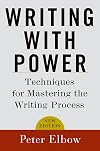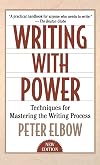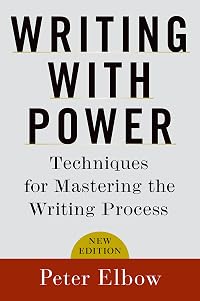
Writing With Power: Techniques for Mastering the Writing Process
by Peter Elbow
On This Page
Description
A classic handbook for anyone who needs to write, Writing With Power speaks to everyone who has wrestled with words while seeking to gain power with them. Here, Peter Elbow emphasizes that the essential activities underlying good writing and the essential exercises promoting it are really not difficult at all. Employing a cookbook approach, Elbow provides the reader (and writer) with various recipes: for getting words down on paper, for revising, for dealing with an audience, for getting show more feedback on a piece of writing, and still other recipes for approaching the mystery of power in writing. In show lessTags
Recommendations






Member Reviews
I've read several books on the writing process during the last year - most aimed at academics (How to Write a Lot, Writing Your Dissertation in Fifteen Minutes a Day) - hoping to find one that would help me to abandon the frenzied, agonizing paper-writing process that had become my default after several years of graduate coursework. This is the only one that has actually altered my writing habits in an immediate and (so far) lasting way.
Unlike authors who offer step-by-step, phase-by-phase approaches to certain kinds of writing projects, Elbow offers one idea that can be adapted for all kinds of tasks: writing time is most productive when you separate your freewheeling, word-generating, creative side from your hard-nosed inner editor, show more and alternate them. You can devote minutes or days to either of these modes, but you must take turns with them. Trying to write while editing what you're writing is bound to be slow going.
This book trains you to pry these modes apart, and to use each one to its fullest advantage. Elbow explains how you can strengthen your writing and editing modes and intersperse them on different kinds of projects, and he includes dozens of prompts and hints to aid both parts of the process for when you're feeling stuck. He does all of this in such a kind voice that it actually feels manageable.
I can't say enough nice things about this book - I find myself recommending it to colleagues and students all the time. show less
Unlike authors who offer step-by-step, phase-by-phase approaches to certain kinds of writing projects, Elbow offers one idea that can be adapted for all kinds of tasks: writing time is most productive when you separate your freewheeling, word-generating, creative side from your hard-nosed inner editor, show more and alternate them. You can devote minutes or days to either of these modes, but you must take turns with them. Trying to write while editing what you're writing is bound to be slow going.
This book trains you to pry these modes apart, and to use each one to its fullest advantage. Elbow explains how you can strengthen your writing and editing modes and intersperse them on different kinds of projects, and he includes dozens of prompts and hints to aid both parts of the process for when you're feeling stuck. He does all of this in such a kind voice that it actually feels manageable.
I can't say enough nice things about this book - I find myself recommending it to colleagues and students all the time. show less
An older book, but the best book about the writing process I've ever read. This is the book that gave me permission to be a writer.
A classic handbook for anyone who needs to write, Writing With Power speaks to everyone who has wrestled with words while seeking to gain power with them. Here, Peter Elbow emphasizes that the essential activities underlying good writing and the essential exercises promoting it are really not difficult at all. Employing a cookbook approach, Elbow provides the reader (and writer) with various for getting words down on paper, for revising, for dealing with an audience, for getting feedback on a piece of writing, and still other recipes for approaching the mystery of power in writing. In a new introduction, he offers his reflections on the original edition, discusses the responses from people who have followed his techniques, how his show more methods may differ from other processes, and how his original topics are still pertinent to todays writer. Source: GoodReads
FYI from 1998 Oxford Press edition (ISBN 0198028199): A classic handbook for anyone who needs to write, Writing With Power speaks to everyone who has wrestled with words while seeking to gain power with them. Here, Peter Elbow emphasizes that the essential activities underlying good writing and the essential exercises promoting it are really not difficult at all. Employing a cookbook approach, Elbow provides the reader (and writer) with various recipes: for getting words down on paper, for revising, for dealing with an audience, for getting feedback on a piece of writing, and still other recipes for approaching the mystery of power in writing. In a new introduction, he offers his reflections on the original edition, discusses the responses from people who have followed his techniques, how his methods may differ from other processes, and how his original topics are still pertinent to today's writer. By taking risks and embracing mistakes, Elbow hopes the writer may somehow find a hold on the creative process and be able to heighten two mentalities--the production of writing and the revision of it. From students and teachers to novelists and poets, Writing with Power reminds us that we can celebrate the uses of mystery, chaos, non-planning, and magic, while achieving analysis, conscious control, explicitness, and care in whatever it is we set down on paper.
Source: Publisher per www.books.google.com show less
FYI from 1998 Oxford Press edition (ISBN 0198028199): A classic handbook for anyone who needs to write, Writing With Power speaks to everyone who has wrestled with words while seeking to gain power with them. Here, Peter Elbow emphasizes that the essential activities underlying good writing and the essential exercises promoting it are really not difficult at all. Employing a cookbook approach, Elbow provides the reader (and writer) with various recipes: for getting words down on paper, for revising, for dealing with an audience, for getting feedback on a piece of writing, and still other recipes for approaching the mystery of power in writing. In a new introduction, he offers his reflections on the original edition, discusses the responses from people who have followed his techniques, how his methods may differ from other processes, and how his original topics are still pertinent to today's writer. By taking risks and embracing mistakes, Elbow hopes the writer may somehow find a hold on the creative process and be able to heighten two mentalities--the production of writing and the revision of it. From students and teachers to novelists and poets, Writing with Power reminds us that we can celebrate the uses of mystery, chaos, non-planning, and magic, while achieving analysis, conscious control, explicitness, and care in whatever it is we set down on paper.
Source: Publisher per www.books.google.com show less
Revisiting this classic of the genre and enjoying it all over again.
writing instruction
Ratings
Members
- Recently Added By
Author Information

17+ Works 1,793 Members
Peter Elbow is Professor of English Emeritus at the University of Massachusetts at Amherst and former director of its writing program, He is the author of Writing Without Teachers, Writing With Power, Embracing Contraries, and Everyone Can Write.
Awards and Honors
Awards
Common Knowledge
- Original publication date
- 1981
- Dedication
- I dedicate this book to Cami with my love
- First words
- I have designed this book so you can either read it straight through or else skip around. [Introduction]
I direct this book to a very broad audience. [Chapter 1] - Last words
- (Click to show. Warning: May contain spoilers.)Though you must believe in magic, then, often you must be willing to do without it.
- Blurbers
- Nemerov, Howard; Willis, Meredith Sue
- Original language
- English
Classifications
Statistics
- Members
- 795
- Popularity
- 34,918
- Reviews
- 5
- Rating
- (4.03)
- Languages
- English
- Media
- Paper, Ebook
- ISBNs
- 8
- ASINs
- 5