On This Page
Description
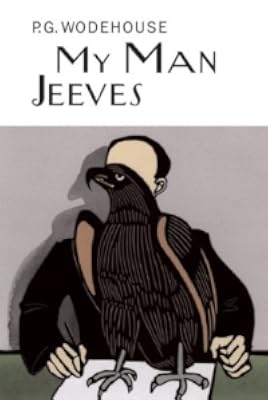
A humorist praised by humorists, P. G. Wodehouse here introduces two of his most beloved characters.My Man Jeeves, first published in 1919, introduced the world to affable, indolent Bertie Wooster and his precise, capable valet, Jeeves. Some of the finest examples of humorous writing found in English literature are woven around the relationship between these two men of very different classes and temperaments. Where Bertie is impetuous and feeble, Jeeves is coolheaded and poised.
This show more collection, the first book of Jeeves and Wooster stories, contains eight stories, including "Leave It to Jeeves," "Helping Freddie," "Rallying round Old George," "Doing Clarence a Bit of Good," "Absent Treatment," and "Jeeves and the Hard-Boiled Egg."
. show less
Tags
Recommendations



















Member Recommendations

TadAD Imagine Bertie, Bingo and Barmie trying to organize a two-week boating expedition up the Thames. Conversely, imagine J., Harris and George trying to steal a cow creamer for their aunt. There you have it.
40
Member Reviews
The adventures of an idle rich idiot and his magical butler. The standard formula for most stories is that a wealthy layabout friend comes to Wooster and explains why some rich uncle or aunt is about to cut him out of an inheritance. Wooster summons Jeeves, who thinks of an elaborate lie that will get the friend back into the good graces of the moneyback relative. The lie always goes horribly wrong. In the end, they wind up black mailing the old relative to keep things alright for the rich brat friend.
Seriously, this book made me completely understand the appeal of communism. At the very least, I now support inheritance taxes at a rate of 110%, and also public floggings of leaches like Wooster.
The only reason I gave the stories 2 show more stars instead of 1 is that, alas, Wodehouse is actually a pretty decent writer. While I loathed the characters, and longed for a story where someone said, "Hey, why don't we try telling the truth?", I must admit he has a way with words and an excellent sense of comic timing. If I didn't exit the stories hating humanity, I probably would have enjoyed them. show less
Seriously, this book made me completely understand the appeal of communism. At the very least, I now support inheritance taxes at a rate of 110%, and also public floggings of leaches like Wooster.
The only reason I gave the stories 2 show more stars instead of 1 is that, alas, Wodehouse is actually a pretty decent writer. While I loathed the characters, and longed for a story where someone said, "Hey, why don't we try telling the truth?", I must admit he has a way with words and an excellent sense of comic timing. If I didn't exit the stories hating humanity, I probably would have enjoyed them. show less
This is the first collection of short stories about the iconic Bertie Wooster and his valet Jeeves. Some stories in this edition are about a different idle rich socialite but were later repurposed as Jeeves & Wooster stories.
Leave It to Jeeves: A rich socialite named Bertie has a socialite artist friend named Corky, who wants to marry a woman named Muriel but is afraid his uncle, who gives him an allowance, won’t approve and will cut him off. As always, Bertie outsources the problem to his valet Jeeves, who suggests that Muriel should pretend to be interested in the uncle’s special interest so that he gets to know her and like her before the uncle finds out she’s engaged to Corky. This backfires and Muriel marries the uncle show more instead. The uncle commissions Corky to paint a portrait of his and Muriel’s new son. The painting is very ugly and Corky’s uncle disowns him, but Corky makes a career out of drawing ugly faces in comics.
Vaguely entertaining, but the treatment of Muriel is pretty gross.
Jeeves and the Unbidden Guest: A friend of Bertie’s aunt wants her son Motty to stay with Bertie, and Bertie is concerned because the young man sounds very dull. Motty turns out to be a drunk and a menace, and Bertie is so annoyed with him that he goes out of town for a week. When he comes home he finds out that Motty is in prison for punching a police officer, and that Motty’s mother saw him in prison when she was visiting to do research for a book she’s writing. Bertie tells Motty’s mother that Motty went to prison voluntarily to help with her research. It turns out that Jeeves bet Motty $50 that he wouldn't punch a police officer.
Some parts of this are funny but it still has the tone of Bertie being a poor little rich boy who has to do things he doesn’t want to do just so he can stay rich.
Jeeves and the Hard-Boiled Egg: Bertie’s rich friend Bicky gets a large allowance from his uncle (a duke) on the condition that he get a job and earn his own money, but he doesn’t want to get a job so he asks Bertie for help. Bertie asks Jeeves. Jeeves says to pretend that Bicky owns Bertie’s apartment and that Jeeves is Bicky’s valet and Bertie is just a guest. The Duke thinks that if Bicky can afford this apartment he doesn’t need an allowance and cuts him off. Bicky tries to start a chicken farm and to get the seed money he sells strangers the opportunity to shake the Duke’s hand under the guise that they are Bicky’s friends. The scheme is quickly uncovered and the Duke is furious. Bertie suggests Bicky could sell the humorous story to the papers so the embarrassed Duke is blackmailed into reinstating Bicky’s allowance.
Not particularly interesting, except for the part where Bertie blows their cover in the initial plan by not knowing how much a normal job’s salary is.
Absent Treatment: Reggie Pepper (a precursor to Bertie Wooster) is invited to his friend Bobbie’s house for dinner, but Bobbie’s wife is acting very strange. Bobbie had forgotten it was their wedding anniversary. He continues to forget things that are important to his wife (though he remembers everything else just fine) until she leaves him. In a note she says she will come back when he wishes her a happy birthday, but Bobbie can’t remember her birthday. He and Reggie go through various schemes to try to figure out what her birthday might be. Bobbie eventually gets it right, but it turns out Reggie was in on the wife’s scheme the whole time, and she blames Reggie when she finds out all the trouble Bobbie had to go through to figure it out.
I enjoyed this one at first because Bobbie’s wife was right to leave him, but of course the woman ends up being fickle and henpeck-y.
Helping Freddie: Reggie’s friend Freddie is sad because his fiancee Angela broke up with him. The two see Angela with a small child and assume he’s her nephew and make a plan to kidnap the child so Freddie and Angela have to reunite. They kidnap the child, but Angela doesn’t know who he is. Turns out he’s just a kid who lives nearby whose whole family is sick and quarantined so Reggie and Freddie have to take care of him for a few days. They train the kid to say “Kiss Freddie” when he sees Angela, and it works.
I feel like I must be missing something here, because this one is fairly straightforward and not particularly interesting.
Rallying Round Old George: Reggie’s friend George needs to meet an uncle in Monte Carlo to collect an inheritance so Reggie tags along. George gets engaged to Stella and is so excited that hesexually assaults kisses the maid, Emma. Stella sees it and breaks up with him. Emma’s fiance, Reggie’s valet, also sees it and breaks up with her. George is so upset he gets black-out drunk and gets into a fight. In the morning George finds out that he can’t collect his inheritance from his uncle because he has a long lost twin named Alfred, and also that a Count was assaulted last night. George decides to pretend to be Alfred to avoid the Count’s men who are looking for him. Reggie’s valet, who has won big at the casino and is still mad about the kiss, quits and then blows George’s cover. It turns out George’s uncle made up Alfred to cover for the fact that he gambled away the whole inheritance. But George actually got in a fight with the Count’s assailant, not the Count, and the Count’s men are looking for him to give him a huge reward.
The convolutedness of this one is fun, but I can’t overlook the sexual assault of an employee.
Doing Clarence a Bit of Good: Reggie’s ex-fiancee, now married to an artist, invites him to visit her country estate. While there she asks him to secretly destroy a painting by her husband’s father which she thinks is not as good as her husband’s painting of the same subject. Through a complicated series of events, Reggie gets confused and destroys the wrong painting.
This one confused me too, Reggie.
The Aunt and the Sluggard: Bertie’s rich friend Rocky gets an allowance from his aunt on the condition that he tell her about all the exciting things he does in New York City, but Rocky is a homebody and doesn’t like doing exciting things. So Jeeves suggests that Rocky pay someone to have an exciting time in New York City and tell him about it so he can tell his aunt. Jeeves volunteers himself. His exploits are so fun that Rocky’s aunt comes to visit, and Bertie has to move into a hotel so Rocky can pretend Bertie’s house and valet are his. Rocky and his aunt go out on the town but his aunt becomes suspicious when his life doesn’t seem to match the letters he wrote. While pretending to be Rocky’s valet, Jeeves “accidentally” takes Rocky’s aunt to see an evangelical preacher, which leads her to decide Rocky’s exciting life is sinful and he needs to be a homebody instead.
I did like this one, though Bertie complaining about giving up his apartment was annoying.
As you can probably tell, these were not really to my taste. I can objectively recognize the humorous writing but I just don’t find rich people problems very funny. All of them revolve around rich young white men doing silly things so they can avoid the worst fate they can possibly imagine - not getting free money. The goofy tone is fun but the situations are not, and I don’t like the way Jeeves, other staff, and all women are treated as sub-human. The humor is very similar to O. Henry, whom I much prefer. I will probably try a full-length novel at some point, because I could see the humor working better for me in a more developed format. show less
Leave It to Jeeves: A rich socialite named Bertie has a socialite artist friend named Corky, who wants to marry a woman named Muriel but is afraid his uncle, who gives him an allowance, won’t approve and will cut him off. As always, Bertie outsources the problem to his valet Jeeves, who suggests that Muriel should pretend to be interested in the uncle’s special interest so that he gets to know her and like her before the uncle finds out she’s engaged to Corky. This backfires and Muriel marries the uncle show more instead. The uncle commissions Corky to paint a portrait of his and Muriel’s new son. The painting is very ugly and Corky’s uncle disowns him, but Corky makes a career out of drawing ugly faces in comics.
Vaguely entertaining, but the treatment of Muriel is pretty gross.
Jeeves and the Unbidden Guest: A friend of Bertie’s aunt wants her son Motty to stay with Bertie, and Bertie is concerned because the young man sounds very dull. Motty turns out to be a drunk and a menace, and Bertie is so annoyed with him that he goes out of town for a week. When he comes home he finds out that Motty is in prison for punching a police officer, and that Motty’s mother saw him in prison when she was visiting to do research for a book she’s writing. Bertie tells Motty’s mother that Motty went to prison voluntarily to help with her research. It turns out that Jeeves bet Motty $50 that he wouldn't punch a police officer.
Some parts of this are funny but it still has the tone of Bertie being a poor little rich boy who has to do things he doesn’t want to do just so he can stay rich.
Jeeves and the Hard-Boiled Egg: Bertie’s rich friend Bicky gets a large allowance from his uncle (a duke) on the condition that he get a job and earn his own money, but he doesn’t want to get a job so he asks Bertie for help. Bertie asks Jeeves. Jeeves says to pretend that Bicky owns Bertie’s apartment and that Jeeves is Bicky’s valet and Bertie is just a guest. The Duke thinks that if Bicky can afford this apartment he doesn’t need an allowance and cuts him off. Bicky tries to start a chicken farm and to get the seed money he sells strangers the opportunity to shake the Duke’s hand under the guise that they are Bicky’s friends. The scheme is quickly uncovered and the Duke is furious. Bertie suggests Bicky could sell the humorous story to the papers so the embarrassed Duke is blackmailed into reinstating Bicky’s allowance.
Not particularly interesting, except for the part where Bertie blows their cover in the initial plan by not knowing how much a normal job’s salary is.
Absent Treatment: Reggie Pepper (a precursor to Bertie Wooster) is invited to his friend Bobbie’s house for dinner, but Bobbie’s wife is acting very strange. Bobbie had forgotten it was their wedding anniversary. He continues to forget things that are important to his wife (though he remembers everything else just fine) until she leaves him. In a note she says she will come back when he wishes her a happy birthday, but Bobbie can’t remember her birthday. He and Reggie go through various schemes to try to figure out what her birthday might be. Bobbie eventually gets it right, but it turns out Reggie was in on the wife’s scheme the whole time, and she blames Reggie when she finds out all the trouble Bobbie had to go through to figure it out.
I enjoyed this one at first because Bobbie’s wife was right to leave him, but of course the woman ends up being fickle and henpeck-y.
Helping Freddie: Reggie’s friend Freddie is sad because his fiancee Angela broke up with him. The two see Angela with a small child and assume he’s her nephew and make a plan to kidnap the child so Freddie and Angela have to reunite. They kidnap the child, but Angela doesn’t know who he is. Turns out he’s just a kid who lives nearby whose whole family is sick and quarantined so Reggie and Freddie have to take care of him for a few days. They train the kid to say “Kiss Freddie” when he sees Angela, and it works.
I feel like I must be missing something here, because this one is fairly straightforward and not particularly interesting.
Rallying Round Old George: Reggie’s friend George needs to meet an uncle in Monte Carlo to collect an inheritance so Reggie tags along. George gets engaged to Stella and is so excited that he
The convolutedness of this one is fun, but I can’t overlook the sexual assault of an employee.
Doing Clarence a Bit of Good: Reggie’s ex-fiancee, now married to an artist, invites him to visit her country estate. While there she asks him to secretly destroy a painting by her husband’s father which she thinks is not as good as her husband’s painting of the same subject. Through a complicated series of events, Reggie gets confused and destroys the wrong painting.
This one confused me too, Reggie.
The Aunt and the Sluggard: Bertie’s rich friend Rocky gets an allowance from his aunt on the condition that he tell her about all the exciting things he does in New York City, but Rocky is a homebody and doesn’t like doing exciting things. So Jeeves suggests that Rocky pay someone to have an exciting time in New York City and tell him about it so he can tell his aunt. Jeeves volunteers himself. His exploits are so fun that Rocky’s aunt comes to visit, and Bertie has to move into a hotel so Rocky can pretend Bertie’s house and valet are his. Rocky and his aunt go out on the town but his aunt becomes suspicious when his life doesn’t seem to match the letters he wrote. While pretending to be Rocky’s valet, Jeeves “accidentally” takes Rocky’s aunt to see an evangelical preacher, which leads her to decide Rocky’s exciting life is sinful and he needs to be a homebody instead.
I did like this one, though Bertie complaining about giving up his apartment was annoying.
As you can probably tell, these were not really to my taste. I can objectively recognize the humorous writing but I just don’t find rich people problems very funny. All of them revolve around rich young white men doing silly things so they can avoid the worst fate they can possibly imagine - not getting free money. The goofy tone is fun but the situations are not, and I don’t like the way Jeeves, other staff, and all women are treated as sub-human. The humor is very similar to O. Henry, whom I much prefer. I will probably try a full-length novel at some point, because I could see the humor working better for me in a more developed format. show less
Somehow, I have made it this far into my life without reading anything by P.G. Wodehouse. My Man Jeeves is the first book in the Jeeves series. It is a delightful collection of short stories first published in 1919. It introduces readers to several eccentric and lovable characters. The collection features eight stories, four starring aristocrat Bertie Wooster and his brilliant valet Jeeves, and four featuring Reggie Pepper.
The Jeeves and Wooster stories are the standouts of the collection. Bertie constantly finds himself in absurd predicaments, only to be rescued by the infinitely resourceful Jeeves. The plots typically involve Bertie attempting to help friends with romantic entanglements or financial troubles, only to become hopelessly show more entangled himself. Jeeves inevitably steps in with an elegant solution (which often comes with a small price for Bertie to pay).
I found this book an excellent introduction to Wodehouse's writing. The prose is playful and witty. I have recently been looking for “fun” books, which also serve as escapism, and this book fits perfectly. I certainly will be reading more of this series. show less
The Jeeves and Wooster stories are the standouts of the collection. Bertie constantly finds himself in absurd predicaments, only to be rescued by the infinitely resourceful Jeeves. The plots typically involve Bertie attempting to help friends with romantic entanglements or financial troubles, only to become hopelessly show more entangled himself. Jeeves inevitably steps in with an elegant solution (which often comes with a small price for Bertie to pay).
I found this book an excellent introduction to Wodehouse's writing. The prose is playful and witty. I have recently been looking for “fun” books, which also serve as escapism, and this book fits perfectly. I certainly will be reading more of this series. show less
This collection contains early versions of stories that were later rewritten for other collections (including Carry On, Jeeves). As such, I would not recommend it as an introduction to Jeeves and Wooster, as they are better characterised in later stories and novels. Instead, this collection should be read once you have wondered at the ease with which Wodehouse appears to write the later stories, to appreciate that there is much hard work and polishing beneath the delightful charm of the later stories.
My Man Jeeves provides a fascinating insight into the creation of stories that we know so well from later versions. All the stories are set in New York, four of them featuring Jeeves and Wooster themselves (although Jeeves does not attain show more that omniscient stature that he later acquires); the rest concerning Reggie Pepper, who reads like an early version of Bertie, but is weaker without the foil of Jeeves to set him off.
The plots are as silly as ever, but the best are the story of the Duke of Chiswick and the Birdsburg delegates (Boost for Birdsburg!), the "Kiss Tuppy" child, and Rockmetteller Todd - a quiet poet, forced by his aunt to enjoy New York nightlife, so that she can enjoy it vicariously.
I must re-quote from below, as I quoted it to my son whilst reading the collection to illustrate Wodehouse's genius of humour:
”She fitted into my biggest arm-chair as if it had been built round her by someone who knew they were wearing arm-chairs tight about the hips that season.” from “Jeeves and the Unbidden Guest”
It is the last tale, The Aunt and the Sluggard, that feels closest to the comic perfection achieved in later stories, when Jeeves "accidentally" leaves the aunt at a revivalist meeting of Jimmy Mundy, so that the poet can return to his quiet rural life and still anticipate inheriting his aunt's wealth in due course.
Not as well polished as the later tales, but still excellent and well worth reading to make you better appreciate the effort that really goes into making the later stories appear such effortless comic genius. show less
My Man Jeeves provides a fascinating insight into the creation of stories that we know so well from later versions. All the stories are set in New York, four of them featuring Jeeves and Wooster themselves (although Jeeves does not attain show more that omniscient stature that he later acquires); the rest concerning Reggie Pepper, who reads like an early version of Bertie, but is weaker without the foil of Jeeves to set him off.
The plots are as silly as ever, but the best are the story of the Duke of Chiswick and the Birdsburg delegates (Boost for Birdsburg!), the "Kiss Tuppy" child, and Rockmetteller Todd - a quiet poet, forced by his aunt to enjoy New York nightlife, so that she can enjoy it vicariously.
I must re-quote from below, as I quoted it to my son whilst reading the collection to illustrate Wodehouse's genius of humour:
”She fitted into my biggest arm-chair as if it had been built round her by someone who knew they were wearing arm-chairs tight about the hips that season.” from “Jeeves and the Unbidden Guest”
It is the last tale, The Aunt and the Sluggard, that feels closest to the comic perfection achieved in later stories, when Jeeves "accidentally" leaves the aunt at a revivalist meeting of Jimmy Mundy, so that the poet can return to his quiet rural life and still anticipate inheriting his aunt's wealth in due course.
Not as well polished as the later tales, but still excellent and well worth reading to make you better appreciate the effort that really goes into making the later stories appear such effortless comic genius. show less
Brought down by the presence of Reggie Pepper, but I liked the short stories featuring Bertie and Jeeves. It was interesting to see how Wodehouse's writing style evolved over time, when comparing My Man Jeeves to some of his later books.
I try to imagine a ménage-à-trois with Dorothy Parker and P. G. Wodehouse — and then I try to imagine something only slightly less prickly: like being first flayed, then cut into tiny, bite-sized morsels and fried in boiling oil by the Grand Poobah of the Spanish Inquisition. P. G. Wodehouse would first have my eyeballs cut out and set upon a high shelf so that I could watch the entire proceeding. Dorothy Parker would strop her wit upon my optic nerves, then stitch my eyelids to my forehead and drip acid into my eyes. All in all, it would be an experience to be cherished and remembered!
And what of P. G. Wodehouse’s My Man Jeeves? — you may ask. I suspect that Reginald Jeeves, valet to Bertie Wooster, will join that memorable show more pantheon of literary characters that includes: Homer’s Odysseus; Virgil’s Aeneus; Joyce’s Stephen Dedalus; and Dickens’s David Copperfield and Uriah Heep. Not to mention: Cervantes’ Alonso Quixano (Don Quixote) and his sidekick, Sancho Panza; Flauber’s Emma Bovary; Tolstoy’s Napoleon Bonaparte; and Dostoevsky’s Rodion Raskolnikov. Yes, he’s that memorable. But he’s really more like one of J. P. Donleavy’s characters — say, Cornelius Christian in A Fairy Tale of New York. As is Jeeves’s entire entourage of characters. In short, what makes Jeeves Jeeves is P. G. Wodehouse — a most memorable and remarkable writer.
I believe the adjective that first (and most frequently) springs to mind when I consider Wodehouse’s prose is ‘piquant’ — and remorselessly so.
First, some general observations.
P. G. Wodehouse is not — at least to this particular reader — knee-slappingly funny. But I defy you — which I was not able to do — to maintain, for more than the space of a single paragraph, a straight face. Wodehouse may well be the most gifted comic writer I’ve ever read, and I’m as sorry for having neglected him all of these years as I’m now bothered, in hindsight, by the tragic ponderousness of my own prose.
Wodehouse quite simply has a gift for making light of life and of his social class. If you’ve ever been annoyed (as I quite often have) at the apparent logorrhea of many Brits — and particularly of the Oxbridge set — Wodehouse sets the record straight, cleans the slate of the entire United Kingdom with one fell swoop, and makes irony appear to be mere foreplay in the hands and loins of a polymorphous lover. At the same time, no one, but no one I’ve read in English makes it look more effortless.
The question naturally occurs: was Wodehouse amused by his own prose? I, for one, suspect not. I rather suspect that he worked feverishly hard to make his prose understandable at first glance. That we, in turn, would get the layers of meaning beneath the uppermost might well have been his wish; but his higher calling was to clarity, brevity and wit.
By way of initiation into Wodehousian prose, a (Brit. Eng.) glossary might be helpful to those of us reading and reviewing his work out here in the colonies. While many of these words also appear in Am. Eng., the application of them is, I suspect, Wodehouse’s own — or at least that of an upper crust (i.e., “posh toddy”) set. And so, here follows in no particular order a short list: beastly … bally … rot … deuce … rummy … jolly … lad … chokey … fat lot … old top … scout … (and perhaps appearing most frequently) chappie.
I think these general observations will suffice for my part of this review. What I’d rather do is show you, with specific examples, the genius of P(elham) G(renville) (“Plum”) Wodehouse — who, incidentally, shared the same Alma Mater (Dulwich College) with another great prose writer, Raymond Chandler.
It might first be useful to give a description of Jeeves in Wodehouse’s own words — even if Jeeves doesn’t appear in all of the stories in this collection. On p. 68, we find the following:
“There was Jeeves, standing behind me, full of zeal. In this matter of shimmering into rooms the chappie is rummy to a degree. You’re sitting in the old arm-chair, thinking of this and that, and then suddenly you look up, and there he is. He moves from point to point with as little uproar as a jelly-fish. The thing startled poor old Bicky considerably. He rose from his seat like a rocketing pheasant. I’m used to Jeeves now, but often in the days when he first came to me I’ve bitten my tongue freely on first finding him unexpectedly in my midst.”
P. G. (in the voice of Jeeves) on the U. S. of A.: “‘In a nutshell, sir, what I mean is this: His grace is, in a sense, a prominent personage. The inhabitants of this country, as no doubt you are aware, sir, are peculiarly addicted to shaking hands with prominent personages. It occurred to me that Mr Bickersteth or yourself might know of persons who would be willing to pay a small fee — let us say two dollars or three — for the privilege of an introduction, including handshake, to his grace’” (p. 69).
P. G. on marriage:
“He chewed the knob of his stick.
‘Women are frightfully rummy,’ he said, gloomily.
‘You should have thought of that before you married one,’ I said” (p. 87).
P. G. on humanity in general:
“‘He was a man who acted from the best motives. There is one born every minute’” (p. 96).
P. G. on man’s inhumanity to man:
“‘Reggie,’ he said, in a strained voice, ‘one moment. I’ll stand a good deal, but I won’t stand for being expected to be grateful’” (p. 106).
P. G. on children:
“Just then the kid upset the milk over Freddie’s trousers, and when he had come back after changing his clothes he began to talk about what a much-maligned man King Herod was. The more he saw of Tootles, he said, the less he wondered at those impulsive views of his on infanticide” (p. 107).
P. G. on man’s inhumanity period(!):
“‘Am I to understand, sir, that, because you are rich and I am poor, you think that you can buy my self-respect?’
‘Oh, come!’ I said.
‘How much?’ said Voules.
So we switched to terms. You wouldn’t believe the way the man haggled” (p. 124).
P. G. on a good valet:
“Voules’s mind had got to be eased as Stella’s had been. I couldn’t afford to lose a fellow with his genius for preserving a trouser-crease” (p. 128).
P. G. on life (or rather Life):
“I spent the afternoon musing on Life. If you come to think of it, what a queer thing Life is! So unlike anything else, don’t you know, if you see what I mean. At any moment you may be strolling peacefully along, and all the time Life’s waiting around the corner to fetch you one. You can’t tell when you may be going to get it. It’s all dashed puzzling” (p. 130).
P. G. on interrupting a couple in the throes of love:
“There’s just one bit more. After dinner that night I came up for a smoke, and, strolling on to the fore-deck, almost bumped into George and Stella. They seemed to be having an argument.
‘I’m not sure,’ she was saying, ‘that I believe that a man can be so happy that he wants to kiss the nearest thing in sight, as you put it.’
‘Don’t you?’ said George. ‘Well, as it happens, I’m feeling just that way now.’
I coughed, and he turned round.
'Halloa, Reggie!’ he said.
‘Halloa, George!’ I said. ‘Lovely night.’
‘Beautiful,’ said Stella.
‘The moon,’ I said.
‘Ripping,’ said George.
‘Lovely,’ said Stella.
‘And look at the reflection of the stars on the—‘
George caught my eye.
‘Pop off,’ he said.
I popped” (p. 134).
P. G. on meeting the husband of the woman who threw you over (for him):
“Have you ever been turned down by a girl who afterwards married and then been introduced to her husband? If so, you’ll understand how I felt when Clarence burst in on me. You know the feeling. First of all, when you hear about the marriage, you say to yourself, ‘I wonder what he’s like.’ Then you meet him, and think, ‘There must be some mistake. She can’t have preferred this to me!’ That’s what I thought when I set eyes on Clarence.
He was a little, thin, nervous-looking chappie of about thirty-five. His hair was getting gray at the temples and straggly on top. He wore pince-nez, and he had a drooping moustache. I’m no Bombardier Wells myself, but in front of Clarence I felt quite a nut. And Elizabeth, mind you, is one of those tall, splendid girls who look like princesses. Honestly, I believe women do it out of pure cussedness” (pp. 139-140).
P. G. on dealing with that same woman ex post facto:
“‘Do you remember, Reggie, once saying you would do anything in the world for me?’
There! That’s what I meant when I said that about the cheek of Woman as a sex. What I mean is, after what had happened, you’d have thought she would have preferred to let the dead past bury its dead, and all that sort of thing, what?
Mind you, I had said I would do anything in the world for her. I admit that. But it was a distinctly pre-Clarence remark. He hadn’t appeared on the scene then, and it stands to reason that a fellow who may have been a perfect knight-errant to a girl when he was engaged to her doesn’t feel nearly so keen on spreading himself in that direction when she has given him the miss-in-baulk and gone and married a man who reason and instinct both tell him is a decided blighter” (p. 142).
P. G. on the Artistic Temperament:
“And then I began to see daylight. What exactly was the trouble I didn’t understand, but it was evidently something to do with the good old Artistic Temperament, and I could believe anything about that. It explains everything. It’s like the Unwritten Law, don’t you know, which you plead in America if you’ve done anything they want to send you to chokey for and you don’t want to go. What I mean is, if you’re absolutely off your rocker, but don’t find it convenient to be scooped into the luny-bin, you simply explain that, when you said you were a tea-pot, it was just your Artistic Temperament, and they apologize and go away. So I stood by to hear just how the A. T. had affected Clarence, the Cat’s Friend, ready for anything” (p. 144).
P. G. on learning that a friend has just received the news of an early and bounteous inheritance:
“It was only then that I really got on to the extremely rummy attitude of the chappie, in view of the fact that a quite unexpected mess of the right stuff had suddenly descended on him from a blue sky. To my mind it was an occasion of the beaming smile and the joyous whoop; yet here the man was, looking and talking as if Fate had swung on his solar plexus. It amazed me” (p. 159).
P. G. on New York City:
“It’s got moral delirium tremens” (p. 160).
P. G. on the ultimate elixir for all occasions (even if not for all nationalities)-- viz., tea:
“At this juncture, with the conversation showing every sign of being about to die in awful agonies, an idea came to me. Tea—the good old stand-by.
‘Would you care for a cup of tea?’ I said.
‘Tea?’
She spoke as if she had never heard of the stuff.
‘Nothing like a cup after a journey,’ I said. ‘Bucks you up! puts a bit of zip into you. What I mean is, restores you, and so on, don’t you know. I’ll go and tell Jeeves’ (. 167).
P. G. on dressing (or being advised on properly dressing for) the part:
“‘Precisely, sir,’ said Jeeves. ‘If I might make the suggestion, sir, I should not continue to wear your present tie. The green shade gives you a slightly bilious air. I should strongly advocate the blue with the red domino pattern instead, sir.’
‘All right, Jeeves,’ I said, humbly. ‘You know!’” (p. 185).
If you’ve indulged me (or at least P. G.) this far, would you allow me to describe the above, in Am. Eng. slang, as “zingers?” Trust me: I’ve given you only a taste of P. G.’s heady brew. The cup — if you will — is positively running over with venerable mead. Now, go and imbibe. Throw caution to the winds and intoxicate thyself on some Château Wodehouse. The buzz — I assure you — will be exquisite!
RRB
03/21/14
Brooklyn, New York, U.S.A. show less
And what of P. G. Wodehouse’s My Man Jeeves? — you may ask. I suspect that Reginald Jeeves, valet to Bertie Wooster, will join that memorable show more pantheon of literary characters that includes: Homer’s Odysseus; Virgil’s Aeneus; Joyce’s Stephen Dedalus; and Dickens’s David Copperfield and Uriah Heep. Not to mention: Cervantes’ Alonso Quixano (Don Quixote) and his sidekick, Sancho Panza; Flauber’s Emma Bovary; Tolstoy’s Napoleon Bonaparte; and Dostoevsky’s Rodion Raskolnikov. Yes, he’s that memorable. But he’s really more like one of J. P. Donleavy’s characters — say, Cornelius Christian in A Fairy Tale of New York. As is Jeeves’s entire entourage of characters. In short, what makes Jeeves Jeeves is P. G. Wodehouse — a most memorable and remarkable writer.
I believe the adjective that first (and most frequently) springs to mind when I consider Wodehouse’s prose is ‘piquant’ — and remorselessly so.
First, some general observations.
P. G. Wodehouse is not — at least to this particular reader — knee-slappingly funny. But I defy you — which I was not able to do — to maintain, for more than the space of a single paragraph, a straight face. Wodehouse may well be the most gifted comic writer I’ve ever read, and I’m as sorry for having neglected him all of these years as I’m now bothered, in hindsight, by the tragic ponderousness of my own prose.
Wodehouse quite simply has a gift for making light of life and of his social class. If you’ve ever been annoyed (as I quite often have) at the apparent logorrhea of many Brits — and particularly of the Oxbridge set — Wodehouse sets the record straight, cleans the slate of the entire United Kingdom with one fell swoop, and makes irony appear to be mere foreplay in the hands and loins of a polymorphous lover. At the same time, no one, but no one I’ve read in English makes it look more effortless.
The question naturally occurs: was Wodehouse amused by his own prose? I, for one, suspect not. I rather suspect that he worked feverishly hard to make his prose understandable at first glance. That we, in turn, would get the layers of meaning beneath the uppermost might well have been his wish; but his higher calling was to clarity, brevity and wit.
By way of initiation into Wodehousian prose, a (Brit. Eng.) glossary might be helpful to those of us reading and reviewing his work out here in the colonies. While many of these words also appear in Am. Eng., the application of them is, I suspect, Wodehouse’s own — or at least that of an upper crust (i.e., “posh toddy”) set. And so, here follows in no particular order a short list: beastly … bally … rot … deuce … rummy … jolly … lad … chokey … fat lot … old top … scout … (and perhaps appearing most frequently) chappie.
I think these general observations will suffice for my part of this review. What I’d rather do is show you, with specific examples, the genius of P(elham) G(renville) (“Plum”) Wodehouse — who, incidentally, shared the same Alma Mater (Dulwich College) with another great prose writer, Raymond Chandler.
It might first be useful to give a description of Jeeves in Wodehouse’s own words — even if Jeeves doesn’t appear in all of the stories in this collection. On p. 68, we find the following:
“There was Jeeves, standing behind me, full of zeal. In this matter of shimmering into rooms the chappie is rummy to a degree. You’re sitting in the old arm-chair, thinking of this and that, and then suddenly you look up, and there he is. He moves from point to point with as little uproar as a jelly-fish. The thing startled poor old Bicky considerably. He rose from his seat like a rocketing pheasant. I’m used to Jeeves now, but often in the days when he first came to me I’ve bitten my tongue freely on first finding him unexpectedly in my midst.”
P. G. (in the voice of Jeeves) on the U. S. of A.: “‘In a nutshell, sir, what I mean is this: His grace is, in a sense, a prominent personage. The inhabitants of this country, as no doubt you are aware, sir, are peculiarly addicted to shaking hands with prominent personages. It occurred to me that Mr Bickersteth or yourself might know of persons who would be willing to pay a small fee — let us say two dollars or three — for the privilege of an introduction, including handshake, to his grace’” (p. 69).
P. G. on marriage:
“He chewed the knob of his stick.
‘Women are frightfully rummy,’ he said, gloomily.
‘You should have thought of that before you married one,’ I said” (p. 87).
P. G. on humanity in general:
“‘He was a man who acted from the best motives. There is one born every minute’” (p. 96).
P. G. on man’s inhumanity to man:
“‘Reggie,’ he said, in a strained voice, ‘one moment. I’ll stand a good deal, but I won’t stand for being expected to be grateful’” (p. 106).
P. G. on children:
“Just then the kid upset the milk over Freddie’s trousers, and when he had come back after changing his clothes he began to talk about what a much-maligned man King Herod was. The more he saw of Tootles, he said, the less he wondered at those impulsive views of his on infanticide” (p. 107).
P. G. on man’s inhumanity period(!):
“‘Am I to understand, sir, that, because you are rich and I am poor, you think that you can buy my self-respect?’
‘Oh, come!’ I said.
‘How much?’ said Voules.
So we switched to terms. You wouldn’t believe the way the man haggled” (p. 124).
P. G. on a good valet:
“Voules’s mind had got to be eased as Stella’s had been. I couldn’t afford to lose a fellow with his genius for preserving a trouser-crease” (p. 128).
P. G. on life (or rather Life):
“I spent the afternoon musing on Life. If you come to think of it, what a queer thing Life is! So unlike anything else, don’t you know, if you see what I mean. At any moment you may be strolling peacefully along, and all the time Life’s waiting around the corner to fetch you one. You can’t tell when you may be going to get it. It’s all dashed puzzling” (p. 130).
P. G. on interrupting a couple in the throes of love:
“There’s just one bit more. After dinner that night I came up for a smoke, and, strolling on to the fore-deck, almost bumped into George and Stella. They seemed to be having an argument.
‘I’m not sure,’ she was saying, ‘that I believe that a man can be so happy that he wants to kiss the nearest thing in sight, as you put it.’
‘Don’t you?’ said George. ‘Well, as it happens, I’m feeling just that way now.’
I coughed, and he turned round.
'Halloa, Reggie!’ he said.
‘Halloa, George!’ I said. ‘Lovely night.’
‘Beautiful,’ said Stella.
‘The moon,’ I said.
‘Ripping,’ said George.
‘Lovely,’ said Stella.
‘And look at the reflection of the stars on the—‘
George caught my eye.
‘Pop off,’ he said.
I popped” (p. 134).
P. G. on meeting the husband of the woman who threw you over (for him):
“Have you ever been turned down by a girl who afterwards married and then been introduced to her husband? If so, you’ll understand how I felt when Clarence burst in on me. You know the feeling. First of all, when you hear about the marriage, you say to yourself, ‘I wonder what he’s like.’ Then you meet him, and think, ‘There must be some mistake. She can’t have preferred this to me!’ That’s what I thought when I set eyes on Clarence.
He was a little, thin, nervous-looking chappie of about thirty-five. His hair was getting gray at the temples and straggly on top. He wore pince-nez, and he had a drooping moustache. I’m no Bombardier Wells myself, but in front of Clarence I felt quite a nut. And Elizabeth, mind you, is one of those tall, splendid girls who look like princesses. Honestly, I believe women do it out of pure cussedness” (pp. 139-140).
P. G. on dealing with that same woman ex post facto:
“‘Do you remember, Reggie, once saying you would do anything in the world for me?’
There! That’s what I meant when I said that about the cheek of Woman as a sex. What I mean is, after what had happened, you’d have thought she would have preferred to let the dead past bury its dead, and all that sort of thing, what?
Mind you, I had said I would do anything in the world for her. I admit that. But it was a distinctly pre-Clarence remark. He hadn’t appeared on the scene then, and it stands to reason that a fellow who may have been a perfect knight-errant to a girl when he was engaged to her doesn’t feel nearly so keen on spreading himself in that direction when she has given him the miss-in-baulk and gone and married a man who reason and instinct both tell him is a decided blighter” (p. 142).
P. G. on the Artistic Temperament:
“And then I began to see daylight. What exactly was the trouble I didn’t understand, but it was evidently something to do with the good old Artistic Temperament, and I could believe anything about that. It explains everything. It’s like the Unwritten Law, don’t you know, which you plead in America if you’ve done anything they want to send you to chokey for and you don’t want to go. What I mean is, if you’re absolutely off your rocker, but don’t find it convenient to be scooped into the luny-bin, you simply explain that, when you said you were a tea-pot, it was just your Artistic Temperament, and they apologize and go away. So I stood by to hear just how the A. T. had affected Clarence, the Cat’s Friend, ready for anything” (p. 144).
P. G. on learning that a friend has just received the news of an early and bounteous inheritance:
“It was only then that I really got on to the extremely rummy attitude of the chappie, in view of the fact that a quite unexpected mess of the right stuff had suddenly descended on him from a blue sky. To my mind it was an occasion of the beaming smile and the joyous whoop; yet here the man was, looking and talking as if Fate had swung on his solar plexus. It amazed me” (p. 159).
P. G. on New York City:
“It’s got moral delirium tremens” (p. 160).
P. G. on the ultimate elixir for all occasions (even if not for all nationalities)-- viz., tea:
“At this juncture, with the conversation showing every sign of being about to die in awful agonies, an idea came to me. Tea—the good old stand-by.
‘Would you care for a cup of tea?’ I said.
‘Tea?’
She spoke as if she had never heard of the stuff.
‘Nothing like a cup after a journey,’ I said. ‘Bucks you up! puts a bit of zip into you. What I mean is, restores you, and so on, don’t you know. I’ll go and tell Jeeves’ (. 167).
P. G. on dressing (or being advised on properly dressing for) the part:
“‘Precisely, sir,’ said Jeeves. ‘If I might make the suggestion, sir, I should not continue to wear your present tie. The green shade gives you a slightly bilious air. I should strongly advocate the blue with the red domino pattern instead, sir.’
‘All right, Jeeves,’ I said, humbly. ‘You know!’” (p. 185).
If you’ve indulged me (or at least P. G.) this far, would you allow me to describe the above, in Am. Eng. slang, as “zingers?” Trust me: I’ve given you only a taste of P. G.’s heady brew. The cup — if you will — is positively running over with venerable mead. Now, go and imbibe. Throw caution to the winds and intoxicate thyself on some Château Wodehouse. The buzz — I assure you — will be exquisite!
RRB
03/21/14
Brooklyn, New York, U.S.A. show less
Scribd is helping me make my way through all of the Jeeves books, which I am very much excited about. I have listened to more Jeeves in the past few months than I normally do in a year! These really are the perfect books to listen to. They don’t take too much attention to understand what is going on, so I can still spend my time designing, not be distracted from what I’m working on, while still getting what’s happening in the story. Though they do still make me giggle occasionally. (Of course they do – they’re by P.G. Wodehouse. What did you expect?)
I had heard that some of the Jeeves books were actually collections of short stories – My Man Jeeves is one of those books, instead of written all together like a novel. What I show more didn’t know going into this was that this particular collection is half stories about Jeeves and Wooster, and half about Reggie Pepper, who was apparently the character that eventually morphed into Bertie Wooster.
Wikipedia tells me that the four Reggie stories are “Absent Treatment,” “Helping Freddie,” “Rallying Round Old George,” “Doing Clarence a Bit of Good”; the four Jeeves & Wooster stories are “Leave it to Jeeves” (which was revised for Carry On, Jeeves as “The Artistic Career of Corky”), “Jeeves and the Unbidden Guest,” “Jeeves and Hard-boiled Egg” and “The Aunt and the Sluggard.” As you can see from these titles, they aren’t exactly the same as the titles listed in the Scribd description… All of the Reggie ones are titled the same, but the Jeeves ones aren’t, so there’s that. I’m having a bit of a hard time figuring out which story is which.
Anyway!
Like I said, I didn’t realize that half of these stories weren’t Jeeves stories until the first story about Reggie. It was actually a pleasant surprise to finally read some of these stories – there are only 7 Reggie stories in total, so now I only have to find the other 3. Also, some of these stories had been rewritten into Jeeves & Wooster stories, so that’s something to look forward to stumbling across.
(Tangent: The Wikipedia page for Reggie Pepper says that the “Doing Clarence a Bit of Good” was rewritten as the Jeeves story “Jeeves Makes an Omelette”, which was originally published in the Toronto Star. The Toronto Star? What’s up with that?)
This book was interesting for the fact that we do get to see an early inspiration for Bertie Wooster. You can definitely see both how similar Reggie is to Bertie and how much Bertie evolved.
Each of the stories was exactly what one would expect from a Wodehouse story – they are highly witty and giggle worthy. The characters are all wonderful, and have a habit of getting into scrapes, not on purpose, but because they just can’t quite help it. Take “Doing Clarence a Bit of Good” for example, where Reggie’s ex fiancee has asked him to pose as a thief in the night, to steal (and destroy) a painting that was a wedding gift from her current father-in-law. Of course, during the adventure, he gets knocked unconscious by another fellow the same woman has begged to pretend to be a thief… and then they come across the father-in-law who is trying to steal the painting back because he doesn’t want his son and daughter-in-law to have it anymore (especially not when he could sell it and make a small fortune off of it himself).
Huh. I’ve just realized that there seem to be a lot of hijinks and scrapes due to women – whether the women are asking the men to do something for them, or whether it’s because a friend is in love with a certain woman and needs to convince his parents (or her) that their marriage is a good idea. Or because aunts want to check up on nephews. I never really noticed that before now. Is it the same for most of the books? I think I’m going to need to be keeping an eye out for this from now on.
By far, the highlight of this collection for me was the last short story included – “The Aunt and the Sluggard.” It tells the story of Bertie’s good friend Rocky, whose aunt will give him more money to live off if only (if only!) he will move to New York and experience the high life for her. Of course, the causes a few problems because Rocky only wants to spend his time in the quiet country, and when he finally does pretend to be living in New York, his aunt decides she’s not too old for the high life herself. Only, this throws a curveball at our wonderful Bertie, who (according to this aunt) is a sluggard living off her nephew’s inheritance (when, all the while, she thinks Bertie’s flat belongs to Rocky). So, Bertie is sent to live at a hotel without Jeeves (gasp!) and our heroes need to find a way to convince Rocky’s aunt that New York isn’t the greatest city for him, while still managing to let him keep his inheritance. There were seriously so many laughs in this story!
The Bottom Line
I’m very much looking forward to continuing with my Jeeves & Wooster reading. show less
I had heard that some of the Jeeves books were actually collections of short stories – My Man Jeeves is one of those books, instead of written all together like a novel. What I show more didn’t know going into this was that this particular collection is half stories about Jeeves and Wooster, and half about Reggie Pepper, who was apparently the character that eventually morphed into Bertie Wooster.
Wikipedia tells me that the four Reggie stories are “Absent Treatment,” “Helping Freddie,” “Rallying Round Old George,” “Doing Clarence a Bit of Good”; the four Jeeves & Wooster stories are “Leave it to Jeeves” (which was revised for Carry On, Jeeves as “The Artistic Career of Corky”), “Jeeves and the Unbidden Guest,” “Jeeves and Hard-boiled Egg” and “The Aunt and the Sluggard.” As you can see from these titles, they aren’t exactly the same as the titles listed in the Scribd description… All of the Reggie ones are titled the same, but the Jeeves ones aren’t, so there’s that. I’m having a bit of a hard time figuring out which story is which.
Anyway!
Like I said, I didn’t realize that half of these stories weren’t Jeeves stories until the first story about Reggie. It was actually a pleasant surprise to finally read some of these stories – there are only 7 Reggie stories in total, so now I only have to find the other 3. Also, some of these stories had been rewritten into Jeeves & Wooster stories, so that’s something to look forward to stumbling across.
(Tangent: The Wikipedia page for Reggie Pepper says that the “Doing Clarence a Bit of Good” was rewritten as the Jeeves story “Jeeves Makes an Omelette”, which was originally published in the Toronto Star. The Toronto Star? What’s up with that?)
This book was interesting for the fact that we do get to see an early inspiration for Bertie Wooster. You can definitely see both how similar Reggie is to Bertie and how much Bertie evolved.
Each of the stories was exactly what one would expect from a Wodehouse story – they are highly witty and giggle worthy. The characters are all wonderful, and have a habit of getting into scrapes, not on purpose, but because they just can’t quite help it. Take “Doing Clarence a Bit of Good” for example, where Reggie’s ex fiancee has asked him to pose as a thief in the night, to steal (and destroy) a painting that was a wedding gift from her current father-in-law. Of course, during the adventure, he gets knocked unconscious by another fellow the same woman has begged to pretend to be a thief… and then they come across the father-in-law who is trying to steal the painting back because he doesn’t want his son and daughter-in-law to have it anymore (especially not when he could sell it and make a small fortune off of it himself).
Huh. I’ve just realized that there seem to be a lot of hijinks and scrapes due to women – whether the women are asking the men to do something for them, or whether it’s because a friend is in love with a certain woman and needs to convince his parents (or her) that their marriage is a good idea. Or because aunts want to check up on nephews. I never really noticed that before now. Is it the same for most of the books? I think I’m going to need to be keeping an eye out for this from now on.
By far, the highlight of this collection for me was the last short story included – “The Aunt and the Sluggard.” It tells the story of Bertie’s good friend Rocky, whose aunt will give him more money to live off if only (if only!) he will move to New York and experience the high life for her. Of course, the causes a few problems because Rocky only wants to spend his time in the quiet country, and when he finally does pretend to be living in New York, his aunt decides she’s not too old for the high life herself. Only, this throws a curveball at our wonderful Bertie, who (according to this aunt) is a sluggard living off her nephew’s inheritance (when, all the while, she thinks Bertie’s flat belongs to Rocky). So, Bertie is sent to live at a hotel without Jeeves (gasp!) and our heroes need to find a way to convince Rocky’s aunt that New York isn’t the greatest city for him, while still managing to let him keep his inheritance. There were seriously so many laughs in this story!
The Bottom Line
I’m very much looking forward to continuing with my Jeeves & Wooster reading. show less
Members
- Recently Added By
Lists

Books Set in Great Britain
191 works; 13 members

Best of British Literature
226 works; 41 members

Recommend the 20 best books you've read in the last five years
2,168 works; 601 members

Books Set in New York City
127 works; 21 members

1910s
90 works; 16 members

Best Workplace Fiction
47 works; 18 members

Books Read in 2014
2,343 works; 89 members

Fiction For Men
142 works; 11 members

Classic British Humor
41 works; 8 members

posh people behave badly
23 works; 6 members

Books on my Kindle
162 works; 3 members

Books with a Character's Name as the Title
129 works; 9 members

Books Read in 2017
4,249 works; 129 members

Books Read in 2015
3,299 works; 129 members

Books Read in 2020
4,379 works; 124 members

Overdue Podcast
806 works; 9 members

Short Story Collections and Anthologies
261 works; 42 members

Books discovered on LibraryThing
256 works; 36 members
Protagonists - Men
32 works; 2 members

Short Story and Novella Collections
47 works; 6 members

KayStJ's to-read list
1,616 works; 11 members

Writers In Public Domain 2026
90 works; 1 member

Unread books
1,063 works; 86 members
Author Information

656+ Works 110,676 Members
P. G. Wodehouse was born in Guildford, United Kingdom on October 15, 1881. After completing school, he spent two years as a banker at the Hong Kong and Shanghai Bank in London and then took a job as a sports reporter and columnist for the Globe newspaper. His first novel, The Pothunters, was published in 1902. He wrote over 100 novels and short show more story collections during his lifetime including A Perfect Uncle, Love Among the Chickens, The Swoop, P. Smith in the City, Meet Mr. Milliner, Doctor Sally, Quick Service, The Old Reliable, Uneasy Money, A Damsel in Distress, Jill the Reckless, The Adventures of Sally, A Pelican at Blandings, The Girl in Blue, and Aunts Aren't Gentlemen. His most famous characters, Bertie Wooster and his manservant, Jeeves, appeared in books such as Much Obliged, Jeeves. He also wrote lyrics for musical comedies and worked as screenwriter in Hollywood in the 1930s. In 1939, he bought a villa in Le Touquet on the coast of France. He remained there when World War II started in 1939. The following year, the Germans appropriated the villa, confiscated property, and arrested him. He was detained in various German camps for almost one year before being released in 1941. He went to Berlin and spoke of his experience in five radio talks to be broadcast to America and England. The talks themselves were completely innocuous, but he was charged with treason in England. He was cleared, but settled permanently in the United States. He became a citizen in 1955. He was made a Knight Commander of the Order of the British Empire in 1975. He died from a heart attack after a long illness on February 14, 1975 at the age of 93. (Bowker Author Biography) show less
Some Editions
Awards and Honors
Awards
Series

Belongs to Publisher Series
Work Relationships
Is contained in
Has the adaptation
Common Knowledge
- Canonical title
- My Man Jeeves
- Original publication date
- 1919
- People/Characters
- Reginald Jeeves; Bertram Wilberforce Wooster; Reggie Pepper; George Lattaker; Mr. Bickersteth; Bruce Corcoran (show all 21); Bobbie Cardew; Agatha Gregson (Aunt Agatha, nee Wooster, later Lady Worplesdon); Clarence Yeardsley; Rocky Todd; Elizabeth Shoolbred; Alexander Worple; Mary Anthony; Jimmy Pinkerton; Stella Vanderley; Lady Malvern; Alfred Lattaker; Denman Sturgis; Muriel Singer; Miss Rockmetteller; Angela West
- Important places
- New York, New York, USA; England, UK
- Related movies
- Jeeves and Wooster (1990 | TV mini-series | IMDb)
- First words
- Jeeves—my man, you know—is really a most extraordinary chap. So capable. Honestly, I shouldn’t know what to do without him. On broader lines he’s like those chappies who sit peering sadly over the marble battlements a... (show all)t the Pennsylvania Station in the place marked “Inquiries.” You know the Johnnies I mean. You go up to them and say: “When’s the next train for Melonsquashville, Tennessee?” and they reply, without stopping to think, “Two-forty-three, track ten, change at San Francisco.” And they’re right every time. Well, Jeeves gives you just the same impression of omniscience.
- Quotations
- I'm a bit short on brain myself; the old bean would appear to have been constructed more for ornament than use, don't you know.
He's like one of those weird chappies in India who dissolve themselves into thin air and nip through space in a sort of disembodied way and assemble the parts again just where they want them. I've got a cousin who's what they... (show all) call a Theosophist, and he says he's often nearly worked the thing himself, but couldn't quite bring it off, probably owing to having fed in his boyhood on the flesh of animals slain in anger and pie.
I was so darned sorry for poor old Corky that I hadn't the heart to touch my breakfast. I told Jeeves to drink it himself.
Jeeves smiled paternally. Or, rather, he had a kind of paternal muscular spasm about the mouth, which is the nearest he ever gets to smiling.
I'm not absolutely certain of my facts, but I rather fancy it's Shakespeare--or, if not, it's some equally brainy lad--who says that it's always just when a chappie is feeling particularly top-hole, and more than usually brac... (show all)ed with things in general that Fate sneaks up behind him with a bit of lead piping. There's no doubt the man's right.
She fitted into my biggest arm-chair as if it had been built around her by someone who knew they were wearing arm-chairs tight about the hips that season.
It's only after a bit of breakfast that I'm able to regard the world with that sunny cheeriness which makes a fellow the universal favourite.
It was one of those jolly, peaceful mornings that make a chappie wish he'd got a soul or something...
That's always the way in this world. The chappies you'd like to lend money to won't let you, whereas the chappies you don't want to lend it to will do everything except actually stand you on your head and lift the specie out ... (show all)of your pockets.
When Nature makes a chump like dear old Bobbie, she's proud of him, and doesn't want her handiwork disturbed.
"He was a man who acted from the best motives. There is one born every minute." - Last words
- (Click to show. Warning: May contain spoilers.)“Precisely, sir,” said Jeeves. “If I might make the suggestion, sir, I should not continue to wear your present tie. The green shade gives you a slightly bilious air. I should strongly advocate the blue with the red domino pattern instead, sir.”
“All right, Jeeves.” I said humbly. “You know!” - Blurbers
- Waugh, Evelyn
- Original language
- English
- Canonical DDC/MDS
- 823.912
Classifications
Statistics
- Members
- 2,458
- Popularity
- 7,882
- Reviews
- 122
- Rating
- (3.81)
- Languages
- Czech, English, German, Russian
- Media
- Paper, Audiobook, Ebook
- ISBNs
- 191
- UPCs
- 1
- ASINs
- 71