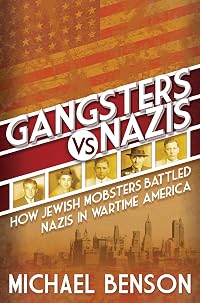
Gangsters vs. Nazis: How Jewish Mobsters Battled Nazis in WW2 Era America
by Michael Benson
On This Page
Description
The stunning true story of the rise of Nazism in depression-era America-and the fearless Jewish gangsters and crime families who joined forces to fight back . . . and fight hard. As Adolph Hitler rose to power in 1930s Germany, a growing wave of fascism began to take root on American soil. Nazi activists started to gather in major American cities, and by 1933, there were more than one-hundred anti-Semitic groups operating openly in the United States. Few Americans dared to speak out or fight show more back-until an organized resistance of notorious mobsters waged their own personal war against the Nazis in their midst. Gangland-style. . . . In this thrilling blow-by-blow account, acclaimed crime writer Michael Benson uncovers the shocking truth about the insidious rise of Nazism in America-and the Jewish mobsters who stomped it out. Learn about: * Nazi Town, USA: How one Long Island community named a street after Hitler, decorated buildings with swastikas, and set up a camp to teach US citizens how to goosestep. * Meyer Lansky and Murder Inc.: How a Jewish mob accountant led fifteen goons on a joint family mission to bust heads at a Brown Shirt rally in Manhattan. * Fritz Kuhn, "The Vest-Pocket Hitler": How a German immigrant spread Nazi propaganda through the American Bund in New York City-with 70 branches across the US. * Newark Nazis vs The Minutemen: How a Jewish resistance group, led by a prize fighter and bootlegger for the mob, waged war on the Bund in the streets of Newark. * Hitler in Hollywoodland: How Sunset Strip kingpin Mickey Cohen knocked two Brown Shirters' heads together-and became the West Coast champion in the mob's war on Nazis. Packed with surprising, little-known facts, graphic details, and unforgettable personalities, Gangsters vs. Nazis chronicles the mob's most ruthless tactics in taking down fascism-inspiring ordinary Americans to join them in their fight. The book culminates in one of the most infamous events of the pre-war era-the 1939 Nazi rally in Madison Square Garden-in which law-abiding citizens stood alongside hardened criminals to fight for the soul of a nation. This is the story of the mob that's rarely told-one of the most fascinating chapters in American history and American organized crime. show lessTags
Recommendations









Member Reviews
The book was not only informative, it was entertaining, which was a hard thing to accomplish when one considers the subject matter. Still, the author did just that. For me, the book was particularly engaging because I am Jewish, my dad was a contemporary of many of the gangsters and an immigrant from Russia, like so many of them. While we did not associate with them, we knew of them. We lived in Brooklyn, and I was familiar with the areas mentioned in the book. My uncles fought in the Golden Gloves. My aunt had Bugsy Siegel’s picture in her photo album. Abe Reles’ family lived within walking distance from my house, albeit with a change of last name. After reading this book, I learned that the lives of my family and the lives of the show more gangsters had many different dimensions. I didn’t know about the German organizations that had tried to spread Hitler’s Aryan supremacy in the United States. I had not heard of the German Bund in America or of the Silver Shirts, before reading this book. I didn’t realize the breadth of my father’s fear of the taint of Communism until after I read it. Also, at one time, I lived in Minnesota, near St. Louis Park. I learned that it was once a haven for Gentiles who didn’t want Jews in their neighborhood. Ironically, when I lived there, it was a haven for religious Jews and was called St. Jewish Park behind closed doors.
I have read extensively on anti-Semitism and the Holocaust and still never knew about this part of America’s history with mobsters fighting Nazis. I did not know that there were German-American organizations actively recruiting people to support Hitler’s National Socialism. I knew that Minnesota had a large pro- German, Nazi contingent, and anti-Semitism was alive and well there when I lived there too, but I did not know about the Nazi camps in the Catskills that taught children to hate. They inserted themselves in The Borscht Belt, the Jewish Haven, to recruit and convert them to Hitler’s demented plan.
The book gave me a whole different viewpoint about the idea of Jews going to the slaughter like lambs, during the Holocaust. These Jews fought back, albeit in America. In Germany, it was almost impossible to resist the mounting hate and anti-Semitic policies, but there was a strong Underground effort to stop Hitler. The mood of America, politically however, was anti-war, and the powers that be were also not always for the cause of Jews. In some ways, the current war in Ukraine is suffering from the same malaise in world opinion.
I grew up being ashamed of Murder Inc., not wanting to be associated with hoods in any way. After reading this book, I wish that most of them had not ended up so badly, because when they were called upon to defend against antisemitism, they did not shrink from the responsibility. As the reader gets to glimpse into their lives, they will discover that wherever they lived and “worked”, they were not cowardly thugs, but sometimes brave men willing to fight for their Jewish brethren when others would not or could not. In fact, no one is all bad or all good.
In America, incongruously, a judge, a rabbi, and a gangster made strange bedfellows, but they indeed slept together to fight hate. How they did it is the subject of this book, and it is a wild story that takes place, largely, over a short period of time. The author tells it with a sense of humor. He traces the history of these gangsters and he softens their edges, as he explains how they fought the influence of the Nazis in America, even when FDR did not. These were men who had been guilty of some pretty heinous crimes, but they rose to the occasion and performed heroically when called upon. Many of the names will be new to the reader, but some like Mickey Cohen, Meyer Lansky, Bugsy Siegel, Abe Reles, et al, will be on the tip of everyone’s tongues. Suffice it to say, these hoodlums and gang members knew how to be heroes as well as villains, and they worked well with their counterparts, who worked for law and order, in order to humiliate and stop the anti-Semitic effort of some wrongheaded Germans in the United States, Germans who were trying to awaken Hitler’s Aryan dream in America.
Judge Nathan Perlman, Rabbi Steven Wise and a gangster, Meyer Lansky, engineered a plan and worked together to fight Nazis. They worked tirelessly to organize the only people who could get away with the effort to defeat the pro-Hitler American-Germans who strutted in their uniforms and displayed their swastikas while shouting Heil Hitler. It is sad to think that there was so much support for Hitler in my own America, but happily, there was a group that could work under the radar to show them that Jews were not to be trifled with, by anyone, ever. show less
I have read extensively on anti-Semitism and the Holocaust and still never knew about this part of America’s history with mobsters fighting Nazis. I did not know that there were German-American organizations actively recruiting people to support Hitler’s National Socialism. I knew that Minnesota had a large pro- German, Nazi contingent, and anti-Semitism was alive and well there when I lived there too, but I did not know about the Nazi camps in the Catskills that taught children to hate. They inserted themselves in The Borscht Belt, the Jewish Haven, to recruit and convert them to Hitler’s demented plan.
The book gave me a whole different viewpoint about the idea of Jews going to the slaughter like lambs, during the Holocaust. These Jews fought back, albeit in America. In Germany, it was almost impossible to resist the mounting hate and anti-Semitic policies, but there was a strong Underground effort to stop Hitler. The mood of America, politically however, was anti-war, and the powers that be were also not always for the cause of Jews. In some ways, the current war in Ukraine is suffering from the same malaise in world opinion.
I grew up being ashamed of Murder Inc., not wanting to be associated with hoods in any way. After reading this book, I wish that most of them had not ended up so badly, because when they were called upon to defend against antisemitism, they did not shrink from the responsibility. As the reader gets to glimpse into their lives, they will discover that wherever they lived and “worked”, they were not cowardly thugs, but sometimes brave men willing to fight for their Jewish brethren when others would not or could not. In fact, no one is all bad or all good.
In America, incongruously, a judge, a rabbi, and a gangster made strange bedfellows, but they indeed slept together to fight hate. How they did it is the subject of this book, and it is a wild story that takes place, largely, over a short period of time. The author tells it with a sense of humor. He traces the history of these gangsters and he softens their edges, as he explains how they fought the influence of the Nazis in America, even when FDR did not. These were men who had been guilty of some pretty heinous crimes, but they rose to the occasion and performed heroically when called upon. Many of the names will be new to the reader, but some like Mickey Cohen, Meyer Lansky, Bugsy Siegel, Abe Reles, et al, will be on the tip of everyone’s tongues. Suffice it to say, these hoodlums and gang members knew how to be heroes as well as villains, and they worked well with their counterparts, who worked for law and order, in order to humiliate and stop the anti-Semitic effort of some wrongheaded Germans in the United States, Germans who were trying to awaken Hitler’s Aryan dream in America.
Judge Nathan Perlman, Rabbi Steven Wise and a gangster, Meyer Lansky, engineered a plan and worked together to fight Nazis. They worked tirelessly to organize the only people who could get away with the effort to defeat the pro-Hitler American-Germans who strutted in their uniforms and displayed their swastikas while shouting Heil Hitler. It is sad to think that there was so much support for Hitler in my own America, but happily, there was a group that could work under the radar to show them that Jews were not to be trifled with, by anyone, ever. show less
Gangsters vs. Nazis: How Jewish Mobsters Battled Nazis in Wartime America, by Michael Benson, is a fascinating and engaging account of the seldom discussed opposition to the spread of Nazism and virulent nationalism during the WWII era.
A decade ago I would have said that the type of hate-filled nationalism and antisemitism that was growing in the US during the 1930s was unthinkable any longer, but as 2016 showed, I would have been wrong. As Hitler and the Nazi regime spread across Europe, groups arose here that supported not just what was happening there but seeking something similar here. It took a somewhat unlikely group to stand up openly and aggressively against, the Jewish mobsters.
This book presents the facts of the events in a show more manner that at times reads like a novel. It is compelling both as history (and a cautionary tale for our time) and a narrative of that moment in history. A page turner, yes, but also information that should make us question many elements of life we take for granted. People who are still largely viewed as American heroes today, such as Ford and Lindbergh, were openly antisemitic and extremely isolationist. And they did not stand out as particularly extreme to many Americans, much like today's Qanon nutjobs.
I listened to the audiobook version and the narration was very good. Gabriel Vaughan provided enough drama in his voice to make the scenes come alive but without going so far that the more fact-giving sections became boring. The book, and the narration, flowed such that the context and the events blended seamlessly.
I would recommend this to those interested in 20th century US social and political history as well as those who simply enjoy well-written history of any type. I would also recommend to those who, like myself, have seen and understand that the past few years in the US has many parallels to 1930s Germany but forget that the parallels are also to 1930s US.
Reviewed from a copy made available by the publisher via NetGalley. show less
A decade ago I would have said that the type of hate-filled nationalism and antisemitism that was growing in the US during the 1930s was unthinkable any longer, but as 2016 showed, I would have been wrong. As Hitler and the Nazi regime spread across Europe, groups arose here that supported not just what was happening there but seeking something similar here. It took a somewhat unlikely group to stand up openly and aggressively against, the Jewish mobsters.
This book presents the facts of the events in a show more manner that at times reads like a novel. It is compelling both as history (and a cautionary tale for our time) and a narrative of that moment in history. A page turner, yes, but also information that should make us question many elements of life we take for granted. People who are still largely viewed as American heroes today, such as Ford and Lindbergh, were openly antisemitic and extremely isolationist. And they did not stand out as particularly extreme to many Americans, much like today's Qanon nutjobs.
I listened to the audiobook version and the narration was very good. Gabriel Vaughan provided enough drama in his voice to make the scenes come alive but without going so far that the more fact-giving sections became boring. The book, and the narration, flowed such that the context and the events blended seamlessly.
I would recommend this to those interested in 20th century US social and political history as well as those who simply enjoy well-written history of any type. I would also recommend to those who, like myself, have seen and understand that the past few years in the US has many parallels to 1930s Germany but forget that the parallels are also to 1930s US.
Reviewed from a copy made available by the publisher via NetGalley. show less
In the 1960s there was a sitcom called Hogan's Heroes, about the rollicking antics of allied prisoners in a German prisoner of war camp. No one ever escaped because they were having too good a time outwitting the dimwitted Germans. Now, Michael Benson has written Gangsters vs Nazis, the true story of American Jewish mobsters who delighted in beating up Nazis, disrupting their meetings, and unwittingly making those beatings safe for all Americans to join in. In just one year, 1938, they made it impossible to carry on and Nazism's attempt to convert Americans faded to nothing.
The book is a remarkably lighthearted, fast paced and a delight to read. It takes almost nothing seriously, including itself. It is full of gangster slang like show more slammer, long naps and popped, that would do justice to a George Raft or Humphrey Bogart gangster film. The seemingly endless list of characters (it's debatable to call them heroes) are all profiled in fascinating depth. It starts with their colorful nicknames, like Bugsy Siegel and Sparky Rubenstein, Tic Toc Tannenbaum, Ice Pick Willie Alderman, Longie Zillman and Blue Jaw Magoon. They ran a parallel mafia to the Italians and Sicilians, just as tough, just as vicious, just as colorful, just as skilled and just as successful. In fact, when needed, they worked together. It was respect, not competition.
Most were the sons of eastern European immigrants, often arriving in America as infants. They came in all shapes and sizes, but they were all tough survivors. Many became boxers, and indeed are in the boxing hall of fame. They tended to drift out of school and into the streets. They learned to hustle, eventually finding their way to a gym where their survival skills got enhanced, refined and disciplined. Their rap sheets could begin as early as age nine, for accepting and passing packages of illegal hooch to a customer for a dollar delivery fee.
In 1933, Hitler announced his plans for the USA: "We will undermine the morale of the people of America. Once there is confusion and after we have succeeded in undermining the faith of the American people in their own government, a new group will take over; this will be the German-American group, and we will help them assume power."
German organizations like the Bund, the Silver Shirts and camps for children started appearing all over the country. They celebrated Hitler, hated Jews and communists, and indoctrinated white Christians to Nazism. That they publicly denied this was their intention and got away with it is pathetic. That America offered them the opportunity to do so was extremely frustrating, especially to Jews. Krystallnacht took place in 1938, demonstrating to the whole world what Nazism was really all about.
Then one day, on his own initiative, a judge by the name of Nathan Perlman in New York , decided to do something about it. He called up the biggest Jewish gangster in town, Meyer Lansky, and asked him if he would like to bang some Nazi heads. Lansky positively jumped at the offer. The judge promised to try to protect any of the gangsters who might be arrested, but they were otherwise free to beat up any and all Nazis. There was one caveat - no killing. They could beat them up, but they couldn't kill them. This was initially a big disappointment everywhere it was proposed, but the boys got over it. After all, they weren't used used to beating people; they were all used to outright killing. In New York, they were known as Murder, Inc., if that helps.
So Lansky took his men to a gym, where they learned to beat people up, use their hands, have plans and tactics ready, and use brass knuckles, baseball bats and sawed off pool cues, along with lead pipes.
They infiltrated the Bund and found out where all the meetings would take place. They showed up, sat in the back, and when the speeches turned to Jews, they let loose. Benson describes the beatings like a Three Stooges comedy. People go flying, crumple, accordion, crash and moan. Blood everywhere. General panic and chaos.
This process got repeated all over the country. Every chapter of the book seems to have Perlman making a call to the lead Jewish gangster in town, followed by an enthusiastic response, training and severe beatings. The places range from Manhattan and Brooklyn to various venues in upstate New York, all over New Jersey, Minnesota, Chicago, and eventually California. It will be amazing for most readers to learn of the large Jewish populations of places like Newark, and how large, active and influential the Jewish gangsters were. And Minnesota? Yes, even Minnesota.
The Bund couldn't understand how the Jews always crashed their secret meetings. And prevented them from ever completing one. But soon they weren't even secret, and spectators started showing up. Then ordinary citizens started to join in. Police were torn between defending the Nazis and beating them themselves. So many of the cops had been bought off by the gangsters, they often did nothing to interfere.
The German Americans were always surprised. They were also usually well lubricated, making them worthless fighters. And they were of extremely low quality people, hardly magnificent specimens of the Aryan super race. In the ensuing years, a number of them were nailed for pedophilia, exposing themselves in public, hate crimes, rape, tax evasion and embezzlement. These were Hitler's finest hope for the future.
Their attendance became weaker and weaker as their meeting got reputations for severe thrashings. And when hauled into court, it was the Germans who got fined, while the gangsters went free.
The gangsters were proud of their work. They were doing their patriotic duty, something actually worthwhile, and not for the money. Some called themselves the Minutemen after the Revolutionary War heroes. Sometimes they donned American Legion caps that got strategically left behind. The lead gangsters kept their word to get them out of jail fast, pay for hospitalization and also give them free reign. The boys got creative, casing the meeting places, throwing stink bombs to drive everyone outside into their clutches, chasing away their buses so they had nowhere to run to, or rushing the front door and beating everyone right in the lobby.
Benson is great on color. He describes every venue, from its construction and layout to its location and even what is on that site today. The characters are all fabulously rich in color, in both their biographies and their actions. It all makes for a fast, entertaining read.
It was a very different era. Physical violence was tolerated to an unthinkable extent. It was permissible at work, in school, at home and on the street. Gangsters were an accepted factor of life. They were even important, supporting charities, making donations and sending gifts as they saw fit. To have enlisted them nationwide for a political cause is not just unprecedented and unique, it is astonishing. That a magistrate was the mastermind behind it all is beyond.
The epilogue follows all the characters to the ends of their lives. A large percentage of them seem to have ended up in electric chairs. Some enlisted and became war heroes. A number of them moved to Las Vegas, where they built, owned and operated the casino industry, but also continued their murderous ways. Some were the victims of their own kind, found in shallow graves here and there, or like Lansky, blasted to pieces while reading the paper on a couch.
A couple of them made other news. Boxer Sparky Rubenstein drifted, eventually ending up in Dallas, where he applied his long experience to paying off cops, lawyers and judges, so he could have unquestioned, easy access to all kinds of places. He needed a new identity, and changed his name to Jack Ruby. That's how he was able to shoot Lee Harvey Oswald right in front of everyone, rousing no suspicion whatsoever. He was still thinking of himself as a great patriot.
The adult daughter of Minnesota's Davey The Jew Berman, was murdered in her own home, seemingly by Robert Durst (one of several he was suspected of), who died before it could be proven in court.
This is a book for everyone, but particularly for anyone who wouldn't read history because it is dull and dry. Prepare to be taken on an extraordinary journey.
David Wineberg show less
The book is a remarkably lighthearted, fast paced and a delight to read. It takes almost nothing seriously, including itself. It is full of gangster slang like show more slammer, long naps and popped, that would do justice to a George Raft or Humphrey Bogart gangster film. The seemingly endless list of characters (it's debatable to call them heroes) are all profiled in fascinating depth. It starts with their colorful nicknames, like Bugsy Siegel and Sparky Rubenstein, Tic Toc Tannenbaum, Ice Pick Willie Alderman, Longie Zillman and Blue Jaw Magoon. They ran a parallel mafia to the Italians and Sicilians, just as tough, just as vicious, just as colorful, just as skilled and just as successful. In fact, when needed, they worked together. It was respect, not competition.
Most were the sons of eastern European immigrants, often arriving in America as infants. They came in all shapes and sizes, but they were all tough survivors. Many became boxers, and indeed are in the boxing hall of fame. They tended to drift out of school and into the streets. They learned to hustle, eventually finding their way to a gym where their survival skills got enhanced, refined and disciplined. Their rap sheets could begin as early as age nine, for accepting and passing packages of illegal hooch to a customer for a dollar delivery fee.
In 1933, Hitler announced his plans for the USA: "We will undermine the morale of the people of America. Once there is confusion and after we have succeeded in undermining the faith of the American people in their own government, a new group will take over; this will be the German-American group, and we will help them assume power."
German organizations like the Bund, the Silver Shirts and camps for children started appearing all over the country. They celebrated Hitler, hated Jews and communists, and indoctrinated white Christians to Nazism. That they publicly denied this was their intention and got away with it is pathetic. That America offered them the opportunity to do so was extremely frustrating, especially to Jews. Krystallnacht took place in 1938, demonstrating to the whole world what Nazism was really all about.
Then one day, on his own initiative, a judge by the name of Nathan Perlman in New York , decided to do something about it. He called up the biggest Jewish gangster in town, Meyer Lansky, and asked him if he would like to bang some Nazi heads. Lansky positively jumped at the offer. The judge promised to try to protect any of the gangsters who might be arrested, but they were otherwise free to beat up any and all Nazis. There was one caveat - no killing. They could beat them up, but they couldn't kill them. This was initially a big disappointment everywhere it was proposed, but the boys got over it. After all, they weren't used used to beating people; they were all used to outright killing. In New York, they were known as Murder, Inc., if that helps.
So Lansky took his men to a gym, where they learned to beat people up, use their hands, have plans and tactics ready, and use brass knuckles, baseball bats and sawed off pool cues, along with lead pipes.
They infiltrated the Bund and found out where all the meetings would take place. They showed up, sat in the back, and when the speeches turned to Jews, they let loose. Benson describes the beatings like a Three Stooges comedy. People go flying, crumple, accordion, crash and moan. Blood everywhere. General panic and chaos.
This process got repeated all over the country. Every chapter of the book seems to have Perlman making a call to the lead Jewish gangster in town, followed by an enthusiastic response, training and severe beatings. The places range from Manhattan and Brooklyn to various venues in upstate New York, all over New Jersey, Minnesota, Chicago, and eventually California. It will be amazing for most readers to learn of the large Jewish populations of places like Newark, and how large, active and influential the Jewish gangsters were. And Minnesota? Yes, even Minnesota.
The Bund couldn't understand how the Jews always crashed their secret meetings. And prevented them from ever completing one. But soon they weren't even secret, and spectators started showing up. Then ordinary citizens started to join in. Police were torn between defending the Nazis and beating them themselves. So many of the cops had been bought off by the gangsters, they often did nothing to interfere.
The German Americans were always surprised. They were also usually well lubricated, making them worthless fighters. And they were of extremely low quality people, hardly magnificent specimens of the Aryan super race. In the ensuing years, a number of them were nailed for pedophilia, exposing themselves in public, hate crimes, rape, tax evasion and embezzlement. These were Hitler's finest hope for the future.
Their attendance became weaker and weaker as their meeting got reputations for severe thrashings. And when hauled into court, it was the Germans who got fined, while the gangsters went free.
The gangsters were proud of their work. They were doing their patriotic duty, something actually worthwhile, and not for the money. Some called themselves the Minutemen after the Revolutionary War heroes. Sometimes they donned American Legion caps that got strategically left behind. The lead gangsters kept their word to get them out of jail fast, pay for hospitalization and also give them free reign. The boys got creative, casing the meeting places, throwing stink bombs to drive everyone outside into their clutches, chasing away their buses so they had nowhere to run to, or rushing the front door and beating everyone right in the lobby.
Benson is great on color. He describes every venue, from its construction and layout to its location and even what is on that site today. The characters are all fabulously rich in color, in both their biographies and their actions. It all makes for a fast, entertaining read.
It was a very different era. Physical violence was tolerated to an unthinkable extent. It was permissible at work, in school, at home and on the street. Gangsters were an accepted factor of life. They were even important, supporting charities, making donations and sending gifts as they saw fit. To have enlisted them nationwide for a political cause is not just unprecedented and unique, it is astonishing. That a magistrate was the mastermind behind it all is beyond.
The epilogue follows all the characters to the ends of their lives. A large percentage of them seem to have ended up in electric chairs. Some enlisted and became war heroes. A number of them moved to Las Vegas, where they built, owned and operated the casino industry, but also continued their murderous ways. Some were the victims of their own kind, found in shallow graves here and there, or like Lansky, blasted to pieces while reading the paper on a couch.
A couple of them made other news. Boxer Sparky Rubenstein drifted, eventually ending up in Dallas, where he applied his long experience to paying off cops, lawyers and judges, so he could have unquestioned, easy access to all kinds of places. He needed a new identity, and changed his name to Jack Ruby. That's how he was able to shoot Lee Harvey Oswald right in front of everyone, rousing no suspicion whatsoever. He was still thinking of himself as a great patriot.
The adult daughter of Minnesota's Davey The Jew Berman, was murdered in her own home, seemingly by Robert Durst (one of several he was suspected of), who died before it could be proven in court.
This is a book for everyone, but particularly for anyone who wouldn't read history because it is dull and dry. Prepare to be taken on an extraordinary journey.
David Wineberg show less
Most know of the German-American Bund aka the American Nazis, but most won’t know of the resistance to them, Jewish mobsters. This isn’t an academic look, more of a Winchell style look. The author does not hold back on his own feelings towards anybody, but also doesn’t glorify the gangsters, showing meeting rather violent ends later on.
Free review copy.
Free review copy.
It's 1938 and fascism is on the march. In Europe, Hitler is poised to take Poland and France, launching the Second World War. In America, a variety of fifth columnist groups think that this is a swell idea, and America should let it happen, and then get rid of their own Jews. The justice system, limited by the First Amendment and widespread antisemitism, isn't going to do much. But one man has an idea. Judge Nathan Perlman makes a call to Meyer Lansky, offering a deal. Lansky and his buddies get to bust heads, Perlman will handle the legal issues as long as no one gets killed.
Welcome to Anti-Fascist Action, gangland style.
Always Be Punching Nazis.
The only linkable gif I can find has the Nazi exploding sonic style
Gangsters vs Nazis is a show more pulpy as hell take on true events. Meyer Lansky, one of the key figures in American organized crime, gathered up his favorite enforcers from Murder Inc and started hitting meetings of the German-American Bund. Lesser Jewish gangsters did much the same in Chicago, Cleveland, Milwaukee, Newark, and Los Angeles. Though the Nazis often had the numbers, their cadres of weekend warriors were no match for the hardened thugs, goons, and boxers that the gangsters could call upon. In a few years, it became clear that being an American Nazi was a painful business, and the dreaded fifth column came to nothing after Pearl Harbor.
The history is fascinating enough, and this book shines in cameo portraits of its various figures. But Benson badly over-eggs his story, inventing camera movements and treating this like a screenplay rather than a book. And while Nazis badly need a fist to the face, the gangsters are portrayed uncritically as heroes, when they were also murderers and thugs.
If I were to read one book on the subject, it'd be Hitler in Los Angeles, which is a more interesting take, though one with less punching. show less
Welcome to Anti-Fascist Action, gangland style.
Always Be Punching Nazis.
The only linkable gif I can find has the Nazi exploding sonic style
Gangsters vs Nazis is a show more pulpy as hell take on true events. Meyer Lansky, one of the key figures in American organized crime, gathered up his favorite enforcers from Murder Inc and started hitting meetings of the German-American Bund. Lesser Jewish gangsters did much the same in Chicago, Cleveland, Milwaukee, Newark, and Los Angeles. Though the Nazis often had the numbers, their cadres of weekend warriors were no match for the hardened thugs, goons, and boxers that the gangsters could call upon. In a few years, it became clear that being an American Nazi was a painful business, and the dreaded fifth column came to nothing after Pearl Harbor.
The history is fascinating enough, and this book shines in cameo portraits of its various figures. But Benson badly over-eggs his story, inventing camera movements and treating this like a screenplay rather than a book. And while Nazis badly need a fist to the face, the gangsters are portrayed uncritically as heroes, when they were also murderers and thugs.
If I were to read one book on the subject, it'd be Hitler in Los Angeles, which is a more interesting take, though one with less punching. show less
This is a nice idea, but there just weren't enough gangsters vs. Nazis to go around, so rather than have a 150-page book, Benson pads out every story with a lot of background, sometimes going pretty far afield. It is never uninteresting, but it is written in such an emphatic style, trying to make the most of a rather thin story, that it becomes almost pathetic after a while. Yes, there were lots of Jews who stood up against Nazis in the United States, but every fight scene in the book reads pretty much the same. And despite their heroic actions, those in the highest echelons of the US Government, such as President Franklin Delano Roosevelt, did next to nothing to help the Jews. (But none of that figure into this book. It is supposed to show more be a feel-good story!) show less
WW2, 1930s, 1940s, gangsters, the-mob, espionage, fascists, historical-figures, historical-places-events, historical-research, historical-setting, history-and-culture*****
This is the way that nonfiction history OUGHT to be presented!
Certainly, there is some salty language, violence, attitudes no longer acceptable (some never should have been but were), and some VERY unpleasant truths. But all in all, it is a terrific read!
The intro ties it all with some attitudes of today by telling us that in Captain America Comics #1 which hit the newsstands a full year before the bombing of Pearl Harbor when so much of the US was still in denial about the vile things happening in Europe, and The Captain showed what needed to be done and threw the show more first punch (but not the last).
From there on, the lesser-known history of the happenings in the US is presented clearly and bluntly but with wit and attitude. The publisher's blurb does a good job of getting readers interested, but you have to read the book to really appreciate it all. Great read!
I requested and received a free e-book copy from Kensington Books/Citadel via NetGalley. Thank you! show less
This is the way that nonfiction history OUGHT to be presented!
Certainly, there is some salty language, violence, attitudes no longer acceptable (some never should have been but were), and some VERY unpleasant truths. But all in all, it is a terrific read!
The intro ties it all with some attitudes of today by telling us that in Captain America Comics #1 which hit the newsstands a full year before the bombing of Pearl Harbor when so much of the US was still in denial about the vile things happening in Europe, and The Captain showed what needed to be done and threw the show more first punch (but not the last).
From there on, the lesser-known history of the happenings in the US is presented clearly and bluntly but with wit and attitude. The publisher's blurb does a good job of getting readers interested, but you have to read the book to really appreciate it all. Great read!
I requested and received a free e-book copy from Kensington Books/Citadel via NetGalley. Thank you! show less
Members
- Recently Added By
Author Information
58+ Works 987 Members
Michael Benson has written on music, sports, crime, film, the military, and politics for a range of national publications. He is the author of Why the Grateful Dead Matter and of numerous books of true crime, including The Devil at Genesee junction and Evil Season. He lives in Brooklyn.
Awards and Honors
Awards
Common Knowledge
- Epigraph
- So we raided the joint. We went over there and grabbed everything in sight, all their bullshit signs, and smacked the shit out of them, broke them up the best we could. Nobody could pay me for this work. It was my patriotic d... (show all)uty. -Mickey Cohen, 1938
- Dedication
- For Keith Brenner
- First words
- I've been a comic-book fan since the days when they cost only twelve cents apiece, which would be the mid-sixties.
- Canonical DDC/MDS
- 973.0431
- Canonical LCC
- E184.G3
Classifications
Statistics
- Members
- 182
- Popularity
- 179,869
- Reviews
- 14
- Rating
- (3.70)
- Languages
- English
- Media
- Paper, Audiobook, Ebook
- ISBNs
- 4
- ASINs
- 2