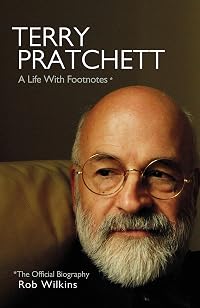
Terry Pratchett: A Life With Footnotes: The Official Biography
by Rob Wilkins
On This Page
Description
"'People think that stories are shaped by people. In fact, it's the other way around.' Terry Pratchett, creator of the phenomenally bestselling Discworld series, knight of the realm, and holder of more honorary doctorates than he knew what to do with, was known and loved around the world for his wildly popular books, his brilliant satirical humour and for the humanity of his campaign work. But that's only part of the picture. At the time of his death in 2015, he was working on his finest show more story yet - his own. The story of a boy who was told by his headteacher aged six that he would never amount to anything, and spent the rest of his life proving him wrong. Who walked out on his A levels to become a journalist, encountering some very dead bodies and the idea for his first novel before he reached twenty. Who celebrated his knighthood by smelting himself a sword, and who, on being awarded the prestigious Carnegie Medal, switched it during the prizegiving for a chocolate replica and proceeded to eat it in front of an audience of horrified librarians. Tragically, Terry ran out of time to complete the memoir he so desperately wanted to write. But now, in the only authorised biography of one of our best known and best loved writers, his manager and friend Rob Wilkins picks up where Terry left off, and with the help of friends, family and Terry's own unpublished work, tells the full story of an extraordinary life"--Publisher's description. show lessTags
Recommendations






Member Reviews
Biographies, especially biographies of people who had already died, are one of those genres where you know how the story ends - so it is all about the path to that end. But knowing how it ends and reading about it turned out to be very different things when you care about the subject.
One day in the last days of the 20th century, a friend convinced me to read two series - Zelazny's Amber books and the first 4 books of the Watch subseries of Discworld. My relationship with fantasy up to this point had been mostly indifferent - I loved science fiction but most of the fantasy I had seen had been either the never ending tales of someone going on a quest (I bounced really hard out from The Lord of the Rings at one point - it was much later show more than I saw more in it than the tale of the trip) or the swords and magic part of the genre (think Conan for example). But I suffered of lack of funds and I had read all the science fiction we had at hand so... fantasy it was. Amber made me raise my brow - I was not as enamored with it as she was but I did not dislike it. [Guards! Guards!] on the other hand had me within 5 pages - and it still had not given up its enchantment on me. At the time I liked mostly dead authors (with some exceptions) or authors' older series (and unlike these days, most of these series did not suddenly get a new book 30 years later...) so liking an author who is not only alive but also still writes books in the series was... fascinating.
That's how my personal story with Sir Terry began and most of the people who liked his stories will have their own. His illness and then his death were one of my first experiences with an author I had started following and reading dying after a protracted illness. So reading his biography was almost inevitable - and it is a perfect way to say goodbye and thanks for all the stories.
Rob Wilkins started as a personal assistant and slowly turned into a lot more. So him telling this story, the one that Sir Terry did not manage to tell himself, is somehow fitting. He mixes what he had seen with what he had been told with the parts of the autobiography that Pratchett managed to write to create the portrait of a human - who turned out to have the gift of storytelling.
But it was not always that obvious - he hated reading (until he did not), he published his first story extremely young (and then took a very long time to actually get to writing the books we know him by). He had a normal job (for some value of normal), he had a family and he had bees. But somewhere in all of that normal life, there were the stories to be told and they started coming. Slowly at first and then much much faster.
I expected that the parts I will enjoy the most in this biography will be the parts about the books but it is the human behind the stories that stole the show. The grief and loss are palpable in the text - the book is nostalgic and heartfelt but also funny - in ways I did not expect. Rib Wilkins spent enough time with Pratchett and transcribed and sorted out enough of the books to catch something of Terry's wit (or maybe he always had it and the relationship made it more pronounced). When the inevitable happened and the diagnosis finally showed up in the book, I wanted to stop reading - it was like losing a friend. And yet, it is part of the story.
A life ending too early is always a tragedy. Rob Wilkins had done a wonderful job in showing us sides of the man we may have not known about. If you are looking for scandals, read something else - not because the life was blameless but because a good man's scandals are never going to be very interesting to people. And Terry Pratchett was a good man (maybe cranky, maybe not always reasonable but a good man). show less
One day in the last days of the 20th century, a friend convinced me to read two series - Zelazny's Amber books and the first 4 books of the Watch subseries of Discworld. My relationship with fantasy up to this point had been mostly indifferent - I loved science fiction but most of the fantasy I had seen had been either the never ending tales of someone going on a quest (I bounced really hard out from The Lord of the Rings at one point - it was much later show more than I saw more in it than the tale of the trip) or the swords and magic part of the genre (think Conan for example). But I suffered of lack of funds and I had read all the science fiction we had at hand so... fantasy it was. Amber made me raise my brow - I was not as enamored with it as she was but I did not dislike it. [Guards! Guards!] on the other hand had me within 5 pages - and it still had not given up its enchantment on me. At the time I liked mostly dead authors (with some exceptions) or authors' older series (and unlike these days, most of these series did not suddenly get a new book 30 years later...) so liking an author who is not only alive but also still writes books in the series was... fascinating.
That's how my personal story with Sir Terry began and most of the people who liked his stories will have their own. His illness and then his death were one of my first experiences with an author I had started following and reading dying after a protracted illness. So reading his biography was almost inevitable - and it is a perfect way to say goodbye and thanks for all the stories.
Rob Wilkins started as a personal assistant and slowly turned into a lot more. So him telling this story, the one that Sir Terry did not manage to tell himself, is somehow fitting. He mixes what he had seen with what he had been told with the parts of the autobiography that Pratchett managed to write to create the portrait of a human - who turned out to have the gift of storytelling.
But it was not always that obvious - he hated reading (until he did not), he published his first story extremely young (and then took a very long time to actually get to writing the books we know him by). He had a normal job (for some value of normal), he had a family and he had bees. But somewhere in all of that normal life, there were the stories to be told and they started coming. Slowly at first and then much much faster.
I expected that the parts I will enjoy the most in this biography will be the parts about the books but it is the human behind the stories that stole the show. The grief and loss are palpable in the text - the book is nostalgic and heartfelt but also funny - in ways I did not expect. Rib Wilkins spent enough time with Pratchett and transcribed and sorted out enough of the books to catch something of Terry's wit (or maybe he always had it and the relationship made it more pronounced). When the inevitable happened and the diagnosis finally showed up in the book, I wanted to stop reading - it was like losing a friend. And yet, it is part of the story.
A life ending too early is always a tragedy. Rob Wilkins had done a wonderful job in showing us sides of the man we may have not known about. If you are looking for scandals, read something else - not because the life was blameless but because a good man's scandals are never going to be very interesting to people. And Terry Pratchett was a good man (maybe cranky, maybe not always reasonable but a good man). show less
The official biography of Terry Pratchett, written by his longtime assistant, Rob Wilkins. It's more detailed and interesting in some areas than others, as it talks very little about Pratchett's family life, for instance, perhaps out of privacy concerns (which, if that's the case, fair enough). The things it does cover are worth knowing about, though. It's intriguing, for example, to think about Pratchett's early career in journalism and how the things he saw and experienced in that job might have later informed his novels. But by and large I'd say the most interesting parts of the book are Wilkins' personal recollections of his work with Sir Terry. He's clearly trying to paint a realistic and honest portrait of his friend, including show more both his irascible, snarky temper and his capacity for childlike delight. And, of course, the genius of his imagination and his writing talent, but anyone who's reading this biography probably already knows about and appreciates those things, and Wilkins -- who clearly knew and appreciated them long before he ever met the man -- treats them largely as the given that they are. And while he does talk about the writing of various of Pratchett's books, there's not a lot of analysis or discussion of them. There are, I am sure, other books for that.
The ending, of course, is utterly heartbreaking, as Wilkins describes Pratchett's diagnosis with a rare form of early-onset Alzheimer's and his subsequent physical and cognitive deterioration. One thing I hadn't known is that, after his diagnosis and some years before his death, Pratchett decided to write his own autobiography. He apparently didn't get past 1979, and what he did write wasn't remotely in a shape suitable for publication, but Wilkins quotes a number of lines from it in the earlier chapters, and, man. I thought I was already as sad and angry as it was possible to be about all the Pratchett books we might have gotten but didn't, and here I've found a whole new one to be sad and angry about, because even those brief quotes are great, and I would have loved to hear this whole life story in Pratchett's own words.
In the absence of that, though, I'm glad we do at least have this. I don't think it's absolutely essential that fans of Pratchett's read it or anything, because his work is what it is whether you know anything about his life or not, and Pratchett was someone who already put himself out there a lot for his fans, anyway. But for those who are interested, it's a worthwhile read and not a bad tribute. Just have a box of tissues handy for the final chapter.
And, because I couldn't possibly finish writing this without adding the traditional memorial: GNU Terry Pratchett. show less
The ending, of course, is utterly heartbreaking, as Wilkins describes Pratchett's diagnosis with a rare form of early-onset Alzheimer's and his subsequent physical and cognitive deterioration. One thing I hadn't known is that, after his diagnosis and some years before his death, Pratchett decided to write his own autobiography. He apparently didn't get past 1979, and what he did write wasn't remotely in a shape suitable for publication, but Wilkins quotes a number of lines from it in the earlier chapters, and, man. I thought I was already as sad and angry as it was possible to be about all the Pratchett books we might have gotten but didn't, and here I've found a whole new one to be sad and angry about, because even those brief quotes are great, and I would have loved to hear this whole life story in Pratchett's own words.
In the absence of that, though, I'm glad we do at least have this. I don't think it's absolutely essential that fans of Pratchett's read it or anything, because his work is what it is whether you know anything about his life or not, and Pratchett was someone who already put himself out there a lot for his fans, anyway. But for those who are interested, it's a worthwhile read and not a bad tribute. Just have a box of tissues handy for the final chapter.
And, because I couldn't possibly finish writing this without adding the traditional memorial: GNU Terry Pratchett. show less
Took me a while to start reading this (published in 2022), mostly because this book, of all the books around Terry Pratchett, will mean knowing something personal about the man behind the genius. Written by Terry's long-time assistant, and very good friend, Rob Wilkins, this is an emotional (inspiring / hilarious and frequently brutally honest) walk through exactly that. At the heart of the writing genius was a gloriously grumpy, irascible, kind and funny human being, with a capacity for vision and thought that was utterly astounding.
Wilkins came into Terry's life as a result of a very fun episode in which a bad case of staff envy overtook Terry on hearing novelist Jilly Cooper talk about her invaluable PA. Of course that could simply show more be Terry's way of justifying a deep seated understanding that the day to day wasn't his strong point - and how could it be with a proto-book on the page in front of him and goodness knows how many brewing quietly in the back of his mind. Aside from the day to day reality of dealing with "the author" Wilkins became a firm friend, almost a family member in some ways - dealing with the complications of the day to day, as well as life on the road before, and sadly after, Terry's increasing impairment due to the early and rare form of Alzheimer's he was dealing with.
To read about life in the day to day job of "the author" was fascinating, but to read about it as he gradually lost capacity such an emotional journey - Terry was a perfectionist, and a deep and creative thinker, who was gradually and inexorably losing all of that - his ability to think remained until the final book, but his ability to transcribe was lost. The idea that he managed to hold onto the complex Discworld and Chalk environments as he described the stories to Wilkins was heart-breaking. I can't imagine what it was like for Wilkins, and Terry's family as they stood by, unable to do anything but support, never able to stop the progress. In particular, the scene described as Neil Gaiman arrived to visit his dear friend one final time took me quite some time to read - the kindness, the gentleness of approach, the sense of profound sorrow and loss, and the sheer awfulness of a disease that takes the core of someone and leaves the shell behind was moving, beautiful and utterly devastating all at the same time.
Wilkins did an outstanding job with this biography (including footnotes which made me smile a lot). It can't have been easy to write, every moment a reminder of what those close to Terry lost. What we have all lost. Of course, there are always the books which are wonderful to read and re-read over and over again, the thought that there were other entries percolating in his mind, before he lost the ability to write them, and before he lost his life, well, it's sad. The thought that his presence has now gone from his family and friends way too early is awful.
This book definitely serves as a reminder that his name must continue to be spoken.
GNU Sir Terry Pratchett.
https://www.austcrimefiction.org/review/terry-pratchett-life-footnotes show less
Wilkins came into Terry's life as a result of a very fun episode in which a bad case of staff envy overtook Terry on hearing novelist Jilly Cooper talk about her invaluable PA. Of course that could simply show more be Terry's way of justifying a deep seated understanding that the day to day wasn't his strong point - and how could it be with a proto-book on the page in front of him and goodness knows how many brewing quietly in the back of his mind. Aside from the day to day reality of dealing with "the author" Wilkins became a firm friend, almost a family member in some ways - dealing with the complications of the day to day, as well as life on the road before, and sadly after, Terry's increasing impairment due to the early and rare form of Alzheimer's he was dealing with.
To read about life in the day to day job of "the author" was fascinating, but to read about it as he gradually lost capacity such an emotional journey - Terry was a perfectionist, and a deep and creative thinker, who was gradually and inexorably losing all of that - his ability to think remained until the final book, but his ability to transcribe was lost. The idea that he managed to hold onto the complex Discworld and Chalk environments as he described the stories to Wilkins was heart-breaking. I can't imagine what it was like for Wilkins, and Terry's family as they stood by, unable to do anything but support, never able to stop the progress. In particular, the scene described as Neil Gaiman arrived to visit his dear friend one final time took me quite some time to read - the kindness, the gentleness of approach, the sense of profound sorrow and loss, and the sheer awfulness of a disease that takes the core of someone and leaves the shell behind was moving, beautiful and utterly devastating all at the same time.
Wilkins did an outstanding job with this biography (including footnotes which made me smile a lot). It can't have been easy to write, every moment a reminder of what those close to Terry lost. What we have all lost. Of course, there are always the books which are wonderful to read and re-read over and over again, the thought that there were other entries percolating in his mind, before he lost the ability to write them, and before he lost his life, well, it's sad. The thought that his presence has now gone from his family and friends way too early is awful.
This book definitely serves as a reminder that his name must continue to be spoken.
GNU Sir Terry Pratchett.
https://www.austcrimefiction.org/review/terry-pratchett-life-footnotes show less
A touching biography of Terry Pratchett written by his personal assistant (and later, his amanuensis). When he received his diagnosis of early onset Alzheimer's, Pratchett started making notes for an autobiography, and about the first half of the book draws heavily on those.
In the space of some 45 books, Terry Pratchett went from witty pastiches of heroic fantasy stories to deep (but still witty) examinations of the human condition. He made his first professional sale at the age of 15 (a short story called The Hades Business) to John Carnell for the magazine Science Fantasy, where his name appeared next to people like Michael Moorcock and Mervyn Peake. He left school at the age of 17 with no higher qualifications and went into show more journalism, starting on his local paper as the archetypal cub reporter. He had the luck to meet his first publisher, Colin Smythe, through his journalism work, and sold his first novel, The Carpet People, at the age of 23. He eventually moved to the Central Electricity Generating Board (CEGB) as a press officer for the south-west at the age of 32, three years before he sold the first Discworld novel, The Colour of Magic. Seven years later, on the back of astronomical sales, he took up writing full-time. In his lifetime, he sold over 100 million books and was knighted for Services to Literature in 2003, though he maintained that his greatest service to literature was “to avoid writing any”.
Rob Wilkins has drawn this account of Terry Pratchett's life from a close working relationship. It doesn't hold back from pointing out that Terry Pratchett wasn't necessarily the benign elf that he was sometimes depicted as. Certainly, the one time I spoke to him, I received moderately short shrift, and that was before he achieved megastardom status; but he was far from the worst offender in the "spiky author" stakes. Even then, in the late 1980s/early 1990s when he was still doing science fiction conventions, his reputation was such that he must have had countless people buttonholing him, and as this book shows, he did not suffer fools gladly. At times, this book does come over as more like Pratchett than Pratchett himself, but that's no bad thing. show less
In the space of some 45 books, Terry Pratchett went from witty pastiches of heroic fantasy stories to deep (but still witty) examinations of the human condition. He made his first professional sale at the age of 15 (a short story called The Hades Business) to John Carnell for the magazine Science Fantasy, where his name appeared next to people like Michael Moorcock and Mervyn Peake. He left school at the age of 17 with no higher qualifications and went into show more journalism, starting on his local paper as the archetypal cub reporter. He had the luck to meet his first publisher, Colin Smythe, through his journalism work, and sold his first novel, The Carpet People, at the age of 23. He eventually moved to the Central Electricity Generating Board (CEGB) as a press officer for the south-west at the age of 32, three years before he sold the first Discworld novel, The Colour of Magic. Seven years later, on the back of astronomical sales, he took up writing full-time. In his lifetime, he sold over 100 million books and was knighted for Services to Literature in 2003, though he maintained that his greatest service to literature was “to avoid writing any”.
Rob Wilkins has drawn this account of Terry Pratchett's life from a close working relationship. It doesn't hold back from pointing out that Terry Pratchett wasn't necessarily the benign elf that he was sometimes depicted as. Certainly, the one time I spoke to him, I received moderately short shrift, and that was before he achieved megastardom status; but he was far from the worst offender in the "spiky author" stakes. Even then, in the late 1980s/early 1990s when he was still doing science fiction conventions, his reputation was such that he must have had countless people buttonholing him, and as this book shows, he did not suffer fools gladly. At times, this book does come over as more like Pratchett than Pratchett himself, but that's no bad thing. show less
This is a biography of the Discworld author by his longtime assistant, based on notes Pratchett made toward an autobiography that he never got around to writing. Lots of good details on Pratchett's youth and early career especially; I liked hearing about his working as a journalist and as a press officer for a nuclear power plant in particular. There's also great but devastating insight into his later years, as the cognitive decline of Alzheimer's began to take hold. I did think that at times Wilkins is (for perhaps natural reasons) a bit too into Pratchett's finances and contracts, and I felt like Pratchett's wife totally disappeared from the book, but if you're even a mild Pratchett fan (which is where I would categorize myself) show more there's a lot to get out of this book. This is a strong work about a key figure in the sf&f field. (Abigail Nussbaum has a very good negative review of the book that I largely agree with... but I still think it's a very good book!) show less
For more reviews and bookish posts please visit: https://www.ManOfLaBook.com
Terry Pratchett: A Life with Footnotes by Rob Wilkins is the famous author’s official biography. Mr. Wilkins was Pratchett’s personal assistant and friend for almost two decades.
If I ever have a biography written about me (a fat chance), I’d like it to be like this one. Terry Pratchett: A Life with Footnotes by Rob Wilkins celebrates the life of, well, Terry Pratchett with joy, gusto and charm letting the readers know the author with all his idiosyncrasies, and wit, filled with humorous footnotes as promised by the title.
Both Mr. Pratchett and Mr. Wilkins admit that some of the stories fall into the category of “Too Good To Check” (TGTC), however as a show more good biographer, the author lets the readers know which ones they are. I tremendously enjoyed this aspect of the book and reminded me of the line “When the legend becomes the fact, print the legend” from John Ford’s classic 1962 western The Man Who Shot Liberty Valance.
As someone working closely with Mr. Pratchett, the author witnessed the tragedy, as well as lightheartedness, of working with a declining beloved person. In the first half of the book, the author relishes the enviable unofficial, or maybe official, role of “keeper of anecdotes”. These heartwarming, and funny stories, told by someone who knew Pratchett most intimately, are interwoven with the fantastic work ethic and output of Discworld books.
Slowly, however, we witness Mr. Pratchett’s decline into dementia which is as difficult as one can imagine, as someone who was a witness to such great sadness. I remember the stories Neil Gaiman told during an evening in Philadelphia, about Mr. Pratchett’s disease, causing him not to see things in front of him, where he would spend a day just looking for a letter on the keyboard.
Sad, indeed, but one can also see the humor.
Whether you are a Pratchett fan or not, this is an immensely enjoyable and intimate book. Told with graciousness, humanity, and humor, this book, I’m sure, would make Mr. Pratchett proud. show less
Terry Pratchett: A Life with Footnotes by Rob Wilkins is the famous author’s official biography. Mr. Wilkins was Pratchett’s personal assistant and friend for almost two decades.
If I ever have a biography written about me (a fat chance), I’d like it to be like this one. Terry Pratchett: A Life with Footnotes by Rob Wilkins celebrates the life of, well, Terry Pratchett with joy, gusto and charm letting the readers know the author with all his idiosyncrasies, and wit, filled with humorous footnotes as promised by the title.
Both Mr. Pratchett and Mr. Wilkins admit that some of the stories fall into the category of “Too Good To Check” (TGTC), however as a show more good biographer, the author lets the readers know which ones they are. I tremendously enjoyed this aspect of the book and reminded me of the line “When the legend becomes the fact, print the legend” from John Ford’s classic 1962 western The Man Who Shot Liberty Valance.
As someone working closely with Mr. Pratchett, the author witnessed the tragedy, as well as lightheartedness, of working with a declining beloved person. In the first half of the book, the author relishes the enviable unofficial, or maybe official, role of “keeper of anecdotes”. These heartwarming, and funny stories, told by someone who knew Pratchett most intimately, are interwoven with the fantastic work ethic and output of Discworld books.
Slowly, however, we witness Mr. Pratchett’s decline into dementia which is as difficult as one can imagine, as someone who was a witness to such great sadness. I remember the stories Neil Gaiman told during an evening in Philadelphia, about Mr. Pratchett’s disease, causing him not to see things in front of him, where he would spend a day just looking for a letter on the keyboard.
Sad, indeed, but one can also see the humor.
Whether you are a Pratchett fan or not, this is an immensely enjoyable and intimate book. Told with graciousness, humanity, and humor, this book, I’m sure, would make Mr. Pratchett proud. show less
Rob Wilkins was hired as a personal assistant to Terry Pratchett in 2000. In later years, he became the author’s business manager and caregiver. He is now Pratchett’s authorized biographer and the executor of his literary estate. Wilkins’s biography, Terry Pratchett: A Life with Footnotes, will be an essential tool for any future study of Pratchett and his work.
Wilkins gives us a sharp picture of the way Pratchett worked day to day and a good sense of the irascible energy and submerged anger that underlays his humor. Wilkins says that no matter how much money he made, Pratchett never abandoned his working-class sensibility. He was grateful to his father for teaching him the value of engineering, and he was aware that his mother show more always worried that he didn’t have “a real job.” In fact, he got a late start as a full-time novelist, working as a journalist and public relations officer until the success of Equal Rites when he was 39. He was always a little worried the money wouldn’t last. He often refused offers of large advances he thought his books might not cover. He did not need to worry. Pratchett enjoyed his success, but it never changed his essential character.
His fight against early-onset Alzheimer’s deserves our respect, and Wilkin’s description of his last years brought more than one tear to my eyes.
I was disappointed that Wilkins does not tell us much about Pratchett’s relationship with his daughter, Rhianna, who has a successful career as a journalist and is an author of video games.
Finally, this is not a literary biography. Wilkins is still worried about costing Pratchett a reader by giving away plot details. show less
Wilkins gives us a sharp picture of the way Pratchett worked day to day and a good sense of the irascible energy and submerged anger that underlays his humor. Wilkins says that no matter how much money he made, Pratchett never abandoned his working-class sensibility. He was grateful to his father for teaching him the value of engineering, and he was aware that his mother show more always worried that he didn’t have “a real job.” In fact, he got a late start as a full-time novelist, working as a journalist and public relations officer until the success of Equal Rites when he was 39. He was always a little worried the money wouldn’t last. He often refused offers of large advances he thought his books might not cover. He did not need to worry. Pratchett enjoyed his success, but it never changed his essential character.
His fight against early-onset Alzheimer’s deserves our respect, and Wilkin’s description of his last years brought more than one tear to my eyes.
I was disappointed that Wilkins does not tell us much about Pratchett’s relationship with his daughter, Rhianna, who has a successful career as a journalist and is an author of video games.
Finally, this is not a literary biography. Wilkins is still worried about costing Pratchett a reader by giving away plot details. show less
Members
- Recently Added By
Lists

Best Biographies, Autobiographies and Memoirs
465 works; 160 members

Top Five Books of 2022
736 works; 272 members

Books Read in 2022
5,226 works; 115 members

DWI Members Recommendations
25 works; 1 member

Books Read in 2023
5,638 works; 147 members

2023 Hugo Awards -- Eligible Works -- Related Works
12 works; 3 members

Top Five Books of 2023
767 works; 317 members

Books Read in 2024
4,727 works; 128 members
Talk Discussions
Past Discussions
Official biography of Terry Pratchett in All Things Discworldian - The Guild of Pratchett Fans (February 2024)
Author Information

3+ Works 544 Members
Awards and Honors
Awards
Distinctions
Observer Book of the Week (2022-09-25)
Common Knowledge
- Original publication date
- 2022-09-28
- People/Characters
- Terry Pratchett
- Important places
- Beaconsfield, Buckinghamshire, England, UK
- First words
- Five months before he died, Terry Pratchett wrote five letters, sealed them in enveloped and locked them in the safe in his office to be opened after his death. (Introduction)
It was never just imagining things. (Chapter 1) - Last words
- (Click to show. Warning: May contain spoilers.)"OK," I said, "...go." (Final chapter)
(Click to show. Warning: May contain spoilers.)No call as yet. (Epilogue) - Original language
- English
Classifications
Statistics
- Members
- 551
- Popularity
- 53,932
- Reviews
- 20
- Rating
- (4.39)
- Languages
- 6 — Catalan, Czech, English, Estonian, Polish, Spanish
- Media
- Paper, Audiobook, Ebook
- ISBNs
- 14
- ASINs
- 5