On This Page
Description
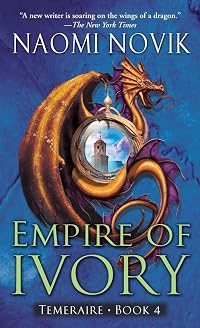
Tragedy has struck His Majesty's Aerial Corps, as an epidemic of unknown origin and no known cure is decimating the dragons' ranks. Only Temeraire and a pack of newly recruited dragons remain uninfected and must stand as the only means of airborne defense against France's ever bolder sorties. As Bonaparte's dragons harrow Britain's ships, Temeraire and his captain, Will Laurence, take wing to Africa in search of a cure for the deadly contagion.Tags
Recommendations














Member Reviews
Empire of Ivory begins right after the conclusion of Black Powder War, with Temeraire and his crew making it back to Britain and finding out why Britain's dragons did not come to the aid of Europe as Napoleon's forces overran the continent: a deadly sickness has spread among the dragons, incapacitating most of them.
Without giving too much away, it turns out that Temeraire is immune to the sickness, probably as a result of something that happened to him in Africa on his long sea voyage from Britain to China in Throne of Jade. Thus, reluctantly, Will Laurence, Temeraire, and a group of sick dragons must set out for Cape Town to see if they can recover and reproduce whatever it was that made Temeraire immune.
Unfortunately, though there are show more lots of good moments of characterization and worldbuilding throughout the book, what results was to my mind the dullest of the Temeraire books thus far. I had a grad school professor who use to talk about the "paradox of tedium": how did you communicate the tediousness of work in your novel without the book itself becoming tedious? But if you didn't make the book itself tedious, then you failed to capture the emotional experience your book was supposedly about. I don't know if that quite applies to Empire of Ivory, but too much of the book is spent in a state of stasis, waiting to see if something works again and again and again, without much to pull the reader along. We do eventually get some more interest and complexity, and the book ends up delving into the role of dragons in (an) African society. There's some good stuff here, though the book doesn't go into as much depth as Throne of Jade did with China, and more tantalizes than spells out. It ends up feeling like a sideshow from the main plot rather than central to it.
That said, the last couple chapters were brilliant. As I am coming to realize is often the case with Novik's work, all the pieces have been carefully put into position to create a climax, and even when the positioning isn't intrinsically interesting, the climax is still highly effective. I may have found Empire of Ivory a weaker book (which isn't to say it's a bad one), but it still left me eagerly anticipating the next installment. How are they going to get out of this one? show less
Without giving too much away, it turns out that Temeraire is immune to the sickness, probably as a result of something that happened to him in Africa on his long sea voyage from Britain to China in Throne of Jade. Thus, reluctantly, Will Laurence, Temeraire, and a group of sick dragons must set out for Cape Town to see if they can recover and reproduce whatever it was that made Temeraire immune.
Unfortunately, though there are show more lots of good moments of characterization and worldbuilding throughout the book, what results was to my mind the dullest of the Temeraire books thus far. I had a grad school professor who use to talk about the "paradox of tedium": how did you communicate the tediousness of work in your novel without the book itself becoming tedious? But if you didn't make the book itself tedious, then you failed to capture the emotional experience your book was supposedly about. I don't know if that quite applies to Empire of Ivory, but too much of the book is spent in a state of stasis, waiting to see if something works again and again and again, without much to pull the reader along. We do eventually get some more interest and complexity, and the book ends up delving into the role of dragons in (an) African society. There's some good stuff here, though the book doesn't go into as much depth as Throne of Jade did with China, and more tantalizes than spells out. It ends up feeling like a sideshow from the main plot rather than central to it.
That said, the last couple chapters were brilliant. As I am coming to realize is often the case with Novik's work, all the pieces have been carefully put into position to create a climax, and even when the positioning isn't intrinsically interesting, the climax is still highly effective. I may have found Empire of Ivory a weaker book (which isn't to say it's a bad one), but it still left me eagerly anticipating the next installment. How are they going to get out of this one? show less
Possibly the 'Temeraire' novel that I've enjoyed the most since the first instalment, Empire of Ivory begins a little slowly but swiftly builds place and ends on a tremendous cliffhanger. I really enjoyed the fact that we got a much more expanded feel of the world in which Lawrence and Temeraire live: a sense of the alterations to history, geography and nationhood which must necessarily have occurred thanks to the interactions of dragons and humans. I wish, wish, wish, however, that we had been given more of a sense of the Tswana people from their own point of view, and that the characters of colour who had speaking roles had been sketched in with a little more depth: there's a flatness that comes perforce from a lack of ability to show more speak, and I was left uneasy and undecided in my own mind as to whether or not the book did edge over the line into the territory of Scary Black People with Spears every now and then. I suppose it depends on how this feeds into the upcoming books, and how great an impact and an agency the (apparently quite unified and powerful) African human-dragon coalition possesses. show less
While I'm immensely impressed by Novik's later novels, I keep finding these early ones a mixed bag. To be clear, the read is always worthwhile, as her characterisations of Laurence and Temeraire are so wonderfully drawn as to continuously be a delight. But I keep having issues with the plotting and pacing, and this installment is perhaps, and unfortunately, the worst installment yet in this regard.
The main plot of the book - many spoilers ahead - is a dragon plague that was fairly clearly telegraphed back in the second novel. But as the protagonist dragoon is already conveniently immune, the threat of it is more of a general one than a personal one after a brief few pages of concern. Similarly, the quest for a cure leads them - as the show more novel's title should give away to anyone - to an unknown African civilisation, but this takes a meandering half of the book before is even discovered, during which there is little to no forward drive to be found. Then it gets some tension and excitement, blessedly, before it slows down yet again for the journey home. Only in the final forty pages or so does this novel's storyline actually get gripping, as the protagonists face an ethical dilemma and makes a hard choice with great consequences.
My complaint isn't that nothing exciting happens - plenty does - but that whenever something with true stakes or tension occurs, it is quickly dealt with, or it peters out inconsequentially. Temeraire's health, Laurence's strained relationship with his old navy friend, the plague (while many dragons die, none that we are particularly attached to), the sudden captivity and ensuing war, the unexpected pregnancy. And as in earlier volumes, so much is solved simply by working itself out or by astonishing coincidence (the first African dragon met is one personally searching for one of the two former slaves that happened to come on the journey with Laurence months before, the mysterious plague's only cure consists of mushrooms Temeraire accidentally ate two books previous), which is also not particularly satisfying in a narrative.
All of this could have been relatively easily remedied by editing the structure, rather than the story points. The nefarious plan of spreading the plague - incredibly obvious as it should have been to anyone without Laurence's particularly enormous ethical blinders - could have been rumoured and speculated earlier, yielding an inner conflict and turmoil in Laurence for much of the story. The plague could have affected Temeraire, too, causing a prolonged fear for his life, and should have claimed at least one, ideally several, of the dragons close to him, to create a real sense of panic. As it was, the cure is of course found conveniently just in time for no known, named characters to perish - another astonishing coincidence. And most importantly, the African civilisation should have been found a hundred pages earlier in the narrative, and the conflict itself given more room to breathe.
But enough griping. There is a lot to like here, as always in these books, and the ending is quite exciting - albeit somewhat soured by the by now well established certainty that everything will nearly work itself out within the first two chapters of the next novel, because that seems to be how all problems sort themselves in this universe. Knowing how good Novik's later standalone novels 'Uprooted' and 'Spinning Silver' are, though, I cannot but have faith that there will be a gradual improvement as the Temeraire books go along. And even should I be wrong about that, the core relationship is always so lovely as to make a slow reading experience still worthwhile. show less
The main plot of the book - many spoilers ahead - is a dragon plague that was fairly clearly telegraphed back in the second novel. But as the protagonist dragoon is already conveniently immune, the threat of it is more of a general one than a personal one after a brief few pages of concern. Similarly, the quest for a cure leads them - as the show more novel's title should give away to anyone - to an unknown African civilisation, but this takes a meandering half of the book before is even discovered, during which there is little to no forward drive to be found. Then it gets some tension and excitement, blessedly, before it slows down yet again for the journey home. Only in the final forty pages or so does this novel's storyline actually get gripping, as the protagonists face an ethical dilemma and makes a hard choice with great consequences.
My complaint isn't that nothing exciting happens - plenty does - but that whenever something with true stakes or tension occurs, it is quickly dealt with, or it peters out inconsequentially. Temeraire's health, Laurence's strained relationship with his old navy friend, the plague (while many dragons die, none that we are particularly attached to), the sudden captivity and ensuing war, the unexpected pregnancy. And as in earlier volumes, so much is solved simply by working itself out or by astonishing coincidence (the first African dragon met is one personally searching for one of the two former slaves that happened to come on the journey with Laurence months before, the mysterious plague's only cure consists of mushrooms Temeraire accidentally ate two books previous), which is also not particularly satisfying in a narrative.
All of this could have been relatively easily remedied by editing the structure, rather than the story points. The nefarious plan of spreading the plague - incredibly obvious as it should have been to anyone without Laurence's particularly enormous ethical blinders - could have been rumoured and speculated earlier, yielding an inner conflict and turmoil in Laurence for much of the story. The plague could have affected Temeraire, too, causing a prolonged fear for his life, and should have claimed at least one, ideally several, of the dragons close to him, to create a real sense of panic. As it was, the cure is of course found conveniently just in time for no known, named characters to perish - another astonishing coincidence. And most importantly, the African civilisation should have been found a hundred pages earlier in the narrative, and the conflict itself given more room to breathe.
But enough griping. There is a lot to like here, as always in these books, and the ending is quite exciting - albeit somewhat soured by the by now well established certainty that everything will nearly work itself out within the first two chapters of the next novel, because that seems to be how all problems sort themselves in this universe. Knowing how good Novik's later standalone novels 'Uprooted' and 'Spinning Silver' are, though, I cannot but have faith that there will be a gradual improvement as the Temeraire books go along. And even should I be wrong about that, the core relationship is always so lovely as to make a slow reading experience still worthwhile. show less
You know, just when I hesitate to start a book in this series because how can it possibly top the last one, I read it anyway. And am still blown away by the breadth and depth of Novik's research and insight into her time period!
Of course, reading it post-2020 is a bit, well, relevant? Is that the right word? Because as the book begins, we find that there is a mysterious, contagious pandemic occurring among the dragons in the British Empire. It broke out while the events of Book 3 were taking place, so of course there are no warning signs until Laurence and Temeraire and their crews and dragons land. And Novik describes the conditions of lockdown and isolation, and the effects of the dragons' deaths both on the defense of Britain and on show more the dragons' handlers.
But since Temeraire does not catch this virus, events and travels become a timeline and the pieces are connected to see how it was that his previous year's journey brought him around the Horn of Africa and to a probable cure. So off to Cape Town go a crew of sailors and less-sick dragons and a ship's captain whose beliefs in the slave trade do not match with Laurence's own. Remember the time that this book takes place, and yes, Wilberforce plays a part in the pre-voyage action of the book.
Events lead everyone to the Dutch settlements in Cape Town, a cure is uncovered, but so is a dragon-centered culture in the midst of Africa who are determined to end the depredations of the slave trade on their villages and people.
And the adventures continue . . . show less
Of course, reading it post-2020 is a bit, well, relevant? Is that the right word? Because as the book begins, we find that there is a mysterious, contagious pandemic occurring among the dragons in the British Empire. It broke out while the events of Book 3 were taking place, so of course there are no warning signs until Laurence and Temeraire and their crews and dragons land. And Novik describes the conditions of lockdown and isolation, and the effects of the dragons' deaths both on the defense of Britain and on show more the dragons' handlers.
But since Temeraire does not catch this virus, events and travels become a timeline and the pieces are connected to see how it was that his previous year's journey brought him around the Horn of Africa and to a probable cure. So off to Cape Town go a crew of sailors and less-sick dragons and a ship's captain whose beliefs in the slave trade do not match with Laurence's own. Remember the time that this book takes place, and yes, Wilberforce plays a part in the pre-voyage action of the book.
Events lead everyone to the Dutch settlements in Cape Town, a cure is uncovered, but so is a dragon-centered culture in the midst of Africa who are determined to end the depredations of the slave trade on their villages and people.
And the adventures continue . . . show less
The fourth of the Temeraire novels, this one is really, really good--better than #s 2&3, in my experience as a reader. It's totally gripping and never loses track of what makes the series so emotionally effective and fun for me in the first place: the characters and their relationships with each other (not just Temeraire and Laurence but also the Rolands, Harcourt, Iskierka, and many other compelling human and dragon characters).
Novik does a surprisingly thoughtful job of dealing with issues of race privilege in a fantasy novel that's focalized through Napoleonic-era sensibilities. I have to admit that I cringed in anticipation of something dreadful when we headed for Africa with a nobly Christian black missionary family here, but I show more ended up pretty impressed with how European and African perspectives on the slave trade, race, civilization, etc. were treated.
I continue to delight in the little strains of gender-bending and feminism at play in these novels. This one features a pregnant character in ways that are awesome and not at all stereotypical.
On the other hand, I spent the whole thing totally freaked out about the well-being of the characters I love; there's hardly a safe-feeling place to book the book down so you can, for instance, sleep; and the cliffhanger ending is just MEAN. Mean, I tell you. show less
Novik does a surprisingly thoughtful job of dealing with issues of race privilege in a fantasy novel that's focalized through Napoleonic-era sensibilities. I have to admit that I cringed in anticipation of something dreadful when we headed for Africa with a nobly Christian black missionary family here, but I show more ended up pretty impressed with how European and African perspectives on the slave trade, race, civilization, etc. were treated.
I continue to delight in the little strains of gender-bending and feminism at play in these novels. This one features a pregnant character in ways that are awesome and not at all stereotypical.
On the other hand, I spent the whole thing totally freaked out about the well-being of the characters I love; there's hardly a safe-feeling place to book the book down so you can, for instance, sleep; and the cliffhanger ending is just MEAN. Mean, I tell you. show less
Fourth book, and stil flying high. Empire of Ivory sees Laurence and Temeraire off to Africa, where they must find a cure for a dreadful disease wreaking havoc on England's dragons. Once again Naomi Novik treats us to a story that is both a rollicking good adventure while also examining key issues of the day: here, slavery and colonialism come to the fore.
There were whole sections of this book that made me laugh out loud: I'm greatly enjoying the antics of the new dragons introduced in the last volume, and Temeraire's own wittiness continues to amuse. I also quite like the way Novik's brought in different cultures and allowed us to view how differently each group treats the dragons among them.
While the series of long treks seems show more unlikely to hold up for much longer, what happens at the end of this volume gives a good opportunity for something different in any event ... I can't imagine I'll be able to wait very long before I pick up the next volume. show less
There were whole sections of this book that made me laugh out loud: I'm greatly enjoying the antics of the new dragons introduced in the last volume, and Temeraire's own wittiness continues to amuse. I also quite like the way Novik's brought in different cultures and allowed us to view how differently each group treats the dragons among them.
While the series of long treks seems show more unlikely to hold up for much longer, what happens at the end of this volume gives a good opportunity for something different in any event ... I can't imagine I'll be able to wait very long before I pick up the next volume. show less
This fourth instalment shares the Temeraire traits of episodic adventures, a slow-building plot and a rush of blood at the climax, but is back to the levels of emotional engagement that made Throne of Jade such a joy for me – albeit with even fewer quiet moments for feelings to recover. It beat me to an emotional pulp and ended on a cliffhanger (be warned: you will not want to be left without book 5 to hand when you finish).
Excellent stuff - between the emotional rollercoaster and the unflinching side-eye at colonialism, slavery, politics and the agency of women in this alternate history, this is probably my favourite Temeraire to date.
Full review.
Excellent stuff - between the emotional rollercoaster and the unflinching side-eye at colonialism, slavery, politics and the agency of women in this alternate history, this is probably my favourite Temeraire to date.
Full review.
Members
- Recently Added By
Lists

Best Historical Fiction
620 works; 261 members

Here There Be Dragons
143 works; 23 members

Speculative Fiction to Read
706 works; 32 members

Swashbucklers
29 works; 6 members

mom
729 works; 1 member

Books Read in 2024
4,623 works; 126 members
Author Information

53+ Works 60,024 Members
Naomi Novik was born in New York on April 30, 1973. She received a Bachelor's degree in English literature at Brown University and a Master's degree in Computer Science from Columbia University. She participated in the design and development of the computer game Neverwinter Nights: Shadows of Undrentide. Her first novel, His Majesty's Dragon, was show more published in 2006 and was the start of the Temeraire series. She has won the John W. Campbell Award for Best New Writer, the Compton Crook Award for Best First Novel, and the Locus Award for Best First Novel. Her book, Uprooted, won the 2016 Nebula Award for Best Novel. (Bowker Author Biography) show less

Naomi Novik is a LibraryThing Author, an author who lists their personal library on LibraryThing.
Some Editions
Series

Work Relationships
Is contained in
Common Knowledge
- Canonical title
- Empire of Ivory
- Original title
- Empire of Ivory
- Original publication date
- 2007-09-25
- People/Characters
- William Laurence; Temeraire; Napoleon Bonaparte; Jane Roland; Horatio Nelson, 1st Viscount Nelson; Samuel Wilberforce (show all 9); Catherine Harcourt; Josiah Erasmus; Thomas Riley [Temeraire]
- Important places
- Cape Town, Western Cape, South Africa; Victoria Falls; London, England, UK; Paris, France; Dover, Kent, England, UK
- Important events
- Napoleonic Wars
- Dedication
- To Francesca, may we always flee lions together.
- First words
- "Send up another, damn you, send them all up, at once if you have to,” Laurence said savagely to poor Calloway, who did not deserve to be sworn at: the gunner was firing off the flares so quickly his hands were scorched bla... (show all)ck, skin cracking and peeling to bright red where some powder had spilled onto his fingers; he was not stopping to wipe them clean before setting each flare to the match.
- Last words
- (Click to show. Warning: May contain spoilers.)He was very certain they would execute him by Michaelmas.
- Blurbers
- King, Stephen; Brooks, Terry; McCaffrey, Anne
- Original language
- English
Classifications
Statistics
- Members
- 3,995
- Popularity
- 3,916
- Reviews
- 114
- Rating
- (3.85)
- Languages
- 10 — Czech, Dutch, English, French, German, Hungarian, Italian, Polish, Spanish, Swedish
- Media
- Paper, Audiobook, Ebook
- ISBNs
- 32
- ASINs
- 16