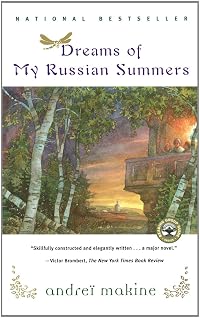
Dreams Of My Russian Summers: A Novel
by Andreï Makine
On This Page
Description
Every summer, young Andrei visits his grandmother, Charlotte Lemmonier, whom he loves dearly. In a dusty village overlooking the vast Russian steppes, she captivates her grandson and the other children of the village with wondrous tales—watching Proust play tennis in Neuilly, Tsar Nicholas II's visit to Paris, French president Felix Faure dying in the arms of his mistress. But from his mysterious grandmother, Andrei also learns of a Russia he has never known: a country of famine and show more misery, brutal injustice, and the hopeless chaos of war.Enthralled, he weaves her stories into his own secret universe of memory and dream. She creates for him a vivid portrait of the France of her childhood, a distant Atlantis far more elegant, carefree, and stimulating than Russia in the 1970s and '80s. Her warm, artful memories of her homeland and of books captivate Andrei. Absorbed in this vision, he becomes an outsider in his own country, and eventually a restless traveler around Europe. Dreams of My Russian Summers is an epic full of passion and tenderness, pain and heartbreak, mesmerizing in every way.
. show less
Tags
Recommendations










Member Reviews
I read Makine’s Music of a Life several months ago and concluded that despite the “exquisite writing” I couldn’t help but conclude that “somehow, and I’m honestly not quite sure how to explain it, ultimately I found the book left me wanting.” It was impressive but it didn’t stay with me. So I decided perhaps I ought to read this one, his fourth, but the one that brought him to the world’s attention and won both the Prix Goncourt and the Prix Médicis. The writing is, again, quite impressive (though, truth to tell, I liked it better in Music of a Life), and so is the story. But this time he’s answered my objections. This one has more weight, more gravitas. It is, on the surface, a work of memory, an adult looking back show more and recalling his “Russian summers.” Summers spent with his grandmother in a remote Siberian village overlooking the steppes, summers spent listening to her stories of another world: Paris at the turn of the century. Stories of Proust, of Tsar Nicholas's visit to Paris in 1896, the great Paris flood of 1910, and of the death of French president Felix Faure in the arms of his mistress. Her stories aren’t all good and happy and filled with nostalgia and wistfulness. She also recounts the story of her husband and his fate—a victim of Stalin’s purges. She tells of famine and of misery, of the chaos of war. As someone wrote on GoodReads, this is a search for self through someone else’s memories. The book contains much more than my short summary suggests and though it can, at times, be a bit overwrought, I ultimately found it more affecting and more powerful than I had anticipated. show less
An incredibly beautiful book of personal history juxtaposed with world history set against the tumultuous backdrops of twentieth century France and Russia. The novel has a very distinct Proustian flavour in that:
- it explores memory through adolescent eyes,
- the protagonist has a close relationship with his grandmother,
- the book is originally in French,
- every line is so damn thoughtful that I've to read it twice.
It's about memory, the importance of storytelling (in particular the stuff that family lores are made of), and my personal favourite - the power of languages especially the dual (or more) personas that come from bilingualism (or multilingualism). And all this is reminisced in the author's hypnotic prose through the eyes of an show more adolescent beginning to grasp the nuances of / find his identity in his family and the world. An impossibly excellent gem of a book. show less
- it explores memory through adolescent eyes,
- the protagonist has a close relationship with his grandmother,
- the book is originally in French,
- every line is so damn thoughtful that I've to read it twice.
It's about memory, the importance of storytelling (in particular the stuff that family lores are made of), and my personal favourite - the power of languages especially the dual (or more) personas that come from bilingualism (or multilingualism). And all this is reminisced in the author's hypnotic prose through the eyes of an show more adolescent beginning to grasp the nuances of / find his identity in his family and the world. An impossibly excellent gem of a book. show less
This is a beautifully-written novel about a young man who spends the summers in Siberia with his French grandmother, Charlotte Lemonnier, along with his sister. The narrative is told as a semi-autobiographical story by Andrei Makine, who fled the Soviet Union in 1987 when he was thirty years old. Charlotte, who became trapped there following the death of her Russian husband, shares a world of memories with the children, including memories of France before World War II. Charlotte's sheer Frenchness raises serious suspicions in the eyes of her neighbors and the authorities in the very paranoid realm of Soviet Communism.
The boy is divided as he grows up between his love of his grandma and the lovely world she conjures and his urge as a show more young child to fit in and embrace his Russian heritage. In his perspective, the French aspect of his character reflects a gauzy humanism and a love of beauty, while the Russian aspect of his character comes to represent a type of barbarism and a potential for violence. His perception, however it may be flawed, convinces him that the Soviets have good reason to be afraid of their Frenchness.
"I became aware of a disconcerting truth: to harbor this distant past within oneself, to let one's soul live in this legendary Atlantis, was not guiltless. No, it was well and truly a challenge, a provocation in the eyes of those who lived in the present."
Living in the West, it is casually assumed that progressives are often the only ones whose souls contain humanism and the good. For Makine and his narrator, the exact reverse is true; at that time, it was necessary to look to the East to find ideals and a culture that exalted human beings, whereas the Soviet Union's progressives did everything in their might to put them out of existence.
It is not surprising that Makine's story occasionally comes out as being somewhat vague and opaque given how deeply personal memory is. He sometimes leans a little too heavily on Proustian and Nabokov connections; a few fewer references to cork-lined chambers and moths wouldn't hurt; we get the point. Furthermore, I'm not enough of a Francophile to find it funny rather than emotional when someone speaks fondly of France. However, I would recommend the book due to the beauty of the writing, a few striking pictures, and the way the plot alludes to the tragedy of 20th-century Russia. show less
The boy is divided as he grows up between his love of his grandma and the lovely world she conjures and his urge as a show more young child to fit in and embrace his Russian heritage. In his perspective, the French aspect of his character reflects a gauzy humanism and a love of beauty, while the Russian aspect of his character comes to represent a type of barbarism and a potential for violence. His perception, however it may be flawed, convinces him that the Soviets have good reason to be afraid of their Frenchness.
"I became aware of a disconcerting truth: to harbor this distant past within oneself, to let one's soul live in this legendary Atlantis, was not guiltless. No, it was well and truly a challenge, a provocation in the eyes of those who lived in the present."
Living in the West, it is casually assumed that progressives are often the only ones whose souls contain humanism and the good. For Makine and his narrator, the exact reverse is true; at that time, it was necessary to look to the East to find ideals and a culture that exalted human beings, whereas the Soviet Union's progressives did everything in their might to put them out of existence.
It is not surprising that Makine's story occasionally comes out as being somewhat vague and opaque given how deeply personal memory is. He sometimes leans a little too heavily on Proustian and Nabokov connections; a few fewer references to cork-lined chambers and moths wouldn't hurt; we get the point. Furthermore, I'm not enough of a Francophile to find it funny rather than emotional when someone speaks fondly of France. However, I would recommend the book due to the beauty of the writing, a few striking pictures, and the way the plot alludes to the tragedy of 20th-century Russia. show less
71 of 75 for 2015. The reading guide for this novel compares it to work by Nabokov and other great Russian authors, although I can't really see that. The book, written originally in French and presented here as an English translation, tells the story of a young man growing up in Soviet era Russia, spending his summers with his grandmother, a native of Paris. As someone who grew up in all the tension of the Cold War, I am fascinated by stories that tell of the life of my counterparts on the other side of the Iron Curtain. Essentially a Bildungsroman, the story of Andrei and his grandmother's history, the novel takes us through many years of growth, including the period when his "difference," that French background he has from his show more grandmother, stands in the way of his acceptance as a good soviet youth. The book has four separate, but interrelated time lines: the narrator's summers with Charlotte, his grandmother; the narrator's school years when he lives with his parents, then his aunt after his parents' deaths; Charlotte's youth in early 20th Century Paris; and the narrator's life after he leaves Russia for the West, primarily set in Paris. The first three weave their strands through most of the book. The fourth is presented almost as an addendum: and then I grew up. This is not one of my "light and frivolous" reads. Lots of detail here, and for me at least, a slow read, but worthwhile. show less
The Goncourt prize in France seems to be drawn to Russian writers who can write French better than many French natives.
In 1938 it was awarded to Henri Troyat (né Lev Aslanovitch Tarasov) for his L’Araigne. He later became a Member of L’Académie Française. In 1956 and again in 1975 it was awarded to Romain Gary (né Roman Kacew). And more recently, in 1995, André Makine (a.k.a. Gabriel Osmonde) received this prestigious prize.
Had Nabokov been the son not of an Anglophile but of a Francophile, we would probably have another example.
Le Testament français is my first novel by Makine. It is also his first novel. I am grateful to Fionnuala who drew it to my attention.
This book is autobiographical in a roundabout way since it is in show more the narration of his own early life that the narrator focuses on the account of someone else’s life, the life of his grandmother. And it is in so doing that the narrator can eventually find himself.
This book has appealed to me in many ways. First and foremost there is its language. Le testament is one of those books that leave a taste in your mouth because its language is so beautiful that you want to detain its words for a little while longer and savor them. The tale is that Makine, when seeking to publish his work in France, had to invent a fictional translator because editors could not believe that such splendid writing in French could be authored by a foreigner.
The second appeal is that ever since I read in my teens, and reread later on, [b:Le Grand Meaulnes|794779|Le Grand Meaulnes|Alain-Fournier|http://d.gr-assets.com/books/1178422620s/794779.jpg|51583] by Alain-Forunier, I have developed a weakness for stories narrated by a young person in the French provinces and taking place either just before WWI or during the interwar period. They embody for me, fully, the meaning of the word nostalgia, even if this perfect nostalgia is extraneous to me since neither the period nor the geography belong to my lived experiences.
And finally there is the added theme of the mixed nationalities as a determinant in the formation of the self. These correspond to two countries standing at opposite cultural poles, and yet with many historical links. The young narrator is torn between the dreamed France with its scenes of sophisticated and exquisite Salons and cultural cafés or delicious countryside, and the tangible and rough Russia in the process of transforming itself into a Stalinist state, with its harsh scenes of severe poverty, disturbing cruelty and inhospitable steppes.
In this search for the self through the memories of someone else, the young narrator will try to collect cues from all possible sources and gradually finish the puzzle of his existence, even if some of these hints insist, like it so often happens with old photographs, to remain stubbornly mute.
Le testament français is a cherishable read and I recommended it to any lovers of Proust. Not only is Marcel Proust mentioned twice in the novel as the epitome of the dreamed refined Paris, but the Proustian themes of memories and self searching are consciously explored here again. This time they are given the new element of the divergent pull from both the Russian and French cultures. It is as if this novel were a deliberate tribute to Proust and his French writing, as felt by a Russian soul.
Wonderful.
-------
It has been translated into English (truly)as [b:Dreams of My Russian Summers|135158|Dreams of My Russian Summers|Andreï Makine|http://d.gr-assets.com/books/1347769108s/135158.jpg|130243]. It is noteworthy that they have chosen the other cultural pole, the Russian not the French, for the English title. I find that this translated title is too prosaic and has lost the evocative power of the original. I hope the rest of the translatio has captured the original lyrical tone. show less
In 1938 it was awarded to Henri Troyat (né Lev Aslanovitch Tarasov) for his L’Araigne. He later became a Member of L’Académie Française. In 1956 and again in 1975 it was awarded to Romain Gary (né Roman Kacew). And more recently, in 1995, André Makine (a.k.a. Gabriel Osmonde) received this prestigious prize.
Had Nabokov been the son not of an Anglophile but of a Francophile, we would probably have another example.
Le Testament français is my first novel by Makine. It is also his first novel. I am grateful to Fionnuala who drew it to my attention.
This book is autobiographical in a roundabout way since it is in show more the narration of his own early life that the narrator focuses on the account of someone else’s life, the life of his grandmother. And it is in so doing that the narrator can eventually find himself.
This book has appealed to me in many ways. First and foremost there is its language. Le testament is one of those books that leave a taste in your mouth because its language is so beautiful that you want to detain its words for a little while longer and savor them. The tale is that Makine, when seeking to publish his work in France, had to invent a fictional translator because editors could not believe that such splendid writing in French could be authored by a foreigner.
The second appeal is that ever since I read in my teens, and reread later on, [b:Le Grand Meaulnes|794779|Le Grand Meaulnes|Alain-Fournier|http://d.gr-assets.com/books/1178422620s/794779.jpg|51583] by Alain-Forunier, I have developed a weakness for stories narrated by a young person in the French provinces and taking place either just before WWI or during the interwar period. They embody for me, fully, the meaning of the word nostalgia, even if this perfect nostalgia is extraneous to me since neither the period nor the geography belong to my lived experiences.
And finally there is the added theme of the mixed nationalities as a determinant in the formation of the self. These correspond to two countries standing at opposite cultural poles, and yet with many historical links. The young narrator is torn between the dreamed France with its scenes of sophisticated and exquisite Salons and cultural cafés or delicious countryside, and the tangible and rough Russia in the process of transforming itself into a Stalinist state, with its harsh scenes of severe poverty, disturbing cruelty and inhospitable steppes.
In this search for the self through the memories of someone else, the young narrator will try to collect cues from all possible sources and gradually finish the puzzle of his existence, even if some of these hints insist, like it so often happens with old photographs, to remain stubbornly mute.
Le testament français is a cherishable read and I recommended it to any lovers of Proust. Not only is Marcel Proust mentioned twice in the novel as the epitome of the dreamed refined Paris, but the Proustian themes of memories and self searching are consciously explored here again. This time they are given the new element of the divergent pull from both the Russian and French cultures. It is as if this novel were a deliberate tribute to Proust and his French writing, as felt by a Russian soul.
Wonderful.
-------
It has been translated into English (truly)as [b:Dreams of My Russian Summers|135158|Dreams of My Russian Summers|Andreï Makine|http://d.gr-assets.com/books/1347769108s/135158.jpg|130243]. It is noteworthy that they have chosen the other cultural pole, the Russian not the French, for the English title. I find that this translated title is too prosaic and has lost the evocative power of the original. I hope the rest of the translatio has captured the original lyrical tone. show less
This book won two top French awards, the Prix Goncourt and the Prix Médicis. (1995, 1997). This is the fictional story of a young Russian boy and his sister, who visit their grandmother every summer. Grandmother Charlotte lives on the edge of the Siberian steppe. Charlotte reads to her grandchildren, anything she can get her hands on: old newspaper articles, magazines, etc. She also goes through family pictures by the hours. Her goal is to overwhelm them with a love for French culture. It was unclear to me, how the family ended up in Russia. With the death of the grandmother also comes the death of what the young man considers "civilized and graceful" France. The young boy is the narrator of the story and remains nameless, except for show more two episodes in the story; once when his school friends call him "Frantsuz", the Russian word for Frenchman and once his grandmother utters the name "Alyosha."
A second story line revolves around the harshness of the Stalinist regime and how often brutal choices had to be made to stay alive.
I'm not ready to say if the book is pretentious or more Proust-like. Time and perhaps a re-reading will answer that question. I understand this is book one in a series, but I've been unable to substantiate that.
It's interesting to note that the author was a Russian school teacher who participated in a teacher exchange program and was sent to France, where he defected. 256 pages show less
A second story line revolves around the harshness of the Stalinist regime and how often brutal choices had to be made to stay alive.
I'm not ready to say if the book is pretentious or more Proust-like. Time and perhaps a re-reading will answer that question. I understand this is book one in a series, but I've been unable to substantiate that.
It's interesting to note that the author was a Russian school teacher who participated in a teacher exchange program and was sent to France, where he defected. 256 pages show less
Charlotte Lemmonier, the book's main character, is an exquisitely special and complex person, and to know her would have been a highlight in anyone's life. So it was a treat for me to read this apparently semi-autobiographical book about her, and the author's relationship to her as a beloved grandson and the ways in which she affected his life.
The book sketched a set of dreamlike images of a time and place that I knew nothing about. In particular, for example, I was blown away by the author's vivid account of the proud, honor-bound urban street battle of the "samovars" of post-WWI and the subsequent mysterious disappearance of these supposed heroes. How logical that such events would have happened, even if I never could have imagined show more them in a thousand years on my own; and (fortunately) how completely alien they are to the contemporary zeitgeist.
However incompletely I comprehended it, I appreciated the author's lucid glimpse into the not-so-long-ago (and, possibly, still extant?) culture of the Russians and his depiction of its many (but by no means all) differences with the westernized First World. show less
The book sketched a set of dreamlike images of a time and place that I knew nothing about. In particular, for example, I was blown away by the author's vivid account of the proud, honor-bound urban street battle of the "samovars" of post-WWI and the subsequent mysterious disappearance of these supposed heroes. How logical that such events would have happened, even if I never could have imagined show more them in a thousand years on my own; and (fortunately) how completely alien they are to the contemporary zeitgeist.
However incompletely I comprehended it, I appreciated the author's lucid glimpse into the not-so-long-ago (and, possibly, still extant?) culture of the Russians and his depiction of its many (but by no means all) differences with the westernized First World. show less
Members
- Recently Added By
Lists

Russian Literature
184 works; 35 members

Llibres que he llegit el 2020
50 works; 1 member

Books Read in 2022
5,226 works; 115 members

Translingualism
191 works; 4 members
Author Information

34+ Works 4,467 Members
Andrei Makine was born in Siberia in 1957. Although raised in the Soviet Union, he learned about France and came to love that country through the stories told by his French grandmother. He now lives in Paris himself, having been granted political asylum by France in 1987, and writes in French. His grandmother figures prominently in the show more autobiographical novel, "Dreams of My Russian Summers," for which Makine received both the Goncourt Prize and the Medicis Prize, becoming the first author to simultaneously receive both of these prestigious French awards. In the U.S., the English translation of "Dreams of My Russian Summers" has also received recognition, including the Boston Book Review Fiction Prize and the Los Angeles Times Best Book of the Year award. Andrei Makine is also the author of "Once Upon the River Love" and "The Crime of Olga Arbelina." (Bowker Author Biography) show less
Some Editions
Awards and Honors
Awards
Distinctions
Series
Belongs to Publisher Series
Common Knowledge
- Canonical title*
- Le testament français
- Original title
- Le testament français
- Alternate titles
- Dreams of My Russian Summers
- Original publication date
- 1995 (original French) (original French); 1995; 1997 (English: Strachan) (English: Strachan)
- People/Characters
- I (protagonist); Charlotte (grandmother)
- Important places
- Siberia, Russia
- Epigraph*
- "[...[ c'est avec un enfantin plaislr et une profonde émotion que, ne pouvant citer les noms de tant d'autres qui durent agir de même et par qui la France a survécu, je transcris ici leur nom véritable [...]"
MARCEL PR... (show all)OUST.
Le temps retrouvé
Le Sibérien demandera-t-il au ciel des oliviers, ou le Provençal du klukwa ? »
JOSEPH DE MAISIRE.
Les Soirées de Saint-Pétersbourg
« Je questionnai l'écrivain russe sur sa méthode de travail et m'étonnai qu'il ne fit pas lui-même ses traductions, car il parlait un français très pur, avec un soupçon de lenteur, à cause de la subtilité de son esprit. Il m'avoua que l'Académie et son dictionnaire le gelaient. »
ALPHONSE DAUDET
Trente ans à Paris - Dedication
- For Marianne Veron and Herbert Lottman
For Laura and Thierry de Montalembert
For Jean-Christophe - First words
- While still a child, I guessed that this very singular smile represented a strange little victory for each of the women: yes, a fleeting revenge for disappointed hopes, for the coarseness of men, for the rareness of beautiful... (show all) and true things in this world.
- Last words
- (Click to show. Warning: May contain spoilers.)What I still had to find were the words to tell it with.
- Original language
- French
- Disambiguation notice
- UK title: Le Testament Français
US title: Dreams of My Russian Summers
*Some information comes from Common Knowledge in other languages. Click "Edit" for more information.
Classifications
Statistics
- Members
- 1,678
- Popularity
- 13,323
- Reviews
- 33
- Rating
- (3.84)
- Languages
- 21 — Catalan, Danish, Dutch, English, Estonian, Finnish, French, German, Greek, Hungarian, Italian, Lithuanian, Norwegian (Bokmål), Norwegian, Polish, Romanian, Serbian, Slovenian, Spanish, Swedish, Thai
- Media
- Paper, Audiobook, Ebook
- ISBNs
- 71
- ASINs
- 32